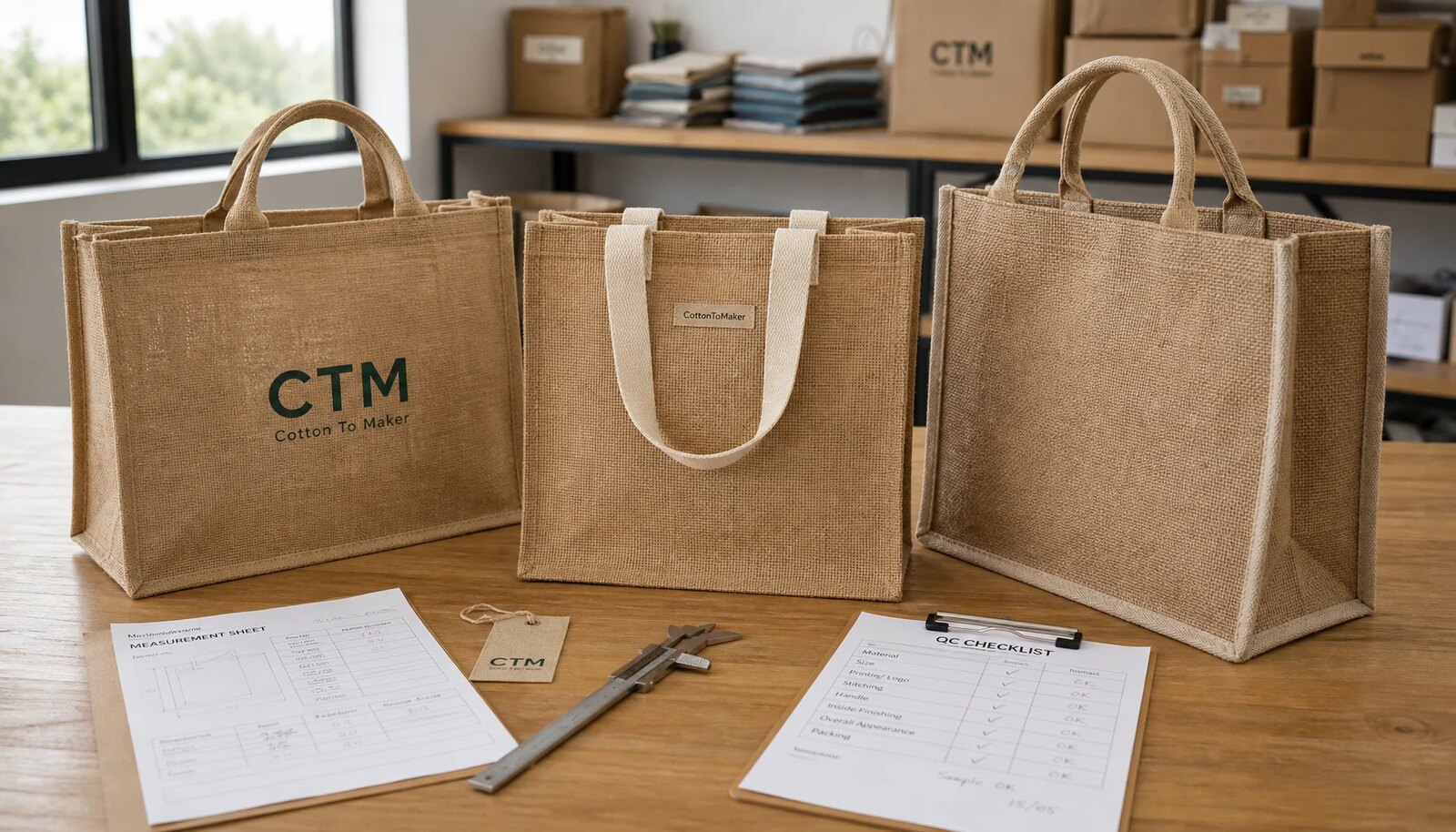
Why jute sourcing is different from cotton tote sourcing
Jute tote bags look simple until the first bulk shipment lands. Jute is a coarse natural fiber, so you get more visible weave variation, more odor sensitivity, and less forgiving print behavior than you would on cotton canvas. That means a spec that works for a cotton tote can produce a messy jute quote: one supplier prices a loose promotional bag, another prices a structured retail tote, and both appear to be quoting the same product.
For eco apparel brands, the buying question is not whether jute sounds sustainable enough for the story. The question is whether the bag can pass internal procurement, compliance, and receiving checks without extra handling work. A useful wholesale jute tote bags for eco apparel brands supplier compliance checklist separates what may vary naturally from what must never vary: size, artwork placement, seam security, document trail, and packing format.
Treat the tote as a production item, not a marketing prop. If the buyer writes the build, the supplier quotes the build. If the buyer leaves the build open, the supplier will fill the gaps with its house standard and the order will drift.
- Natural variation is normal in jute; uncontrolled variation is not.
- Odor, fiber shedding, and print sharpness should be discussed before sampling.
- Laminated and unlaminated jute are different products for use, cost, and compliance.
- The legal entity on the paperwork should match the actual production site.
Start with use case, channel, and receiving rules
The cleanest way to source wholesale jute tote bags is to define how the bag will be used before you ask for a price. A point-of-sale shopper bag can be simpler than a resale tote sold next to apparel. An event giveaway can prioritize low MOQ and fast turnaround. An e-commerce insert may need clean folding and low odor. Each use case changes what the supplier should quote and what your warehouse will accept.
This is where many RFQs go vague. They ask for jute tote bag, custom print, and price. That gets you a generic quote, not a useful one. If the bag has to support retail display, write that into the request. If the bag must pack flat for e-commerce, say so. If the tote should look premium next to garments, ask for a more finished inside seam, better handle presentation, and narrower tolerance on size and print position.
The channel also changes the cost of failure. A bag used for internal checkout can tolerate more roughness than a branded tote sold to a consumer. The procurement standard should reflect that difference, or the supplier will optimize for the cheapest passable build.
- Store shopper: prioritize cost, speed, and readable branding.
- Retail resale bag: prioritize presentation, shape retention, and repeatability.
- Event or giveaway: prioritize MOQ flexibility and freight efficiency.
- E-commerce insert: prioritize foldability, low odor, and clean carton packing.
Write the bag as a measurable spec, not a style description
A good jute spec starts with dimensions in centimeters and ends with a clear tolerance. State width x height x gusset, handle drop, handle width, and whether the measurements are flat or finished. If you want a common retail size, give an example such as 35 x 40 x 15 cm, but still define the tolerance the buyer will accept.
Separate every component. Say what the body is made of, what the handles are made of, whether there is lining, whether reinforcement patches are required, and whether lamination is part of the build. Do not write only jute bag or eco tote. Those phrases are too broad for sourcing and create unnecessary back-and-forth once sampling starts.
GSM is useful, but only when it is tied to the actual construction. A 270-300 GSM body can work for a basic shopper program, while a 300-320 GSM build may be better for a structured retail tote. That range is not universal. Region, supplier type, fiber source, and order complexity can all shift the real quote. Use the range as a conversation starter, not as a universal rule.
- Write body size, handle drop, and gusset depth separately.
- State whether the GSM target applies before or after lamination.
- List the handle material and attachment method explicitly.
- Write the natural shade variation you will accept.
- Define which defects are automatic rejects.
Construction choices that move cost, feel, and failure rate
Construction is where the real commercial trade-offs sit. A simple unlaminated body with standard handles is cheaper and easier to source, but it will not always look like a retail-ready product. Adding lamination, seam binding, reinforcement patches, or a heavier body improves structure and presentation, but it also changes feel, folding behavior, and unit cost.
Handles are usually the first failure point. If you use cotton webbing, specify tape width, color, insertion depth, and stitch pattern. If you use self-jute handles, define whether they are folded, laminated, or reinforced. A vague strong handle note is not enough. Ask the supplier how it transfers load into the body and what reinforcement is standard at the stress point.
Lamination deserves a separate decision. It can reduce shedding and improve shape retention, but it also changes the natural look that many eco apparel brands want. If the bag is meant to feel natural and soft, unlaminated construction may be the right choice. If it must wipe clean or stand upright on a shelf, lamination may be worth the tradeoff.
- Basic shopper programs often start with a simpler body and standard handle build.
- Structured retail programs usually need cleaner seam finish and stronger reinforcement.
- Lamination can improve presentation but can also stiffen the bag and alter fold behavior.
- Ask for handle stitch photos from the actual line, not only a polished sample.
- Confirm whether the factory can repeat the same build at the target volume.
Branding on coarse jute: set the artwork limits early
Most production disputes on jute bags start with artwork. A digital mockup can make a logo look crisp, but coarse weave will break up thin lines and tiny text. For that reason, the buyer should set the minimum line thickness and the smallest readable text size before the supplier prepares screens or approves a strike-off.
Screen print is usually the best-value choice for bold logos and simple spot colors. Heat transfer can be useful for more detailed artwork, but it tends to work better on smoother or laminated surfaces. Woven labels, sewn patches, and embroidery are useful when the main logo is too detailed for direct print. Do not let the supplier choose the decoration method by default if the brand has a specific retail look to protect.
If legal copy, care text, or brand marks matter, keep them simple. Fine text is one of the first things to fail on jute. Review the strike-off on actual material under normal lighting, not just on a screen. If the printed sample cannot carry the artwork clearly at the intended size, revise the art before bulk starts.
- Best value for simple branding: screen print.
- Best for more detailed artwork: heat transfer on a suitable surface.
- Best for a premium retail cue: woven label or sewn patch.
- Set minimum line thickness before screens are made.
- Approve a physical strike-off on actual jute, not only a digital file.
Compliance evidence buyers should request
Compliance should be attached to the actual order route, not to a sales deck. Ask for the legal entity, the manufacturing address, and the subcontracting plan for the goods you are buying. A supplier can have valid paperwork and still not be the right production site if printing, handle work, or packing happens somewhere else.
The most useful evidence categories are practical, not decorative. Ask for a current site audit report or compliance questionnaire summary if your program requires one. Ask for social compliance evidence such as a third-party audit summary and the corrective action status if available. Ask for restricted substance declarations for inks, adhesives, lamination films, labels, and packaging where relevant. Ask for labeling review materials so fiber content, origin claims, and required consumer information are not guessed at the last minute.
Traceability matters too. You want to know which lot of fabric, trim, or film went into the batch, who packed it, and where any outsourced step occurred. If your market or retailer uses specific chemical or product rules, confirm that the supplier can provide the documents your compliance team actually uses. The standard should be site-specific and order-specific, not generic.
- Verify factory name and address against the actual production site.
- Request a subcontractor list and written approval rule for outsourced steps.
- Ask for restricted substance declarations for inks, films, adhesives, and labels.
- Request labeling review support for fiber content and consumer-facing marks.
- Ask for traceability records that tie the batch to the production lot.
Compare supplier types before you compare unit prices
A unit price means very little until you know what the supplier actually is. A direct factory may give you better control over stitching and material use, but weaker support on export paperwork. A trading company can help with mixed requests, but only if it can name the real factory and own QC decisions. A compliance-led supplier may cost more, but it can reduce onboarding friction when your retailer asks for site or substance documents.
The cheapest option is often a low-cost generalist that sells a standard bag with broad tolerances. That can be fine for a simple promo order. It is usually not fine for a retail program where the tote sits next to apparel and needs to reflect the same brand standards. The practical buyer question is not which supplier is cheapest. It is which supplier can hold the spec without introducing hidden work for your team.
When you request quotes, force the same basis across suppliers. Normalise the dimensions, the GSM, the handle build, the decoration method, the packing format, and the compliance document set. That is how you get a real comparison instead of a pricing illusion.
- Ask whether the named factory is the actual production site.
- Ask who owns QC sign-off if printing or handles are outsourced.
- Check whether the supplier can handle packing, carton marks, and shipping labels to your receiving standard.
- Use the same spec across all quotes before comparing price.
- Do not compare a promotional build with a retail build.
Quote questions that expose hidden cost and weak control
A clean quote request should tell you what is included and what is not. Ask whether the price includes screens, strike-off, pre-production sample, packing method, and any revision allowance. Ask for tiered pricing at realistic quantities, such as 1,000, 3,000, and 5,000 pieces, so you can see whether the factory is truly competitive or only cheap at one volume point.
You should also ask about component sourcing. Are handles made in-house or bought in? Is lamination done at the same site? Are labels printed or sourced elsewhere? Each dependency adds lead time and can shift the defect risk. If the supplier cannot describe who owns each part of the build, it is not ready for a production order.
Freight data belongs in the quote too. Request carton dimensions, pieces per carton, gross carton weight, and estimated CBM. These numbers affect warehouse receiving, pallet planning, and the final landed cost. If the supplier cannot give the carton data before order confirmation, it is not giving you a complete procurement offer.
- Ask for tiered pricing at 1,000, 3,000, and 5,000 pieces.
- Require a breakdown for setup, sampling, packing, and special trims.
- Confirm whether handles, labels, and lamination are made in-house or sourced.
- Request carton dimensions, gross weight, and pieces per carton.
- Normalize the scope before comparing quotes.
Sampling should test production reality, not only appearance
A useful sampling process has three steps: a development sample to settle the spec, a strike-off on actual material, and a pre-production sample made with the bulk-intended process and packing method. If the supplier sends a hand-finished sample that cannot be repeated on the bulk line, the sample is misleading and should not be treated as approval of production capability.
Measure the physical sample against the approved spec. Check the body size, handle drop, and gusset. Review print placement on the actual weave. Open the seams and inspect the inside finish, not only the front face. Fold the bag the way it will be packed and see whether the crease affects the logo, the edge finish, or the body shape. If odor or fiber shedding matters in your market, capture that in the approval comments instead of leaving it implicit.
Not every change deserves a full reapproval cycle, but meaningful changes do. A minor print shift may be acceptable if it stays inside the written tolerance. A change to handle material, lamination type, seam finish, or artwork method should trigger fresh sign-off. This keeps the supplier from treating a material change as a routine adjustment.
- Use a strike-off on actual jute, not only a mockup.
- Measure the sample before approval and keep the numbers on file.
- Check the inside finish and handle attachment points.
- Fold the sample as it will be packed for shipping.
- Define which changes require reapproval before bulk starts.
QC and packing: define defects, rework, and carton controls
The most common shipment issues on jute totes are crooked print, uneven size, loose handles, odor, and poor packing condition. These are manageable only if the acceptance rules are written in advance. Define what is a minor defect, what is a major defect, and what is critical enough to reject outright. On natural jute, some shade and weave variation is normal. Visible holes, open seams, severe panel skew, unreadable logo text, or strong chemical or damp odor are not normal.
If your team uses an AQL plan, write the sample size and thresholds into the PO or inspection instruction before production. If you use an internal inspection rule instead, define the same logic clearly. A major defect should trigger rework or hold, not automatic release. A critical defect should stop shipment. The point is to prevent the factory from inventing the inspection standard when the carton is already closed.
Packing deserves the same attention as the bag build. Decide whether individual polybags are needed or whether a master-carton or bundling method is acceptable for the route. Ask for carton marks, SKU labels, quantity per carton, and the expected gross weight. If the bags are going to a distribution center, make sure the carton size and weight match receiving rules. If the route is humid or long-haul, specify the moisture control method rather than assuming the supplier will choose one that fits your process.
- Critical defects: wrong size beyond tolerance, wrong artwork, open seam, strong contamination odor, missing required labels.
- Major defects: weak handle security, shifted print, or a fit issue that affects retail use.
- Minor defects: loose threads, small shade variation, or slight weave irregularity inside the approved band.
- Require carton counts, SKU marks, and packing-list accuracy before dispatch.
- Confirm the packing method for moisture control and warehouse receiving.
Specification comparison for buyers
| Supplier option | What to verify | Commercial advantage | Buyer risk to control |
|---|---|---|---|
| Direct sewing factory | jute roll photos, lamination sample, odor-control process, handle pull evidence, and pre-shipment carton condition photos | Better sample-to-bulk control and faster production feedback | May be weaker on export paperwork or branded packing unless checked early |
| Trading company | Factory name, production photos, trim-source proof, and who owns QC decisions | Can coordinate small mixed orders and extra services | Markup can hide real factory capability and slow defect decisions |
| Specialized bag workshop | handle stitching, side gusset, lamination edge control, inner seam cover, and fiber shedding tolerance | More practical for detailed construction, trims, and repeat programs | Capacity may be limited during peak seasons |
| Low-price general supplier | laminated or unlaminated jute, cotton-jute blend, inner coating, odor control, yarn thickness, and color shade variation | Useful for simple promotional runs with loose specs | Material downgrades, weak packing, and vague inspection scope can erase savings |
| Retail-ready supplier | airing time, moisture absorber, carton liner, bundle wrap, odor separation, and warehouse ventilation before loading | Can handle labels, SKU separation, carton marks, and receiving rules | Higher unit cost must be compared against reduced warehouse work |
| Compliance-focused supplier | Fabric records, labeling review, test plan, and production traceability | Safer for retail programs and repeat brand orders | Documentation claims need evidence, not only sales language |
| Local sample room plus bulk factory | Signed sample, bulk factory handoff, first-piece photos, and deviation owner | Good for complex branding before large production | Sample room quality may not match bulk line unless handoff is controlled |
Buyer checklist before sampling
- State the end use in one line before asking for price: point-of-sale shopper, resale tote, e-commerce insert, event giveaway, or garment carrier.
- Specify the body build by component: 100% jute, jute-cotton blend, laminated jute, or jute body with cotton canvas pocket, trim, or reinforcement.
- Write the finished size in centimeters as width x height x gusset, plus handle drop, handle width, and whether measurements are flat or finished.
- Set the GSM target with a caveat for construction and region; a 270-300 GSM band is common for basic shopper programs, while structured retail totes often need 300-320 GSM or another agreed build.
- Separate the tolerance for body fabric from the tolerance for the finished bag, especially if lamination or lining changes weight and thickness.
- Clarify whether the natural jute shade can vary by lot or whether the brand needs a tighter visual band for retail presentation.
- Define artwork by panel and method: screen print, heat transfer, woven label, patch, embroidery, or no small text on the main face.
- Set the minimum line thickness and smallest readable text size for the chosen print method on coarse weave.
- State the handle material, length, insertion depth, and stitch pattern; do not assume the factory will choose a standard that matches your brand.
- Specify seam finish and reinforcement details: overlock, seam binding, piping, bartack pattern, inner lining, or exposed raw edge allowance.
Factory quote questions to send
- What is the exact composition of the body, handles, lining if any, lamination film if any, labels, thread, and reinforcement panels?
- What finished GSM do you quote, and what tolerance do you allow for production and final inspection?
- Is the quoted bag based on natural jute shade as available, or is it a dyed, printed, or color-matched construction?
- Which printing method is included, how many colors are covered, which panel is printed, and what artwork limits apply on coarse weave?
- What is included in the unit price: screens, strike-off, pre-production sample, packing, polybag or master-carton protection, and one revision if the first sample fails approval?
- What is the MOQ per style, per color, and per print design, and how does the unit price change at 1,000, 3,000, and 5,000 pieces?
- Are handles made in-house or sourced, and what stitch pattern, tape width, insertion depth, and reinforcement are standard?
- Which compliance documents can you provide for the actual production site, and which parts of the order do they cover?
- Which steps are outsourced, if any, and who owns the final QC sign-off for those steps?
- What in-line and final QC checks do you run for size, stitch security, print position, odor, moisture, and carton packing?
Quality-control points to confirm
- Body dimensions within the approved tolerance, with a separate tolerance for handle drop and gusset depth.
- No unauthorized change in body fabric, lining, lamination, thread, or handle material compared with the approved sample.
- Print position centered and level within the written tolerance, with no major ink breaks, missing strokes, or unreadable small text.
- No broken jute yarns creating visible holes, open seams, or weak stress points near the handle attachment or bottom seam.
- Handle attachment secure with the agreed stitch pattern, with no skipped stitches, loose bartacks, or unraveling thread ends.
- Cartons dry and undamaged, with packing marks, SKU labels, and counts matching the packing list.
- Odor acceptable for retail unpacking, with no strong chemical, mold, sour, or damp smell after normal airing.
- If your team uses an AQL plan, define the sample size and major/minor thresholds before production; if not, write an equivalent inspection rule into the PO.
- Critical defects that should trigger rejection include wrong size beyond tolerance, wrong artwork, open seams, strong contamination odor, or missing required labels.
- Major defects should trigger rework or hold, not automatic release, if they affect fit, print clarity, or handle security.