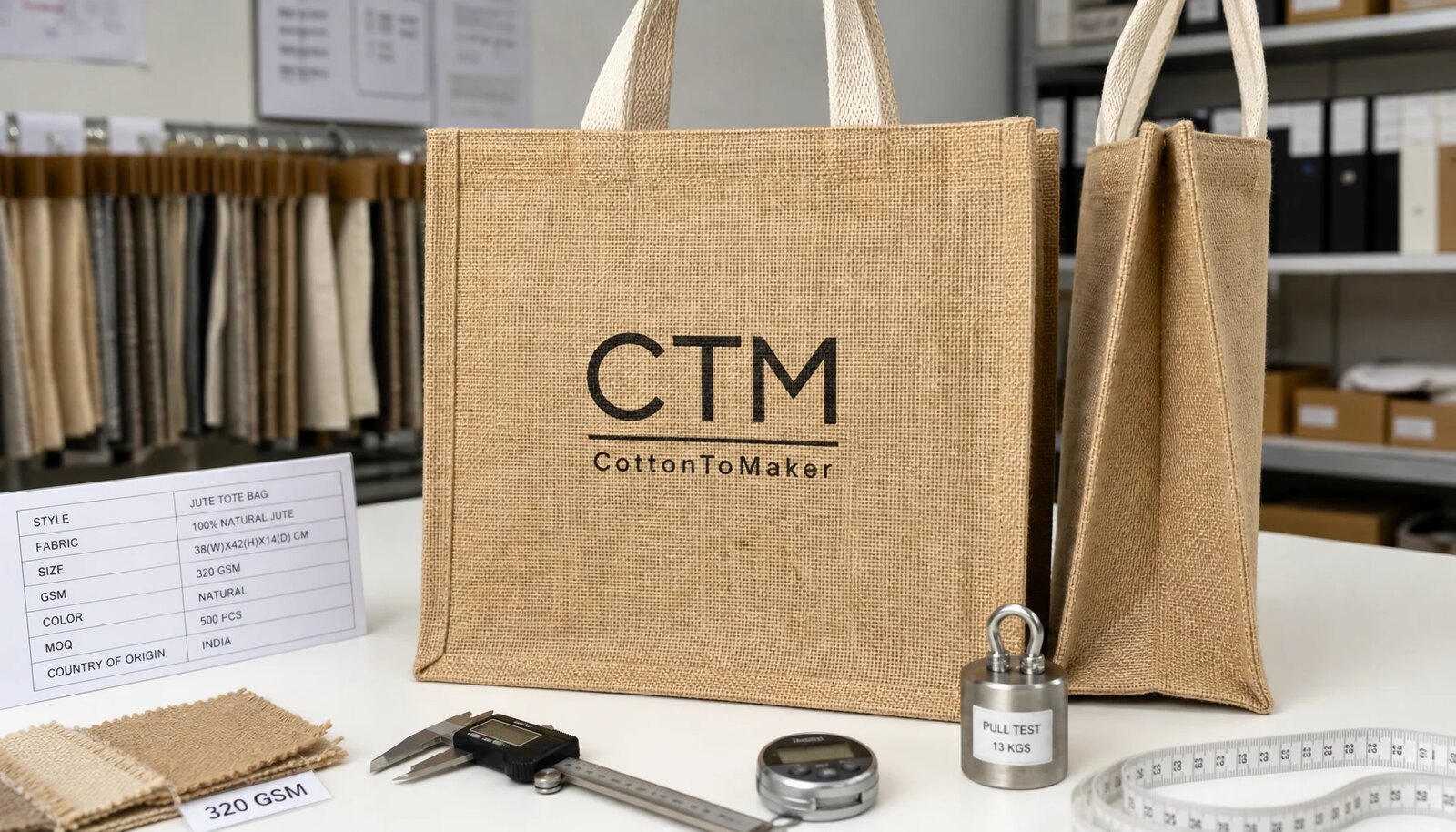
Start With Compliance, Then Negotiate Price
Wholesale jute tote bags for craft fairs look straightforward until the quotes arrive. One supplier may price a 300 GSM laminated natural jute tote with cotton webbing handles, reinforced stitching, and screen printing. Another may price a lighter unlaminated burlap-style fabric, narrow handles, basic stitching, and loose bulk cartons. If both offers simply say “jute tote with logo,” the buyer is not comparing the same product.
For procurement teams, compliance is not only a legal document folder. It is the supplier’s ability to repeat the approved sample, identify the material, hold realistic print tolerances, pack cartons for the receiving process, and support inspection before shipment. It also covers moisture control, odor handling, traceability, defect classification, and responsibility when production moves away from the approved standard.
The strongest RFQ removes guesswork before negotiation starts. Define the fabric weight, lamination, dimensions, handle reinforcement, print method, print tolerance, packing, inspection level, and delivery basis. Then suppliers price the same work. If a supplier returns a number without asking about GSM, logo size, carton rules, or inspection access, treat it as an early estimate, not a purchasing decision.
This discipline also helps internal alignment. Marketing wants the event logo to look acceptable on rough jute. Operations wants cartons that can be received and sorted quickly. Compliance may need material, ink, labeling, or country-of-origin statements. Finance wants the cost broken into useful lines. A good buying file brings those needs together instead of letting each team solve problems after the PO is placed.
- Normalize all quotes by material type, GSM, lamination, size, handle, print method, packing, inspection access, and Incoterm or freight basis.
- Reject vague descriptions such as “eco burlap bag” until the supplier confirms exact fabric, finish, and construction.
- Ask for compliance evidence before PO placement, not after goods are sewn, printed, and packed.
- Use the approved sample, fabric swatch, strike-off, and written tolerance sheet as the commercial standard.
- Require written deviation approval because small changes in fabric weight, lamination, or handle reinforcement can affect performance and claims.
Convert the Craft Fair Use Case Into a Spec
A craft fair tote can play many roles. It might be a free visitor giveaway, a paid merchandise item, a vendor welcome kit, a sponsor bag, a reusable shopping tote, or packaging for handmade goods. Each role changes the right balance of cost, strength, appearance, and packing. A giveaway can be simple and efficient. A retail tote sold at a booth needs cleaner folding, lower odor, stronger presentation, and fewer visible defects.
Write the expected load as a testable requirement. Craft fair visitors may carry candles, ceramics, glass jars, soaps, catalogs, textiles, packaged food, or several small purchases at once. An empty bag can look fine while the handle stitching or bottom gusset is underbuilt. Instead of asking for a “durable” bag, state the intended load range and ask the factory how it will test that load.
The selling environment matters too. Premium handmade markets usually need cleaner front panels, neater folding, and controlled odor. Outdoor fairs may put more weight on cost, fast distribution, and simple carton handling. Food, soap, candle, and beauty brands should be stricter about fiber shedding, dust, moisture, and smell because the bag can affect product presentation. Sponsor-heavy programs put extra pressure on artwork version control and logo placement.
Define the use case before requesting price. That keeps the team from overbuying a retail-grade tote for a one-day giveaway, but it also prevents underbuying a weak promotional bag for paid merchandise. Once the supplier understands the use, it can recommend a more sensible GSM, lamination, handle style, reinforcement, and packing method.
- For giveaways, prioritize stable supply, simple artwork, low major-defect risk, and efficient cartons.
- For retail resale, prioritize cleaner sewing, lower odor, consistent folding, handle comfort, labels, and shelf-ready carton sorting.
- For vendor kits, confirm the tote can hold catalogs, samples, sponsor inserts, and heavier booth items without handle or seam strain.
- For food, soap, candle, or beauty brands, review odor, fiber shedding, moisture control, and restricted substance needs before sample approval.
- For multi-location craft fairs, define artwork version names, destination marks, carton labels, and packing list lines during the RFQ stage.
Specify Material, GSM, and Tolerances Clearly
“Natural burlap tote” is not a specification. Common craft fair jute totes are often quoted around 270 to 320 GSM, roughly 13 to 15 oz per square yard depending on conversion, weave, and finish. Smaller giveaway bags may use lighter fabric. Larger market totes, box-bottom styles, and retail merchandise may need heavier material or stronger construction.
Ask the supplier to name the body material: true jute, cotton-jute blend, dyed jute, laminated jute, unlaminated jute, or coated jute. Laminated jute usually stands better, reduces loose fibers inside the bag, and gives the tote more structure. It can also crease more visibly and may affect recycling or compostability claims. Unlaminated jute feels more natural and flexible, but it can shed more and hold a softer shape.
Tolerances belong in the RFQ, not in a post-shipment argument. A practical fabric-weight tolerance may be ±5% when mill control is strong or ±10% where control is looser, but the supplier should confirm what it can actually inspect. Finished body measurements are often managed around ±1 cm. Print placement may be tighter, often ±5 mm to ±10 mm depending on artwork, fixture control, and bag construction.
Natural jute will never look like smooth canvas. Slubs, shade movement, uneven yarns, and open weave are part of the material. They become a problem only when the acceptable range is undefined. Keep a labeled swatch with the approved sample and use it as the reference for incoming material and final inspection.
- Specify material as natural jute, dyed jute, laminated jute, unlaminated jute, coated jute, or cotton-jute blend.
- State GSM or oz per square yard, plus the supplier’s incoming material tolerance and checking method.
- Define finished size as width x height x gusset and clarify flat measurement, opened measurement, and whether handles are excluded.
- Record acceptable shade range, weave openness, slub level, fiber shedding, surface marks, and lamination condition.
- Require a labeled swatch and bulk roll photos before cutting starts.
Lock Construction Before Sampling
Construction decides whether the tote works in real use. Define the width, height, side gusset, bottom gusset, bottom shape, top binding, side seam, inner seam cover, and whether the bag must stand upright when empty. A flat tote with a small side gusset is not the same product as a box-bottom market tote designed for table display.
Handles are one of the fastest ways a low-cost jute tote order can fail. Cotton webbing handles are common because they are comfortable and clean-looking. Jute handles support a more natural style, but they may feel rougher in the hand. Rope handles create a rustic look and more bulk, so the attachment must be secure. The RFQ should state handle material, width, color, drop length, attachment position, stitch color, and reinforcement pattern.
For many medium shoulder totes, handle drops around 25 to 30 cm are common, but the approved sample should decide the final target. Cotton webbing width often falls around 2.5 to 3.8 cm; wider handles usually feel better with heavier contents. These values are useful starting points, not universal rules. Confirm the exact numbers and tolerances in the quote.
Reinforcement should be visible and priced. Box-X stitching, bartack, double rows, or a reinforced top band may be suitable depending on the load target and look. Do not let “standard stitching” carry the order. If reinforcement is not named, photographed, and approved, it can quietly change between sample and bulk.
- Confirm gusset type, bottom construction, top binding, side seam, inner seam finish, and stand-up requirement.
- Define handle material, width, color, drop, attachment point, stitch pattern, thread color, and reinforcement method.
- Request photos of acceptable box-X, bartack, double-stitch, or top-band options before sampling.
- Set body measurement tolerance, handle drop tolerance, and acceptable panel symmetry in the specification.
- Reject twisted handles, uneven handle lengths, loose thread nests, skipped stitches, weak attachment, and top-edge puckering as inspection defects.
Plan Artwork Around Coarse Jute
Jute does not print like cotton canvas, polyester, or nonwoven polypropylene. The surface is coarse, yarns are irregular, and slubs can break fine details. For wholesale jute tote bags for craft fairs, screen printing is often practical for bold one- or two-color logos, sponsor names, event dates, and simple graphics. Heat transfer or other decoration methods may allow more detail, but adhesion, hand feel, edge quality, and durability must be tested on the same jute planned for bulk.
Artwork needs to be engineered for the material. Thin serif fonts, small legal text, gradients, fine illustrations, large solid ink blocks, and tiny QR codes can lose clarity. Bold, dark artwork usually performs better on natural jute. If a QR code is required, scan the physical strike-off after printing and again after folding. A digital proof cannot show how the weave will interrupt the code.
Print position also depends on the bag construction. Seams, gusset folds, wrinkles, and panel distortion can make a centered logo look slightly off when the bag is opened. Ask the supplier to confirm the maximum print area on the finished bag, not only on a flat fabric panel. Typical placement tolerance may be ±5 mm in controlled production or ±10 mm where the construction is rougher, but the approved tolerance should be written before printing starts.
A reliable print approval path includes artwork file review, print method confirmation, physical strike-off, drying or curing confirmation, production-start photo, and final inspection. The strike-off must use the same jute weight, color, and lamination as bulk. A strike-off on smoother stock fabric is useful for layout discussion, but it does not prove bulk performance.
- Use bold artwork, limited colors, adequate line thickness, and realistic expectations for edge sharpness on jute.
- Provide Pantone targets, but judge final color against a physical strike-off because natural jute changes perceived shade.
- Measure print placement from top seam, side seam, and centerline rather than by visual judgment alone.
- Approve ink opacity, registration, edge quality, rub resistance, cracking, smudging, and drying or curing condition.
- Control artwork versions with named files, signed proofs, carton labels, and separate packing list lines.
Understand MOQ, Price Breaks, and Hidden Cost Drivers
MOQ is tied to production economics, not only to supplier preference. Fabric roll minimums, dye or lamination lots, cutting efficiency, sewing line setup, print screens, drying space, label application, and carton sorting all influence the minimum order. A 3,000-piece order in one size with one artwork is much easier than 3,000 pieces split across three sizes, four handle colors, and ten sponsor logos.
The most useful quotation separates the cost drivers. Fabric weight affects material cost and freight. Lamination affects structure, crease risk, odor handling, and sometimes product claims. Larger bags use more fabric and increase carton volume. Wider or dyed handles add trim cost. Multi-color printing adds screens, setup time, registration risk, and inspection work. Retail packing adds labor, labels, and often more materials.
There are better ways to control cost than weakening the bag. Standardize one size, one jute weight, one handle type, and one carton plan, then vary artwork only where the program truly needs it. For multi-location craft fairs, ask for the incremental cost per artwork version and per destination packing configuration. That makes the cost of complexity visible.
Compare landed cost, not just ex-factory unit price. Jute totes are bulky. A low unit price can be offset by higher CBM, expensive storage, repacking labor, receiving errors, or leftover event-dated inventory. When the order is tied to a fixed fair date, missed inspection or repacking time can cost more than the small unit-price difference procurement fought to save.
- Major cost drivers include GSM, lamination, size, gusset, handle type, reinforcement, print colors, print area, packing style, carton volume, and inspection requirements.
- MOQ drivers include fabric rolls, dye lots, lamination lots, screen setup, sewing changeover, artwork versions, and destination sorting.
- Request separate lines for blank bag, decoration, setup, sample, courier, packing, labels, testing, inspection support, documents, and freight basis.
- Ask which changes reduce cost without reducing critical performance, such as standardizing handle color or carton quantity.
- Compare landed cost, storage impact, and receiving labor before selecting the lowest ex-factory unit price.
Build an Order-Specific Compliance File
A compliant supplier should give you more than attractive product photos. Useful evidence includes a factory profile, production flow, material specification, jute weight statement, lamination description, handle specification, print process, packing plan, QC checklist, and final inspection report format. Retail or branded programs may also need barcode layouts, carton label templates, country-of-origin marking, and traceability references.
Documents must connect to the actual order. A generic certificate for unrelated cotton bags does not prove the jute body, ink, dye, lamination, handles, or production site for this tote. If restricted substance statements are required, ask which component they cover: jute fabric, dye, lamination film, printing ink, handle webbing, thread, label, or packing material. Whenever possible, documents should name the supplier, factory, material, lot, or PO.
Subcontracting needs attention. Dyeing, lamination, printing, sewing, label application, and carton packing may happen in different facilities. That is not automatically a problem. The buyer simply needs to know who controls quality, where inspection can occur, and who owns corrective action. If printing is outsourced, the approved artwork, strike-off, and placement rules must travel with the goods.
Observable proof helps during production. Photos of fabric rolls, cutting, first-piece sewing, printing, drying, in-line QC, packed cartons, and carton labels can catch issues early. These photos do not replace final inspection. They do, however, reduce the chance that the first real problem appears after the goods are sealed and ready to load.
- Ask for factory profile, production address, process flow, subcontracted steps, and quality decision-maker.
- Collect material evidence for jute, lamination, handles, thread, ink or dye where applicable, and approved swatch reference.
- Request packing evidence including carton dimensions, carton marks, inner bundles, SKU separation, barcode labels, gross weight, and pallet plan if required.
- Use compliance documents linked to the actual PO, supplier, factory, material, or lot whenever possible.
- Require production photos at material arrival, cutting, first-piece sewing, printing, packing, and sealed-carton stages.
Control Samples Like Commercial Standards
A structured sample process prevents many bulk disputes. Approve the blank construction sample, fabric swatch, handle sample, print strike-off, and final pre-production sample before mass production. A showroom sample made from available stock can show style, but it does not prove the bulk fabric, lamination, handle webbing, stitching, or print behavior.
Review the blank sample before decoration. Check finished size, gusset shape, handle drop, fabric weight, hand feel, lamination, seam finish, folding, and general structure. Measure it. Photograph it. Record accepted deviations and required corrections before anyone spends time printing the wrong bag.
The print strike-off should prove how the artwork behaves on the actual jute. Review color, opacity, edge sharpness, registration, artwork scale, position, drying, rubbing, cracking, and smudging. For sponsor-heavy craft fair bags, each logo or artwork version may need approval. Digital proofs are useful for layout, but they cannot show ink performance on rough jute.
The final pre-production sample should combine every approved element: fabric, handle, stitching, print, label if any, folding, carton packing, and carton mark. Keep one control sample with the buyer and one with the factory. The PO should reference the sample date, version number, photos, measurement sheet, swatch, and allowed deviations.
- Approve blank construction before printing to avoid wasting decoration time on an incorrect bag.
- Attach fabric swatch, handle swatch, measurement sheet, and print strike-off to the control file.
- Record sample date, version number, photos, target dimensions, tolerances, and accepted natural jute variation.
- Keep one signed control sample with the factory and one with the buyer or inspection partner.
- Do not release bulk cutting or printing until the controlling standard is clearly named in the PO.
Set the QC Plan Before Cartons Are Sealed
Final inspection should be planned before production starts. Many buyers use an AQL-based sampling plan for consumer goods, but the exact inspection level and acceptance limits should be agreed with the supplier or inspection company. Even when AQL is used, the defect list must be customized for jute totes because natural slubs, shade movement, fiber shedding, and lamination creases need clear boundaries.
A practical QC plan covers incoming materials, in-line checks, final inspection, and shipment release. Incoming inspection confirms fabric weight, shade, odor, lamination, handles, thread, and trims. In-line inspection checks first-piece sewing, handle reinforcement, dimensions, and early print results. Final inspection should pull random cartons across production batches, not only the cartons staged for photos.
Defect classification keeps the discussion objective. Critical defects may include mold, contamination, wrong material, sharp foreign objects, unsafe handle failure, or severe odor that makes the goods unusable. Major defects may include wrong artwork, unacceptable print position, broken seams, weak handles, wrong size outside tolerance, incorrect packing, or wet cartons. Minor defects may include small loose threads or natural slubs within the approved range.
Functional tests need exact instructions. If the bag is expected to carry 7 kg, define whether the supplier tests one sample per lot, several samples per production run, or a buyer-approved sample set. State the hold time, movement if any, pass/fail criteria, and whether permanent deformation after the test is acceptable. A load test is not a full inspection, but it gives useful evidence where handle failure would be costly.
- Agree inspection level, sampling method, AQL or acceptance rules, and defect classes before PO confirmation.
- Classify mold, contamination, wrong material, severe odor, and unsafe handle failure as critical issues.
- Classify wrong artwork, weak stitching, incorrect size, major print defects, wet cartons, and packing errors as major issues.
- Measure dimensions, handle drop, print position, and carton quantities against written tolerances, not supplier judgment.
- Release shipment only after inspection report, carton photos, packing data, and deviation approvals are complete.
Protect Packing, Moisture, and Delivery Timing
Jute totes are bulkier than thin cotton or nonwoven bags, so packing choices affect landed cost. Loose packing increases CBM. Over-compression can crease laminated jute, distort handles, flatten gussets, and weaken retail presentation. Ask for pieces per carton, carton dimensions, gross weight, net weight, folding method, inner bundle count, and estimated CBM per 1,000 pieces before freight comparison.
Craft fair programs often ship to event warehouses, distributors, sponsors, or multiple venues. Carton marks should be readable by non-specialist receiving teams. At minimum, they should identify item code, artwork version, quantity, gross weight, carton number, and destination where required. Mixed cartons can reduce freight cost, but they also increase receiving errors. Use them only when the packing list is exact and the buyer accepts the risk.
Moisture control matters with jute. Goods should not be packed damp, and cartons should not sit in wet conditions before loading. Laminated jute can trap odor if bags are packed too soon after production or printing. Ask how the supplier airs bags, checks odor, stores cartons, uses liners or desiccants where appropriate, and protects cartons during loading. Any moisture-control method should also fit the buyer’s packaging and sustainability rules.
Plan the schedule backward from the receiving deadline, not from the event opening day. Include material booking, sample approval, artwork proofing, strike-off, cutting, sewing, printing, drying or curing, in-line QC, final inspection, carton sealing, export handover, international transit, customs, domestic trucking, and warehouse receiving. Leave buffer for artwork revisions, courier delays, inspection failure, rework, and venue delivery appointments.
- Request carton quantity, carton dimensions, gross weight, net weight, and CBM per 1,000 pieces before comparing freight options.
- Define folding, inner bundles, carton liners, polybag rules, carton marks, barcode labels, destination labels, and pallet limits.
- Separate cartons by artwork version, destination, or SKU when receiving accuracy matters more than minimum carton count.
- Confirm goods are dry, aired, odor-checked, and protected from moisture before carton sealing and loading.
- Track schedule milestones by material arrival, sample approval, cutting, sewing, printing, drying, inspection, packing, and shipment handover.
Specification comparison for buyers
| Supplier option | What to verify | Commercial advantage | Buyer risk to control |
|---|---|---|---|
| Direct sewing factory | jute roll photos, lamination sample, odor-control process, handle pull evidence, and pre-shipment carton condition photos | Better sample-to-bulk control and faster production feedback | May be weaker on export paperwork or branded packing unless checked early |
| Trading company | Factory name, production photos, trim-source proof, and who owns QC decisions | Can coordinate small mixed orders and extra services | Markup can hide real factory capability and slow defect decisions |
| Specialized bag workshop | handle stitching, side gusset, lamination edge control, inner seam cover, and fiber shedding tolerance | More practical for detailed construction, trims, and repeat programs | Capacity may be limited during peak seasons |
| Low-price general supplier | laminated or unlaminated jute, cotton-jute blend, inner coating, odor control, yarn thickness, and color shade variation | Useful for simple promotional runs with loose specs | Material downgrades, weak packing, and vague inspection scope can erase savings |
| Retail-ready supplier | airing time, moisture absorber, carton liner, bundle wrap, odor separation, and warehouse ventilation before loading | Can handle labels, SKU separation, carton marks, and receiving rules | Higher unit cost must be compared against reduced warehouse work |
| Compliance-focused supplier | Fabric records, labeling review, test plan, and production traceability | Safer for retail programs and repeat brand orders | Documentation claims need evidence, not only sales language |
| Local sample room plus bulk factory | Signed sample, bulk factory handoff, first-piece photos, and deviation owner | Good for complex branding before large production | Sample room quality may not match bulk line unless handoff is controlled |
Buyer checklist before sampling
- Define the use case in the RFQ: free visitor giveaway, paid merchandise, vendor welcome kit, sponsor bag, reusable shopping tote, or packaging for food, soap, candles, beauty, ceramics, textiles, or other handmade goods.
- State finished dimensions as width x height x gusset in centimeters or inches, clarify flat versus opened measurement, and request a normal body-size tolerance such as ±1 cm unless the supplier quotes tighter control.
- Specify the body material by exact type: natural jute, dyed jute, laminated jute, unlaminated jute, coated jute, or cotton-jute blend; do not accept “burlap tote” as the only material description.
- Request fabric weight in GSM or oz per square yard and require the supplier to state tolerance, commonly ±5% to ±10% depending on mill control; keep a labeled swatch with the approved sample.
- Confirm lamination details if used: inner or outer lamination, approximate film thickness if available, edge finish, crease tolerance, peeling risk, odor airing time, and whether lamination affects sustainability or recycling claims.
- Define handle material, width, color, drop length, attachment position, reinforcement pattern, stitch color, and whether box-X stitching, bartack, double row, or reinforced top binding is included.
- State a practical load expectation, such as 5 kg, 7 kg, or 10 kg depending on bag size and use, plus hold time, sample quantity, and pass/fail criteria for handle attachment and seam strain.
- Provide artwork files, print dimensions, Pantone targets, number of colors, side count, position reference points, minimum line thickness, and maximum acceptable logo placement tolerance, often ±5 mm to ±10 mm on jute.
- Require a physical print strike-off on the same jute weight, color, and lamination as bulk, especially for sponsor logos, QR codes, fine text, large ink coverage, or multiple craft fair artwork versions.
- Set packing rules: pieces per carton, folding method, inner bundle quantity, polybag restrictions, carton dimensions, carton marks, SKU separation, barcode or destination labels, pallet limits, and mixed-carton permissions.
Factory quote questions to send
- What exact body fabric are you quoting: natural jute, dyed jute, laminated jute, unlaminated jute, coated jute, or cotton-jute blend?
- What GSM or oz per square yard will be used, what tolerance do you control at incoming inspection, and can you attach a labeled swatch to the approved sample?
- Is the jute laminated on the inside or outside, and what controls do you use for creasing, peeling, odor, moisture, and edge cracking?
- What are the finished width, height, side gusset, bottom gusset, handle width, and handle drop, and what measurement tolerances will your final QC apply?
- What handle reinforcement is included in the quoted price, and can you show photos of box-X, bartack, double-stitch, or top-band options for our target load?
- What practical load test do you recommend for this size and use case, including weight, hold time, number of samples, and failure definition?
- Which printing method are you quoting, and what minimum line thickness, maximum solid ink area, curing or drying time, and color tolerance should we approve?
- Will the print strike-off be made on the same fabric, lamination, and color as the bulk order, not on smoother stock fabric or a digital mockup only?
- What logo placement tolerance do you recommend from fixed reference points such as top seam, side seam, and panel centerline?
- What MOQ applies per size, fabric color, handle type, print color count, artwork version, packing configuration, and shipment destination?
Quality-control points to confirm
- Incoming jute fabric weight checked against the approved swatch and stated GSM or oz tolerance, with shade, weave openness, slubs, lamination condition, odor, and moisture risk recorded.
- Material identity verified: true jute versus blend, laminated versus unlaminated, dyed versus natural, and any coating or film matched to the purchase specification.
- Finished bag dimensions measured from fixed points, including width, height, side gusset, bottom gusset, handle drop, handle width, and panel symmetry, using the agreed flat or opened method.
- Handle construction checked for material, width, color, drop length, attachment location, stitch count, stitch pattern, thread color, reinforcement alignment, and top-edge distortion.
- Practical load test performed to the agreed weight and hold time, with failures defined as broken stitches, torn jute, detached handle, seam opening, or unacceptable permanent deformation.
- Logo inspection completed against the approved strike-off for print size, ink color, opacity, registration, edge sharpness, missing ink, smudging, cracking, rubbing, adhesion, and drying or curing quality.
- Print placement measured from fixed reference points such as top seam, side seam, and centerline, with defect classification tied to the approved tolerance rather than eye judgment only.
- Sewing quality checked across cartons and production times for skipped stitches, seam opening, top binding, gusset alignment, corner finish, loose threads, thread nests, puckering, and uneven folding.
- Cleanliness inspected for oil marks, stains, mold spots, damp smell, strong chemical or jute odor, excessive fiber shedding, dirt, insects, and foreign material contamination.
- Packing verified for carton quantity, inner bundle count, artwork version separation, SKU accuracy, carton marks, barcode readability, destination labels, gross weight, packing list match, and carton condition.