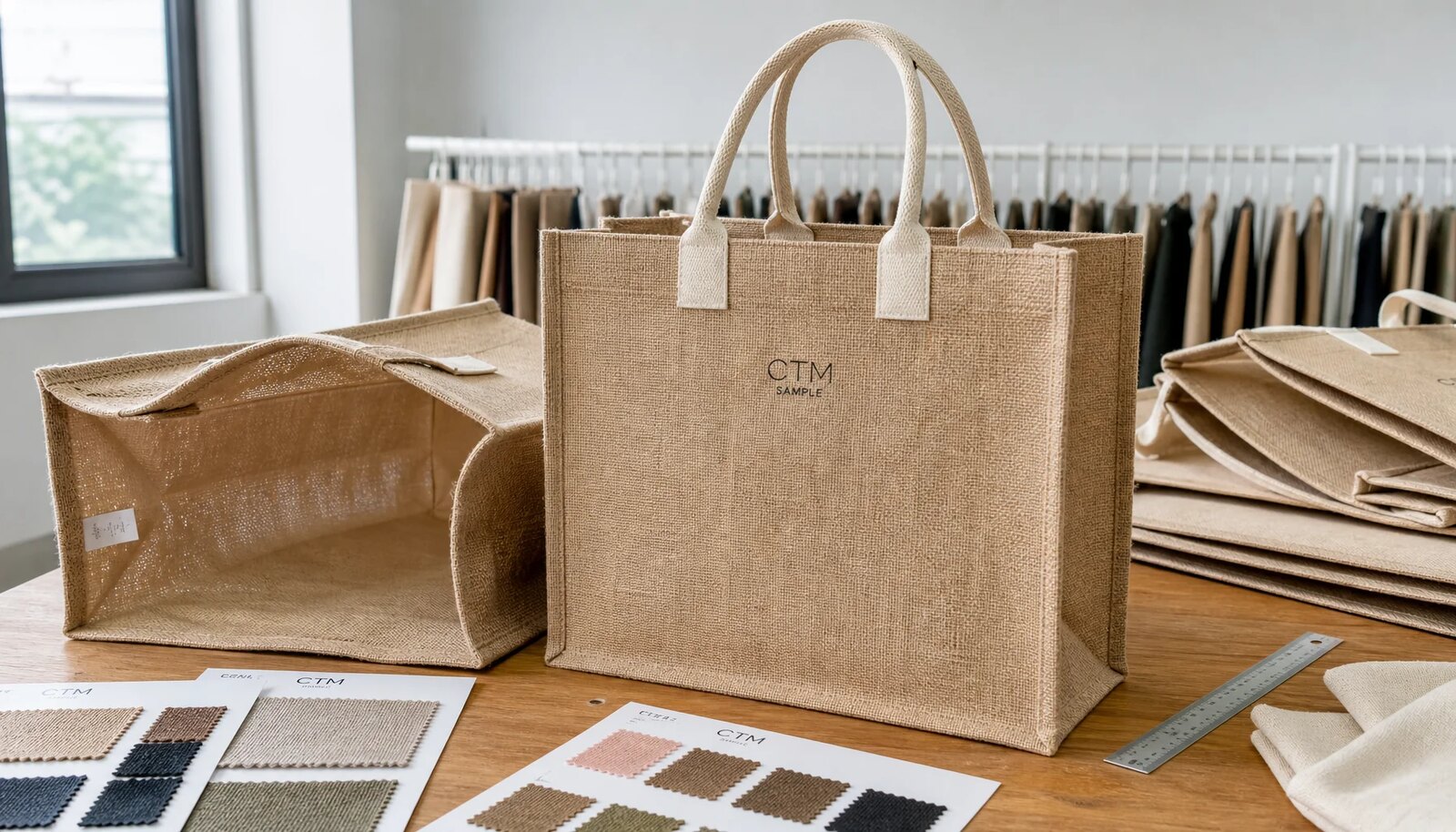
Start With the Real Craft Fair Load
Wholesale jute tote bags for craft fairs fail most often because the buyer specifies the look but not the load. A tote used for greeting cards and scarves is not the same construction as a tote used for candles, ceramics, bottled sauces, books, or vendor sample kits. Before asking for a quote, set the realistic carrying load in kilograms and define whether the bag is a giveaway, a retail resale item, or a reusable shopping tote.
For craft fair programs, a practical RFQ should state the target load, the expected number of reuse cycles, and the product mix going inside the bag. If the bag is sold by vendors as a reusable market tote, build the specification around repeated use. If it is only packaging for a single purchase, you may reduce weight and reinforcement, but do not remove handle security. A cheaper tote with weak handles creates complaints faster than a slightly rough jute texture.
- Light craft purchases: 2-3 kg target load, suitable for flat totes or lighter gussets.
- Mixed market shopping: 4-6 kg target load, better with 13-14 oz jute and reinforced handles.
- Heavy vendor merchandise: 6-8 kg target load, consider full-height webbing, wider handles, and stronger bottom seams.
- Distributor stock programs: specify one construction for the heaviest expected customer, not the average booth display.
Choose Jute Weight by Use, Not by Photo
Jute fabric weight is one of the biggest cost and durability drivers. Many supplier quotes use simple descriptions such as natural jute, burlap, or eco tote, but those words do not tell you how the bag will perform. For wholesale buying, ask for the actual weight in GSM or oz and require the same weight on the pre-production sample and bulk material. A small reduction in fabric weight can change the hand feel, opacity, seam strength, and bottom stability.
For craft fair totes, 13-14 oz jute, roughly 370-420 GSM, is a common durable range. Lighter 10-12 oz material can work for small promotional totes, but it may stretch around the handle stitches and show more slubs in print areas. Heavier jute can improve perceived value, but it increases material cost, carton weight, and sometimes minimum order constraints because the mill may require a larger fabric roll purchase.
- State the fabric weight and tolerance: for example, 400 GSM with agreed production tolerance.
- Review fabric slubs in the print zone because rough areas can break logo edges.
- Check whether the quoted fabric is from current stock or needs a new mill run.
- Do not compare quotes fairly until every supplier confirms the same jute weight and coating status.
Laminated Versus Unlaminated Construction
Laminated jute gives the bag a cleaner inside surface, improves shape retention, and reduces fiber shedding onto merchandise. It is often preferred for retail buyers and distributors because the bag looks more finished when opened by the end customer. The tradeoff is that lamination can crack if the bag is folded too sharply, and it can create odor issues if the material is not aired and packed correctly.
Unlaminated jute has a more natural hand feel and may fit brands that want a rustic burlap appearance. It usually needs better seam binding and stricter loose-fiber control. If unlaminated construction is selected to reduce cost or support a natural look, do not leave the inside seams undefined. Raw seam edges can fray during repeated use, especially at the bottom corners and near the gusset folds.
- Laminated jute: better shape, cleaner inside, more stable for printed retail totes.
- Unlaminated jute: softer natural look, more fiber shedding risk, higher need for seam finishing.
- Fold test: bend the sample along the bottom gusset and watch for coating cracks or whitening.
- Odor check: seal one sample in a polybag for 24 hours, then open and evaluate before approval.
Handle Design Is the Main Failure Point
The handle is usually the first place a jute tote fails under craft fair use. Buyers often approve a sample by appearance, then discover during a show that the handle stitch tears through the jute body. A strong handle specification includes the handle material, width, length, stitch pattern, reinforcement, and placement. For most wholesale jute tote bags, cotton webbing or a jute-cotton blend webbing is more comfortable than narrow rope and easier to stitch consistently.
A basic straight stitch is not enough for heavier loads. A Box-X stitch, bar tack, or reinforced patch spreads stress over a wider area. For heavier craft fair bags, full-height webbing that runs down the front and back panels can improve load distribution, although it changes the visual style and raises material cost. The best choice depends on whether the tote is meant to be a low-cost event bag or a reusable retail item.
- Handle width: 30-40 mm is a practical range for comfort and load distribution.
- Handle length: define hand carry or shoulder carry because each changes stress and user comfort.
- Stitching: approve Box-X, bar tack, reinforcement patch, or full-height webbing on the physical sample.
- Placement: keep handle stitching away from the top edge if the hem is too narrow to carry load.
Print Durability on Rough Jute
Printing on jute is not the same as printing on cotton canvas. The uneven weave, natural fiber slubs, and occasional raised threads affect line sharpness. Spot-color screen printing is usually the most practical method for craft fair logos, sponsor marks, and simple retail graphics. Heat transfer can look cleaner on some materials, but adhesion and edge durability must be tested carefully because rough jute surfaces are less predictable.
Artwork should be adapted to the material. Very small text, fine outlines, tight registration between multiple colors, and large solid ink blocks can create problems. A buyer-ready artwork note should include the print size, position tolerance, Pantone or approximate color reference, number of colors, and acceptable edge softness. Durability testing should include dry rub, light scratch, and carton friction review after the print has fully cured.
- Best for jute: bold logos, simple icons, sponsor names, and medium-size text.
- Risky on jute: fine reverse text, photo effects, gradients, and tight multi-color registration.
- Print position: allow realistic tolerance because jute cutting and sewing can shift slightly.
- Rub test: use a clean white cloth for repeated strokes after curing and record visible ink transfer.
Build a Sample Approval That Predicts Bulk Quality
A pretty counter sample does not guarantee production durability. The sample approval should verify the same fabric weight, handle construction, seam finish, lamination, print process, and packing fold that will be used in bulk. If the factory makes the first sample from available stock but quotes a different bulk material, the sample is only a visual reference, not a production standard.
For importers and distributors, keep sample approval practical but strict. Request front, back, side gusset, bottom, inside seam, handle stitch, print close-up, and folded packing photos before shipping the sample. Once approved, sign and date the sample or keep a sealed reference. During production inspection, compare against this sample instead of relying only on written descriptions.
- Measure actual bag width, height, gusset depth, handle length, and print position.
- Weigh the sample and compare it with quoted fabric weight and construction.
- Load the sample with the target weight plus safety margin and hang it before reviewing seams.
- Reject sample approval if the factory cannot confirm which details are identical to bulk production.
Durability Tests Buyers Can Specify
Durability testing does not need to be complicated, but it must be written into the RFQ and purchase order. A useful test plan covers static load, handle pull, seam slippage, print rub, folding, and carton compression effects. The exact threshold depends on the intended use, but buyers should avoid vague language such as strong handle or good quality. Use measurable acceptance criteria wherever possible.
A practical craft fair test might load the bag to 1.5 times the stated working load for 30 minutes, followed by short lifting cycles to simulate customer handling. After testing, there should be no broken handle stitches, jute tearing, bottom seam opening, or major distortion. For printed bags, test after curing and again after packed samples rub against each other in a carton. Many print complaints are caused by friction during shipping, not only by customer use.
- Static load: hang the filled bag and record weight, time, and visible seam changes.
- Jerk test: lift and lower the loaded bag repeatedly to expose weak handle attachments.
- Seam slippage: inspect bottom corners and handle stitch holes after loading.
- Folding test: fold along the packed carton position and inspect lamination or print cracking.
- Carton rub: place printed panels face-to-face with packing paper and check transfer after compression.
MOQ Logic and Cost Drivers
MOQ for jute tote bags is driven by fabric sourcing, handle color, print setup, cutting efficiency, and packing requirements. A supplier may accept a lower quantity if the buyer uses stock natural jute, standard sizes, existing handle colors, and one-color printing. MOQ increases when the buyer requests dyed jute, custom woven handles, uncommon sizes, multiple print designs, or strict retail packaging.
When comparing wholesale quotes, separate material cost from customization cost. A low unit price may exclude stronger handles, inner binding, export cartons, or proper inspection support. A higher quote may include heavier GSM, better seam finishing, and safer packing. The RFQ should ask suppliers to itemize the assumptions behind the price so procurement teams can compare construction, not only unit cost.
- Lower MOQ path: natural stock jute, standard dimensions, one logo, one handle color.
- Higher MOQ path: dyed jute, custom lining, multiple SKUs, retail barcode packing, special cartons.
- Common hidden cost: screen setup, sample remake, carton upgrade, inner polybag, and label application.
- Quote comparison rule: reject any quote that does not state GSM, handle construction, print method, and packing.
Packing Choices That Protect the Bag
Jute bags can be damaged by poor packing even when the sewing is correct. Over-compression creates deep creases, especially on laminated jute. Damp cartons create odor and mold risk. Printed panels packed face-to-face can transfer ink if curing is incomplete or if the carton is stored in hot conditions. For export orders, packing should be specified before the freight quote is finalized.
Flat packing is usually better than aggressive baling for retail-quality craft fair totes. The carton should be sized to prevent crushing while still controlling freight volume. For humid routes or long warehouse storage, a carton liner or moisture control method may be necessary. If the buyer needs the bags to look clean at a booth or retail counter, packing quality is part of the product specification, not an afterthought.
- Request carton dimensions, pieces per carton, gross weight, and net weight with the quote.
- Use paper separation or controlled stacking when printed panels may rub in transit.
- Avoid tight folding across printed areas and laminated bottom gussets.
- Add carton drop and compression review for distributor orders with multiple warehouse transfers.
Lead Time Risk in Craft Fair Programs
Craft fair programs often have fixed event dates, which makes schedule risk more expensive than a small unit price difference. Lead time should be planned in stages: artwork confirmation, sample making, sample shipping, sample revision, material booking, bulk production, inspection, export packing, and freight. If the order includes several designs for different vendors or sponsors, artwork approval becomes a real bottleneck.
A realistic production plan should include buffer time for sample correction and material variation. Natural jute can vary in shade between lots, and print results can shift when fabric texture changes. If the buyer waits until final bulk inspection to review shade or print sharpness, it may be too late to correct without missing the event. Early pre-production approval reduces that risk.
- Artwork stage: lock logo size, color, placement, and acceptable print tolerance before sampling.
- Sample stage: allow time for one remake if handle strength or print quality fails.
- Material stage: confirm jute lot and handle material before cutting begins.
- Inspection stage: schedule inspection before final carton sealing when possible.
- Freight stage: base booking on real carton volume, not estimated bag dimensions.
Specification comparison for buyers
| Spec decision | Recommended option | When it fits | Buyer risk to check |
|---|---|---|---|
| Jute body weight | 13-14 oz jute or about 370-420 GSM with even weave | Craft fair buyers carrying candles, pottery, packaged food, books, or multiple small purchases | Underweight jute can look acceptable in photos but stretch at the handle seam and collapse after repeated loading |
| Inner construction | Laminated jute with PE or starch-based coating, or unlaminated jute with bound inner seams | Laminated for cleaner retail use; unlaminated for natural positioning and lower material stiffness | Lamination can crack if folded tightly; unlaminated jute sheds fibers and needs better seam finishing |
| Handle material | Cotton webbing or jute-cotton blend webbing, 30-40 mm wide | Reusable fair tote programs where comfort and repeat carrying matter | Thin rope or narrow webbing cuts into hands and may fail pull testing at lower loads |
| Handle attachment | Box-X stitch with reinforcement patch or full-height webbing on heavier bags | Orders expected to carry 5-8 kg or be used as retail shopping totes | Short tack stitching may pass a light sample check but tear during booth use or customer reuse |
| Print method | Spot-color screen print with ink penetration controlled for rough jute surface | Logos, craft fair branding, sponsor marks, or simple retail graphics | Fine lines and small reverse text fill in on jute; poor curing causes rub-off during carton friction |
| Gusset structure | Side and bottom gusset with 10-15 cm depth, squared bottom if shelf display is needed | Vendor kits, market shopping, and products that must stand in a booth or retail display | Flat totes cost less but overload the lower corners and look less stable when filled |
| Top edge finish | Folded and stitched top hem with bound internal seam ends | Visible retail programs where buyers inspect finish quality at close range | Raw or poorly folded edges fray quickly and create loose fibers on merchandise |
| Packing method | Flat pack in export carton with moisture barrier liner and controlled compression | Long sea freight, humid storage, or distributor inventory programs | Over-compressed bales save freight but crease lamination, distort gussets, and transfer print ink |
Buyer checklist before sampling
- Define target load in kilograms and test the sample with 1.5 times that load for at least 30 minutes before approval.
- Specify jute weight in GSM or oz plus acceptable tolerance, not only the words natural jute or burlap.
- Approve the exact handle width, length, material, stitch pattern, and reinforcement method on a signed sample.
- Test print rub resistance on the rough jute surface after curing, especially for dark ink on natural jute.
- Open the sample and inspect inner seam binding, loose fibers, lamination cracks, and bottom corner stress points.
- Request carton packing photos and carton dimensions before mass production so freight quotes are based on real volume.
- Set AQL inspection points for handle pull strength, seam slippage, print position, odor, stains, moisture, and carton condition.
- Keep one approved sample with the buyer and one sealed reference sample with the factory for comparison during production.
Factory quote questions to send
- What exact jute GSM or oz weight are you quoting, and what tolerance will be used during incoming material inspection?
- Is the bag laminated or unlaminated, and what coating type, thickness, odor control, and folding limitation should we know?
- What handle material, width, length, stitch pattern, and reinforcement are included in the quoted price?
- What load test can your factory perform on this construction, and can you share the acceptance threshold in kilograms?
- Which print method are you quoting, how many colors are included, and what artwork limits apply on jute texture?
- What is the MOQ by bag size, jute color, handle color, and print design, and what changes create a new MOQ?
- What are the sample cost, sample lead time, production lead time, and earliest inspection date after order confirmation?
- What are the export carton dimensions, pieces per carton, gross weight, and packing method for freight calculation?
- Which defects are considered critical, major, and minor for this product during final inspection?
- Can you provide pre-production sample photos showing front, back, bottom gusset, inside seams, handle stitching, and carton packing?
Quality-control points to confirm
- Body fabric weight should match the approved GSM or oz specification within the agreed tolerance.
- Handle seams should survive the approved static load and jerk test without broken stitches, tearing, or seam slippage.
- Print should pass dry rub and light scratch checks without visible ink transfer or flaking after curing.
- Bag dimensions should be measured after sewing and pressing, with gusset depth checked separately from flat width.
- Inner seams should be bound or folded cleanly with no loose thread bundles, raw fraying, or sharp lamination edges.
- Finished bags should be free from damp odor, oil marks, heavy slubs in logo areas, insect contamination, and visible mold.
- Cartons should remain dry, correctly labeled, and strong enough for export handling without crushing the bottom bags.