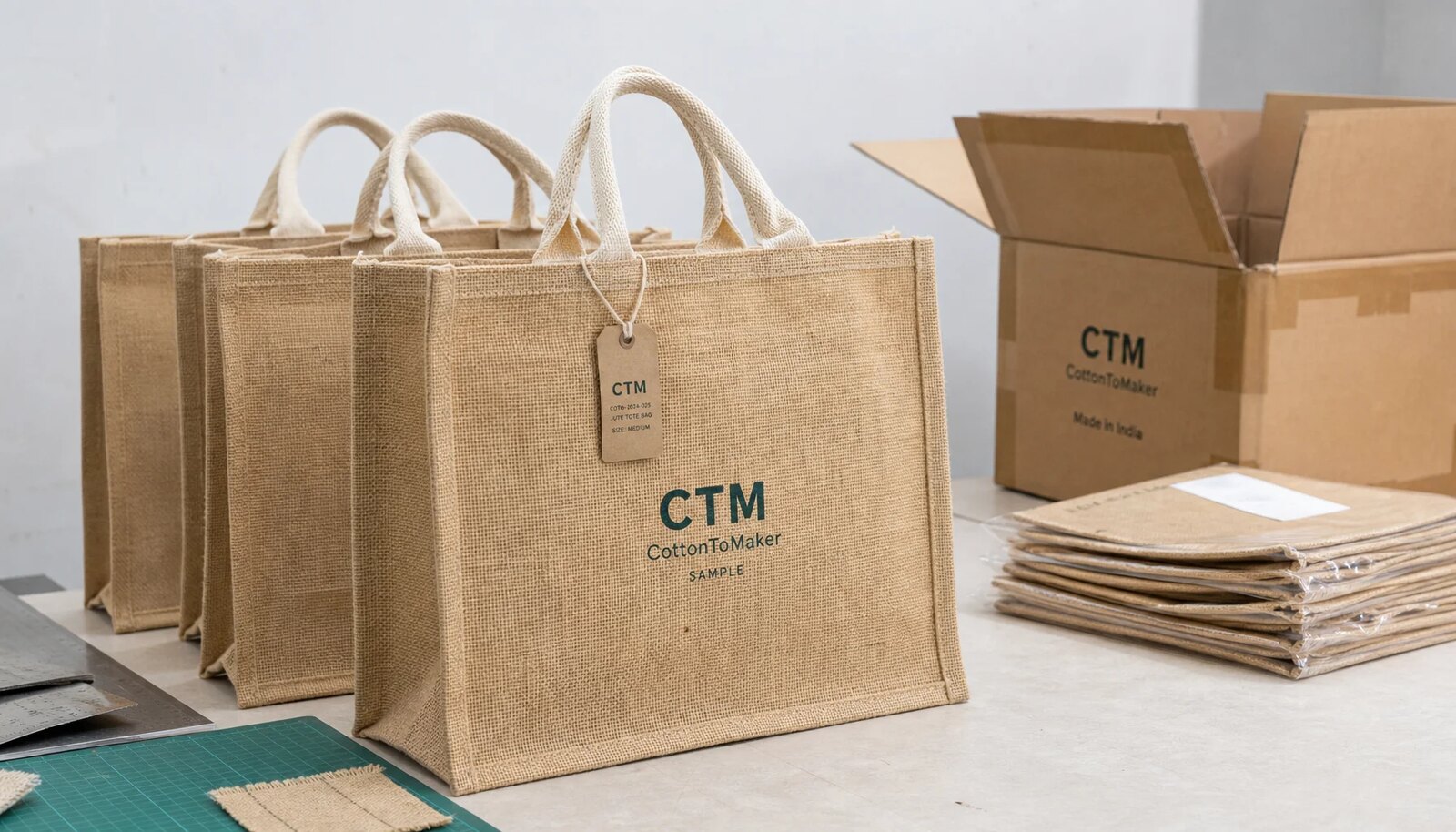
Start With the Carton Problem, Not Only the Tote Design
Wholesale jute tote bags for craft fairs are easy to judge by appearance. Buyers look at the natural texture, the reusable feel, the earthy retail presentation, and the space available for an event logo or sponsor mark. That is only half the job. Many procurement problems begin later, when cartons arrive too heavy for event staff, carton counts do not match the packing list, labels are unclear, or the freight quote changes because carton dimensions were estimated before anyone packed the actual bag.
A craft fair tote moves through more hands than many retail bags. It may leave the factory, pass through a forwarder, sit in an importer warehouse, transfer to a 3PL, arrive at a fairground, and then get opened by temporary staff before vendor check-in. If the carton plan is weak, the bag specification cannot save the order. Unclear counts slow booth allocation. Bulging cartons crush gussets. Random folding can crease the logo panel right before the event.
Treat the project as a bag-and-packing system. A sponsor giveaway packed 100 pcs per carton has different needs from a vendor welcome kit packed by booth number. A resale tote may need individual polybags, hangtags, barcodes, and a cleaner interior. A simple shopper bag may only need tidy bundles of 10 pcs and readable carton marks. The right plan depends on how the bags will be received, counted, stored, and distributed.
The RFQ should require the supplier to quote the tote and carton data together. A line that says "natural jute tote with one-color print" is not complete enough for B2B buying. Ask for pieces per carton, carton dimensions, gross weight, net weight, total carton count, CBM per 1,000 pcs, inner packing method, carton mark format, and whether export cartons are included. Without that information, landed cost and event labor cannot be compared fairly.
- Define the receiving point: importer warehouse, retail DC, 3PL, event site, sponsor office, or distributor hub.
- State the distribution method: standard carton, booth allocation, vendor kit, retail unit, or mixed-SKU event pack.
- Set a carton gross-weight limit before quoting; 15-18 kg is often more practical than maximum compression.
- Request carton dimensions and CBM in the first quote, then reconfirm after a packed-carton trial.
- Ask whether the supplier has packed this exact size before or must validate data from a production sample.
Turn the Craft Fair Use Case Into Measurable Specs
Craft fairs sound like one market, but the loading conditions vary widely. A textile fair may need a medium tote for scarves, yarn, and packaged accessories. A ceramics market may need a wider gusset, stronger seams, and reinforced handle stitching for boxed pottery. A candle or apothecary event may need a cleaner interior so product cartons do not collect loose fibers. A sponsor bag may only carry brochures and light gifts for one day. These differences should become measurable specifications before suppliers quote.
Write the brief in finished measurements, not catalog language. Include width, height, gusset, top hem, handle drop, handle width, jute weight, lining or lamination, print size, print position, and packing method. If the bag must stand upright at a booth, panel stiffness and a boxed bottom matter. If bags will be packed into vendor kits, flatness and fold direction matter. If the tote will be sold as merchandise, retail finishing such as hangtags, barcode labels, individual polybags, and cleaner thread trimming may be necessary.
Procurement should also define the expected load. The factory does not need every product detail, but it should know whether the bag will carry brochures, books, jars, candles, ceramics, apparel, or boxed gifts. That single detail helps prevent two expensive mistakes: buying a heavy, bulky tote for a light giveaway, or approving a weak low-cost tote that fails once shoppers add real purchases throughout the day.
Separate mandatory requirements from nice-to-have upgrades. This keeps quotes comparable. For example, a boxed bottom, 3 cm cotton webbing handle, one-color screen print, and 10 pcs per inner bundle may be mandatory. Cotton lining, hangtags, individual polybags, and pallet labels may be optional. When suppliers know the difference, they can show price tiers without changing the core bag.
- Specify finished size such as 35 x 40 x 15 cm instead of "medium jute tote".
- Define target use: light giveaway, mixed shopper purchase, boxed goods, vendor kit, or resale item.
- Choose a boxed bottom when the tote must hold bulky products or stand more neatly on a table.
- State presentation requirements: hangtag, barcode, individual polybag, kraft label, or retail sticker.
- Separate mandatory specs from optional upgrades so quote tiers remain comparable.
Select Jute Weight by Load, Weave, and Freight Impact
For reusable craft fair tote bags, natural jute in the 13-15 oz range, commonly around 280-350 GSM depending on yarn and weave density, is a practical starting point. Lighter fabric around 250-280 GSM can work for brochures, light giveaways, and short event use. Heavier jute can improve stiffness and perceived value, but it also increases packed thickness, carton volume, and freight cost per 1,000 pcs. There is no single best GSM for every fair program.
GSM is useful, but it is not the full quality standard. Two jute fabrics with similar weight can behave differently because yarn thickness, weave tightness, fiber length, and finishing affect panel stability. A loose weave may feel substantial yet distort near side seams or make a printed logo look broken. A tighter weave may support cleaner printing and better shape retention. During sampling, hold the panel to the light, bend it, rub the surface for loose fibers, and check fraying at cut and sewn edges.
Construction decides whether the fabric works in real use. A top hem helps the bag mouth look finished and reduces fraying. A boxed gusset increases usable capacity, but it adds sewing points that need inspection. Bottom corners and side seams need enough seam allowance and reinforcement for heavier products such as books, jars, ceramics, and candles. If the bag is laminated, the body may feel more structured, but fold marks, odor, and edge separation need closer control.
Freight should be part of the fabric decision. A heavier, stiffer tote may look better in a sample room but reduce pieces per carton and increase total CBM. Before approving an upgrade, ask the supplier to show carton quantity, carton dimensions, gross weight, and CBM per 1,000 pcs for each fabric option. That comparison gives procurement a better view of true landed cost.
- Light duty: 250-280 GSM for brochures, samples, and low-load giveaways.
- Standard craft fair use: 280-350 GSM for reusable shopper totes with a boxed gusset.
- Premium structured use: 350 GSM and above when stiffness matters more than carton efficiency.
- Check weave tightness, loose fibers, fraying, shade variation, and panel distortion on the finished sample.
- Avoid vague labels such as "eco premium jute"; specify GSM range, weave expectation, and intended load.
Decide Lining, Lamination, and Odor Controls Early
Unlined jute gives the most natural burlap appearance. It usually keeps cost, weight, and production complexity lower, which makes it useful for rustic maker markets, farmers markets, art fairs, and sponsor giveaways. The tradeoff is a rougher interior, possible fiber shedding, and less protection for light-colored paper inserts or delicate packaging. If the tote will carry cosmetics, stationery, boxed food gifts, or retail merchandise, the inside of the bag deserves as much attention as the outside.
Laminated jute adds structure and can create a cleaner inner face. It helps when bags need to stand upright or when products should not touch raw fibers. The risks are stiffness, odor, fold whitening, crease marks, and possible peeling at stress points. Cotton lining gives a more finished interior and better handfeel, but it increases sewing cost, adds dimensional variation, and may introduce shade or shrinkage differences. These choices affect unit price, lead time, packed thickness, carton quantity, and final CBM.
Odor control belongs in the purchase order. Natural jute can have a plant-fiber smell, and lamination, damp storage, or tight compression can make odor more noticeable. Event orders often leave little time to unpack and air goods after delivery. Ask how long bags will air before packing, whether desiccant is appropriate, and how the factory keeps packed goods away from damp floors, wet loading areas, and humid storage zones.
Do not leave moisture management to a general promise such as "standard export packing." Jute absorbs warehouse moisture and can show mildew, water marks, or musty odor if handled poorly. For time-bound craft fair programs, a moisture issue discovered at receiving can mean emergency sorting, repacking, or lost distribution windows. Put the acceptance standard in writing.
- Use unlined jute when rustic look, lower cost, and simple reuse are the priority.
- Use laminated jute when structure, cleaner separation, or wipeability justifies the risk controls.
- Use cotton lining when resale presentation and interior finish justify added cost and sewing time.
- Define odor acceptance in QC, especially for laminated bags or tightly compressed cartons.
- Ask the supplier to confirm airing time, storage condition, and moisture-control steps before packing.
Specify Handles as Load-Bearing Components
Handles are often the first failure point on craft fair tote bags. Shoppers may add purchases throughout the day, carry the bag on one shoulder, hang it from a stroller, or load it with irregular items. Cotton webbing is common because it feels softer than jute rope, lies flatter for packing, and matches the natural look of a jute tote. A width of 2.5-3.8 cm is practical for many reusable event bags. Narrow handles can reduce cost, but they concentrate pressure on the hand and can create complaints when the bag is full.
Handle drop should match the carry style. A shorter hand-carry drop keeps the bag compact and can reduce carton bulk. A longer shoulder-friendly drop improves comfort but adds material, increases handle tangling risk, and can create uneven carton compression if handles are not laid consistently. Define handle drop from the top edge of the bag to the top of the handle opening, or include a simple drawing. "Standard handle" is not a procurement specification.
The attachment area is a functional safety point. Reinforced box stitching, cross stitching, or bar-tack reinforcement spreads load better than a single straight seam. The stitch area must be large enough to grip the bag body and should not sit too close to the edge. Thread quality, stitch density, and placement should be checked on both sides of the bag. A neat front view is not enough if the reverse side is weak.
Add a simple load or pull test to the PO. Define the test weight, how long the bag must hold it, and what counts as failure: broken thread, tearing jute, handle detachment, severe seam opening, or visible distortion beyond the agreed limit. The test does not need to be complex, but it must be clear enough that the factory, buyer, and inspector apply the same standard.
- Specify handle material: cotton webbing, jute webbing, rope, blended tape, or contrast cotton tape.
- Specify handle width, drop length, total handle length if relevant, and attachment position.
- Require reinforced box stitching, cross stitching, or bar-tack reinforcement at every handle point.
- Define load-test weight, duration, and failure criteria before inspection.
- Review long-handle packing because shoulder drops increase carton bulk and tangling risk.
Adapt Artwork to Coarse Jute Before Printing
Screen printing is usually the most practical method for wholesale jute tote bags with one or two solid colors. It suits craft fair logos, sponsor marks, vendor names, and simple resale branding. The limitation is the material. Jute is coarse, uneven, and fibrous, so thin lines, small reversed text, tight multi-color registration, and delicate serif fonts can lose definition. Artwork that looks sharp in a PDF proof may look softer once ink hits woven jute.
Design for the surface instead of asking jute to behave like paper or canvas. Increase line thickness, simplify small sponsor logos, avoid tiny URLs where possible, and test whether a QR code can scan at the chosen size. Natural beige-brown jute also changes color perception. Dark green, black, navy, and deep brown usually read more clearly than pale inks, but contrast must be checked on the actual production shade. Pantone references help communication, yet they do not remove the effects of absorption, texture, and fiber variation.
Heat transfer can be considered for finer detail, especially on laminated surfaces, but it should be tested for edge finish, adhesion, flexibility, and appearance after folding. Embroidery can work for premium programs, but it adds cost and may require backing that affects the interior. For most craft fair procurement, the print strike-off is the practical control point.
Approve a physical strike-off on production jute before bulk printing. Keep it with the approved sample and write the print-position tolerance into the PO. Define measurement points from fixed edges, such as center alignment and distance from the top hem. If sponsor names, URLs, recycling claims, or care statements are included, inspect the smallest required text on the real surface, not only in digital artwork.
- Use screen print for bold one-color or two-color logos and cost-controlled bulk orders.
- Use heat transfer only after adhesion, flex, edge, and fold testing on the selected bag surface.
- Avoid small reversed text, thin serif fonts, low-contrast ink, and large solid areas that may look uneven.
- Set print-position tolerance from fixed edges, such as center alignment and distance from top hem.
- Approve a physical strike-off on production jute, not only a digital proof or paper print.
Quote MOQ, Price Breaks, and Hidden Cost Drivers Separately
MOQ for wholesale jute tote bags depends on fabric availability, cutting efficiency, print setup, sewing labor, handle material, lining, lamination, and packing supplies. Stock natural jute with a simple one-color print can often support a lower order quantity than custom dyed jute, special lamination, unusual handle color, nonstandard gusset, or multiple print positions. For a new craft fair program, 500-1,000 pcs may be possible for a stock construction, while 2,000 pcs or more may be more realistic for customized materials or finishing.
Price breaks should match the real buying plan. Ask for 500, 1,000, 3,000, and 5,000 pcs if those quantities fit the event calendar. This shows whether the supplier's cost is driven mainly by setup, raw material, labor, or packing. A sharp price drop after 1,000 pcs may point to setup and cutting efficiency. A small difference across quantities may mean material and labor dominate. That information helps buyers decide whether to combine multiple events into one run or keep smaller seasonal batches.
Ask suppliers to itemize the pieces that often disappear inside vague unit pricing. Individual polybags, barcode labels, hangtags, silica gel, stronger export cartons, special carton marks, pallet labels, palletization, inspection support, and local delivery can all change the final cost. Some of these are necessary. The problem is not the cost itself; the problem is discovering it after supplier selection.
When comparing quotes, bring the carton plan into the price table. A lower unit price can lose its advantage if the carton count is inefficient, the CBM is high, the goods need repacking, or key labels are excluded. A complete quote should allow procurement to compare unit price, setup cost, sample cost, packing cost, carton count, CBM, lead time, and inspection readiness side by side.
- Material cost changes with jute weight, weave quality, lining, lamination, dyeing, and handle type.
- Labor cost changes with gusset structure, lining, trimming, reinforcement, print handling, and inspection requirements.
- Print cost changes with color count, print area, screens, strike-offs, ink type, and artwork revisions.
- Packing cost changes with polybags, inner bundles, hangtags, barcode labels, silica gel, and carton strength.
- Freight cost changes with carton dimensions, pieces per carton, CBM per 1,000 pcs, and palletization.
Build the Carton Packing Plan Before Bulk Production
The carton packing plan should be confirmed after the approved pre-production sample, not improvised during final packing. Jute totes do not compress like thin cotton bags. Gusset width, lamination, fabric stiffness, handle drop, lining, and print protection all affect how many pieces fit safely. If a carton is overfilled, bags may arrive with bent corners, crushed gussets, distorted handles, or creased logo panels. If it is underfilled, the buyer pays for avoidable CBM and needs more storage space than planned.
A practical structure is often 10 pcs per inner bundle and 50-100 pcs per export carton, depending on size and stiffness. Medium unlined bags usually pack more densely than large laminated shoulder-handle bags. The carton should remain within the agreed gross weight, commonly around 15-18 kg for manual handling unless the buyer's receiving team accepts a different limit. A stronger 5-ply export carton is recommended for sea freight, long domestic trucking, repeated warehouse touches, or temporary event storage where cartons are stacked.
The packing method should protect both function and presentation. Fold direction should avoid a hard crease through the front logo. Handles should be laid consistently so one side of the carton does not become bulky. Inner bundles should be uniform for quick counting. If individual polybags are required, confirm bag size, warning text if applicable, ventilation needs, barcode placement, and whether the polybag changes carton quantity.
Carton marks should identify item number, PO number, SKU or artwork version, quantity, color, carton number, gross weight, net weight, destination, and country of origin where required. For multi-SKU orders, avoid mixed cartons unless the label and packing list make the split unmistakable. Event teams should not have to open cartons one by one to find the correct artwork version or booth allocation.
Final carton dimensions should come from a real packed-carton trial, not theoretical flat bag measurements. Request open carton photos, closed carton photos, carton mark photos, gross weight, net weight, and total CBM before freight booking. If palletization is required, ask for pallet size, cartons per layer, layers per pallet, pallet height, pallet gross weight, and whether cartons overhang. These details prevent last-minute freight changes and receiving disputes.
- Specify flat fold direction so printed front panels are not sharply creased.
- Use consistent inner bundle counts, commonly 10 pcs, for fast receiving and recounting.
- Avoid mixed SKUs in one carton unless labels and packing lists clearly identify the split.
- Require 5-ply export cartons for sea freight or routes with repeated handling.
- Confirm carton marks include item number, PO number, SKU, quantity, carton number, weight, and destination.
- Request carton dimensions, gross weight, net weight, and CBM after a real packed-carton trial.
Approve Samples in the Same Sequence as Production Risk
Many buyers approve the tote sample but not the packing system. That leaves a major gap because craft fair orders are time-bound and often handled by temporary teams. A bag can meet the design requirement and still fail operationally if cartons are hard to count, inner bundles are inconsistent, logo panels are creased, or carton weight is unsafe. Sample approval should cover the finished product, the print result, and the way goods will be packed.
A strong sample path usually starts with fabric and print, then moves to the full bag, then packing. The fabric swatch confirms jute shade, weave, GSM, lamination, and handfeel. The print strike-off confirms contrast, line clarity, ink coverage, and placement on the real surface. The pre-production sample confirms finished dimensions, handle drop, handle width, lining, gusset, top hem, and stitching. Packing photos confirm fold direction, inner bundle count, carton closure, carton marks, and whether the front logo is protected.
For larger or critical orders, one physical packed carton sample can reveal issues that photos miss. It shows carton bulging, actual weight, compression behavior, handle tangling, and whether bags slide or distort inside the carton. If a physical carton sample is not practical, request detailed packed sample photos with a measuring tape and scale reading. The goal is not to create extra paperwork; it is to remove guesswork before full packing starts.
Approved references should be retained and labeled. One sample should stay with the factory, one with the buyer if practical, and one should be available to the inspection team or documented with measurements and photos. Photos are useful, but they do not fully show fabric stiffness, odor, handle strength, or print texture. If natural jute shade variation is expected, define the acceptable range in writing and photograph the range under neutral lighting. This reduces rejection disputes over normal natural-fiber variation.
- Approve actual production fabric before bulk cutting starts.
- Approve print strike-off on jute before bulk printing starts.
- Measure finished bag size, gusset, handle drop, handle width, and print position.
- Review one packed carton or detailed packing photos before full packing begins.
- Keep approved samples sealed, dated, and labeled as inspection references.
- Record accepted shade range, odor requirement, load test, and dimensional tolerance in the PO.
Use QC Thresholds That Match Event-Day Risk
Quality control for wholesale jute tote bags should focus on usability, appearance, and packing accuracy. The most visible failures are crooked printing, uneven handles, dirty fabric, loose threads, strong odor, and wrinkled logo panels. The most costly failures are weak handles, broken seams, wrong carton counts, mixed SKUs, mold, and late discovery of packing errors. AQL inspection can be useful, but only when defect definitions match the buyer's real distribution and brand risks.
Classify defects before production. Critical defects may include mold, damp goods, unsafe contamination, wrong product, wrong artwork, severe odor, or carton count errors that block distribution. Major defects may include broken seams, weak handle attachment, dimensions outside tolerance, heavy stains, unreadable logo, tilted print beyond tolerance, severe lamination peeling, wrong handle length, or incorrect packing method. Minor defects may include small thread ends, slight fiber variation, or shade differences within the approved range. Written categories help the factory, buyer, and inspector apply the same pass/fail logic.
Functional checks should be part of the inspection plan. Handle attachment can be checked with the agreed load or pull test. Seams should be reviewed at the side, bottom gusset, top hem, and handle base. Print should be checked for position, ink spread, missing coverage, pinholes, smudging, and contrast. Odor and moisture should be checked after opening packed cartons, not only from loose samples on a table.
Packing should be audited by opening random cartons and verifying inner bundle count, carton quantity, carton marks, carton dimensions, and weight against the approved packing list. If the order ships directly to an event site, carton accuracy is as important as cosmetic appearance. A beautiful tote packed in the wrong count can still create overtime sorting, booth shortages, and sponsor complaints.
- Dimension tolerance: commonly +/-1 cm for body size and gusset unless tighter control is agreed.
- Print tolerance: define acceptable position deviation and reject unreadable or visibly tilted logos.
- Handle test: set load weight, duration, and failure criteria before final inspection.
- Odor check: open packed cartons and evaluate before shipment release, especially for laminated goods.
- Carton audit: verify quantity, bundle count, marks, dimensions, and weight against the approved packing list.
- Moisture check: reject mold, damp cartons, wet jute, or musty odor before goods are released.
Specification comparison for buyers
| Spec decision | Recommended option | When it fits | Buyer risk to check |
|---|---|---|---|
| Jute body fabric | 13-15 oz natural jute, commonly around 280-350 GSM depending on yarn and weave density | Reusable craft fair shopper bags for candles, books, ceramics, textiles, packaged gifts, and maker-market purchases | GSM alone does not prove performance. Check weave tightness, loose fiber shedding, panel distortion, edge fraying, and seam behavior on the finished bag. |
| Lining construction | Unlined for rustic programs; laminated inner face or cotton lining for cleaner handling and higher presentation | Unlined bags fit vendor giveaways and market shoppers; laminated or lined bags fit cosmetics, boxed gifts, paper goods, and resale programs | Lamination can add odor, stiffness, fold marks, and peeling risk. Cotton lining adds sewing cost and dimensional variance, so approve the exact build before comparing prices. |
| Handle material | Cotton webbing 2.5-3.8 cm wide with reinforced box, bar-tack, or cross stitching | Comfortable repeat-use tote bags where shoppers may carry mixed purchases for several hours | Thin or short handles reduce cost but increase complaints. Define handle drop, width, attachment patch size, stitch type, and load-test requirement. |
| Print method | One or two color screen print for bold logos; heat transfer only after adhesion and flex testing on the selected surface | Screen print suits event logos, sponsor marks, vendor names, and simple resale branding with predictable bulk pricing | Small type, thin lines, tight registration, and QR codes can blur on coarse jute. Require a strike-off on actual production fabric before bulk printing. |
| Bag size | Medium 35 x 40 x 15 cm or large 40 x 45 x 15 cm with boxed bottom, measured as finished size | Medium fits most craft fair merchandise; large fits bulky handmade products, vendor kits, and retail bundles | Oversizing raises CBM quickly. Compare carton count, carton gross weight, and CBM per 1,000 pcs before approving a larger pattern. |
| Unit packing | Flat folded, 10 pcs per inner bundle, 50-100 pcs per export carton depending on size, lining, handle length, and fabric stiffness | Useful for distributors, event teams, and 3PL receiving teams that need fast counting and predictable carton handling | Loose random packing can crease logo panels, tangle handles, and slow receiving. Specify fold direction, bundle count, bundle label, and carton mark format. |
| Export carton | 5-ply corrugated carton, reinforced tape, clean carton marks, and target gross weight around 15-18 kg unless the receiving team approves otherwise | Suitable for sea freight, pallet loading, mixed-SKU warehouse intake, and temporary event storage | Oversized cartons can bulge because jute compresses unevenly. Request packed carton photos, dimensions, gross/net weight, and handling-test confirmation. |
| MOQ logic | 500-1,000 pcs may fit stock natural jute with simple print; 2,000+ pcs is more realistic for custom dyed jute, special lamination, custom handles, or multiple print positions | Helps buyers separate true production minimums from sales minimums and compare quote tiers | Low MOQ may rely on available fabric lots. Define shade tolerance, reorder expectations, and whether fabric can be reserved for repeat orders. |
| Inspection focus | AQL-based final inspection plus functional checks for handles, seams, print, odor, moisture, and carton count | Best for event orders where late discovery means missed distribution windows, overtime sorting, or costly rework | Generic inspection is not enough. Define critical, major, and minor defects, then require a carton audit against the approved packing list. |
Buyer checklist before sampling
- Define the commercial use: free giveaway, resale merchandise, vendor welcome kit, shopper purchase bag, sponsor bag, retail replenishment item, or booth allocation pack.
- Specify finished bag width, height, gusset, handle drop, handle width, jute weight, weave expectation, lining, lamination, print colors, print area, print position, and fold direction in the RFQ.
- State target load use, such as light brochures, mixed shopper purchases, boxed candles, books, ceramics, packaged food gifts, or vendor supplies.
- Ask for pieces per carton, carton dimensions, gross weight, net weight, total cartons, and CBM per 1,000 bags before comparing landed cost.
- Set a maximum carton gross weight before production so warehouse, event, and 3PL teams can handle cartons safely, commonly 15-18 kg for manual handling.
- Approve a physical pre-production sample made with actual jute fabric, actual handle material, actual lining or lamination, and actual print method.
- Check print legibility on the coarse jute surface at the smallest required text size, including sponsor names, URLs, QR codes, recycling claims, or care statements if used.
- Require a print strike-off on actual production fabric and keep it as the reference for color contrast, ink coverage, line thickness, and placement.
- Require packed sample photos showing folding method, inner bundle count, polybag use, carton marks, carton closure, and how the logo panel is protected.
- Confirm whether the quote includes print setup, screen charges, sample fee, artwork adjustment, export carton, inner packing, labels, hangtags, silica gel, inspection support, and local delivery to port or warehouse.
Factory quote questions to send
- What exact jute weight, weave type, yarn appearance, fabric source, and GSM tolerance are included in this quoted price?
- Is the bag unlined, cotton-lined, laminated, or partly laminated, and does the quotation include airing time or moisture-control packing?
- What are the finished dimensions, gusset style, top hem construction, seam allowance, and normal size tolerance after sewing?
- What handle material, width, drop length, attachment size, stitching pattern, thread type, and pull-test or load-test target are included?
- Which print method is quoted, how many colors are included, what ink type is planned, and what is the maximum printable area on the selected jute panel?
- What is the smallest recommended line width and text height for this jute surface, and can you provide a strike-off before bulk printing?
- What is the MOQ for this size and print, and what changes at 500, 1,000, 3,000, and 5,000 pcs?
- What cost items are separate from unit price: sample, screens, artwork cleanup, hangtag, barcode label, individual polybag, inner bundle, export carton, palletizing, or local delivery?
- What are the carton dimensions, pieces per carton, gross weight, net weight, total carton count, and total CBM for the order and per 1,000 pcs?
- Are inner bundles, individual polybags, silica gel, hangtags, barcode labels, retail stickers, carton labels, or pallet labels included or extra?
Quality-control points to confirm
- Fabric GSM and weave consistency measured from actual production fabric, not only from a supplier swatch card or previous batch.
- Natural jute shade checked against the approved sample or shade range, with normal fiber variation separated from stains, discoloration, and water marks.
- Bag dimensions checked after sewing and pressing, with tolerance normally within +/-1 cm for body size and gusset unless the PO requires tighter control.
- Handle drop, handle width, stitch box size, bar-tack or cross-stitch placement, and handle attachment strength tested because craft fair shoppers often carry heavy mixed purchases.
- Seam allowance and corner reinforcement inspected at side seams, bottom gusset, top hem, handle attachment points, lining joins, and laminated turning points.
- Print position checked against approved artwork, with attention to ink spread, pinholes, smudging, color contrast, tilted placement, and incomplete coverage over coarse fibers.
- Small text, sponsor logos, URLs, and QR codes checked for legibility on actual jute, not only against digital artwork.
- Odor, dampness, mildew, loose fiber contamination, oil marks, dirt, and handprints checked before packing because jute absorbs warehouse moisture and shows contamination easily.
- Carton count, inner bundle count, carton marks, SKU separation, gross weight, and net weight verified against the approved packing list.
- Packed carton condition checked for bulging, weak tape, crushed corners, incorrect dimensions, moisture exposure, and cartons exceeding the agreed weight limit.