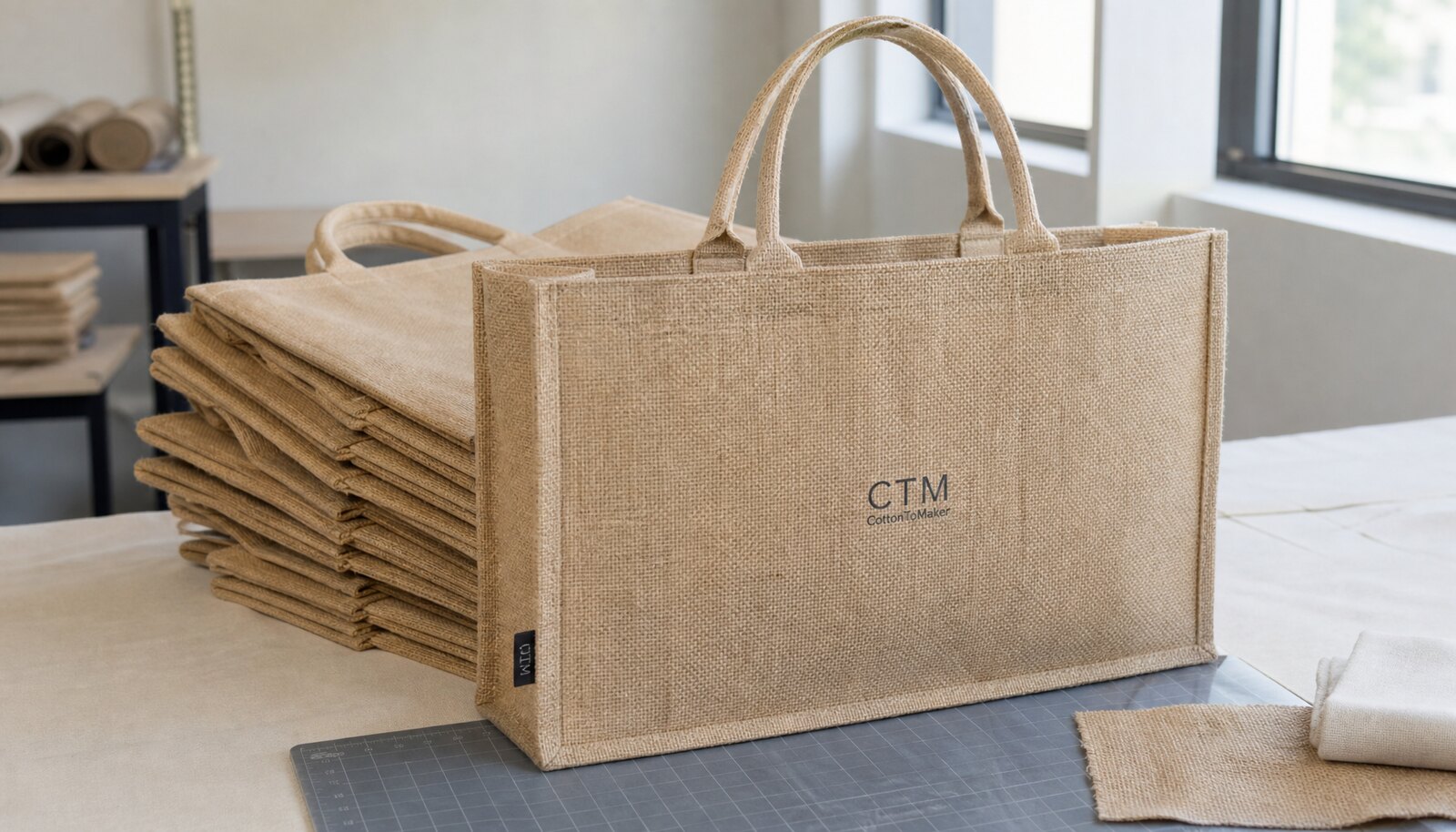
Start with the job the bag must do
Wholesale jute tote bags for corporate gifting are not just inexpensive carriers. They are part of the handover moment: the conference check-in desk, the employee welcome box, the holiday delivery, the client meeting, or the retail-style gift pack. A vague request such as “natural jute tote bag with logo, best price” leaves too much open. The supplier has to guess the fabric weight, gusset, handle, lining, logo method, carton count, and inspection standard.
Those guesses make quotes hard to compare. One supplier may price a thin flat tote with a one-color screen print. Another may assume a gusseted bag with lining, reinforced handles, and individual packing. On a spreadsheet, both lines may look like the same item. In production, they are different products with different costs, lead times, failure points, and freight volume.
A strong RFQ works like a practical production brief. It tells the factory what the bag must carry, what it should look like, how the brand mark should be applied, how it should be packed, and which defects matter. The goal is not to overcomplicate a simple tote. The goal is to remove the small assumptions that become late approvals, hidden charges, weak handles, poor print results, or missed event dates.
- Name the program type: employee onboarding kit, conference giveaway, VIP client gift, retail merchandise, holiday hamper, office distribution, or regional campaign.
- Separate fixed requirements from cost-saving options so suppliers can suggest alternatives without weakening the core item.
- Ask for line-by-line pricing for unit cost, print setup, samples, labels, packing, cartons, pallets, inspection, and rush work.
- Attach one controlled artwork file and one written specification version so every supplier quotes the same bag.
- Give suppliers enough RFQ time to check fabric availability, print feasibility, packing volume, and capacity before they quote.
Define size before discussing price
Bag structure drives cost, presentation, freight cube, and recipient experience. A flat, unlined jute tote may be fine for a light conference handout. It may be the wrong choice for a gift set with a bottle, notebook, candle, snack box, garment, or several inserts. If the bag collapses, tips over, or pulls out of shape after packing, the quality problem is visible even when the logo is correct.
Quote finished dimensions, not only a catalog code or photo. Use width x height x gusset, then state the bottom style: flat tote, side gusset, T-gusset, boxed bottom, or reinforced base. A 35 x 40 cm flat bag and a 35 x 40 x 12 cm gusseted bag are not interchangeable. They use different fabric, sew differently, pack differently, and hold a gift set differently.
Measurement method also needs a line in the RFQ. Some factories think in panel size before sewing. Buyers usually care about finished size after sewing. Inspectors may measure the empty bag flat, while the buyer may care about usable capacity when lightly filled. For many corporate jute totes, a practical starting point is +/-1.0 cm for width and height, +/-0.5 cm for gusset, and +/-1.0 cm for handle drop. Tighten only where the bag has to fit a rigid insert, carton, or gift box.
- For light event kits, consider a flat or modest-gusset body, standard jute, one-color print, and bulk packing.
- For premium client gifts, specify a structured body, stronger handles, cleaner interior, and stricter visual inspection.
- For bottle or box sets, define gusset depth, bottom construction, target loaded weight, and whether a base insert is required.
- For retail-style distribution, confirm hangtags, barcodes, individual packing, carton labels, and outer carton presentation at RFQ stage.
- For shoulder carry, state handle drop clearly; total handle length alone can be misleading.
Specify jute in real production terms
Fabric is one of the largest cost drivers, but GSM alone does not define quality. For corporate gifting, many buyers start around 250-300 GSM because it gives useful body without becoming too stiff, bulky, or expensive. A 220-240 GSM fabric can work for economy giveaways when the load is light. A 300-350 GSM fabric can feel more substantial, but it may raise material cost, sewing effort, folded volume, and freight cost.
Jute is a natural bast fiber. Shade movement, slubs, yarn-thickness variation, and a textured weave are part of the material. That does not mean anything goes. Holes, mildew, oil marks, dampness, heavy dark bands, broken yarn areas, strong odor, and dirty panels are quality defects for corporate gifting. Approve a physical swatch and define the acceptable shade range before bulk material is cut.
Lamination and lining should be chosen for a reason. Inner PP lamination can reduce fiber shedding, add stiffness, and provide some moisture resistance, but it affects recyclability messaging and may create odor or fold marks if poorly handled. Non-woven lining can make the interior cleaner. Cotton lining can feel more premium, but it adds cost, thickness, and sewing steps. If the gift campaign includes environmental language, align the material claim internally before sending the RFQ.
- Ask suppliers to state GSM, weave description, natural/dyed/bleached status, lamination type, lining type, and whether fabric is stock or custom sourced.
- Request economy, standard, and premium constructions when budget is still being tested.
- Define unacceptable material defects: holes, mildew, oil marks, heavy stains, damp cartons, strong odor, and major shade mismatch.
- Clarify whether lamination is internal or external, glossy or matte, full-body or partial, and whether it affects printing or folding.
- Approve a physical swatch because photos can hide stiffness, weave openness, fiber shedding, and odor.
Choose handles for the actual load
Handle construction is not a styling detail. It decides how the tote feels in use and whether it survives the gift contents. Same-material jute handles keep the natural look consistent, but they can feel rougher on the hand. Cotton webbing is often more comfortable and can look cleaner for a premium corporate gift. Rope handles may suit a decorative pack, but they need careful attachment design.
The RFQ should state handle material, width, color, total length or handle drop, attachment position, and reinforcement. Common reinforcement options include box stitch, X-stitch, bar-tack, or an added patch at the handle base. Do not leave stitch quality as “strong.” Ask the supplier to confirm its normal stitch density and provide close-up photos of the proposed handle attachment on the sample.
Load testing should match the program. If the gift set weighs 3 kg, the bag should not be approved only from an empty beauty photo. For many corporate gifting programs, asking the supplier to verify loaded use at 5-8 kg is a sensible starting point, depending on bag size and construction. Define the method: hanging, carrying, or holding the loaded bag for an agreed duration, then checking handle attachment, seams, and distortion.
- State expected contents and estimated total load instead of asking for a generic “strong handle.”
- Specify handle drop from the top edge of the bag to the handle apex, especially for shoulder-carry designs.
- Require reinforcement details at handle attachment points and ask for close-up sample photos.
- Check whether handle material may bleed color, shed fibers, shrink, twist, or distort after packing.
- Classify detached handles, broken handle stitching, and seam tearing under load as major or critical defects.
Match branding to coarse jute texture
Logo application is where a jute tote can quickly move from polished to disappointing. Jute is coarse and uneven, so it does not print like smooth cotton canvas or polyester. Fine legal text, thin strokes, small icons, gradients, and tight registration can lose clarity. For many one- or two-color corporate logos, screen printing is the practical starting point because it gives strong coverage and is straightforward to quote.
More complex artwork needs proofing on the actual material. Heat transfer or digital print may carry detail better, but the finish can look like a film sitting on top of the natural surface. Embroidery can feel premium in the right design, although small details may distort on coarse weave. Woven patches, cotton patches, leather-look patches, sewn labels, or side labels can help when the mark is detailed, subtle, or needs to remain consistent across repeat orders.
Send vector artwork and specify print size, placement, color references, and minimum readability. As a practical guide, avoid text below about 2.0-2.5 mm height and avoid very thin strokes unless a strike-off proves they work. For standard screen print placement, +/-5 mm is often realistic. Brand-critical color should be approved from a strike-off on actual jute, not a digital mockup.
- Provide AI, EPS, SVG, or print-ready PDF artwork instead of a low-resolution email image.
- State whether branding appears on the front, back, side gusset, inner label, side label, hangtag, or several positions.
- Confirm print area, placement from top edge and side seams, and whether alignment is judged when the bag is flat or filled.
- Avoid QR codes, gradients, tiny disclaimers, and fine outlines unless a real strike-off is approved.
- Ask whether the same ink, curing process, mesh, transfer film, or patch material will be used in bulk production.
Ask for MOQ and price ladders that reveal the tradeoffs
MOQ is usually tied to the construction, not just the supplier’s preference. A stock jute body with a one-color print may support a low minimum. Custom size, dyed jute, woven labels, special handle colors, inner lining, hangtags, and individual packing may each introduce their own minimums. That is why two suppliers can give very different MOQs while appearing to quote the same tote.
Ask for a pricing ladder at quantities such as 500, 1,000, 2,500, 5,000, and 10,000 pieces. Require the same specification at every level unless the supplier clearly marks a change. This shows whether savings come from spreading print setup, improving cutting yield, consolidating packing labor, or quietly downgrading material. It also helps procurement decide whether regional demand should be combined into one production run.
Very low MOQ and heavy customization rarely sit comfortably together. A factory may still accept the order, but the added setup, label, sample, packing, or rush fees can make the landed cost unattractive. For a tight deadline, a stock-based pilot bag may be the better commercial choice. For repeat annual gifting, take the time to develop a more customized version with proper samples and a cleaner cost structure.
- Ask for the exact MOQ for the quoted specification, not the supplier’s generic catalog MOQ.
- Request the same bag specification at several quantities so unit-cost changes are visible.
- Ask which changes reduce MOQ: stock body, standard handle, one-color print, bulk packing, or no custom label.
- Ask which features increase MOQ: custom size, dyed jute, lining, woven labels, multi-color print, or custom packaging.
- Confirm whether sample units, overrun/underrun, and replacement pieces are counted separately from MOQ.
Use an RFQ table suppliers cannot blur
A useful RFQ makes hidden assumptions visible. Instead of asking for “best price,” give every supplier the same fields: finished size, fabric GSM, handle type, reinforcement, print method, print colors, label requirements, packing method, carton data, MOQ, lead time, Incoterms, and payment terms. Procurement can then compare real specifications rather than photos and unit prices alone.
Separate one-time charges from recurring unit charges. Screen setup, artwork adjustment, sample development, custom label setup, barcode handling, special carton marks, and packing instructions may not repeat on reorder. If those costs are buried in the unit price, reorder economics stay unclear. If they are omitted, the quote may rise after supplier selection.
Carton data belongs in the RFQ, not at the last minute. Jute totes are bulky, and small differences in folding, compression, and pieces per carton can change freight cost. Ask for preliminary carton dimensions, gross weight, net weight if available, pieces per carton, and packing method. Final carton data can be confirmed after sample approval, but early estimates help with landed-cost comparison and warehouse planning.
- Require one quotation line for each specification and quantity level.
- Separate unit price, setup charge, sample charge, label charge, packing charge, carton charge, pallet charge, and rush fee.
- Include RFQ version, artwork file name, specification revision, quote validity, and production start trigger.
- Ask suppliers to confirm whether prices are EXW, FOB, FCA, CIF, DDP, or another Incoterm.
- Do not accept quotes that omit fabric, print method, packing, MOQ, lead time, carton assumptions, or exclusions.
Sample before bulk cutting and bulk printing
A sample is useful only when it represents the bulk order. Many issues start when buyers approve a prototype without confirming that it uses the actual jute fabric, handle construction, print process, label, and packing method. Photos can help with communication, but they do not show stiffness, odor, fiber shedding, handle comfort, or how ink sits on the weave.
Use staged sampling when the project has brand, timing, or load risk. Start with a material swatch if GSM, shade, or lining is uncertain. Approve a logo strike-off when color, fine detail, or ink coverage matters. Then approve a complete pre-production sample with final dimensions, gusset, handle, lining or lamination, print, labels, hangtags, and packing fold.
Review the sample as the recipient will experience it. Load it with intended contents, carry it, set it upright, fold it as it will be packed, and inspect whether the logo creases, handles twist, bottom distorts, or lining pulls. Measure the sample against the RFQ tolerance and document every approved deviation. If an exception is accepted, put it in the updated specification so final inspection is not left to memory.
- Measure width, height, gusset, handle drop, print position, and label position.
- Check print readability, ink coverage, smudging, edge bleed, cracking, and color against the strike-off.
- Review fabric odor, dust, shade, slubs, holes, stains, and lining or lamination adhesion.
- Load the bag with expected contents and inspect handle attachment, side seams, bottom seams, and shape retention.
- Document approval with date, photos, measurements, sample status, specification version, and signed comments.
Write QC criteria for natural jute
Quality control for jute totes should respect the material while protecting the brand. Natural fiber variation is normal, so rejecting every slub or small shade movement is unrealistic. At the same time, natural variation does not excuse holes, mildew, oil stains, dirty packing, unreadable logos, detached handles, wrong artwork, or incorrect carton counts.
Define critical, major, and minor defects before production begins. For many B2B orders, buyers use a final random inspection based on a recognized sampling approach such as ANSI/ASQ Z1.4 or ISO 2859-1. The exact AQL levels depend on the order risk, but a common starting framework is 0 critical defects, 2.5 major defects, and 4.0 minor defects. This is a procurement tool, not a universal rule.
QC should cover more than the final carton count. Ask whether the supplier checks fabric before cutting, confirms print registration before mass printing, inspects handle reinforcement during sewing, and audits cartons before shipment. If a third-party inspector will be used, share the checklist with the factory before production so the supplier can build to the same standard that will be used at final inspection.
- Critical defects may include mildew contamination, unsafe sharp components, wrong branding, or severe handle failure depending on use.
- Major defects may include detached handles, open seams, large stains, unreadable logos, wrong size outside tolerance, missing labels, or wrong carton count.
- Minor defects may include small loose fibers, slight shade movement within range, minor slubs, or small thread ends that do not affect use or presentation.
- Check handle strength and seam integrity with the intended load, not only by visual inspection.
- Tie all inspection decisions to the approved sample, approved artwork, RFQ version, and purchase order.
Plan packing, freight cube, and receiving labels early
Jute totes are bulky and sensitive to storage conditions, so packing affects landed cost and claim risk. Individual polybags protect units from dust and can support barcode control, direct distribution, or retail-style handling. They also add material, labor, and volume, and they may conflict with sustainability messaging. Bulk packing is often better for office handouts or event staging, but it still has to prevent crushing, moisture, odor transfer, and print scuffing.
Request carton details early: pieces per carton, carton dimensions, gross weight, bundle method, inner protection, board strength, and outer marks. Laminated or gusseted bags may not compress like flat unlined totes. Too much compression can crease the logo or deform the bag. Too little compression increases freight cube. If goods ship directly to venues or regional offices, clear carton labels and receiving-friendly pack counts may be worth more than a small unit-price saving.
Moisture and odor deserve direct RFQ language. Jute can absorb smell from damp warehouses, poor cartons, chemical storage, or long transit. For sea shipments, humid seasons, or extended storage, ask about dry packing conditions, carton liners or poly liners when appropriate, desiccant practice if needed, and ventilation before loading. These controls should be proportionate, but they are far easier before shipment than after cartons arrive with mildew risk.
- State whether individual polybags are mandatory, optional, or prohibited by the program’s sustainability policy.
- Request carton size, gross weight, piece count, bundle count, and maximum carton weight acceptable for receiving teams.
- Confirm carton marks, SKU labels, regional labels, barcode stickers, PO number, and split-shipment instructions before mass packing.
- Ask how the factory prevents moisture, mildew, odor transfer, carton crushing, and print scuffing during storage and shipment.
- Require a carton audit before shipment release, including count, marks, carton condition, and packing method.
Specification comparison for buyers
| Spec decision | Recommended option | When it fits | Buyer risk to check |
|---|---|---|---|
| Finished bag size | Quote finished dimensions as width x height x gusset, plus handle drop; common corporate gifting sizes include 30 x 35 x 10 cm, 35 x 40 x 12 cm, and 40 x 35 x 15 cm | Employee welcome kits, conference packs, client gifts, holiday hampers, sales meeting packs, bottle-and-box sets | A supplier may quote flat panel size instead of usable filled size; boxed bottom, T-gusset, and side gusset change capacity and carton cube |
| Dimension tolerance | Use a practical bulk tolerance such as +/-1.0 cm for width/height, +/-0.5 cm for gusset, and +/-1.0 cm for handle drop unless the design needs tighter control | Orders where bags must fit gift boxes, inserts, laptop sleeves, product bundles, or shipping cartons | No tolerance invites inspection disputes; unrealistically tight tolerance on natural jute can raise rejects, rework, and cost |
| Jute fabric weight | Use about 250-300 GSM for standard structured gifting; request 220-240 GSM economy and 300-350 GSM premium options if budget is still open | Corporate gifting programs that need a natural look, enough body, and a usable carry function | GSM alone is not the full quality story; weave openness, lamination, lining, and yarn quality affect hand-feel, print behavior, and strength |
| Weave and shade | Approve a physical swatch and shade range for natural jute; use dyed or bleached jute only after lab dip or production swatch approval | Eco-positioned gifts, rustic premium packaging, neutral brand campaigns, seasonal gift sets | Natural shade varies by batch; dyed jute may crock or vary between panels if colorfastness and shade tolerance are not defined |
| Handle construction | Use jute handles, cotton webbing, rope, or padded cotton webbing with reinforced X-stitch, box stitch, or bar-tack at attachment points | Event bags, employee kits, notebooks, bottles, candles, boxed goods, retail-style merchandise | Narrow handles and low stitch density can look fine in photos but fail during loaded use |
| Load target | State intended contents and target carried weight; for many gifting totes, request practical verification at 5-8 kg, or higher only if designed for it | Programs where recipients will carry several gift items, books, bottles, samples, or retail merchandise | A bag can pass visual inspection empty but distort, tear, or pull at the handles when loaded |
| Lamination or lining | Use inner PP lamination, non-woven lining, or cotton lining only when needed for stiffness, cleaner interior, moisture resistance, or dust control | Gift packs needing cleaner presentation, better body, reduced fiber shedding, or a more finished interior | Lamination affects recyclability messaging, odor risk, fold marks, heat sensitivity, and freight volume |
| Logo application | Use screen print for 1-2 solid colors; approve transfer, digital print, patch, or woven label only after a proof on actual jute | Simple corporate marks, event names, campaign slogans, front-panel branding, repeat procurement programs | Fine text under about 2.0-2.5 mm, thin strokes, gradients, QR codes, and tight registration may fail on coarse weave |
| Print tolerance | Specify print area, placement from top/side seam, color reference, and position tolerance such as +/-5 mm for standard screen print | Brand-controlled gifting, repeat orders, regional campaigns with shared artwork | Without placement tolerance, a centered logo may drift between panels; Pantone matches on jute need realistic visual tolerance |
Buyer checklist before sampling
- Define the exact gifting use case: employee onboarding kit, conference giveaway, VIP client gift, retail-style merchandise, holiday hamper, sales meeting pack, internal brand event, or regional campaign.
- List intended contents and estimated loaded weight, including the heaviest item, sharp corners, bottles, boxed goods, notebooks, inserts, or retail packaging that may affect gusset depth and reinforcement.
- Specify finished bag dimensions as width x height x gusset in cm or inches, bottom style, seam assumptions if relevant, and handle drop measured from the bag top to the handle apex.
- State the required jute construction: natural, dyed, bleached, laminated, lined, fabric GSM range, weave appearance, shade range, and whether the material must be stock or custom sourced.
- Set measurable tolerances for finished dimensions, handle drop, print placement, label position, carton quantity, and acceptable shade variation against the approved swatch or sample.
- Provide logo artwork in vector format, number of colors, Pantone or brand color references, print size, print placement, minimum readable text size, and whether a strike-off is mandatory.
- Identify branding add-ons separately: woven side label, inner care label, swing tag, barcode sticker, insert card, carton mark, regional allocation sticker, or compliance mark.
- Request a pricing ladder at realistic quantities such as 500, 1,000, 2,500, 5,000, and 10,000 pieces, plus the exact MOQ for each construction and branding option.
- Ask suppliers to separate tooling, screen setup, sample, artwork adjustment, label, packing, carton, inspection, palletization, and rush charges from the unit price.
- Define sample stages: material swatch, logo strike-off, fit sample, pre-production sample, approval photos, and one retained signed reference sample for inspection.
Factory quote questions to send
- What finished size, gusset depth, bottom construction, seam type, and handle drop are included in this quotation? Please confirm whether measurements are taken flat, filled, or before sewing.
- What dimension tolerances are you applying for width, height, gusset, handle drop, label position, and print placement in bulk production?
- What jute fabric weight in GSM, weave density or weave description, color/shade range, and lining or lamination option are included in the unit price?
- Is the fabric stock, custom woven, dyed, bleached, laminated, or batch sourced? How does that affect MOQ, lead time, shade consistency, and repeat-order matching?
- What handle material, width, length, stitching pattern, stitch density, and reinforcement method are included? Can you support a loaded-use test at our target weight?
- Which logo method are you quoting: screen print, heat transfer, digital print, embroidery, patch, woven label, or sewn label? What is the setup charge per color or artwork?
- What maximum print area, minimum line thickness, minimum text height, and registration tolerance do you recommend for this jute weave?
- Can you provide a print strike-off on actual jute before bulk production, and will the same ink, screen mesh, curing process, and fabric be used in bulk?
- What is the exact MOQ for this specification, and what changes if we use a stock size, remove lining, reduce print colors, change handle material, or simplify packing?
- Can you provide a complete pre-production sample made with actual fabric, handle, stitching, logo, labels, and intended packing method before cutting bulk material?
Quality-control points to confirm
- Finished dimensions should be checked against the approved sample and RFQ tolerance, including width, height, gusset, handle drop, bottom shape, and usable filled capacity where relevant.
- A practical starting tolerance for many jute totes is +/-1.0 cm on width/height, +/-0.5 cm on gusset, +/-1.0 cm on handle drop, and +/-5 mm on standard print placement, adjusted for design risk.
- Jute fabric should be inspected for unacceptable holes, broken yarns, heavy slubs, oil marks, mildew, dampness, insect contamination, strong odor, and major shade panels outside the approved range.
- Normal natural-fiber variation should be separated from defects: small slubs and slight shade movement may be minor, while holes, stains, mildew odor, and weak panels should be major or critical depending on severity.
- Handle attachment must use the agreed reinforcement method, such as X-stitch, box stitch, or bar-tack, with no skipped stitches, loose threads, seam opening, or misaligned placement at stress points.
- Loaded-use checks should reflect the intended program: fill the bag with the target weight, carry or suspend it for an agreed duration, and inspect handle attachment, side seams, bottom seams, and distortion.
- Seam strength should be reviewed at side seams, bottom seams, gusset corners, lining joins, and handle attachment points because these are common stress areas in gifting and event distribution.
- Print must be readable and consistently placed; check small text, line breaks, ink coverage, edge bleed, smudging, cracking, scuffing, pinholes, registration, and curing against the approved strike-off.
- Print adhesion can be checked with a simple rub or tape method agreed in advance; the exact method should be stated because different inks and finishes behave differently on jute.
- Color matching should be judged under consistent lighting with realistic tolerance for textured jute; brand-critical colors need a strike-off on actual fabric, not approval from a digital mockup.