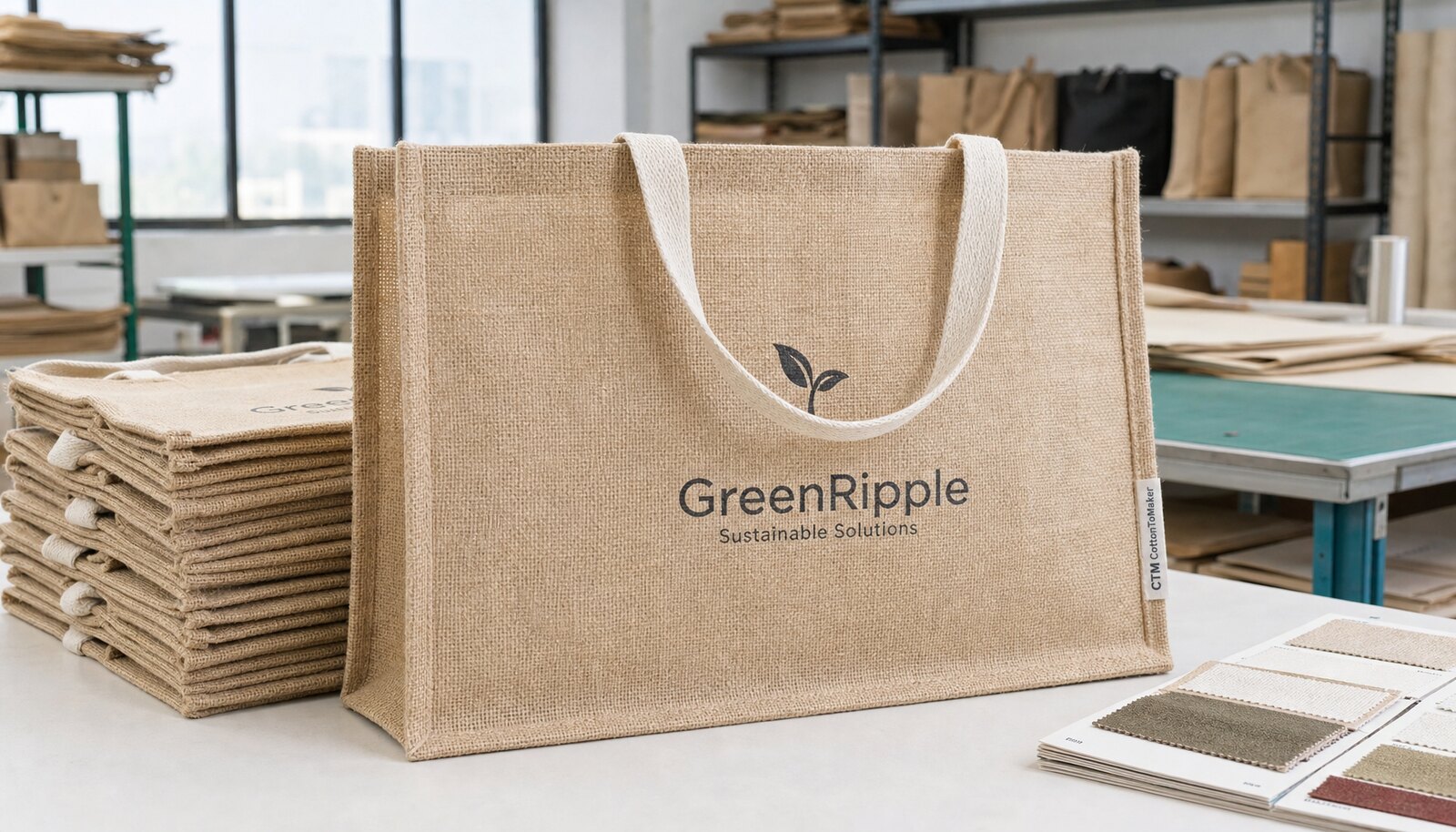
1. Start With the Gift Use Case Before Discussing MOQ
MOQ discussions go off track when the RFQ says only "jute tote bag with logo." For corporate gifting, that phrase is too broad. A conference giveaway, employee welcome kit, client appreciation gift, and regional sales-pack all may use jute, but they do not need the same construction. Contents weight, presentation level, distribution route, and reuse expectation influence fabric weight, handles, gusset, print method, packing, and the minimum quantity a factory can sensibly accept.
Begin with the contents. A notebook and leaflet do not need the same support as a bottle, boxed snack set, electronics accessory, or multi-item onboarding kit. If the bag is handed out at a booth, the front logo and table presentation may matter most. If it ships to employees, folding, carton compression, moisture protection, and label accuracy become more important. For an executive gift, the buyer may need a cleaner inside finish, heavier body, tighter logo placement, and more controlled presentation packing.
The best MOQ negotiation happens after these choices are clear. A supplier can often be flexible when the buyer accepts a stock size, natural jute, in-stock cotton handles, one-color logo, and bulk carton packing. It is much harder when the same order also asks for custom dimensions, special handle color, two-sided multi-color artwork, lining, and individual gift wrapping. Decide which features affect the receiver experience and which can stay standard for the first run.
- Event handout: standard size, 320-350 gsm jute, one-side logo, bulk carton packing, fast approval path.
- Employee welcome kit: 360-400 gsm jute, defined gusset, reinforced cotton handles, stronger carton protection.
- Premium client gift: heavier jute, cleaner seams, controlled logo placement, possible lining or tissue packing.
- Recurring corporate program: standardize one base bag and keep the master sample for repeat orders.
- Courier or multi-office distribution: prioritize fold method, carton label accuracy, carton strength, and moisture protection.
2. Turn Brand Language Into Factory Specifications
Internal teams may ask for something natural, premium, sustainable-looking, sturdy, minimal, or polished. Those words are useful in a creative brief, but a factory cannot quote adjectives. One supplier may interpret "premium" as 400 gsm jute with cotton lining and 38 mm webbing handles. Another may quote an unlined stock bag with a thicker-looking weave. Both may think they answered the brief. Procurement then receives prices that cannot be compared fairly.
A strong RFQ translates the brand direction into measurable details: finished dimensions, fabric gsm, finish, handle construction, logo process, artwork count, packing method, carton data, sample route, lead time, and trade terms. Write dimensions as width x height x gusset, and state that they are finished measurements. Handle drop should be separate because hand-carry and shoulder-carry bags feel different in use. In corporate gifting, handle comfort is noticed immediately.
Be careful with custom features that sound small. Dyed handles, unusual proportions, two-sided logos, lining, individual polybags, barcode labels, and insert cards can all be valid. They also add sourcing, setup, labor, or inspection work. When MOQ is tight, protect the visible quality drivers first: fabric feel, handle comfort, logo clarity, and clean finishing. Simplify where the receiver is less likely to notice, such as artwork versions, nonessential packaging layers, or a small custom size change.
- State finished dimensions as width x height x gusset, with tolerance and measurement method.
- Specify jute fabric weight in gsm and finish instead of only saying thick or premium.
- Define handle width, handle drop, material, color, and reinforcement stitch.
- Provide logo placement from top edge, side seam, and gusset, not just "centered."
- State whether the order has one artwork version or multiple department, sponsor, or language versions.
- Include packing requirements in the RFQ because packing can change labor time, carton cube, and MOQ.
3. Choose the Jute Body Construction With Tolerance in Mind
For many corporate gifting tote bags, woven jute around 320-400 gsm is a practical starting range. Around 320-350 gsm can suit lighter event handouts and cost-sensitive programs. Around 360-400 gsm often gives a better hand feel for welcome kits and client gifts. Heavier 400-450 gsm jute, laminated jute, lined jute, or a base insert can improve structure, but each choice adds cost, handling time, carton volume, and more points to approve.
Jute is a natural woven material. It has texture, fiber variation, slubs, and shade movement. That is part of the look, but it must be managed. It will not behave like smooth cotton canvas or polyester. Coarse weave can affect cutting, seam appearance, and print edges. If the brand needs tiny text or very flat color, adjust the artwork or consider another decoration method. If the brand wants a natural surface, define the acceptable range before production.
Tolerances should be written before the PO. For many sewn jute tote bags, about +/-10 mm on body dimensions is more realistic than expecting machine-part precision. Logo placement can often be tighter, but it still needs a defined allowance, such as +/-5 mm to +/-10 mm depending on construction and printing method. Fabric gsm can also arrive within a range. Ask the supplier to state its normal tolerance during the quote stage, not after inspection.
- 320-350 gsm: lower-cost option for light event use and simple contents.
- 360-400 gsm: common middle range for corporate welcome kits and reusable gift bags.
- 400-450 gsm: stronger body and presentation, but usually higher unit cost and minimum quantity.
- Laminated jute: adds structure and a cleaner inner surface, but check odor, stiffness, cracking, and scuffing.
- Lined jute: improves interior finish, but adds sewing operations, material matching, and inspection points.
- Base board or insert: useful for heavy or boxy gifts, but must be checked for fit, thickness, and carton effect.
4. Specify Handles and Strength, Not Just "Sturdy"
Handles are a high-risk, high-visibility detail. They are the first part the recipient grabs, and they are often the first part to fail if the construction is under-specified. A bag can look fine on a table and still disappoint if the handles stretch, feel rough, tear at the seam, or sit unevenly. Procurement should define handle material, width, drop, color, reinforcement method, and intended contents weight.
Cotton webbing handles are often a strong choice for B2B gifting because they feel better in the hand than basic self-jute handles and can be sewn consistently. Common widths are about 25-38 mm. The right choice depends on bag size, expected load, and whether the bag should be hand-carried or shoulder-carried. Ask how the handle ends are inserted and reinforced. Box-X stitching, cross-stitching, and bar-tacks are common approaches, but the supplier should confirm what it will actually use.
Strength should be linked to the real gift. If the bag will carry 2 kg, say so. If it will carry several boxed items, request a practical load check on approved construction. The method can be simple: load representative weight into random samples, hold or carry for a defined period, then inspect handle stitching, seam stress, and slippage. Agree this method before production so inspection is objective.
- Specify handle material: cotton webbing, jute, rope, blended tape, or another option.
- Define handle width and handle drop, and state whether hand carry or shoulder carry is required.
- Use visible reinforcement such as box-X, cross-stitch, or bar-tack where load matters.
- Ask whether handle tape is in stock; custom color tape may create a separate MOQ.
- Check stitch density, loose threads, handle alignment, and whether both sides match.
- Tie strength expectations to real contents weight rather than a vague sturdy claim.
5. Find the Real Source of the MOQ
MOQ is rarely one simple rule. It is usually the result of material purchasing, cutting efficiency, print setup, sewing-line planning, trim availability, packing labor, and supplier risk. Once buyers understand the constraint, they can negotiate intelligently. If natural jute, standard cutting patterns, and common handle tape are already available, the first-run minimum may be flexible. If the order needs custom fabric, dyed handles, lining, multiple artwork versions, and individual packing, the minimum rises for practical reasons.
Fabric is often the first constraint. Jute may be bought in rolls, and roll length or usable width affects panel yield. A 20 mm change in width or gusset may look minor on a drawing, yet it can create more waste or require a new cutting marker. Cutting tables and sewing lines also work better with repeatable sizes, especially for gusseted totes where panel squareness affects the finished shape.
Decoration adds another MOQ layer. One-color screen printing on one side is usually easier to set up, inspect, and repeat. Each extra color adds registration risk. Each logo version adds screens, sorting, labels, and packing separation. Ten office logos at fifty pieces each are not the same production flow as one logo at five hundred pieces.
Packing can be the hidden driver. Bulk cartons move quickly. Individual polybags, tissue, insert cards, barcodes, and office-specific carton marks add labor and QC checks. If MOQ feels high, ask which part sets the floor. The answer may reveal an easy compromise: keep the premium bag but use bulk packing, or keep the special packing but choose a stock bag size.
- Fabric MOQ: affected by roll availability, width, color, lamination, lining, and shade matching.
- Cutting MOQ: affected by panel yield, gusset design, cutting marker, and changeover time.
- Print MOQ: affected by color count, screen setup, ink coverage, logo complexity, and artwork versions.
- Sewing MOQ: affected by lining, binding, handle reinforcement, base board, and line efficiency.
- Packing MOQ: affected by polybags, inserts, barcodes, carton sorting, and regional delivery labels.
- Commercial MOQ: affected by supplier administration, sampling time, inspection burden, and payment terms.
6. Read the Factory Quote Like a Cost Map
A useful quote shows what the buyer is actually buying. If the supplier gives only one blended unit price, procurement cannot see whether the MOQ is driven by fabric, printing, sewing, packing, or commercial risk. Ask the supplier to separate the blank bag, decoration, screen or setup charges, sample cost, packing extras, carton configuration, and trade terms. Not every supplier will disclose factory cost, but a clearer quote exposes the production logic.
Request quantity breaks using the same specification, such as 300, 500, 1,000, and 3,000 pieces if those quantities match the project. Watch the price pattern. A sharp drop after a certain point may signal setup recovery or line efficiency. A small drop may mean material and packing dominate cost. If the price changes mainly when artwork versions change, the print setup and sorting plan are likely the issue.
Sample wording matters. A showroom sample is a reference. A blank sample confirms size and construction, but not print. A print strike-off confirms artwork behavior, but not finished sewing. A production-style pre-production sample is the strongest approval tool because it should use the intended fabric, handle tape, stitching, logo process, and packing method.
Compare trade terms consistently. EXW, FOB, CIF, and DDP are different commercial offers. A low EXW price can lose its advantage once inland freight, export handling, ocean or air freight, duties, taxes, and destination delivery are added. For event gifting, schedule risk is also a cost. A quote without carton dimensions, gross weight, production lead time, and handoff point is not ready for approval.
- Ask for line items: blank bag, print, setup, sample, packing extras, carton, and trims.
- Request price breaks at realistic quantities using the exact same spec.
- Confirm whether repeat orders can reuse screens, cutting pattern, approved sample, and carton plan.
- Require carton dimensions, pieces per carton, net weight, gross weight, and folding method.
- Compare quotes on landed cost and delivery feasibility, not factory unit price alone.
- Clarify payment terms and inspection timing before the purchase order is placed.
7. Negotiate MOQ by Changing the Right Variables
The most useful MOQ question is not "Can you do less?" It is "Which change would reduce the minimum most?" That question moves the conversation away from pressure and toward production planning. The answer may be stock fabric, standard size, one artwork, in-stock handle tape, one-color print, or bulk carton packing.
There are two clean negotiation routes. The first is controlled simplification: keep the visible quality but remove custom variables. A natural 360-400 gsm jute bag, standard factory size, cotton webbing handles, one-side one-color screen print, and bulk cartons will usually be easier to place at a lower MOQ. The second route is commercial flexibility: keep the premium spec and accept a higher unit price for a smaller run. Both can work. What rarely works is asking for low MOQ, low price, custom construction, several logos, premium packing, and urgent delivery all at once.
If the first order is a qualification run for a larger program, say that clearly but do not promise unapproved volume. A supplier may be more flexible when the base construction can repeat. Ask whether screens, cutting patterns, master samples, and carton plans can be held for future orders. Reorder MOQ may be easier once materials and approvals are stable.
Document every concession. If MOQ dropped because the buyer moved from 400 gsm to 360 gsm, reduced print size, used stock handles, removed polybags, or combined artwork versions, the revised quote and PO must say so. Otherwise internal stakeholders may expect the original product and dispute the normal differences later.
- Ask which specification is setting the MOQ floor.
- Use stock fabric, stock handle tape, and standard size for the first run where possible.
- Reduce artwork versions before reducing construction quality.
- Consider paying a higher unit price for a smaller run if premium specs are non-negotiable.
- Combine shipments or departments only if carton labeling and distribution remain manageable.
- Put all negotiated changes into the quote, sample approval sheet, and purchase order.
8. Control Logo and Print Risk on Coarse Jute
Artwork that looks sharp on paper, polyester, or smooth cotton canvas may not behave the same way on jute. The surface is coarse, fibrous, and uneven. Fine lines can break. Small reversed text can fill in. Gradients may look muddy. For corporate gifting, the aim is a clean, recognizable brand mark that suits the natural texture, not a perfect digital reproduction.
One-color screen printing is often the safest first-run option for wholesale jute tote bags because it limits registration and setup risk. Multi-color screen print is possible, but approval must be tighter. Heat transfer, woven labels, embroidery patches, and leather-look patches can also work for certain logos, but each brings its own checks: adhesion, edge finish, flexibility, needle impact, patch alignment, and color consistency.
Provide vector artwork and ask the supplier to review minimum line width, reversed text, small details, and solid ink areas before screens are made. Pantone references help, but color on natural jute will not look exactly like color on coated paper. Approve the logo on the actual jute or on a confirmed equivalent fabric. A digital mockup is useful for position; it does not prove ink coverage, edge sharpness, rub resistance, or final color.
Treat every artwork version as its own approval. A sponsor logo, office name, department mark, or language version changes setup, sorting, and inspection. If versions are packed separately, carton labels must identify them clearly. Many corporate gifting problems are sorting problems, not sewing problems.
- Provide vector files such as AI, EPS, or production-ready PDF, not only low-resolution PNG or JPEG.
- Avoid tiny reversed text, thin strokes, gradients, and complex icons unless tested on jute.
- Specify logo size and placement from physical reference points on the finished bag.
- Approve a print strike-off or production-style sample on the actual fabric where possible.
- Check edge clarity, ink coverage, registration, color, and rubbing resistance.
- Confirm setup charge, screen count, and MOQ effect for each artwork version.
9. Use Samples and Written Tolerances to Prevent Bulk Rework
Sampling should answer the questions that matter in bulk: fabric feel, shade, gsm range, body size, gusset shape, handle drop, reinforcement, stitch quality, print placement, print clarity, odor, folding, and carton marking. If a sample does not use the planned bulk material or process, call it a reference sample. It can guide discussion, but it should not release production.
For higher-risk orders, use staged samples. A fabric swatch confirms material and shade. A print strike-off shows how the logo behaves. A blank construction sample confirms size and handle feel. A pre-production sample brings the full product together. Simple orders may not need every stage, but premium or deadline-sensitive programs should not rely only on a digital mockup.
Written tolerances keep normal variation from becoming a dispute. Define body size, handle drop, logo placement, shade range, odor standard, loose thread limits, print defect limits, and packing expectations before bulk starts. Natural jute will have fibers, slubs, and texture variation. The question is not whether variation exists; it is what range the brand can accept.
Keep sealed master samples. One should stay with the supplier and one with the buyer or inspection team. Label them with the date, spec number, artwork version, and approval signature. For repeat orders, this sample is valuable because staff, inspectors, and even factory teams may change.
- Approve fabric swatch, print strike-off, blank bag, or pre-production sample according to project risk.
- State that showroom samples and mockups are references unless confirmed as bulk standards.
- Write tolerances for body size, handle drop, print shift, shade, and natural fabric variation.
- Seal and label master samples with date, spec number, artwork version, and approval signature.
- Treat any post-approval change in fabric, handle, print, or packing as a revised specification.
- Do not release bulk production until sample approval and PO specification match.
10. Put QC, Packing, and Freight Into the Purchase Order
Quality control belongs in the PO, not in a last-minute email before shipment. The purchase order should reference the final spec sheet, approved master sample, tolerances, inspection method, packing standard, carton marks, and remedy process for failed goods. Without those details, both sides end up debating subjective words like good, strong, clean, or premium.
For jute tote bags, inspection should focus on measurements, fabric consistency, seam strength, handle reinforcement, print appearance, odor, stains, loose fibers, packing accuracy, and carton condition. In-line checks are useful because print and sewing issues are easier to correct before everything is packed. Final random inspection should open cartons, measure finished bags, confirm logo placement, check counts, verify version sorting, and compare carton labels with the packing list.
Formal AQL inspection can be used when appropriate, but it should be agreed before production. For smaller or lower-risk orders, structured factory QC photos may be enough: material rolls, cutting, print close-ups, handle stitching, measurement photos with a ruler, packing, and sealed cartons. For larger, premium, or event-critical programs, buyer-appointed third-party inspection before balance payment or shipment release is worth considering.
Packing and freight also affect quality. Jute can crease, scuff, absorb odor, or suffer moisture damage if packed poorly. Cartons that are too tight may distort the bag or mark the print; cartons that are too loose may allow abrasion. Confirm pieces per carton, fold method, carton dimensions, gross weight, net weight, carton label format, and moisture protection. Approve the order based on landed cost, transit time, receiving needs, and event deadline, not factory unit price alone.
- Put approved sample reference, tolerance table, inspection method, and packing method into the PO.
- Inspect fabric, seams, handles, logo, odor, stains, loose fibers, count, labels, and carton condition.
- Use in-line photo checks at cutting, printing, sewing, and packing stages for early issue detection.
- Use third-party inspection for larger, premium, or deadline-critical corporate gifting orders.
- Confirm carton dimensions, pieces per carton, gross weight, net weight, folding method, and carton marks.
- Match packing to the delivery route: one warehouse, multiple offices, direct mail, event venue, or kit assembly.
- Compare landed cost, transit time, customs risk, and event deadline before approving final terms.
Specification comparison for buyers
| Spec decision | Recommended option | When it fits | Buyer risk to check |
|---|---|---|---|
| Base bag fabric | Approx. 320-400 gsm woven jute for most corporate gifting runs | Conference giveaways, welcome kits, employee gifts, client appreciation packs, and light-to-medium contents | Too-light fabric may show open weave, weak body structure, print feathering, and less substantial hand feel |
| Premium body build | 400-450 gsm jute, laminated jute, jute with cotton lining, or a removable base board | Heavier kits, bottles, boxed gifts, executive presentation, or bags expected to stand upright | Higher MOQ, added sewing steps, stiffness, lamination odor, carton cube increase, and more approval points |
| Bag size and gusset | Use a factory stock size before requesting a custom cut; common ranges are 14-16 in wide, 15-17 in high, 4-6 in gusset | Best when contents fit a standard footprint and procurement needs MOQ flexibility | Minor size changes can reduce fabric yield, require new cutting markers, increase waste, and create separate minimums |
| Handle construction | Cotton webbing handles, commonly 25-38 mm wide, with box-X, cross-stitch, or bar-tack reinforcement | Better hand feel and higher perceived value than basic self-jute handles for reusable corporate gifts | Check handle drop, tape color, shrinkage, stitch density, alignment, and practical load expectation |
| Print method | One-color screen print for the first production run unless brand requirements justify another method | Most corporate logos, event marks, and simple campaign artwork on natural jute | Fine strokes, gradients, small reversed text, and large solid ink blocks need strike-off approval on actual jute |
| Artwork strategy | One approved logo version across the main quantity | Predictable setup, inspection, carton sorting, and schedule control | Office names, departments, languages, or sponsor versions can create separate screens, setup fees, sorting rules, and MOQ pressure |
| Sampling route | Material swatch plus production-style pre-production sample; seal an approved master sample | Any branded gift order where fabric feel, handle strength, logo placement, odor, and packing matter | Showroom samples and digital mockups do not prove bulk material, stitching, print adhesion, carton fit, or packing accuracy |
| Size tolerance | Agree tolerances before PO; typical practical target is about +/-10 mm for body dimensions and +/-5 mm for logo placement on sewn bags | Useful for natural woven jute where sewing and folding create small variation | Unwritten tolerances turn normal variation into disputes or allow unacceptable variation to pass as normal |
| Packing spec | Bulk carton packing for operational programs; individual packing only when presentation or distribution requires it | Bulk delivery to offices, event handout, kit assembly, regional shipment, or gift-ready presentation | Polybags, tissue, inserts, barcodes, and office-specific carton marks add labor, carton volume, QC points, and possible MOQ increases |
Buyer checklist before sampling
- Final finished bag width, height, gusset depth, handle width, and handle drop, with measurement method and accepted tolerance stated in millimeters or inches.
- Target jute fabric weight in gsm, weave appearance, natural shade range, and whether the body is unlined, laminated, coated, lined, washed, or unwashed.
- Expected packed contents and estimated use load; ask whether the supplier can support a practical handle pull or load test, such as holding the intended gift weight for a defined time.
- Handle material, color, width, reinforcement style, stitch color, stitch density expectation, and whether handle ends are folded, bound, or raw inside the seam.
- Logo file in vector format, print size, position from top edge and side seam, color count, Pantone reference if needed, and minimum line-width concerns.
- Decoration method: screen print, heat transfer, embroidery patch, woven label, leather-look patch, hangtag, insert card, carton print, or mixed branding.
- MOQ requirement by bag size, fabric color, handle color, artwork version, packing format, and shipping split so the supplier can identify the true minimum driver.
- Sample route: fabric swatch, print strike-off, blank construction sample, pre-production sample, sealed master sample, and any sample approval deadline.
- Written tolerances for dimensions, logo shift, color variation, odor, stains, loose threads, print defects, carton count, and acceptable natural jute variation.
- Lead time split by artwork proof, material sourcing, sampling, sample transit, buyer approval, bulk cutting, printing, sewing, packing, inspection, and shipment handoff.
Factory quote questions to send
- Which part of the MOQ is driven by fabric procurement, fabric width, cutting loss, screen setup, sewing line efficiency, handle tape, trim sourcing, or packing labor?
- Can you quote the closest stock-size bag first, then show the MOQ and unit price change for custom width, height, gusset, or handle drop?
- What is the exact jute fabric weight in gsm, approximate tolerance, weave style, finish, and natural shade range? Is the fabric unwashed, washed, laminated, coated, or lined?
- What handle tape is in stock, what width is it, what material is it, and what reinforcement stitch will be used at each handle end?
- What practical load test do you recommend for this construction, and can the test be repeated on pre-shipment samples?
- How many print colors are included, what is the screen setup charge, and what is the repeat charge for additional logo versions or future reorders?
- What minimum line width, minimum reversed text height, and maximum solid ink area do you recommend for this jute weave?
- Can you provide a print strike-off on the actual bulk jute or the closest approved fabric before full production?
- What sample types do you offer: material swatch, digital proof, print strike-off, blank sample, pre-production sample, production-line sample, or pre-shipment sample?
- Is the sample cost credited after bulk order confirmation, and will the approved sample use the same fabric, handle tape, stitch method, logo process, and packing as bulk production?
Quality-control points to confirm
- Measure finished bag width, height, gusset, handle width, and handle drop against the approved spec. Write practical tolerances before production; for many sewn jute bags, buyers use approximately +/-10 mm on body size and tighter placement tolerances where possible.
- Check fabric gsm or agreed weight range using random panels or finished bags when feasible. Watch for thin patches, open weave, shade bands, fraying, stains, oil marks, moisture marks, and inconsistent lamination.
- Inspect cutting and panel squareness. A small cutting skew can become visible after sewing, especially on boxy gusseted tote bags with front logo placement.
- Inspect stitching at handle ends, side seams, bottom seam, gusset corners, inner binding, and lining join for skipped stitches, broken threads, loose thread ends, seam puckering, and uneven tension.
- Verify handle reinforcement method, stitch count, and alignment. Perform a practical load check using the intended gift weight or an agreed test weight, and inspect for seam tearing or handle slippage after the test.
- Confirm print position from top edge, side seam, and gusset on finished sewn bags, not only on flat panels. Check multiple pieces because bag folding and sewing can shift the visual center.
- Check ink coverage, edge sharpness, rubbing resistance, adhesion, registration, and pinholes on the woven surface. Coarse jute may break fine detail even when a digital proof looks sharp.
- Review logo color against the approved reference under normal indoor light. Do not approve color only from phone photos, direct sunlight, or high-contrast studio lighting.
- Review odor, dust, fiber shedding, loose jute hairs, stains, mold risk, and moisture exposure, especially for laminated, coated, lined, or tightly packed constructions.
- Open random cartons to confirm quantity, folding method, individual packing if required, carton labels, barcodes, insert cards, and consistency with the packing list.