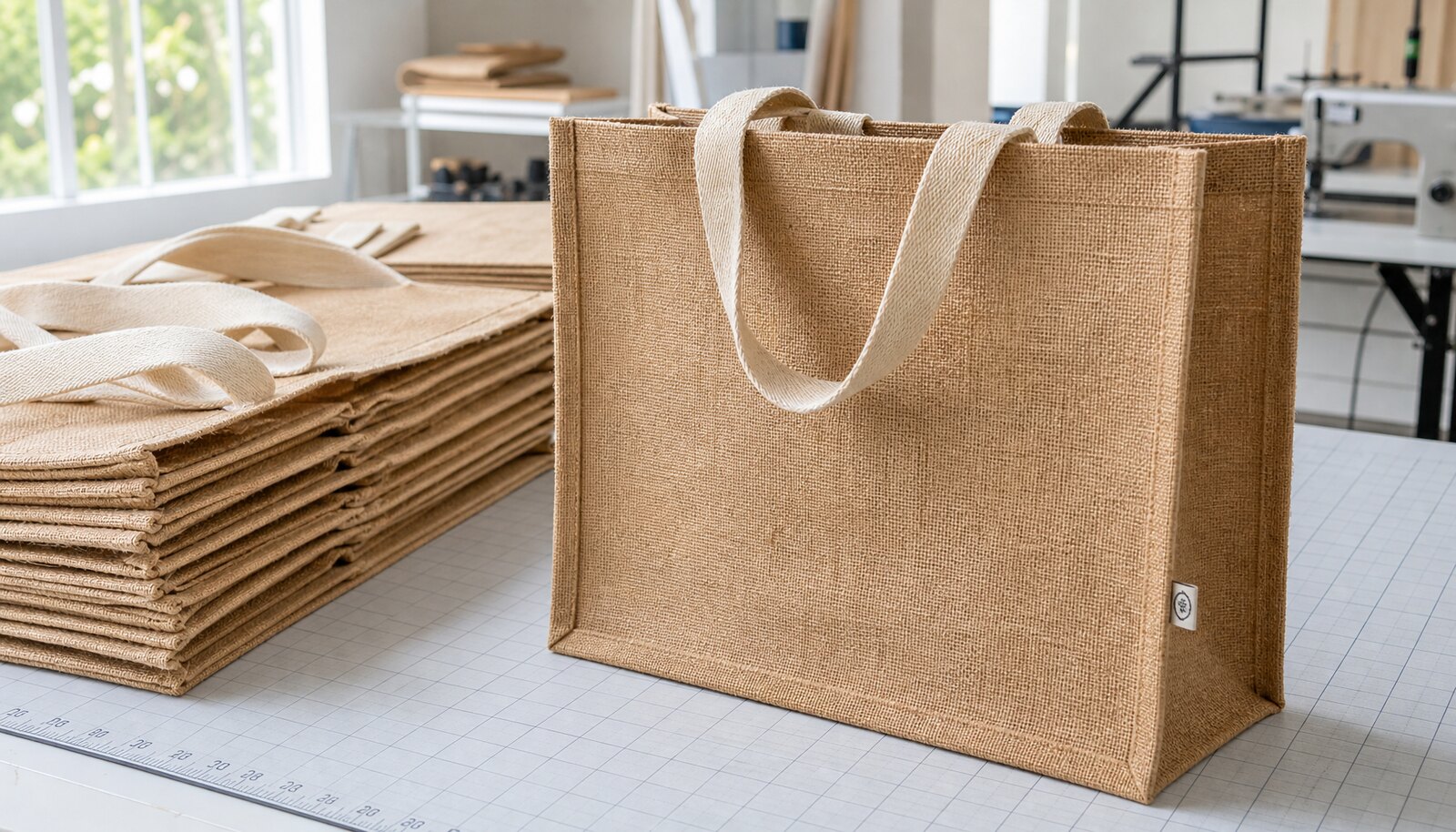
Start with the date that cannot move
Corporate gifting orders usually fail in one of two places: the bag itself arrives late, or it arrives on time but too close to the kitting deadline to be useful. A jute tote may look like a simple branded carrier, yet in a corporate program it often becomes the outer packaging for an employee welcome kit, conference handout, customer onboarding pack, holiday gift, or sales meeting bundle. If the totes miss the window, the whole kit can sit unfinished.
That is why lead time planning matters as much as unit price. A low-cost order is not a saving if the event agency cannot pack the gifts, the warehouse cannot receive the cartons, or the regional office has to replace the bag at the last minute. Buyers should work backward from the real event-ready date, not from a vague “delivery by” date.
Jute adds a few timing variables that paper bags and stock mailers often do not have. The fabric has visible texture, natural shade variation, slubs, and bulk. It has to be booked or pulled from stock, cut, printed, dried or cured, sewn, trimmed, inspected, folded, packed, documented, and released for pickup. A small change in lining, handle, artwork, closure, or packing can push the order into a different production slot.
- Set separate dates for ex-factory readiness, forwarder pickup, port or airport departure, warehouse arrival, kitting start, and event-ready release.
- Ask exactly when the supplier’s lead time begins: RFQ, PO, deposit, artwork approval, sample approval, or material receipt.
- Create a no-change date for artwork, fabric, handles, closures, labels, carton marks, and packing.
- Give internal approvers real deadlines. Marketing, brand, finance, event agencies, and end users rarely approve everything in one afternoon.
- If sample approval is late, treat it as a schedule change rather than asking the factory to absorb all lost time.
Build the bag around the contents, not the other way around
A weak RFQ says, “natural jute tote with logo.” A useful RFQ says what the bag needs to carry, how it will be handled, and how it should look when filled. Two totes with the same outside dimensions can behave very differently. One may be a light open-weave giveaway bag. Another may use heavier laminated jute, reinforced cotton handles, a flat gusset, and a cleaner interior finish.
Start with the gift kit. List the largest item dimensions, total packed weight, sharp box corners, bottles or jars, notebooks, apparel, food items, or loose accessories. Decide whether the bag must stand upright on an event table or in a photography setup. A tote that looks fine when empty may sag, twist, or pull at the seams once a boxed gift is inside.
Handle comfort is also a procurement detail, not just a design choice. Cotton webbing handles are often smoother for recipients than rough jute handles, especially at conferences where attendees carry the tote for hours. Handle drop should match use: shorter for hand carry, longer for shoulder carry. Width, stitch pattern, thread, and top-edge reinforcement affect durability more than decorative add-ons.
- Include the filled weight and largest item size in the RFQ.
- Specify finished bag width, height, gusset depth, handle drop, and handle width; do not rely on cut-panel dimensions.
- For a common event tote, buyers may consider around 35 x 40 cm with a 10-15 cm gusset, but the correct size depends on the actual kit.
- Base gusset depth on the largest box, bottle, or folder rather than estimated volume alone.
- Ask for a sample photo or physical sample loaded with the real contents or a weight equivalent.
- If the kit weighs 3 kg, evaluate the sample under that load instead of approving an empty front-view photo.
Use precise jute specifications instead of broad labels
Terms such as “premium jute,” “heavy jute,” and “eco bag” are not enough for procurement. They do not tell the factory, inspector, or buyer what to measure. Ask for GSM or oz/sq yd, weave appearance, lamination status, lining material, handle material, and finished-bag weight. Some suppliers quote jute on a traditional ounce basis; others use GSM. Either can work, but the basis needs to be written down.
Also confirm whether the stated weight is measured before or after lamination or finishing. A laminated fabric can feel firmer and heavier than an unlaminated base fabric even when the base jute is similar. That affects structure, folding, print behavior, carton volume, and freight cost. If buyers compare quotes without this detail, one supplier may appear cheaper simply because the material is lighter or less finished.
Natural jute is not supposed to look perfectly uniform. Small slubs, fiber color differences, and texture irregularities are part of the material. That said, holes, oil marks, mold, strong damp odor, severe thin spots, heavy dust, water stains, and visibly mismatched panels should not be waved through as “natural.” If the brand expects a clean corporate gift presentation, include that expectation in the quote because tighter sorting can add waste, labor, and time.
- Request exact fabric basis: GSM, oz/sq yd, or the supplier’s internal material code.
- Confirm whether fabric weight is before lamination, after lamination, or an average from the finished bag.
- Use an agreed tolerance, often around ±5% for fabric weight unless the supplier documents another standard.
- Separate acceptable natural variation from rejectable defects.
- If odor matters, require dry, ventilated goods that are free from mold or strong chemical smell before packing.
- For premium programs, approve material swatches before locking the bulk quote.
Choose decoration that suits coarse natural fiber
Brand teams may supply a clean digital logo and expect the tote to match it exactly. Jute does not behave like coated paper. Its coarse, uneven surface softens edges and can reduce color density. Fine type, gradients, small registration marks, and photographic artwork usually look less sharp than they do on a screen.
For many corporate gifting bags, screen printing is the most predictable option for one- or two-color logos with bold shapes. It is straightforward, scalable, and familiar to most tote bag factories. Heat transfer can work for small multicolor artwork or short runs, but it should be tested on the actual material. Buyers should check adhesion, edge lifting, gloss, flexibility after folding, and whether the transfer changes the natural appearance of the bag.
Bigger branding is not always better. A moderate front print, woven side label, internal label, or sewn patch can feel more reusable than a large event logo covering the whole panel. From a sourcing perspective, each additional print position, label, patch, or embroidery step adds setup, handling, and inspection. Quote these separately so the team can see which brand choices add time or cost.
- Supply editable vector artwork rather than low-resolution JPG or PNG files.
- Specify Pantone or brand color references while accepting that natural jute can shift perceived color.
- Define logo width, height, and placement from fixed points such as top edge, side seam, or center line.
- Agree a realistic logo placement tolerance, commonly ±5 mm to ±10 mm depending on size and production method.
- Request a physical strike-off for small type, dark ink, large coverage, multicolor registration, or color-sensitive logos.
- Confirm whether the packing fold can cross the logo; if not, define a folding method that avoids the print area.
Map the full lead time, not just factory production
A supplier may say production takes a certain number of days, but that is only one part of the calendar. The full project includes artwork proofing, sample or strike-off preparation, courier time, buyer review, possible revision, material booking, cutting, printing, drying or curing, sewing, trimming, final inspection, packing, export documents, and freight handoff. The factory can only protect the schedule when these stages are visible.
For a simple open-top natural jute tote with one-color screen print and bulk packing, the production stage may be relatively manageable once approvals are complete. The risk is usually around the edges: incomplete artwork, delayed brand approval, unclear carton marks, late packing instructions, or a sample revision that changes the material or handle. These delays are easy to miss because they happen before the production clock officially starts.
Use calendar days for the whole project and working days for factory tasks, then check holidays in both countries. A week with local holidays, port congestion, or peak gifting demand may not behave like a normal week. If the event is fixed, protect two buffers: one before bulk production for sample issues and one before delivery for freight, customs, warehouse receiving, or kitting problems.
- Typical planning blocks may include artwork proofing 1-3 working days, sample or strike-off preparation over several working days, courier time of 3-7 calendar days depending on route, buyer approval of 1-5 working days, production based on quantity and complexity, final QC and packing of 2-5 working days, and export handoff of 1-3 working days.
- Add time for dyed jute, custom fabric, lining, zippers, multiple artwork versions, barcodes, individual packing, or retail-style labeling.
- Ask the supplier for the last safe date to book material and the last safe date to freeze artwork.
- Write the required event-ready date and kitting start date into the PO, not only the preferred ship date.
- Clarify whether “ready” means finished goods packed in cartons, passed final QC, export documents prepared, or goods available for forwarder pickup.
Make sample approval a functional test
A sample should do more than look pleasant from the front. Load it with the actual gift kit or an accurate weight substitute. Check whether the gusset fits the largest item, whether the bag stands upright, whether corners strain the seams, whether the handle feels comfortable, and whether the logo remains visually centered when the bag is filled. A flat tote can pass a photo review and still fail in real use.
Not all samples answer the same question. A construction sample checks dimensions, handle, gusset, and sewing. A print strike-off checks ink behavior, logo size, and color direction. A pre-production sample should match the final fabric, lamination or lining, handle, label, closure, print method, folding, and packing as closely as possible. For a repeat order, a sealed reference and new strike-off may be enough. For a new corporate gifting program, a physical pre-production sample is safer.
Approvals should be written and measurable. “Looks good” leaves too much room for disagreement later. Record finished dimensions, handle drop, logo position, fabric appearance, shade range, packing method, and any approved deviations. Keep a retained sample or signed reference available for final inspection. If the buyer approves one handle construction and later requests another, the timeline should be reissued because sourcing and sewing have changed.
- Measure width, height, gusset, handle drop, handle width, logo size, and logo distance from top and side edges.
- Check odor, hand feel, fiber shedding, sharp edges, loose threads, and interior cleanliness.
- Photograph the approved sample from the front, back, side, inside, handle close-up, seam close-up, logo close-up, and packed condition.
- If the sample differs from the final specification, document each difference and approve the production standard in writing.
- Do not release mass production while waiting for legal logo approval, brand color confirmation, final recipient lists, or destination labels if those details affect production.
Control MOQ, artwork versions, and split deliveries early
MOQ is not only about price. It reflects material booking, cutting setup, print setup, sewing-line allocation, inspection, and packing efficiency. A small custom order may be possible, but it is not automatically faster. It may need to fit between larger production runs. A larger order can sometimes receive clearer capacity planning, though it also needs more fabric, more cartons, and more packing time.
Ask what the MOQ applies to. It may be per size, fabric color, artwork, print color, label, closure, packing format, or destination. If a company wants five department logos at 200 pieces each, the factory may treat that as five versions rather than one 1,000-piece order. Each version needs artwork proofing, print setup, production separation, inspection by design, and carton identification.
Version control becomes critical once the bags move to a 3PL, event agency, distributor, or regional office. A correct tote in the wrong carton can delay fulfillment just as much as a defective tote. Carton marks and packing lists should show PO number, item code, artwork version, quantity, destination, and carton numbering clearly enough for receiving teams to sort without guessing.
- Clarify MOQ by total order, bag size, fabric color, artwork file, print color, label, closure, packing method, and destination.
- For urgent small runs, simplify the product: standard natural jute, open top, standard handle, one print position, and bulk packing.
- Ask whether multiple logos can share cutting and sewing while staying separated at printing and packing.
- Use consistent artwork version names on proofs, samples, carton marks, packing lists, and invoices.
- For repeat programs, keep approved artwork, label files, carton marks, sample references, and any reusable setup information to shorten reorders.
Decide packing before the bags are made
Packing is often treated as an afterthought, but it affects appearance, carton volume, receiving speed, and freight cost. Jute totes are bulky. Fold them too sharply and the logo may crease. Pack them too tightly and handles can deform or ink can scuff. Pack them too loosely and the bags can shift inside the carton. The folding and carton plan should be approved before mass packing begins.
Bulk packing by count is usually practical when the bags will be unpacked and filled quickly at a warehouse or event agency. Individual polybags may reduce dust and handling marks, but they may conflict with a customer’s sustainability policy. Paper bands, grouped inner packs, tissue, or carton liners can be useful alternatives. Whatever the choice, include it in the quote because it changes labor, material cost, carton size, and sometimes lead time.
Warehouse requirements should be collected early. Some receiving teams set maximum carton weights, pallet height limits, barcode rules, or carton-mark formats. Multi-destination orders need even tighter control. If cartons contain mixed regions, departments, or artwork versions, the packing list must show the allocation clearly; otherwise the goods may be held for sorting before kitting can start.
- Define whether the logo can be folded or must remain flat.
- Specify bags per inner pack, bags per master carton, carton dimensions, net weight, gross weight, and maximum carton weight.
- Confirm individual polybags, paper bands, tissue, carton liners, grouped packs, or no inner packing.
- Require carton marks that match the PO and packing list exactly.
- Ask for final packing photos, carton mark photos, and a carton count summary before shipment release.
- If palletizing, specify pallet size, maximum height, stretch wrap, corner protection, and whether mixed versions can share a pallet.
Write QC tolerances that an inspector can use
“Good quality” is not a workable inspection standard. For wholesale jute tote bags, QC needs to define what is critical, major, and minor. Critical or major defects may include broken handles, wrong artwork, severe print shift, wrong size, missing label, mold, severe stains, sharp hardware, wrong carton count, or mixed designs. Minor defects may include small loose threads that can be trimmed, slight natural slubs, or shade variation inside the approved range.
Tolerances should be practical for a natural textile bag. Jute is not a precision molded product. A sensible starting point for many gifting orders is around ±1 cm for main finished dimensions, ±1 cm for handle drop, ±5 mm to ±10 mm for print placement, and around ±5% for fabric weight. The final tolerance should be agreed with the supplier based on construction, production method, and inspection plan. If the buyer asks for very tight tolerances, the supplier may need slower production or more sorting.
Inspection should not wait until the bags are already at the buyer’s warehouse. Incoming material checks catch holes, stains, odor, and shade problems before cutting. In-line checks catch print, sewing, and handle issues while rework is still possible. Final inspection confirms size, appearance, load-related details, label placement, carton count, carton marks, and packing. A retained approved sample keeps subjective judgments consistent.
- Write the measurement method into the spec: lay flat, measure finished bag, and include or exclude seams consistently.
- Reject holes, mold, oil marks, water stains, severe thin spots, heavy dust, strong odor, and unacceptable panel mismatch.
- Reject wrong color direction, missing ink, peeling, cracking, heavy bleed, upside-down logo, or placement outside tolerance.
- Reject broken seams, skipped stitches at stress points, loose handles, crooked labels, sharp hardware, or lining sewn incorrectly.
- Include carton count, artwork separation, carton marks, and packing list accuracy in the inspection scope.
- State the required disposition after a failed inspection: rework, sort, replace, reinspect, hold shipment, or buyer approval.
Compare landed cost and schedule risk together
A cheaper quote is not always a better quote. It may use lighter fabric, no lamination, narrower handles, smaller print area, no strike-off, bulk-only packing, optimistic carton counts, or a lead time that starts only after sample approval. Another quote may look higher because it includes reinforced handles, physical sampling, individual packing, carton marks, and realistic QC. Unless the assumptions match, the unit prices cannot be compared fairly.
A strong RFQ forces suppliers to quote the same product and service scope: finished dimensions, fabric weight, lamination or lining, handle material, print method, number of colors, print area, labels, closure, sample requirement, packing method, carton size, shipment term, and target ready date. If a supplier suggests a cost-saving alternative, ask exactly what changes. Does the fabric become lighter? Does the print area shrink? Are handles narrower? Is the lead time based on stock fabric only?
Freight can be a major variable because jute totes are volumetric. Laminated or lined bags may pack fewer pieces per carton. Individual packing can also increase CBM. For air freight, chargeable weight may be driven by volume rather than actual weight. For sea freight, cubic meters and consolidation timing matter. Ask for estimated carton dimensions and gross weight with the quote, then reconfirm after sample approval or a packing trial.
- Separate product unit cost from sample charge, screen charge, label setup, packing surcharge, inland freight, export fees, inspection cost, and international freight.
- Request estimated CBM, carton dimensions, gross weight, and bags per carton at quotation stage.
- Confirm Incoterms or delivery terms so suppliers are not quoting different handoff points.
- Check whether the ready date means packed goods, goods passed final QC, export documents ready, or goods available for forwarder pickup.
- Do not choose the lowest quote until the supplier identifies which specification, service, packing, or schedule assumption differs.
Specification comparison for buyers
| Spec decision | Recommended option | When it fits | Buyer risk to check |
|---|---|---|---|
| Jute fabric weight | Quote by actual GSM or oz/sq yd basis, not only “light/medium/heavy”; common corporate-gift builds often sit around 280-450 GSM depending on lamination and structure | When the bag must carry boxed gifts, notebooks, drinkware, apparel, or sample kits without looking thin | Confirm whether weight is measured before or after lamination/finishing; agree tolerance, often around ±5% unless the supplier states another standard |
| Bag dimensions | Specify finished width, height, gusset, handle drop, and handle width in cm or inches | When contents must fit a known box, folder, bottle, or gift kit | Cut size is not finished size; request finished-size tolerance such as ±1 cm for main dimensions and tighter tolerance for logo placement |
| Handle build | Cotton webbing, padded cotton, or reinforced jute handles with X-stitch, box stitch, or bar-tack reinforcement | When the bag will be carried through events, offices, hotels, or shipping handoff points | Ask for handle material width, drop, stitch count/length, thread type, and a practical load or pull-test method matched to the intended contents |
| Print method | Screen print for 1-2 solid colors; heat transfer for small multicolor art; woven label or patch when fine brand detail is required | When artwork must remain legible on coarse natural fiber | Jute texture softens edges; require physical strike-off for small type, Pantone-sensitive color, large coverage, dark ink, or multicolor registration |
| Logo placement | Front-panel print with defined distance from top edge and side seam; optional woven side label or internal label | When the tote should promote the brand but remain reusable after the campaign | Set placement tolerance, commonly ±5 mm to ±10 mm depending on bag size and manual handling; confirm seam clearance and whether logo may cross fold lines |
| Closure style | Open top for fastest and lowest-risk production; zipper, button, magnetic snap, flap, or drawcord only when contents require retention | When the bag must protect or conceal higher-value gift contents | Closures add accessory sourcing, sewing time, alignment checks, and defect modes; confirm added days, MOQ, and hardware safety requirements |
| Interior finish | Unlined for simple gifting; laminated jute for body and reduced fiber shedding; cotton lining for premium presentation or small loose items | When the gift includes items that can snag, mark, or fall through a coarse weave | Lining and lamination affect stiffness, odor, print method, carton volume, and inspection criteria; ask for finished-bag weight and packing count |
| Packing standard | Bulk by count in export cartons, or inner polybags/paper bands/carton liners for dust control and 3PL handling | When goods move through event agencies, warehouses, distributors, or corporate mailrooms | Overfilled cartons deform handles and logos; require bags per carton, folding rule, carton size, gross weight, carton marks, and pallet limits |
| Lead time model | Plan separate calendar time for proofing, sample, courier, buyer approval, material booking, production, QC, packing, export documents, and pickup | When delivery is tied to conferences, onboarding dates, holiday gifting, or product launches | The lead time clock often starts after sample approval or deposit, not RFQ date; confirm the trigger in writing |
Buyer checklist before sampling
- Confirm finished bag width, height, gusset depth, handle drop, handle width, intended load weight, largest item dimensions, and whether the filled bag must stand upright for presentation photos or event tables.
- Specify jute type, GSM or oz/sq yd basis, weave appearance, lamination side, lining requirement, acceptable shade range, odor expectation, fiber shedding tolerance, and whether natural slubs are acceptable.
- Send editable vector artwork, Pantone or brand color references, logo dimensions, print position from top and side edges, number of print colors, minimum line thickness, and whether a physical print strike-off is mandatory.
- State practical tolerances in the RFQ: for example, main dimensions ±1 cm, handle drop ±1 cm, logo placement ±5-10 mm, and fabric weight ±5% unless the supplier proposes a different measurable standard.
- Decide whether the approved sample must include final fabric, final handle, final print, final label, final closure, final folding, and final packing method before bulk production is released.
- Ask the supplier to separate artwork proof time, sample making time, sample courier time, buyer approval time, production time after approval, packing time, export document time, and forwarder pickup readiness.
- Clarify MOQ by total order, bag size, fabric color, print artwork, print color, label type, packing method, and delivery destination if the project has multiple departments, regions, or artwork versions.
- Agree carton packing, folding method, inner polybag or paper-band requirement, barcode or hangtag needs, carton marks, pallet height limits, maximum carton weight, and warehouse receiving rules before cutting starts.
- Record inspection checkpoints for fabric stains, holes, thin spots, mold odor, size tolerance, seam strength, handle attachment, print adhesion, print placement, carton count, and mixed-design prevention.
- Build an internal approval calendar naming who approves artwork, sample, packaging, pre-shipment photos, inspection results, and shipment release, with a decision deadline for each stage.
Factory quote questions to send
- What exact jute fabric weight, weave style, lamination, lining, and finishing are included in this quote, and is the weight measured before or after lamination or finishing?
- What tolerance do you apply for fabric weight, finished dimensions, handle drop, logo placement, and carton quantity, and can those tolerances be written on the proforma invoice or specification sheet?
- Is the jute material in current stock or must it be booked after deposit or PO? If booking is needed, how many calendar days are required before cutting can start?
- How many days are needed for artwork proof, sample making, print strike-off, sample courier, revision if needed, and mass production after written sample approval?
- Which print method is included, how many colors are priced, what is the maximum print area, what is the minimum recommended line thickness, and what is the cost or time impact of oversized logos or extra placements?
- What is the MOQ by bag design, fabric color, print version, label type, closure, and packing format, and can one order be split across multiple artwork files without changing the schedule?
- What handle construction is quoted, including handle material, width, drop length, stitch pattern, reinforcement, stitch density, thread type, and any load or pull test used by the factory?
- What carton packing spec is quoted, including bags per carton, folding method, inner bags or paper bands, carton dimensions, net weight, gross weight, carton marks, and palletization if needed?
- What QC controls are performed at incoming material, cutting, printing, sewing, trimming, packing, and final inspection, and what defect rate or rework policy applies before shipment?
- Do you use an AQL inspection level or internal sampling plan? If yes, what critical, major, and minor defect limits apply to corporate gifting bags?
Quality-control points to confirm
- Fabric weight matches the quoted GSM or oz spec within the agreed tolerance, and the weave does not show unacceptable thin spots, holes, oil marks, mold, water stains, excessive loose fibers, or severe shade variation between panels.
- Finished bag dimensions are within the approved measurement range for width, height, gusset, handle drop, and handle width after sewing, finishing, folding, and packing; measuring method is consistent across inspector and factory.
- Handle stitching is reinforced at stress points, with no skipped stitches, loose thread ends that affect strength, crooked bar-tacks, weak top seams, cracked lamination at the edge, or seam puckering that changes bag shape.
- Handle strength is checked against the intended load, using a practical hanging or pull test agreed before production; the test weight should reflect the gift kit weight plus a reasonable handling margin.
- Print registration and placement are within approved tolerance, with no obvious ink bleed, cracking, peeling, smudging, missing coverage, wrong Pantone direction, upside-down placement, or visible shade shift between cartons.
- Heat transfer, patch, embroidery, or label applications are checked for adhesion, edge lifting, puckering, wrong label orientation, loose stitches, and performance after normal folding and carton packing.
- Closures, linings, hangtags, barcodes, and accessories match the approved sample, with no missing zipper pulls, mis-sewn labels, reversed tabs, sharp hardware, or loose components.
- Cartons are sealed, labeled, and counted correctly, with no mixed artwork, mixed destinations, overfilled cartons, undercount, wet cartons, crushed cartons, or carton marks that conflict with the packing list.
- A retained approved sample, print strike-off, or signed production reference is available during final inspection so subjective issues such as texture, color tone, handle feel, and logo placement are judged consistently.
- Inspection reporting includes photos of defects, measurement data, carton count, packaging method, carton marks, and clear disposition: pass, rework, sort, replace, or hold shipment.