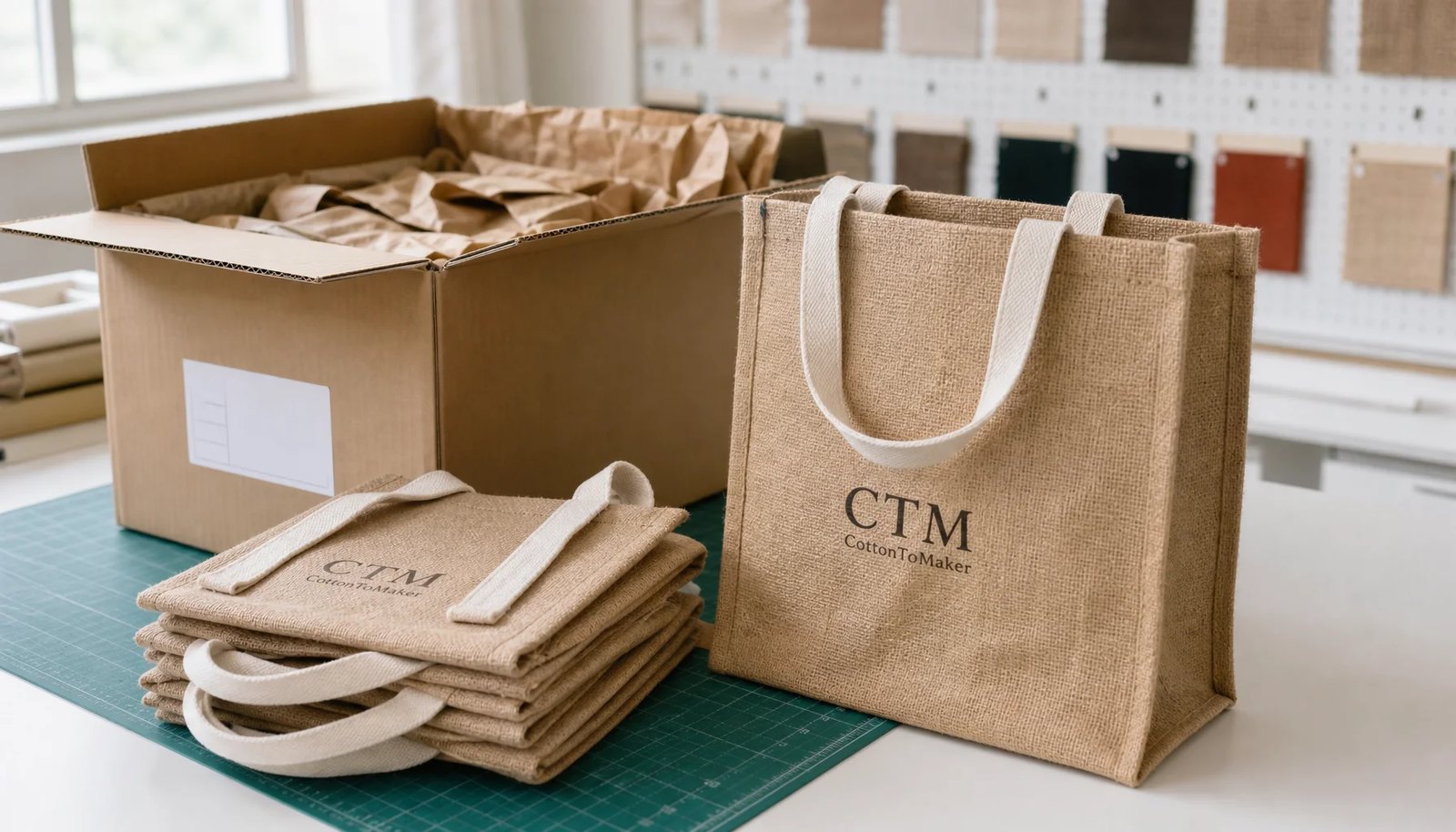
Why carton planning matters
For wholesale jute tote bags used by trade show exhibitors, the carton plan is part of the product spec, not a warehouse afterthought. It determines whether the buyer can count bags quickly, move cartons safely, keep the printed logo clean, and deliver the right quantities to each booth before the event opens. A good tote can still produce a bad sourcing result if cartons arrive crushed, mixed by artwork version, too heavy for venue handling, or packed so tightly that the bags keep hard crease lines.
Jute behaves differently from cotton canvas. It is thicker, rougher, more sensitive to moisture, and usually bulkier after lamination. A carton plan that works for cotton totes may produce unstable cartons for jute totes. When procurement teams compare supplier quotes, carton quantity, gross weight, CBM, and label control should sit beside unit price, fabric weight, and print cost. The lowest unit price is not useful if the order creates excess freight, slow receiving, or booth-level shortages.
The right reference point is the event workflow, not the factory floor. Trade show buyers need the bags to land at a receiving dock, be counted against the packing list, and move into an exhibitor kit without repacking delays or quality disputes. If the carton scheme is vague, the buyer may save a little on manufacturing and lose it later in freight handling, receiving, and on-site distribution.
- Treat carton data as part of the product spec, not just shipping information.
- Compare quotes using total landed cost per usable bag, including carton CBM and handling risk.
- Require the supplier to quote one fixed packing method so all vendors price the same standard.
- Use the packing plan to protect event timing, not only to make factory loading easier.
- Ask whether the same carton format can be reused across all artwork versions to simplify receiving.
Lock the bag specification before you ask for a carton quote
Carton planning starts with the finished bag, because every dimension changes the packing result. A common trade show jute tote is around 38 x 35 x 15 cm, with 55-60 cm cotton web handles. That size holds brochures, catalogs, and light sample items without becoming awkward on the booth floor. If the event kit includes thick folders or product samples, the gusset depth matters more than the front panel width. A narrow gusset may reduce carton volume, but it can make the bag less useful once the exhibitor starts loading it.
For fabric, many buyer RFQs should specify 13 oz to 15 oz jute or roughly 380-430 GSM before lamination, depending on the supplier's measurement method. Laminated jute gives better structure and print stability, but it is stiffer and can hold fold marks if over-compressed. Unlaminated jute has a softer natural look but is harder to print cleanly and can shed more fibers. Quote comparisons must state the fabric weight, lamination, handle material, and finished size together; otherwise the carton data is not comparable.
A procurement buyer should also define the acceptable tolerance. Natural fibers vary more than synthetic fabrics, so a jute tote may not land within the same tolerance band as a woven polypropylene bag. If the buyer does not set a tolerance, the supplier may quote on an optimistic sample and then produce cartons that are too tight, too loose, or too inconsistent for efficient packing. That is where minor drafting errors turn into freight and receiving problems.
- For general exhibitor giveaways, use medium laminated jute rather than very light loose-weave fabric.
- For premium retail-style gifting, consider heavier jute and reinforced cotton handles, then accept lower pieces per carton.
- For flat document bags, a reduced gusset or no gusset can increase carton quantity but lowers carrying capacity.
- For mixed-use retail promotions, confirm whether the bag must stand upright after unpacking.
- Set one measurement reference for finished size, including whether the bag is measured laid flat or lightly shaped.
Match the tote to the booth use case
The best packing plan depends on what the exhibitor will place inside the bag. A bag intended for a conference handout with a brochure and a sample card can be packed more densely than a bag meant to hold a catalog, a boxed product, and a giveaway item. Buyers should tell the factory the actual event use case, not only the bag dimensions. That lets the supplier judge whether the tote needs a taller profile, a deeper gusset, or a stronger handle attachment.
Booth bags also differ by audience. Some trade shows use the tote as a welcome item that gets handed out empty. Others expect it to hold media kits, catalog inserts, or product literature on the first day. If the bag needs to survive multiple handoffs or repeated use, the buyer should prioritize structure, handle comfort, and seam reinforcement. Those choices can change carton count because a more structured bag occupies more volume than a simple flat giveaway tote.
When several exhibitors share the same order, the use case should be written line by line on the RFQ. One version may be for a high-traffic booth and another for a smaller sponsor activation. The carton plan should not assume one packing density for every use case. This is one of those places where a little more detail early on saves time, money, and tension later.
- State whether the bag is for welcome kits, literature handouts, retail samples, or sponsor merchandise.
- Tell the supplier the heaviest planned insert so they can judge structure and handle load.
- Use separate carton logic for different booth programs if the contents are not identical.
- Avoid designing to a single visual mockup when the real use case requires more capacity.
Choose print and decoration with packing in mind
Print method affects packing because ink coverage, drying time, and surface texture influence how bags can be stacked. For most wholesale jute tote bags, screen printing is the practical choice for trade show logos. One or two solid colors usually print more reliably than small reversed text, gradients, or photographic artwork. On coarse jute, allow realistic registration tolerance and avoid artwork that needs razor-sharp edges across uneven fibers.
Large print coverage should not be packed immediately after production. Even when ink feels dry on the surface, stacked jute can trap odor or transfer ink under pressure. A factory should plan drying and airing time before bundling. If the buyer needs white ink on natural jute, the supplier may need an underbase or thicker ink layer, which can increase drying time and change the feel of the printed panel. That matters when the order is tied to a fixed show date.
Decoration also affects visual control at receiving. A bag with a large front logo can hide slight stitching variation, while a small chest logo or corner mark makes every small deviation visible. For this reason, the buyer should approve the art placement together with the packing method. A design that looks fine on a mockup may show pressure marks, crease lines, or handle offsets once the carton is compressed and stacked.
- Use vector artwork with minimum line thickness suitable for rough jute texture.
- Set print position tolerance in millimeters, especially when artwork sits close to seams or handles.
- Approve actual print on jute, not only a digital layout on a flat rectangle.
- Include a rub test and an ink transfer check after bags have been stacked in a bundle.
- Ask for a packed sample photo that shows the printed panel after folding, not only before packing.
Set inner bundle rules before mass production
Inner packing is where many exhibitor orders become messy. Loose bags inside a carton can twist handles, rub printed panels, and make receiving counts slower. A practical method is 25 pieces per inner polybag or kraft paper bundle, then 50 pieces per export carton for many medium jute totes. For smaller flat bags, 100 pieces per carton may be possible, but only if the carton weight and compression remain reasonable.
The bundle method should match the downstream workflow. If a distributor will split inventory into booth kits, smaller bundles reduce counting time. If the full carton will be delivered to one exhibitor, larger bundles may be acceptable. Buyers should decide whether polybags are allowed, whether recycled kraft wrapping is preferred, and whether each inner bundle needs a small label. Sustainability teams may dislike extra plastic, but unprotected jute can collect dust and abrasion marks during transit.
Handle management belongs in the bundle decision. A folded handle can become a pressure point if it sits under a bag corner or at the carton edge. The factory should show the exact fold order before production begins. If handles are wrapped, tied, or tucked, that method must be fixed in the approved sample and repeated consistently across the lot. Small handling differences create the kind of variation that slows receiving and sparks unnecessary questions.
- Use one handle fold method so every carton has the same thickness and appearance.
- Keep printed panels facing the same direction inside bundles to reduce rubbing against seams or handle edges.
- Label inner bundles when cartons contain several artwork versions or booth allocations.
- Do not approve bulk loose packing unless the buyer has accepted slower counting and higher presentation risk.
- Specify whether kraft paper, polybag, or no inner wrap is allowed for the program.
Define carton count, carton strength, and pallet plan
A carton plan should include pieces per carton, carton dimensions, gross weight, net weight, total carton count, and total CBM. For medium jute tote bags, 50 pieces per carton is often a safer starting point than forcing a higher quantity. The right answer depends on bag size, fabric weight, handle thickness, lamination stiffness, and whether the bag is folded. Procurement teams should request actual carton data after sample confirmation because quotation-stage dimensions are often estimates.
Carton gross weight is a commercial issue, not only a logistics detail. Trade show venues, courier networks, and distributor warehouses may have manual handling limits. If cartons are too heavy, they are more likely to be dropped, refused, split, or repacked at extra cost. A buyer can set a maximum gross weight, then let the factory adjust the pieces per carton. That may increase carton count, but it can reduce damage and handling disputes.
Palletization should also be decided early. Palletized cartons are usually easier to receive, count, and move through venue docks or third-party warehouses. Loose-loaded cartons can be fine for direct warehouse unloading when the importer has the staff and the schedule to sort them. The buyer should tell the supplier which path will be used, because pallet size, stack height, and carton compression standards all change the packing plan.
- Use 5-ply export cartons for sea freight, LCL shipments, or multi-leg domestic delivery.
- Avoid cartons that bulge after sealing; bulging usually means compression marks will appear on bags.
- Record actual production carton dimensions during final inspection for freight reconciliation.
- Keep carton dimensions compatible with pallet size if the goods will be palletized after import.
- Set a maximum stack height if cartons will sit in a venue warehouse before distribution.
Control moisture, odor, and contamination
Jute is a natural fiber, and moisture control deserves a clear place in the packing plan. Damp fabric, high warehouse humidity, or sealing cartons too soon after printing can create odor, mildew risk, or staining. Laminated jute can trap moisture between layers more than open cotton fabric. This does not mean buyers should reject jute; it means the order needs drying time, ventilation, and inspection before cartons are closed.
A practical RFQ can state that bags must be dry, free from mildew smell, and packed with desiccant where the shipping route requires it. Desiccant is not a cure for wet goods. It only helps manage normal humidity during transit. The factory should store finished bags off the floor, away from wet walls, and avoid packing during rain exposure. If the shipment is going by sea or moving through a humid port, carton board quality and container condition also matter.
Moisture control is especially important when the event is in a climate-controlled venue. A bag that smells acceptable at the factory may become noticeable once cartons are opened in an enclosed booth space. Buyers should define the odor standard before packing, because the receiving team will judge the goods by the environment where the bags are actually used. That is a practical quality standard, not a theoretical one.
- Set a moisture and odor acceptance point in the QC checklist, especially for natural jute.
- Require airing time after print curing before inner bundling.
- Use desiccants based on route and carton volume, not as a substitute for proper drying.
- Reject cartons with wet spots, mildew odor, or softened board before shipment.
- Ask the supplier to confirm storage conditions for finished cartons before pickup.
Label cartons for event receiving and version control
A trade show order often has multiple versions: sponsor logos, booth numbers, regional teams, or distributor allocations. Carton labels must make those differences visible. A useful label includes PO number, item code, product description, artwork version, bag color or trim, quantity per carton, carton sequence, gross weight, net weight, carton dimensions, and destination reference. If the buyer uses barcodes or warehouse SKUs, those should be included in the carton artwork file, not added casually at the end.
Version control prevents expensive confusion. Natural jute bags with similar black logos can look nearly identical when packed. If cartons are mixed at the factory, the error may not appear until the event site opens the boxes. For multi-exhibitor orders, the buyer should require carton labels and packing lists that match exactly. The supplier should photograph representative carton labels before shipment so mistakes can be corrected while goods are still at the factory.
Label placement matters too. A carton label on one side only may be enough for warehouse pallets, but venue teams sometimes unload cartons in different orientations. Buyers should ask for labels on at least two adjacent sides if cartons will be handled repeatedly. That simple choice reduces delays when the receiving team is trying to find the right carton in a stack.
- Use one carton label format across all styles and artwork versions in the order.
- Print carton numbers as 1 of 40, 2 of 40, and so on for each SKU or artwork version.
- Separate mixed versions by carton whenever possible instead of mixing inside the same carton.
- Match carton label wording to the commercial invoice and packing list to reduce customs and warehouse questions.
- Request carton label photos before loading so mismatches can be fixed before dispatch.
Build the sample approval path
A jute tote sample should not stop at fabric and print approval. For exhibitor orders, the buyer should also approve how the bag folds, how the handles sit, how many pieces fit in an inner bundle, and whether the printed panel shows pressure marks after packing. A pre-production sample confirms the bag. A packing sample or packed carton photo confirms whether the bag will survive the logistics plan.
The best time to correct packing is before mass production is fully packed. Once thousands of bags are sealed into cartons, changing the fold method or reducing carton quantity creates labor cost, carton waste, and schedule pressure. Buyers can request a small packing trial using production materials. The trial should show an open carton, inner bundle, folded bag, carton label, and carton weight. That gives the procurement team evidence to approve or change the plan.
A good approval path separates product approval from packing approval. That keeps the discussion specific. The bag itself can be right while the carton scheme is wrong, or the carton can be fine while the handle fold creates visible damage. Treat them as separate checkpoints so the supplier knows exactly which issue is approved and which issue still needs correction. That structure removes a lot of ambiguity from the order.
- Approve fabric swatch, print strike-off, finished sample, and packing method as separate milestones.
- Keep one approved sample at the factory and one with the buyer or local inspection agent.
- Test whether fold marks relax after 24 hours outside the carton.
- Confirm that the logo is not hidden, distorted, or rubbed by the folding method.
- Require a representative packed carton photo before authorizing full shipment.
Compare supplier quotes on the same basis
When three factories quote wholesale jute tote bags, the unit price may hide major differences. One supplier may quote lighter jute, smaller handles, thinner carton board, and 100 pieces per carton. Another may quote heavier fabric, better packing, and lower carton quantity. The first quote can look cheaper until freight, damage risk, and repacking labor are counted. Procurement should compare the total order using both product cost and packing performance.
A useful quote comparison includes fabric GSM, finished size tolerance, handle spec, print method, inner packing, carton quantity, carton CBM, gross weight, sample charge policy, MOQ, production lead time, inspection access, and carton correction responsibility. MOQ logic also matters. A factory may accept a lower MOQ for one standard jute size with one-color print, but require higher MOQ for dyed jute, custom handle color, special lamination, or many artwork versions. The buyer should not treat all MOQ numbers as equal.
To make quote comparison practical, buyers should ask all suppliers to use the same line-item assumptions. That means the same tote size, the same number of print colors, the same inner bundle count, the same carton weight limit, and the same shipping term. Without that discipline, the procurement team is not comparing like for like. It is comparing different products that happen to share a name.
- Normalize all quotes to the same bag size, fabric weight, print colors, and carton packing method.
- Calculate freight cost using quoted CBM and carton count, not only total pieces.
- Flag unusually low carton count if it creates high gross weight or heavy compression.
- Confirm whether repacking due to buyer-requested carton limits is included or charged separately.
- Ask the supplier to show how many cartons change if the gross weight cap is tightened.
Specification comparison for buyers
| Spec decision | Recommended option | When it fits | Buyer risk to check |
|---|---|---|---|
| Jute fabric weight | 13 oz to 15 oz laminated jute, or about 380-430 GSM base fabric before lamination | Standard trade show totes carrying brochures, catalogs, and light samples | Underweight fabric can collapse in cartons and show deep fold lines; overweight fabric raises freight cost and may reduce carton quantity |
| Finished bag size | About 38 x 35 x 15 cm with 55-60 cm cotton web handles | General exhibitor giveaway bag for A4 or letter-size inserts | A narrow gusset reduces usefulness; oversized bags increase CBM and can look empty on the booth floor |
| Finished size tolerance | Typically +/- 0.5 cm on width and height, +/- 0.3 cm on gusset when the bag is measured flat | Orders that need comparable lots across multiple exhibitors or print versions | Loose tolerances can change carton count and create receiving disputes if one lot packs differently from another |
| Print method | 1-2 color screen print on laminated jute, with practical placement tolerance of about 3-5 mm on natural fiber | Bold booth logo, sponsor logo, or event mark with solid colors | Fine reversed text, gradients, and large ink coverage can fill in or crack on coarse jute texture |
| Handle specification | Cotton web handle, commonly 2.5-3.8 cm wide, stitched with reinforced X-box or bar tack where the design allows | Repeated use at a venue, heavier inserts, or premium event kits | Thin handles can twist in cartons and may fail if the bag is loaded with catalogs or boxed samples |
| Inner packing | 25 pieces per inner bundle with consistent handle fold, then 50 pieces per export carton for many medium totes | Fast booth counting and cleaner carton presentation for distributor repacking | Loose packing causes handle tangling, uneven counts, abrasion marks, and slower receiving checks |
| Export carton count | 50 pieces per carton for medium totes; 100 pieces only for smaller flat jute bags | Balanced carton weight, stable stacking, and easy exhibitor site handling | Cartons above practical manual handling weight may be refused, split open, or damaged at venue docks |
| Carton board strength | 5-ply export carton, with moisture-resistant outer liner for sea freight or humid routes | LCL shipments, long transit, or warehouse cross-docking | Weak cartons deform under jute weight and make carton counts unreliable during receiving |
| Carton label format | PO number, item code, color, print version, carton number, quantity, gross/net weight, dimensions, and destination | Multiple exhibitors, mixed artwork, or distributor fulfillment from one container | Missing version control leads to the wrong logo, wrong colorway, or wrong booth allocation |
Buyer checklist before sampling
- Define finished bag size, gusset depth, handle length, fabric weight, lamination, print colors, and acceptable tolerance before requesting carton data.
- State the required carton quantity per style and artwork version, not only the total order quantity, when several exhibitors share one shipment.
- Require supplier carton dimensions, gross weight, net weight, CBM, pieces per carton, inner bundle quantity, and total carton count in the quotation.
- Approve a packed sample carton or packing photo set before mass packing begins, not after all cartons are sealed.
- Set a maximum carton gross weight suitable for venue handling, often around 14-18 kg depending on carton size, carrier rules, and destination.
- Specify whether handles must be folded inward, laid flat, wrapped, or protected to prevent bending and dirt marks.
- Include carton label fields in the purchase order so warehouse, freight forwarder, and event site teams read the same data.
- Confirm whether cartons will be loose-loaded, palletized, or repacked into booth kits after arrival.
- Check whether jute odor and moisture are controlled by drying time, ventilation, and desiccant use before sealing cartons.
- Reserve inspection time for carton count, carton label accuracy, packing condition, and outer carton damage, not only print quality.
Factory quote questions to send
- What fabric weight and lamination thickness are included in your quotation, and what GSM tolerance do you allow on production fabric?
- What is the finished bag size, handle width, handle length, and seam reinforcement method included in the quoted price?
- How many pieces will be packed per inner bundle and per export carton for this exact bag size and artwork version?
- What are the estimated carton dimensions, gross weight, net weight, and total CBM for the full order quantity?
- Can you keep carton gross weight below our venue or warehouse handling limit, and how would carton quantity change if that limit is reduced?
- Will the bags be folded once, folded twice, or packed flat, and where will the handles sit inside the carton?
- What carton board grade will be used for sea freight or LCL shipments, and can you provide a packed carton photo before shipment?
- How will mixed logos, color trims, or exhibitor versions be separated and labeled on cartons?
- Can you provide a pre-production sample plus one production-style packed carton sample or packing mock-up for approval?
- What print drying or airing time is included before packing to reduce odor transfer and ink offset?
Quality-control points to confirm
- Measure finished bag size and gusset on a flat bag using the same folding method used during packing.
- Verify fabric weight by approved swatch or GSM test, especially when quote comparisons show unusually low unit prices.
- Check handle width, handle length, and stitch reinforcement against the approved sample before carton packing starts.
- Rub test the print after drying and check for ink transfer onto adjacent bags in the inner bundle.
- Confirm seam strength and handle attachment before bags are compressed into cartons.
- Open random cartons and count both inner bundles and total pieces per carton.
- Check carton label data against PO, artwork version, color, and carton sequence number.
- Inspect for moisture, mildew odor, loose jute fibers, oil marks, and crushed corners before shipment release.
- Perform a carton drop or compression check when cartons will move through courier networks or venue docks.
- Record carton dimensions and gross weight from actual production cartons rather than relying only on quotation estimates.