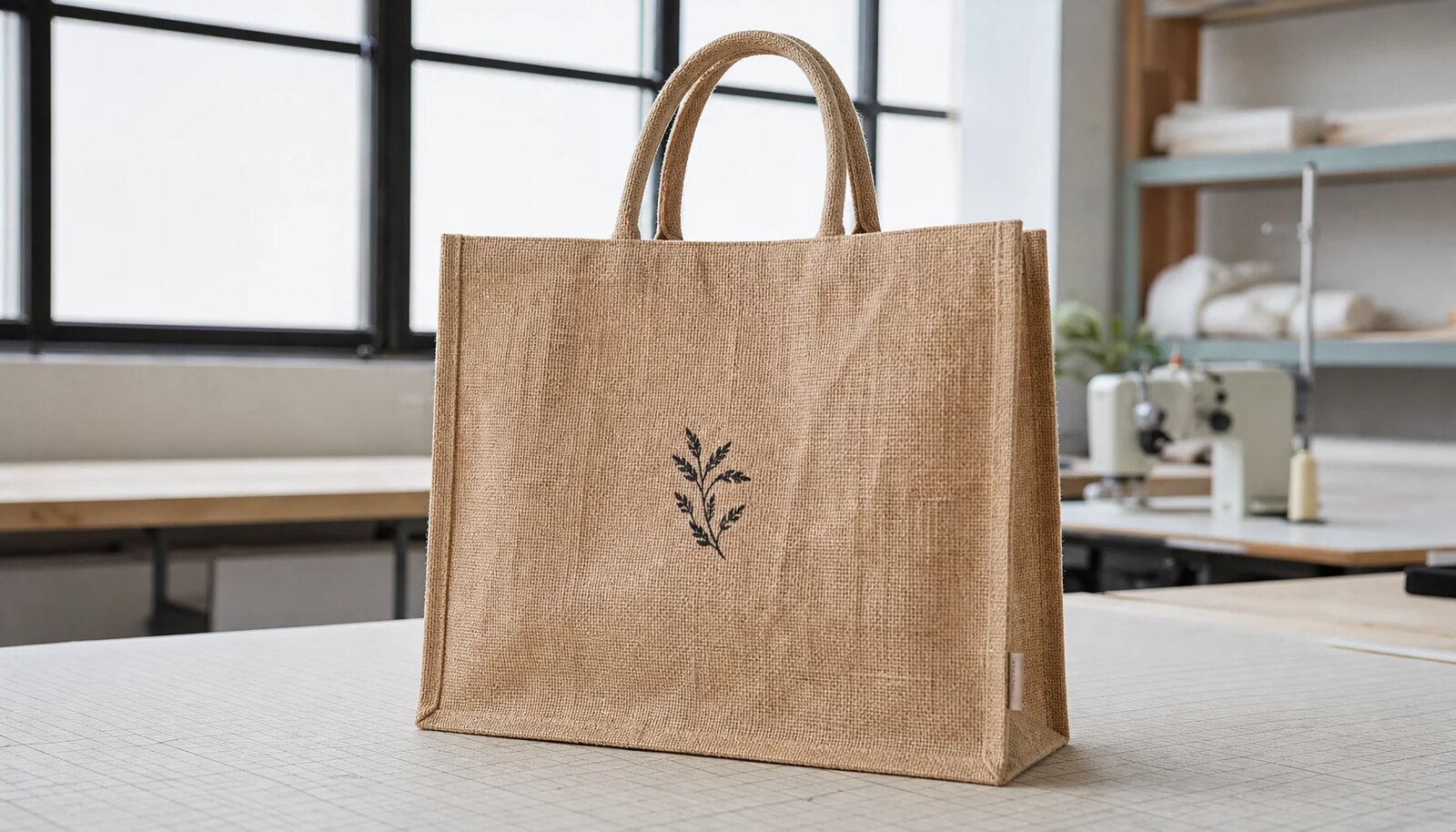
Start with the tote's job, then talk price
Wholesale jute tote bags look simple in a product photo. In procurement, they are rarely simple. The same natural jute bag might be used as store packaging, a paid retail add-on, an event giveaway, a gift-with-purchase item, or a reusable checkout carrier. Each role changes the specification. A tote sold at the register needs cleaner finishing and steadier sizing than a one-day handout. A bag carrying folded knitwear needs a cleaner interior and better odor control. A reusable carrier needs handles that feel comfortable and hold under real use.
That is why a bulk pricing plan should begin with the job of the bag, not the lowest quote. Write what the tote must carry, where it will be displayed, how long it should last, and how it will move through cartons, warehouses, stores, or e-commerce packing lines. A supplier can then quote a real construction instead of the cheapest catalog item that roughly matches the photo.
For eco apparel brands, the better metric is cost per usable delivered bag. Ex-factory unit price is only one part of the total. Setup charges, sample fees, artwork work, custom labels, carton packing, inspection, freight cube, duties, rework risk, and rejection risk all sit inside the real cost. A lower quote can be legitimate if the factory is efficient. It can also mean lighter GSM, weaker handles, rougher printing, looser shade control, or cartons that arrive in poor condition.
- Define whether the tote is retail-ready, warehouse-ready, event-ready, or packaging-only before requesting price.
- Compare suppliers against the same written specification, not catalog phrases such as standard jute tote.
- Use landed cost per usable bag as the procurement metric, especially for import orders.
- Separate real production efficiency from cost cutting that weakens fabric, printing, packing, or QC.
- Assign a quality level based on brand exposure; sold merchandise usually needs tighter control than a short-life giveaway.
Build a spec sheet factories can quote
A strong RFQ for wholesale jute tote bags reads more like a technical sheet than a mood board. At minimum, include finished width, finished height, gusset depth, handle drop, handle width, jute GSM, print method, print size, print location, packing method, quantity ladder, target delivery term, and the intended contents. If the tote must fit folded apparel, shoeboxes, catalogs, hangtags, or a prepared gift set, say so. That information lets the supplier judge structure, handle strength, and carton pack count.
Finished dimensions need tolerances. For many standard jute totes, width and height tolerance around +/-1 cm is a practical starting point. Gusset depth and print placement may need +/-0.5-1 cm depending on design. Handle drop should be measured separately because it controls how the customer carries the bag. A short drop is hand-carry. A longer drop is closer to shoulder-carry. The right choice depends on tote size, garment weight, and brand preference.
Do not describe handles as strong and stop there. State the material, width, drop, stitch type, thread color if relevant, and reinforcement at each attachment point. Self-jute handles keep the look consistent. Cotton webbing usually feels softer in the hand. A common procurement spec may call for 2.5-4 cm wide handles with box stitch, cross-stitch, or bar-tack reinforcement. If you need woven labels, hangtags, barcode stickers, inner binding, rope handles, or contrast stitching, put them in the RFQ before price comparison begins.
- Specify width x height x gusset, handle drop, handle width, top hem, seam type, and bottom construction.
- State expected contents and load instead of relying on the word durable.
- Use written tolerances for dimensions, handle drop, and print placement before bulk approval.
- Clarify whether the bag should stand upright, fold flat, or fit a specific retail display.
- List all trims in the RFQ: woven label, hangtag, barcode sticker, care card, inner pocket, lining, or lamination.
Choose jute weight and finish deliberately
Fabric is the first visible cost driver. For many apparel retail, gift, and reusable carrier programs, natural jute around 280-350 GSM is a sound starting range. It gives the bag enough body for retail use while keeping weight and cost under control. Lighter 220-260 GSM material can work for low-load events or short-term promotion, but it may wrinkle, collapse, shed more, or print less cleanly. Heavier 360-420 GSM jute can make a premium structured tote, yet it adds raw material cost, sewing difficulty, carton volume, and sometimes freight cost.
Ask what the supplier means by GSM. Some quote finished fabric weight. Others include coating, backing, or lamination. Some use oz-equivalent language or internal weave shorthand. A laminated jute may feel stiffer and weigh more, but that does not always mean the jute yarn itself is heavier. For a clean comparison, request a swatch from current stock and then approve a full bag sample made from the same material.
Natural jute should not be judged like synthetic fabric. Slubs, irregular yarns, and mild shade movement are part of the material. That does not make every flaw acceptable. Weak thin zones near handles, open weave at seams, water stains, oil marks, mold, foreign fibers, and severe streaking should be rejected. If store presentation must be consistent across regions, agree on a shade band or physical reference sample instead of expecting perfect uniformity.
Lining and lamination should solve a specific problem. Unlined jute is usually the lowest-cost and most natural option. Cotton lining improves the inside presentation and keeps rough fibers away from light-colored apparel. Lamination can add stiffness and moisture resistance, but it may affect hand-feel, odor, recyclability expectations, and lead time. Add these features because the bag needs them, not because they sound premium in a quote.
- Use 280-350 GSM as a retail-facing starting range, then adjust for load, structure, and budget.
- Ask whether GSM includes lamination, coating, or backing before comparing suppliers.
- Approve a full bag sample; a swatch alone cannot show folding, sewing, print behavior, or odor.
- Set realistic shade expectations for natural jute while rejecting stains, mildew, oil marks, and weak weave zones.
- Choose lining or lamination only when interior cleanliness, stiffness, or moisture resistance is worth the added cost.
Keep artwork readable on a rough surface
Jute is not a smooth canvas. Its open weave, slubs, and surface texture break edges and change ink coverage. For bulk orders, 1-color screen printing is often the best balance of price, repeatability, and brand readability. It suits bold logos, simple type, campaign slogans, and line art with enough stroke weight. Two-color screen printing can work, but registration tolerance must be realistic because fabric movement and texture can shift the edges.
Artwork should be adjusted for the material before sampling. Avoid small legal copy, thin serif fonts, hairline outlines, gradients, tight borders, and complex fills. As a practical reference, text below roughly 8-10 pt and strokes under about 1 mm are risky on coarse jute unless the supplier proves the result on a physical sample. White ink on natural jute may need opacity testing. Pantone references help, but ink will not look identical on jute, paper, cotton, and screen.
Print placement needs numbers. Instead of saying centered on front, specify print width, print height, distance from the top edge, horizontal centerline, and tolerance. A common placement tolerance is +/-0.5-1 cm, depending on bag size, artwork size, and production method. If front and back printing are required, quote them separately. If a side gusset, label, pocket, or seam affects alignment, mark it on the placement sheet.
Sampling should include a print strike-off or a full pre-production sample on the actual jute. Digital mockups can confirm layout, but they hide weave breakage, bleeding, cracking, scuffing, and poor curing. Also ask how printed panels are dried before stacking and whether slip sheets are needed in cartons. A print that looks fine on the table can arrive scuffed if the packing method is wrong.
- Prefer 1-color screen print for clean bulk pricing and predictable repeat production.
- Test 2-color artwork for registration before approving full production.
- Increase small text and thin strokes before sampling; do not expect paper-like sharpness on jute.
- Specify print dimensions, position, side count, ink color, and placement tolerance in writing.
- Inspect print after folding and rubbing, not only when the bag is freshly printed.
Use MOQ ladders to reveal the real price break
MOQ is not just a sales preference. The factory has to prepare material, cut panels, set screens, print, dry, sew, inspect, and pack. On a small order, those fixed tasks are spread over fewer pieces. For a launch test, low MOQ may be worth the higher unit price. For a store rollout, seasonal program, or replenishment plan, a single minimum quote is not enough.
Ask each supplier to quote the exact same specification at 1,000, 3,000, 5,000, and 10,000 pieces. Require unit price, sample fee, screen setup, custom label cost, special packing, carton printing, and inspection support to be shown separately. This makes the price curve visible. The main break may appear between 1,000 and 3,000 pieces because setup is absorbed. In other cases, fabric purchase volume, sewing line efficiency, or carton loading improves at 5,000 or 10,000 pieces.
Clarify how MOQ is counted. A 5,000-piece quote might mean 5,000 per size, per fabric color, per artwork, per print color, or per delivery destination. An 8,000-piece program split across eight slogans may price more like eight small orders than one bulk run. If the brand needs multiple regions or campaigns, consider holding the same body size, handle construction, and fabric while limiting artwork variation. Destination separation can often be handled through carton labels rather than product changes.
Quote validity deserves a line in the plan. Jute, cotton webbing, cartons, and freight can move over time. Ask how long pricing is valid and what assumptions are included. For repeat programs, share a realistic forecast but keep purchase releases clear. Suppliers can plan better with credible volume, and buyers avoid disputes when each release quantity is documented.
- Request 1,000 / 3,000 / 5,000 / 10,000 piece pricing using the same technical spec.
- Ask whether MOQ applies per order, size, fabric shade, artwork, print side, or destination pack.
- Keep setup charges separate from unit price so the total program cost is visible.
- Reduce artwork fragmentation when bulk pricing is the main goal.
- Confirm quote validity, lead time, and raw material booking assumptions before issuing the PO.
Check production ownership before you award
Wholesale jute tote bags may come from a direct factory, sourcing agent, or trading company. Any of those routes can work. The procurement question is not the label on the seller; it is visibility and accountability. A direct factory may answer faster on fabric, printing, sewing, and packing. A sourcing agent may help with supplier screening, local follow-up, inspection coordination, or consolidation with other packaging. A trading company can be useful for smaller mixed-category orders if responsibility is clear.
Ask who performs each step: fabric sourcing, cutting, printing, sewing, final inspection, and export packing. These steps may happen in one facility or across several workshops. If any step is subcontracted, ask who approves the subcontractor, who controls the sample, and who owns defects. A seller that cannot explain GSM, stitch reinforcement, print curing, carton loading, or moisture control may not have enough control for a retail-facing program.
You do not need a heavy audit for every order, but you do need practical evidence. Ask for photos or short videos of similar jute tote production, handle stitching, print tables, drying areas, QC tables, and packed export cartons. Ask whether printing happens before or after sewing. Ask how finished goods are stored before shipment and how cartons are protected from humidity.
For first orders, new artwork, or high-volume launches, consider an inline check soon after production starts. An inline review can catch wrong fabric, wrong print position, weak handle stitching, or poor packing before the full order is complete. Final inspection is still important, but inline control reduces the chance that every unit carries the same preventable defect.
- Verify who owns or controls cutting, printing, sewing, inspection, and packing.
- Ask for production evidence related to jute totes, not only catalog photos.
- Use agents or trading companies only when quality accountability and factory identity are clear.
- Consider inline inspection for new suppliers, new artwork, or large retail launches.
- Keep the approved sample and PO specification as the controlling reference for all parties.
Make RFQs comparable before negotiating
Many price arguments begin with incomplete RFQs. One supplier assumes unlined 280 GSM jute. Another assumes laminated 350 GSM jute. A third includes custom labels and export-grade cartons. The quotes may all look like jute tote pricing, but they are not pricing the same product. A clean RFQ package removes most of that noise before negotiation starts.
The package should include a drawing, measurement points, material target, handle construction, artwork file, print method, quantity ladder, packing requirement, carton data request, sample process, QC tolerances, and delivery term. The goal is not paperwork for its own sake. It is to remove assumptions so the buyer can compare unit cost, setup cost, lead time, carton efficiency, and quality risk.
Artwork should be production ready. Send vector files where possible, outline fonts, specify ink colors, and mark exact print size. If brand color is critical, request a printed strike-off or pre-production sample. If small text must remain readable, point it out in the RFQ so the supplier can warn you before quoting or sampling.
Packing belongs in the RFQ, not after production. Ask for units per carton, carton dimensions, gross weight, net weight, carton material, inner liner, carton label format, and sea-freight suitability if relevant. Carton cube can change landed cost on bulky jute bags. A supplier with a slightly higher unit price may still be more economical if carton loading, moisture control, and receiving accuracy are better.
- Send one spec sheet to all suppliers instead of negotiating from vague product photos.
- Include artwork files, print size, print position, color references, and readability requirements.
- Ask every supplier to list included and excluded charges in the same format.
- Request carton size, carton weight, and units per carton before freight comparison.
- Control revisions with version numbers across RFQ, sample, PO, and inspection documents.
Approve a physical sample, then freeze it
A pre-production sample is essential for first-time wholesale jute tote orders. Jute texture affects print, stiffness, folding, seam bulk, odor, and handle feel. A digital mockup can show the approximate artwork direction, but it cannot prove production quality. Bulk approval should be based on a physical bag made with the actual jute, actual handle material, actual print method, actual trim, and proposed packing fold.
Review the sample with a measuring tape, not just an opinion. Record finished width, height, gusset, top hem, handle width, handle drop, print width, print height, and print position from the top and side edges. Check whether the tote stands or folds as needed. Inspect the top hem, side seams, bottom corners, gusset corners, handle attachment, inside seams, loose threads, shade, odor, and fiber shedding.
Run a simple load check tied to the intended use. If the bag is for light apparel, test with the buyer's expected contents, for example 3 kg. If it is intended as a reusable store carrier, 5 kg or another agreed load may be more suitable. Write the method: load weight, hold time, lift points, and pass/fail criteria. The point is to catch handle tear-out, seam opening, and fabric rupture before raw material is committed.
Sample comments should be specific. Replace make stronger with increase handle width to 3 cm, add box stitch at all four handle ends, move logo down 2 cm, reduce print width to avoid seam distortion, or change fold direction to protect the printed face. Once approved, freeze the sample version and use it as the standard for mass production, inspection, and dispute resolution.
- Approve a full physical bag sample, not only a render, swatch, or catalog photo.
- Measure and record all critical points before signing the sample approval.
- Run a load check based on real apparel or retail contents.
- Photograph approved details: front, back, gusset, bottom, handle stitch, print close-up, inside seam, label, and folded pack.
- Freeze the approved sample version before raw material booking and mass production.
Define QC around jute-specific defects
Quality control for jute totes has to balance natural material variation with retail standards. Slubs, yarn irregularity, and slight shade movement can be acceptable when they match the approved sample. Open seams, broken stitches, mold odor, heavy stains, loose handles, unreadable artwork, and wrong carton labels are defects. The PO or inspection checklist should define critical, major, and minor defects in terms that fit jute bags.
Critical defects include safety or severe contamination issues such as sharp objects, mold, strong chemical contamination, or major foreign matter. Major defects include wrong size outside tolerance, wrong artwork, wrong print color, open seams, broken handle reinforcement, severe print bleeding, heavy stains, damp odor, or carton quantity errors. Minor defects may include limited loose threads, small natural slubs, slight shade variation within the approved band, or minor print texture that does not reduce logo readability.
Measurement points should be consistent. Inspectors should check width, height, gusset, handle drop, handle width, print placement, and carton quantity. A practical tolerance for many standard jute totes is width/height +/-1 cm and print placement +/-0.5-1 cm, but the final standard should match the design and supplier capability. A large front logo may need tighter visual control than a rustic event bag.
Functional testing belongs in inspection. Randomly load selected bags to the agreed weight and observe handle attachment, seam stress, and fabric distortion. Stitch density can be compared with the approved sample; roughly 6-8 stitches per inch is a common reference for many tote seams, but the agreed sample should control. Odor and moisture checks are especially important for sea freight because jute absorbs humidity and can create receiving complaints if packed damp.
- Define critical, major, and minor defects specifically for jute tote bags.
- Write tolerances for dimensions, handle drop, print placement, fabric weight, and carton quantity.
- Use the approved sample as the standard for shade, stitch density, handle reinforcement, and print texture.
- Perform random load checks on handles and seams using the agreed test weight.
- Require inspection photos and defect counts before shipment release on new or high-visibility orders.
Treat packing and moisture as cost controls
Jute totes are bulky, textured, and sensitive to poor storage. Packing that looks cheap can become expensive at receiving. If bags are packed too loosely, freight cube increases. If they are compressed too tightly, handles deform, seams crease, and print can scuff. If cartons are weak or damp, jute may absorb odor or show moisture marks. Packing is part of the product specification, not a footnote.
Ask the supplier to confirm the folding method, units per carton, carton dimensions, gross weight, net weight, carton ply, and carton label format. Request packed carton photos before mass packing. The buyer should know how many cartons are expected per 1,000 pieces and whether final carton dimensions match the freight booking. If individual polybags are proposed, confirm whether they are truly needed for retail presentation or scuff prevention. Many eco apparel brands prefer less packaging waste, but the goods still need protection.
Moisture control should match the route and season. Dry export cartons, clean warehouse storage, inner liners, and desiccant may be appropriate for sea freight or humid conditions. Avoid vague wording such as good packing. Define what is included. If the brand avoids individual polybags, it may still need an inner carton liner, slip sheet, or controlled storage period to reduce damp odor risk.
Landed cost discipline means adding these variables together. A lower unit price can lose its advantage if cartons are larger, labels are missing, prints scuff, or 2-3% of the order needs rework. A useful wholesale jute tote bags for eco apparel brands bulk pricing plan protects price, presentation, and receiving efficiency at the same time.
- Confirm carton pack count, dimensions, gross weight, and carton quantity before freight planning.
- Use individual polybags only when retail presentation or scuff prevention justifies the cost and waste.
- Define moisture protection clearly: dry cartons, inner liner, desiccant, storage condition, or other agreed method.
- Check carton labels against warehouse requirements, SKU, artwork version, destination, and quantity.
- Compare suppliers by cost per usable delivered bag, not only ex-factory unit price.
Specification comparison for buyers
| Spec decision | Recommended option | When it fits | Buyer risk to check |
|---|---|---|---|
| Jute fabric weight | Natural jute around 280-350 GSM for most apparel retail and gift programs; 220-260 GSM only for low-load promotion; 360-420 GSM for premium structured totes | Reusable store carriers, folded apparel bundles, event merchandise, retail add-on items, and gift-with-purchase bags | Confirm whether GSM is finished fabric weight and whether coating, backing, or lamination is included. A low price may come from a thinner weave that collapses, sheds more, or prints poorly. |
| Finished size tolerance | Write target dimensions and tolerances: width/height typically +/-1 cm, gusset +/-0.5-1 cm, handle drop +/-1 cm unless a tighter standard is agreed | Programs that must fit folded garments, shoeboxes, inserts, retail displays, or carton plans | Without tolerances, suppliers may treat visible size drift as normal handmade variation. Measure bulk units against the approved pre-production sample. |
| Handle construction | Cotton webbing or self-jute handles, 2.5-4 cm wide, with box stitch, cross-stitch, or bar-tack reinforcement at each attachment point | Bags expected to carry apparel purchases, denim, hoodies, catalog kits, or store merchandise | Handle pull-out is a common functional defect. Specify reinforcement size, stitch type, thread, and a loaded test weight tied to actual use. |
| Print method | 1-color screen print for the best bulk pricing and repeatability; 2-color screen print for simple artwork; transfer only for complex graphics after testing | Bold apparel logos, campaign slogans, simple brand marks, and retail-facing graphics | Jute's open weave breaks fine lines. Avoid small text below roughly 8-10 pt, thin strokes under about 1 mm, gradients, and tight registration unless sampled. |
| MOQ and price ladder | Request the same spec at 1,000 / 3,000 / 5,000 / 10,000 pcs, with setup and sample fees shown separately | Buyers planning launch tests, multi-store campaigns, or replenishment programs | MOQ may apply per size, fabric color, artwork version, print color, or destination pack. Split artwork versions can erase bulk price breaks. |
| Lining or lamination | Use unlined jute for lowest cost and natural feel; add cotton lining or PP/PE lamination only when interior cleanliness, stiffness, or moisture resistance is required | Premium gift sets, light-colored garments, accessories, cosmetics-and-apparel bundles, or structured retail packaging | Lamination may add odor, stiffness, recyclability concerns, and lead time. Lining adds cutting/sewing labor and changes folding volume. |
| Color and shade control | Natural jute with an approved shade band, or dyed/bleached jute with lab dip or material approval before bulk | Eco apparel brands that need a consistent shelf presentation across stores or regions | Natural jute varies by lot. Reject stains, mildew, oil marks, severe streaks, and contamination, but allow agreed natural slubs and minor shade movement. |
| Packing method | Bulk pack in export cartons with controlled folding; add inner liner, slip sheet, or desiccant only where moisture/scuff risk justifies it | Large import shipments where carton cube, print protection, and warehouse receiving matter | Overpacking increases cost and waste; underpacking causes print abrasion, crease complaints, damp odor, and carton failure. |
| Inspection plan | Use an approved sample, written defect list, size/print tolerances, and random inspection. Apply AQL only after defining major/minor/critical defects for jute totes | First orders, new suppliers, retail launches, or high-visibility branded packaging | A generic bag inspection misses jute-specific issues: fiber shedding, odor, weak weave zones, handle tear-out, print bleeding, and moisture marks. |
Buyer checklist before sampling
- Define the tote's job: retail merchandise, reusable checkout carrier, garment bundle, trade-show giveaway, e-commerce insert, gift-with-purchase bag, or staff/event kit.
- Write finished size as width x height x gusset and include target tolerances, for example width/height +/-1 cm, gusset +/-0.5-1 cm, handle drop +/-1 cm.
- State target jute weight in GSM and ask whether the figure is finished fabric weight, coated weight, or an informal oz-equivalent used by the supplier.
- Specify construction: top hem width, side seam type, bottom gusset, inner binding if required, handle material, handle width, handle drop, and reinforcement stitch.
- Define a realistic load expectation, such as 3 kg for light apparel, 5 kg for store purchases, or another buyer-approved weight based on intended contents.
- Provide artwork in vector format with outlined fonts, print size, print position, ink color reference, number of sides, and minimum readable text requirements.
- Avoid artwork that is too fine for jute: small text, gradients, hairline strokes, tight borders, and multi-color registration should be tested before committing.
- Request a MOQ ladder at the same specification, such as 1,000, 3,000, 5,000, and 10,000 pieces, and ask whether MOQ is per size, color, or artwork.
- Separate one-time and variable charges: screen setup, sample fee, artwork adjustment, custom woven label, hangtag, barcode sticker, inner packing, carton printing, and inspection support.
- Approve a physical pre-production sample made with actual jute, actual handle, actual print method, actual trim, and the proposed folding/packing style.
Factory quote questions to send
- What exact jute weight are you quoting in GSM, and is it finished fabric weight before or after lamination, coating, or backing?
- Is the jute natural, bleached, dyed, laminated, coated, lined, or unlined, and what lot-to-lot shade variation should we expect?
- What weave or construction description do you use for this fabric, and can you provide a swatch or reference sample from current stock?
- What finished width, height, gusset depth, top hem width, handle width, and handle drop are included in the quote?
- What production tolerances do you accept for width, height, gusset, handle drop, print placement, and carton quantity?
- What handle material is included, and what reinforcement will be used at the attachment point: box stitch, cross-stitch, bar-tack, or another method?
- What loaded test weight do you recommend for this construction, and how many seconds or cycles can you test during inspection?
- Which print method is included, how many colors are covered, what is the maximum print area, and what is the surcharge for second side or second color?
- Can you print our smallest text clearly on this jute surface, or should strokes/text be enlarged before sampling?
- What is the MOQ per size, per fabric color, per artwork version, and per print position?
Quality-control points to confirm
- Fabric GSM matches the approved sample and PO within the agreed tolerance, commonly +/-5% if no stricter standard is negotiated; measure using an agreed sampling method rather than visual judgment.
- Jute shade, weave character, and slubs stay within the approved shade band; severe streaks, oil stains, water marks, mildew, mold spots, insect contamination, or foreign fibers are not acceptable.
- Finished width and height remain within the written tolerance, often +/-1 cm for standard totes; gusset depth and handle drop should be checked separately because they affect use and display.
- Top hem is even and secure; side seams, bottom seam, gusset corners, and inner seam ends show no open seams, skipped stitches, broken threads, needle holes, or unraveling.
- Stitch density matches the approved sample or written requirement; for many tote constructions, roughly 6-8 stitches per inch is a practical reference, but the buyer and factory should agree the standard before production.
- Handle attachment is reinforced consistently on all stress points with box stitch, cross-stitch, bar-tack, or approved equivalent; reinforcement size and placement must match the sample.
- Random loaded checks are performed against the buyer's intended use, for example holding 3-5 kg for light-to-medium apparel use, or the buyer's stated load, without handle tear-out, seam opening, or fabric rupture.
- Print position is measured from top edge and side edges; front print should stay inside the agreed placement tolerance, commonly +/-0.5-1 cm depending on artwork size and production method.
- Ink coverage is acceptable for the jute texture; reject severe bleeding, heavy cracking, incorrect color, unreadable logo text, major smearing, under-cured ink, or abrasion after normal folding.
- For multi-color prints, registration tolerance must be realistic and written; misregistration that changes brand readability or creates a visibly sloppy logo should be treated as a major defect.