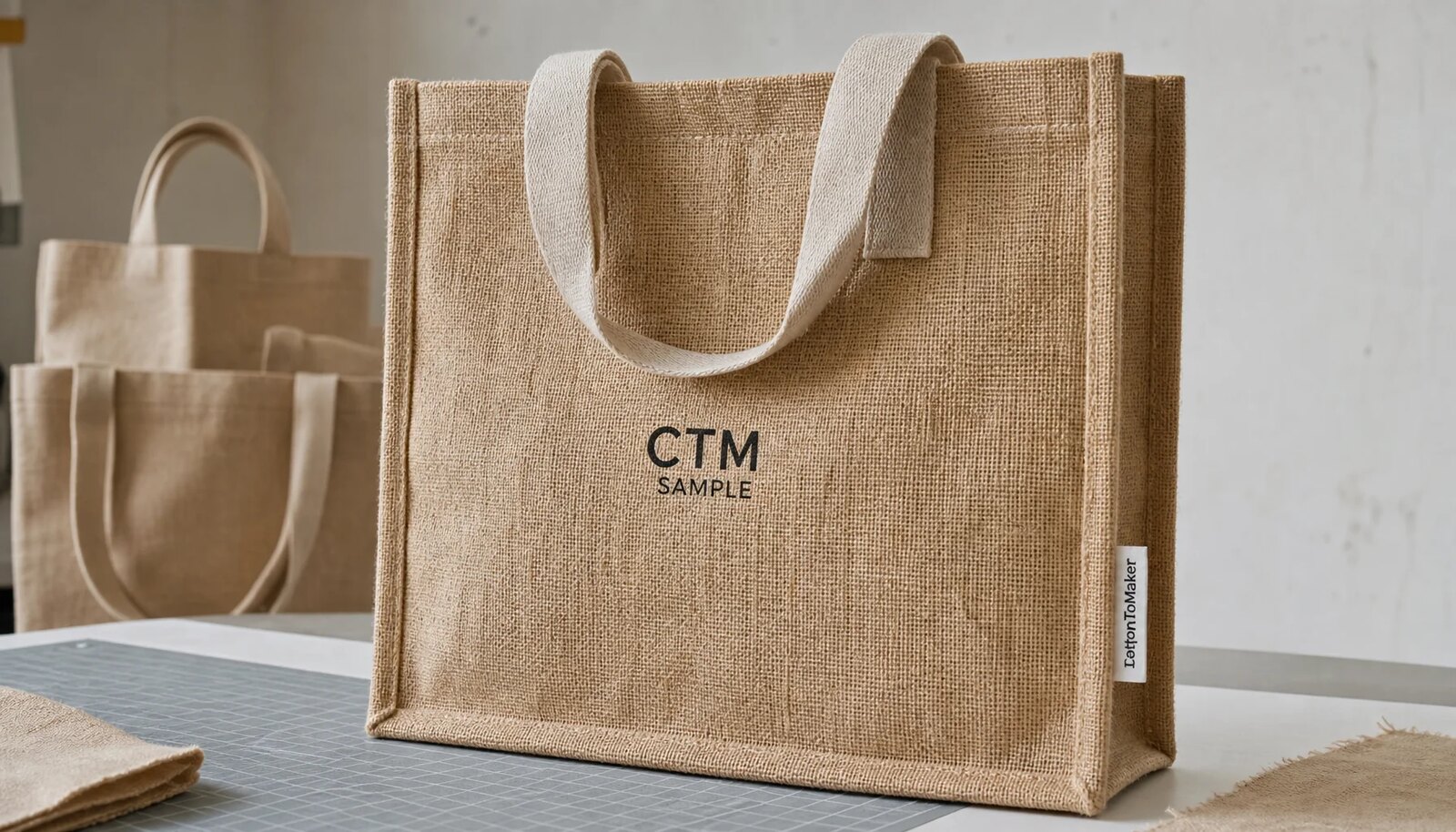
Define the buying problem before writing the RFQ
Wholesale jute tote bags for craft fairs are not only a bag purchase. They are part event merchandise, part retail packaging, and part walking advertisement. A procurement team that writes the RFQ as “jute tote bag with logo” will receive quotes that are difficult to compare because each factory may choose a different jute weight, lamination, handle, print size, and packing method.
The first decision is the use case. A bag used for lightweight brochures at a craft fair can be softer and lower cost. A bag sold at a booth or used to carry candles, jars, ceramics, yarn, or small handmade goods needs better structure, stronger handles, and a cleaner finish. The RFQ should describe what will go inside the bag and how long the end user will carry it.
- For giveaway use, prioritize stable print, acceptable appearance, and economical carton packing.
- For resale or retail packaging, prioritize fabric appearance, handle comfort, seam strength, and lower defect tolerance.
- For food or farmers market use, clarify whether lamination, odor control, and moisture resistance are required.
- For multi-event programs, standardize one body size and manage different logos as separate print versions.
Specify jute fabric weight and construction clearly
Jute is often quoted by oz, GSM, or a factory’s internal fabric grade. Those numbers are not always identical across suppliers because weave density and yarn thickness affect the handfeel and shape. For most craft fair tote programs, a practical range is about 13–16 oz or roughly 280–360 GSM. Lighter jute may be acceptable for promotional use, but it can look open-weave and weak when printed with a large logo.
The RFQ should also state whether the bag is laminated. Unlaminated jute has a natural texture and softer eco-positioning, but it can shed more fiber and may absorb moisture. PP-laminated jute is stiffer, stands better, and protects against light moisture, but it changes the surface, odor profile, and sustainability wording. If your retail team plans to make environmental claims, do not let the factory choose this detail silently.
- Quote the fabric as natural jute, dyed jute, bleached jute, or laminated jute.
- Request actual production GSM or oz, not only “standard quality.”
- Define whether the inside should show raw jute, laminated backing, or a cotton lining.
- Treat large color variation, mildew marks, oil stains, and broken yarn bands as inspection concerns.
Choose a bag size that matches craft fair merchandise
A common RFQ mistake is copying a tote size from a catalog without checking what the fair vendor actually sells. A bag for prints, stationery, folded textiles, handmade soaps, candles, or pottery needs different depth and handle drop. For many craft fair programs, a medium tote around 35 x 40 x 15 cm works because the gusset allows small boxed items to sit more naturally. Smaller sizes around 30 x 35 x 10 cm can reduce cost for light retail goods.
Finished size should be written with tolerance. Jute is a coarse woven material and cutting, folding, and stitching can create variation. A realistic tolerance is better than an unrealistic one that the factory ignores. The RFQ should also define whether dimensions include gusset folds, seam allowances, and finished measurement after stitching.
- Use width x height x gusset in centimeters or inches and label the measurement standard.
- Define handle length or handle drop based on hand-carry or shoulder-carry use.
- For heavier goods, avoid very tall narrow bags that tip over and stress the seams.
- For retail display, require the bag to stand reasonably square when opened.
Match handle design to the carrying load
Handle specification is one of the easiest places for a low quote to hide risk. Cotton webbing handles, jute-cotton blend handles, rope handles, and self-fabric handles all carry differently. For craft fairs, shoppers may carry the bag for hours while walking between booths. A narrow or rough handle can make an otherwise acceptable bag feel cheap.
The handle attachment should be described in construction terms, not just material. Cross stitching or box stitching at the stress point is usually safer than a simple straight stitch. If the bag will carry jars, candles, small ceramics, or books, the factory should know the target load so it can choose the right stitch density and reinforcement.
- State handle material, width, total length, and handle drop.
- Require reinforcement stitching at each handle attachment point.
- For shoulder carry, verify drop length on a physical sample, not only a drawing.
- Use a simple load test during sample review to confirm the handle does not tear or distort.
Select print method by artwork, not habit
Most wholesale jute tote bags for craft fairs use screen printing because it is economical for spot-color logos and event artwork. Natural jute is rough, so fine details, small sponsor names, QR codes, and thin lines may not reproduce cleanly. A logo that prints well on cotton canvas may look broken or fuzzy on jute unless the artwork is adjusted.
For detailed, full-color, or photographic artwork, buyers may consider heat transfer, digital panel printing, or a printed cotton patch sewn to the bag. These methods can improve detail but may increase unit cost, setup time, and handfeel differences. The RFQ should tell the factory whether brand color accuracy or natural texture is more important.
- For screen print, provide Pantone colors and maximum print size.
- For rough jute, avoid very small text and require a minimum line width.
- For multi-logo programs, list each artwork version and quantity per version.
- Require a print strike-off on actual jute before approving bulk production.
Understand MOQ logic and quote comparability
MOQ for jute tote bags is driven by fabric purchasing, cutting efficiency, print setup, labor line changeover, and packing requirements. A factory may accept a combined MOQ for one shared bag size but still apply a minimum quantity per print design. This matters for craft fair programs where the buyer may need several regional logos, sponsor versions, or booth kits.
To compare quotes properly, separate the base bag cost from version-specific charges. A supplier quoting one logo at 5,000 pcs may look cheaper than another quoting five logos at 1,000 pcs each, but the second quote may include more setup work. The RFQ should show the full order matrix so suppliers price the real job.
- List quantity per size, color, print design, and packing destination.
- Ask whether the factory can combine fabric MOQ across multiple print versions.
- Separate unit price, screen charge, sample fee, labeling fee, and carton marking cost.
- Request price breaks at realistic quantities such as 1,000, 3,000, 5,000, and 10,000 pcs.
Build the RFQ around cost drivers
A useful RFQ helps the factory quote the same product you intend to buy. The main cost drivers are jute weight, lamination, bag size, gusset depth, handle material, print method, number of colors, number of artwork versions, sample requirements, packing method, and inspection standard. If these are missing, the factory will fill the gaps with assumptions.
Buyers should request a quote sheet that exposes the assumptions instead of hiding them inside one unit price. This is especially important for distributors and retail buyers who must explain margin changes to internal teams. A higher unit price may be reasonable if it includes stronger handles, lower carton weight, better printing, and realistic sampling.
- Base bag cost: fabric, cutting, sewing, handles, and standard thread trimming.
- Decoration cost: screen setup, print labor, ink, artwork version changes, and strike-off.
- Packing cost: inner polybag if needed, export carton, labels, barcode stickers, and pallet rules.
- Commercial cost: sample courier, inspection support, documentation, and special warehouse requirements.
Set sample approval rules before bulk production
A pre-production sample should be treated as a contract sample, not a casual photo. It should use the correct fabric, handle, stitching, print method, and packing approach. If final fabric is not available, the supplier should clearly label the sample as substitute material and provide a production swatch before bulk cutting.
Sample review should include more than appearance. Open the bag, check the gusset shape, measure the handle drop, rub the print lightly, smell the inside after it has been packed, and load it with goods similar to the craft fair use case. Written sample comments reduce later disputes because both buyer and factory know what was approved and what still needs correction.
- Measure finished size at the top, body, gusset, and handle drop.
- Compare print placement to artwork center line and approved print size.
- Check loose fibers, stains, odor, seam alignment, and handle reinforcement.
- Approve with signed comments, photos, and a dated reference sample where possible.
Control packing so bags arrive usable
Packing is not a small detail for jute tote bags. Natural jute can hold moisture and odor, and laminated jute can crease if over-compressed. A carton that saves a few cents can create damaged presentation at the craft fair site. For wholesale distribution, the carton plan should consider warehouse handling, store receiving limits, and event setup speed.
Flat packing is common, but the number of pieces per carton must match the bag size and stiffness. Too many pieces per carton may bend handles, crease laminated panels, or make cartons too heavy for manual handling. If the bags need to go directly to event venues or retail stores, shipping marks and inner bundle counts should be part of the RFQ.
- Define pieces per carton and maximum gross weight per carton.
- Use moisture protection when shipping during humid seasons or long ocean transit.
- Request carton dimensions for freight planning and landed-cost comparison.
- Specify barcode, PO number, artwork version, destination, and carton sequence on shipping marks.
Plan lead time around approval milestones
Production lead time should not start from the first email inquiry. It starts after artwork, material, sample comments, deposit or payment terms, and packing instructions are approved. For craft fairs, the delivery date is fixed by the event calendar, so a late approval can be more damaging than a small unit price increase.
A realistic schedule includes artwork review, sample making, sample courier time, buyer comments, material booking, bulk cutting, printing, sewing, final inspection, packing, export documentation, and vessel or air shipment. Buyers should build internal deadlines backward from the event date and reserve buffer for rework if the print strike-off fails.
- Do not approve bulk cutting until fabric quality and print method are locked.
- Keep artwork approval separate from full sample approval.
- Allow time for carton label approval if goods ship to multiple destinations.
- Use air freight only as a recovery option, not as the default fix for late approvals.
Specification comparison for buyers
| Spec decision | Recommended option | When it fits | Buyer risk to check |
|---|---|---|---|
| Jute fabric weight | 13–16 oz natural jute or about 280–360 GSM, depending on weave density | Craft fair giveaways, artisan market retail bags, and mid-weight merchandise packaging | Low quote may use loose weave jute that looks thin, sheds more fiber, and loses shape after packing |
| Inner construction | Unlaminated for a natural handfeel, or light PP lamination when moisture resistance and upright structure matter | Unlaminated fits eco-positioned craft programs; laminated fits farmers markets, gift sets, and heavier retail items | Lamination changes recyclability claims, odor level, stiffness, and printing behavior, so it must be declared in the RFQ |
| Handle material | Cotton webbing or soft padded jute-cotton blend handles, reinforced with cross-stitching | Retail buyers that expect shoppers to carry the bag for several hours at a fair | Cheap rope or narrow handles can cut into the hand and create return complaints even when the bag body is acceptable |
| Print method | Screen print for 1–3 spot colors; heat transfer or digital panel print only for detailed artwork | Logos, booth names, event marks, and sponsor graphics on natural jute surfaces | Fine text can fill in on rough jute; require minimum line width and pre-production print strike-off |
| Bag size | Common fair size around 35 x 40 x 15 cm or smaller 30 x 35 x 10 cm for lighter handmade goods | Booth kits, craft subscription packs, retail checkout bags, and market tote promotions | Comparing quotes without gusset, seam allowance, and finished tolerance creates false price differences |
| MOQ logic | Use one body size with shared fabric and split colors or print versions if the factory accepts combined production | Distributors ordering several craft fair logos or regional programs | Each print design may trigger separate screen charges, setup waste, carton labels, and approval samples |
| Packing method | Flat pack 50–100 pcs per export carton with moisture protection and carton weight under practical handling limits | Bulk distribution to craft fair organizers, warehouses, retail stores, or fulfillment centers | Over-compressed cartons can crease laminated jute and distort handles before the event |
| Inspection standard | AQL inspection with defined critical points for print placement, seam strength, odor, stains, and size tolerance | Programs where bags are resold or used as branded retail packaging | A generic inspection checklist may pass the shipment while missing jute-specific defects such as broken yarns and panel color bands |
Buyer checklist before sampling
- Define the finished bag size with width, height, gusset, handle length, and acceptable tolerance instead of sending only a reference photo.
- State whether the jute should be natural, dyed, bleached, laminated, or unlaminated, and require the factory to quote the actual fabric weight or GSM.
- Specify print method, print size, Pantone colors, artwork position, minimum line width, and whether print registration must follow the front panel center line.
- Clarify use case weight: light flyers, handmade soaps, pottery, candles, apparel, food items, or mixed market goods.
- Request handle type, handle width, stitch pattern, and reinforcement method because this affects both cost and customer experience.
- Ask for all setup charges separately, including screen, sampling, logo plate, artwork adjustment, export carton, and special labeling fees.
- Require a pre-production sample or at least a print strike-off on actual jute before bulk cutting starts.
- Set carton packing rules: pieces per carton, carton dimensions, gross weight limit, moisture protection, barcodes, and shipping marks.
- Confirm lead time by approval milestone, not only by production days, including artwork approval, material booking, sample approval, mass production, inspection, and vessel cutoff.
- List inspection acceptance criteria for size, print, odor, stitching, stains, loose fibers, broken yarns, and carton condition.
Factory quote questions to send
- What is the quoted jute fabric weight in GSM or oz, and is the fabric laminated or unlaminated?
- Is the quoted size measured as finished size after stitching, and what tolerance do you apply to width, height, gusset, and handle drop?
- What handle material, width, length, and reinforcement stitch are included in the price?
- Which print method is included, how many colors are quoted, and what is the maximum print area?
- Are screen charges, artwork adjustment, sample cost, courier cost, and pre-production sample cost included or listed separately?
- What is your MOQ for one size with multiple print designs, and what is the minimum per artwork?
- How many pieces are packed per carton, what is the estimated carton size and gross weight, and can you keep cartons under the buyer’s warehouse limit?
- What defects do you treat as critical for jute tote bags, and what AQL level do you suggest for final inspection?
- What is the realistic schedule from artwork confirmation to sample approval, bulk production, inspection, and shipment readiness?
- Can you provide fabric swatches, previous production photos without customer-confidential branding, and a packing photo from a similar jute tote order?
Quality-control points to confirm
- Finished size tolerance should normally be controlled within about ±1 cm for width and height and ±0.5–1 cm for gusset, depending on construction.
- Handle attachment should use consistent box or cross stitching with no skipped stitches, loose threads, or weak reinforcement at the stress point.
- Print should be centered according to approved artwork, with no major ink bleeding, pinholes, color contamination, or heavy ink buildup on rough jute yarns.
- Natural jute color variation is normal, but obvious panel mismatch, stains, oil marks, mildew, or large dark bands should be rejected.
- Odor should be checked after opening inner polybags or cartons because jute, lamination, and ink can trap smell during packed storage.
- Seams and gussets should sit square when the bag is opened, especially for retail display or gift packaging programs.
- Cartons should be dry, clean, correctly marked, and strong enough for stacking without crushing the bottom layer of bags.
- Random load testing should match the intended use case, such as carrying candles, jars, small ceramics, or apparel for several hours at a fair.