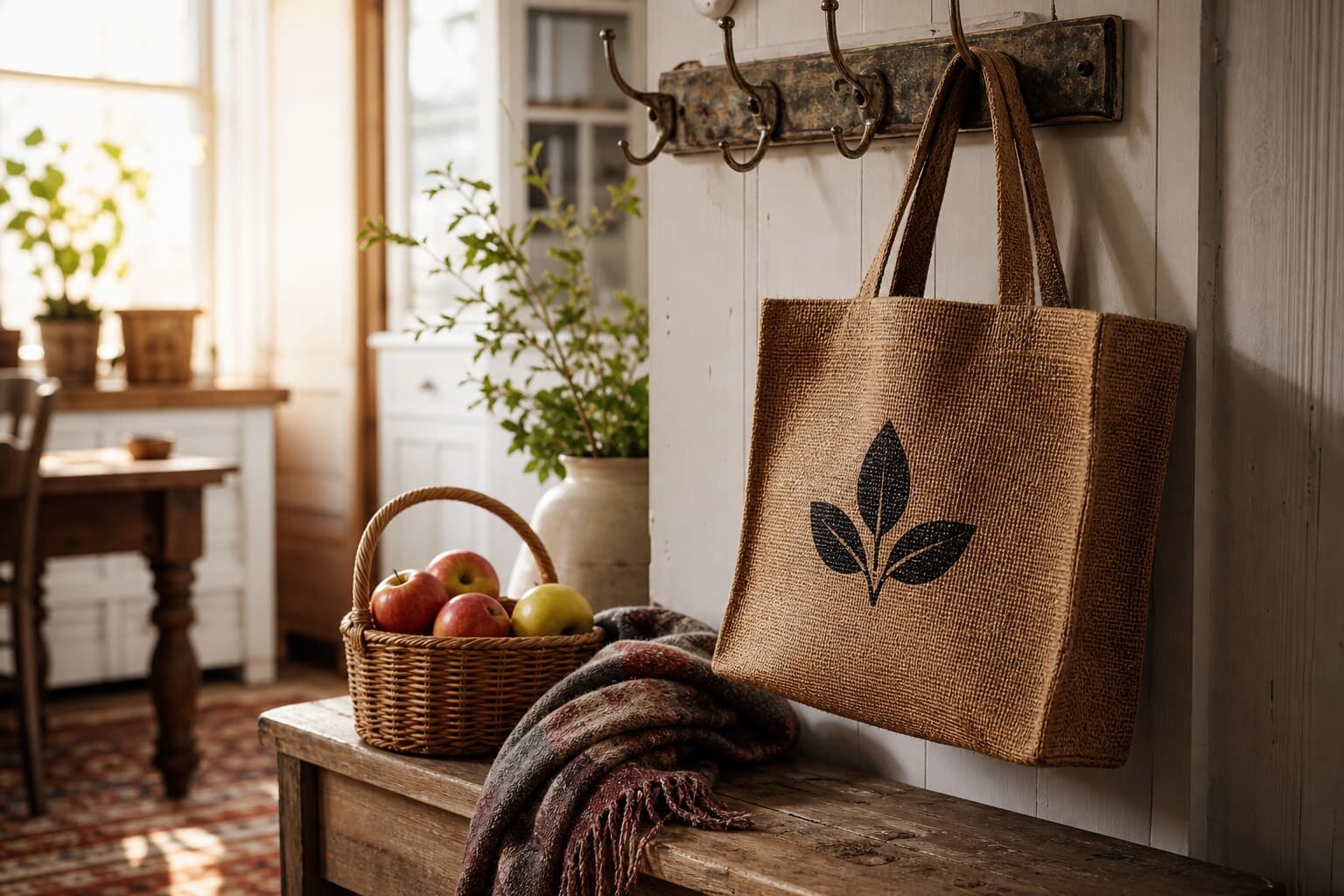
1. The buying problem: jute samples can look acceptable but fail in bulk
A wholesale jute or burlap bag sample often looks simple: natural fabric, stitched sides, handles, and a printed logo. The risk is that the sample may hide the exact items that create disputes later. Jute varies by yarn thickness, weave openness, lamination quality, odor, and moisture content. Burlap can look attractive in a sample photo but shed fibers heavily or distort after sewing. If procurement approves only the appearance, bulk production can still fail on handle strength, print readability, carton creasing, or inconsistent fabric shade.
For importers and distributors, the sample review should not be a quick visual approval. It should be a controlled comparison between the RFQ, the supplier quote, the physical sample, and the final use. A wine bag, grocery tote, gift pouch, and retail shopping bag do not need the same GSM, seam strength, or packing. The purpose of this sample review is to help your team approve what is commercially safe to produce, not just what looks good on a desk.
- Use one approved physical sample as the control standard for bulk production.
- Record every approved detail in writing: GSM, lamination, print method, handle type, packing, and tolerance.
- Separate natural material variation from defects; buyers should accept some slub and shade variation but not weak seams or unreadable logo print.
- Ask the factory to mark sample differences that will change in production, such as hand-cut panels, temporary thread, or trial packing.
2. Start with fabric identity, not the bag shape
Jute and burlap are often discussed together, but they are not always the same buying specification. Many factories use the word jute for heavier woven shopping bags and burlap for looser, rustic fabric used in pouches, bottle sacks, and gift wraps. Some bags are natural jute laminated with PP inside. Others are unlaminated burlap, cotton-jute blends, dyed jute, or hessian-style fabric. If the quote only says natural jute bag, the supplier has room to choose a cheaper fabric during bulk production.
The first sample check is fabric identity. Ask for the actual GSM and whether it is measured before or after lamination. A 300 GSM laminated jute bag may feel stiffer than a 300 GSM unlaminated fabric because the coating adds structure. A 180 GSM burlap pouch may be acceptable for gift packaging but too weak for bottles or heavy promotional kits. Procurement should define the fabric according to use, not according to a catalog name.
- For reusable shopping totes, many buyers specify around 270-320 GSM natural jute, depending on size and load.
- For burlap drawstring pouches, 180-250 GSM may be suitable if the contents are light and the rustic open weave is desired.
- For wine bags, review both fabric GSM and internal bottle support; a thin body with a weak base is a common failure point.
- For laminated jute bags, check coating uniformity, inside cracking, and odor after the sample is closed inside a carton or polybag.
3. Measure the sample like a production item, not a presentation piece
Jute fabric moves during cutting and sewing. The panel can stretch, the weave can skew, and the gusset may not sit exactly flat. A supplier may send a carefully made sample that is more accurate than normal production. Your approval should therefore include clear measurement points and tolerances. Measure the width at top and bottom, the height at both side seams, the gusset depth, bottom width, handle drop, and distance from logo to top edge. Do not rely only on the nominal size in the quote.
Dimensional tolerance should match the bag type. A small pouch may need tighter tolerance because it must fit a product box. A large jute shopping tote can usually accept a wider tolerance, but the handle drop and print position still need control. If your distributor catalog lists the bag as 35 x 40 x 15 cm, your sales team will receive complaints if the real bulk goods vary enough to affect perceived size or case packing.
- Define whether dimensions are measured flat, open, including gusset, or excluding handle.
- For gusseted totes, check whether the bottom opens squarely and supports the intended load.
- For pouches, test the product fit with real contents, not a paper template only.
- Record print placement from fixed edges, such as top seam and side seam, because natural fabric edges may not be perfectly straight.
4. Review print method before approving the artwork
Most jute and burlap bags use screen printing for solid color logos. It is practical, economical, and stable for many wholesale programs. However, the woven surface is uneven, so fine lines, tiny legal text, QR codes, gradients, and four-color photo effects are risky. A logo that prints sharply on canvas may look broken on burlap. The buyer should approve print quality based on the actual fabric and color, not on a digital artwork file.
Heat transfer, woven labels, sewn patches, and embroidery can be used, but each option has a trade-off. Heat transfer may cover the texture but can look less natural. A woven label is cleaner for small text but adds sewing operations and MOQ considerations. Embroidery on loose burlap can distort unless backing is used. If the brand requires exact Pantone matching, explain that natural jute color influences the final appearance, especially for light ink colors.
- Ask the factory to confirm the minimum line thickness they can hold on the selected fabric.
- Check print rubbing after the ink is fully cured, especially if bags are stacked face to face.
- Avoid placing critical text over seams, folds, or the most open sections of burlap weave.
- For multi-color screen print, confirm registration tolerance and whether extra screens affect MOQ or sample cost.
5. Handles and seams decide whether the bag is reusable
A jute tote can have a strong-looking body but still fail because of handle attachment. Cotton webbing handles, padded jute handles, rope handles, and self-fabric handles all behave differently. For grocery, wine, and retail carry bags, the handle should be reviewed with the actual load in mind. Look at cross stitching, bartack density, thread thickness, reinforcement patch size, and whether the handle is inserted deep enough into the top seam.
Seams deserve the same attention. Bottom corners carry the load when the bag is filled. If the seam allowance is too narrow or the overlock is loose, the bag may open after a few uses. Jute fibers are coarse, so needle choice and thread tension affect both appearance and strength. A clean sample seam is not enough; ask the factory what seam construction is used in production and whether it is included in the quoted price.
- Perform a practical load test using the intended contents or a comparable weight.
- Check whether the top hem is folded evenly and whether handle stitching is hidden or exposed as specified.
- Inspect inside corners for raw edges, loose yarns, and missed overlock stitches.
- For wine bags, lift repeatedly by the handle and check bottom stress after the bottle is inserted.
6. MOQ logic: separate fabric, printing, accessories, and packing
Wholesale buyers often ask for one MOQ, but jute bag MOQ is usually built from several parts. The fabric supplier may have one minimum for natural jute, another for dyed fabric, and another for laminated color matching. The printing department may have setup costs for each color. Handle materials, custom labels, drawcords, metal eyelets, and individual retail packaging may each create their own minimum. If these are not separated, quotes become difficult to compare.
A useful RFQ asks the factory to explain the MOQ logic by component. For example, a natural jute tote with one-color logo may support a lower MOQ than a dyed laminated jute tote with two-color print, custom cotton handles, and barcode sticker on each polybag. Distributors should also ask about mixed artwork quantities. A factory may accept one bag size with three logo versions, but the print setup and packing labels may change the cost.
- Ask for MOQ by bag style, fabric color, print design, print color count, and packing style.
- Confirm whether sample approval locks the fabric lot or only the construction.
- For repeat orders, ask whether remaining fabric or accessories can be reserved, and for how long.
- Do not compare two supplier quotes unless both include the same lamination, handle, print, and packing assumptions.
7. Packing is part of quality, especially for natural fiber bags
Jute and burlap bags are vulnerable to moisture, odor retention, crushing, and print transfer. A good sample review includes packing simulation. If the logo is screen printed, place printed faces together and check whether ink marks appear. If the bag is laminated, fold it as proposed for export packing and check whether the coating forms permanent white lines. If the bag has a gusset, confirm whether flat packing damages the bottom shape or creates a crease across the branding area.
Export cartons should be specified clearly. Buyers should ask for pieces per carton, carton dimensions, gross weight, net weight, and whether the cartons use liners or moisture absorbers. Individual polybags protect against dust but may trap natural odor if the goods are packed before enough airing time. Paper bands or carton-only packing may fit eco-positioned retail programs, but the freight route and warehouse conditions must be considered.
- For printed bags, request paper interleaving or safe stacking direction if ink transfer is a risk.
- For sea freight, discuss moisture control and carton strength rather than relying on standard export carton wording.
- For retail-ready goods, confirm barcode placement, suffocation warning if polybags are used, and master carton marks.
- Check whether packing method changes the quoted volume, because bulky jute bags can affect freight cost significantly.
8. Lead time should include fabric, sample approval, and curing time
Lead time for wholesale jute and burlap bags is not only sewing time. Natural fabric availability, lamination, dyeing, printing screens, ink curing, accessory sourcing, and packing all add time. A one-color natural jute tote may move quickly after approval, while dyed fabric, custom handles, or multiple artwork versions can extend the schedule. The buyer should ask for a lead time breakdown rather than one optimistic production number.
Sampling time also matters. A first sample may be made from available fabric to confirm construction, while a pre-production sample should match bulk fabric, print, handle, and packing. If your launch date is fixed, approve a realistic workflow: artwork confirmation, sample production, sample review, revision if needed, pre-production sample sealing, bulk material preparation, production, inspection, and shipment booking. Rushing the front end usually creates more delays during inspection.
- Ask whether the quoted lead time starts from deposit, artwork approval, sample approval, or fabric arrival.
- Allow extra time for dyed jute, custom woven labels, special drawcords, or retail packaging.
- Confirm ink curing time before packing, especially for large solid print areas.
- For repeat orders, ask what can be pre-approved to reduce sampling time without changing quality control.
9. Quote data procurement should require before comparing suppliers
A low quote without technical detail is not a reliable quote. For jute and burlap bags, procurement should require enough data to compare total landed cost and production risk. The supplier should state bag dimensions, material GSM, lamination status, handle material, print method, number of print colors, included accessories, packing method, carton quantity, carton size, gross weight, MOQ, sample cost policy, and lead time basis. Without these details, two quotes that look similar may represent very different products.
Ask the factory to identify optional cost drivers. For example, changing from natural cotton webbing to dyed cotton webbing may affect MOQ and lead time. Adding an inner pocket, zipper, button closure, transparent window, or kraft hangtag changes both labor and inspection points. If you are buying for a retail chain, request the data needed for their vendor manual early, including carton marks, barcode handling, and packing restrictions.
- Require the quote to state whether export carton packing is included and what grade or strength is used.
- Ask for estimated CBM per 1,000 pieces so freight cost can be compared fairly.
- Request clear sample revision terms: what is free, what is charged, and what changes affect unit price.
- Keep one quote comparison sheet that lists technical differences, not only unit price.
10. Approval criteria: what to accept, reject, or clarify before bulk order
A good sample approval decision separates acceptable natural variation from unacceptable production risk. Some color variation, slubs, and minor yarn irregularity are normal for jute and burlap. Buyers should not reject every natural mark if the product is positioned as rustic or eco-style. However, structural defects, strong mildew odor, loose handles, severe fabric holes, unreadable logo print, wrong dimensions, and unstable packing should be rejected before bulk production.
Before signing the purchase order, issue an approval note that states exactly what is approved and what must be corrected. If the sample has a small issue that the factory promises to improve in bulk, write that correction into the PO and inspection checklist. Never rely on verbal agreement for jute bags, because material and sewing details are easy to change during production. The final goal is a sample that your factory can reproduce and your inspection team can judge objectively.
- Accept: normal jute slubs, slight natural shade variation, and minor weave irregularity within agreed appearance standards.
- Reject: handle weakness, open seams, wet or mildew odor, wrong lamination, incorrect GSM, and print that fails rub or readability checks.
- Clarify: minor dimension differences, fabric tone variation, packing creases, and whether sample materials are the same as bulk materials.
- Seal one approved sample at the factory and keep one with the buyer or local office for final inspection comparison.
Specification comparison for buyers
| Spec decision | Recommended option | When it fits | Buyer risk to check |
|---|---|---|---|
| Fabric weight | 270-320 GSM natural jute for shopping totes; 180-250 GSM burlap for pouches | Retail packaging, gift bags, wine bags, farmers market bags, promotional reusable bags | Low GSM may collapse, shed fibers, or show print distortion after packing |
| Inside finish | Laminated jute for shape and moisture resistance; unlaminated burlap for natural feel | Laminated for retail totes and wine carriers; unlaminated for rustic pouches and gift wraps | Lamination changes hand feel, odor, recyclability claims, and folding marks |
| Handle construction | Cotton webbing or padded jute handles with cross-stitch reinforcement | Heavier carry loads, grocery programs, brand retail bags | Thin rope or weak bartack can fail under load even if bag body is strong |
| Printing method | Screen print for 1-3 solid colors; heat transfer only for complex artwork on suitable surface | Logo programs, distributor stock designs, simple brand graphics | Burlap texture causes broken edges; small text and gradients may not pass approval |
| Seam type | Inside overlock plus top stitch, or bound seam for premium retail finish | Reusable totes and bags expected to carry bottles, jars, or boxed goods | Single loose stitching can open at bottom corners during carton compression |
| Packing method | Flat packed with paper interleaving for printed faces; export carton with moisture control | Printed bags, laminated bags, natural fiber goods shipped by sea | Creasing, ink transfer, mildew odor, and carton deformation if packing is not specified |
Buyer checklist before sampling
- Confirm the actual fabric GSM by weighing a measured panel, not only reading the supplier tag.
- Check whether the sample is laminated, unlaminated, dyed, bleached, or blended with cotton, and record this in the approval file.
- Measure width, height, gusset, handle drop, and bottom size on three points because jute can stretch and shift during sewing.
- Inspect shedding, odor, color tone, weave density, and slub level under normal retail lighting.
- Review logo position, print edge sharpness, ink coverage, color tolerance, and whether small text remains readable on the woven surface.
- Pull handles by hand and check cross-stitch, bartack, and reinforcement patch alignment before load testing.
- Open all seams and corners to check loose threads, skipped stitches, needle damage, and raw edge control.
- Place the sample in the proposed carton packing direction to see whether the bag creases through the logo area.
- Ask the factory to identify which sample details are handmade trial differences and which will match mass production.
- Do not approve the sample until quote, artwork file, packing method, carton size, lead time, and inspection standard match the same specification.
Factory quote questions to send
- What is the exact jute or burlap GSM, and is it measured before or after lamination?
- Is the material natural, dyed, bleached, laminated, or blended, and can the same lot be reserved for bulk production?
- What MOQ applies to the bag body, fabric color, handle type, printing color count, and custom packing separately?
- Which print method are you quoting, and what is the minimum line thickness and smallest readable text size on this fabric?
- Are handle reinforcements included in the quoted price, such as cross stitch, bartack, rivets, or inner patches?
- What size tolerance, GSM tolerance, print position tolerance, and color tolerance will be used for final inspection?
- How many pre-production samples are included, and will the approved sample be sealed as the factory control sample?
- What is the estimated sampling time, bulk production time, and extra time needed for dyed fabric or custom accessories?
- What packing is included: individual polybag, paper band, carton only, moisture absorber, inner carton, or palletization?
- Can you provide carton dimensions, gross weight, net weight, pieces per carton, and loading quantity for our freight comparison?
Quality-control points to confirm
- Fabric GSM and lamination thickness must match the approved sample within the agreed tolerance.
- Bag dimensions should be measured after sewing and flattening, not from the cutting panel.
- Print artwork should be checked for registration, pinholes, broken edges, ink bleeding, and rubbing resistance.
- Handle drop, handle length, and reinforcement stitching must be consistent across the production lot.
- Bottom gusset and side gusset should open evenly and stand correctly if the bag is sold as a shopping or gift bag.
- Natural odor must be controlled before packing, especially for laminated jute shipped in sealed cartons.
- Cartons should be dry, clean, correctly labeled, and strong enough for sea freight stacking.
- Final inspection should include load testing based on the intended product use, not only visual appearance.