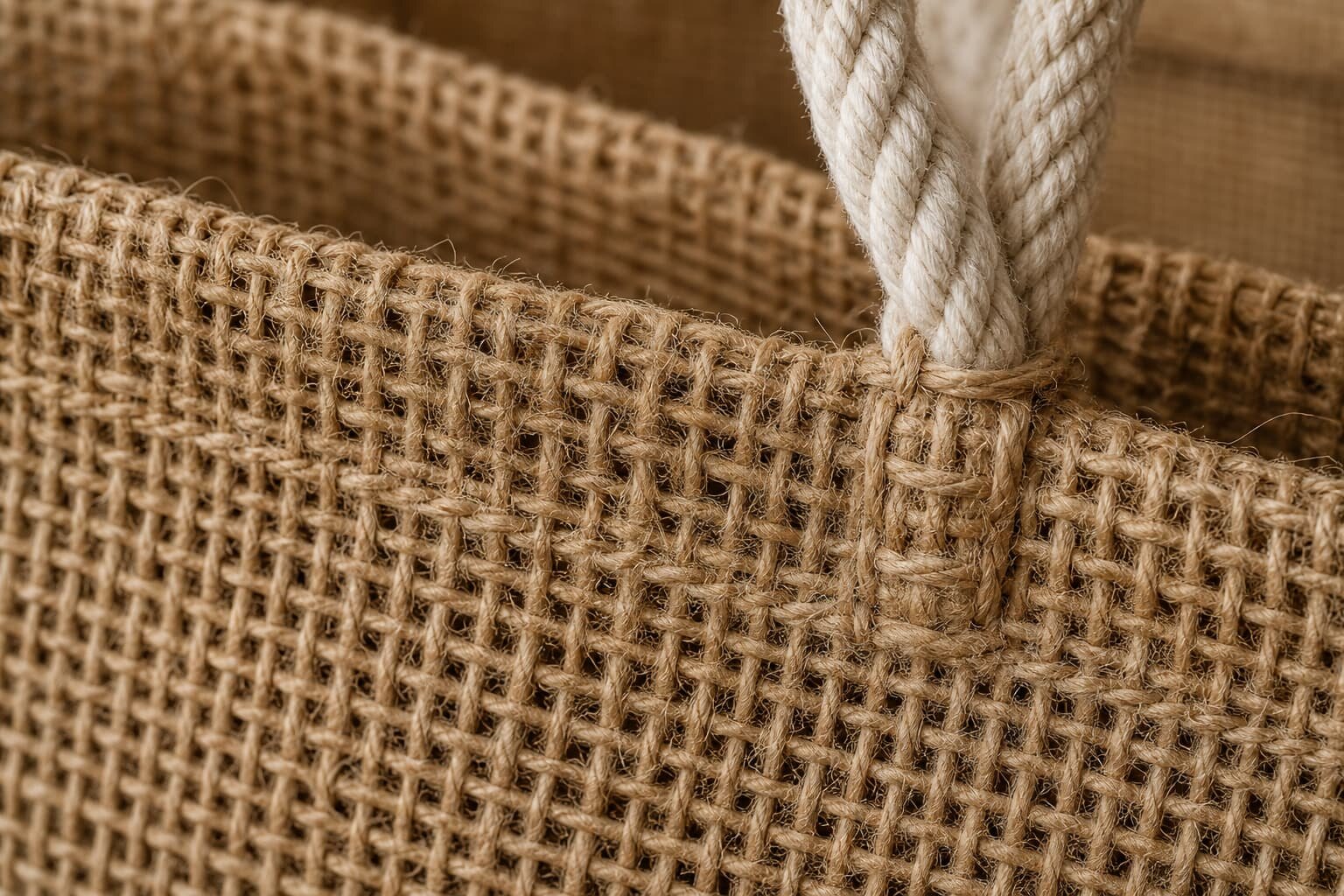
1. Why MOQ matters more for jute and burlap than many buyers expect
For jute and burlap bags, MOQ is rarely just a factory policy number. It usually reflects fabric booking, loom or roll availability, printing setup, sewing efficiency, and the number of labor steps needed to finish the bag. If you ask for a very specific size, a heavier GSM, custom handles, and a branded print, the order stops looking like a stock item and starts behaving like a small production run.
That is why two quotes for what sounds like the same bag can look very different. One factory may quote a low MOQ but use standard fabric, standard sizes, and simple packaging. Another may give a higher MOQ because they are reserving a custom woven fabric, a specialized print screen, or a separate sewing line. Buyers who understand this logic negotiate better and avoid comparing unrelated offers.
- MOQ is usually driven by fabric, print setup, and sewing labor, not only by bag count.
- A simple stock-style bag can support a lower MOQ than a fully custom promotional bag.
- The same bag can have different MOQ levels depending on color, logo complexity, and packing.
2. The spec choices that move MOQ up or down
The fastest way to control MOQ is to reduce the number of custom variables. Fabric weight, bag size, print colors, handle material, and finishing details all affect whether a factory can combine your order with existing production or must open a separate line. For wholesale jute and burlap bags, a buyer often gets better pricing by simplifying one or two details rather than pushing for the lowest printed unit price without changing the spec.
Fabric weight is a good example. A standard 240–300 GSM jute body is easier to source and cut than a heavier 320 GSM+ construction, especially if the bag must stay upright or carry heavier retail goods. The same logic applies to handles: self-fabric handles are usually easier to run than cotton webbing handles, while stitched reinforcement and lining add labor and inspection time.
- Higher GSM usually means better structure, but also more material cost and often higher MOQ pressure.
- More print colors, larger print areas, or print-on-both-sides increase setup work.
- Extras such as lining, lamination, zippers, or internal pockets change the order from simple to custom.
3. Recommended spec ranges buyers can use as a starting point
If you are writing an RFQ, start with a practical baseline rather than asking the supplier to interpret a loose concept. For many wholesale jute and burlap bag programs, a standard shopping tote often lands around 240–300 GSM with a simple open top and one-color screen print. If the bag must feel more premium, hold shape better, or carry heavier goods, a 300–320 GSM range is usually easier to defend in a quote than a very light fabric that looks cheap after sewing.
The print method should match the artwork. Screen printing works well for one or two solid colors and keeps the quote more stable. If you need detailed artwork, gradients, or a multi-color logo, ask whether heat transfer or digital print is available on the chosen fabric. Buyers should be careful here: a print method that looks cheaper in the RFQ may become more expensive once the factory adjusts for labor, registration, or rejection rate.
- Standard retail tote baseline: 240–300 GSM, open top, simple handle, one-color print.
- Structured retail or heavier carry use: 300–320 GSM+, reinforced seams, stronger handle stitching.
- Detailed artwork: confirm the print method before comparing unit price.
4. How factories usually calculate MOQ for jute and burlap bags
Most factories do not calculate MOQ from one single formula. They consider the minimum fabric run, the print setup cost, and the sewing line efficiency together. A one-color logo on a standard size bag may allow a lower MOQ because the same screens and sewing patterns can be repeated. But if you change the bag dimensions, add a gusset, switch to a different handle, and request individual polybags, the factory may need to split the order into more operations and quote a higher minimum.
This is why asking only for the 'best price' can produce misleading answers. A supplier may lower the unit price by excluding packing, using a lighter GSM, or assuming a generic sample approval. Better RFQs ask the supplier to state exactly what MOQ is tied to which spec. If they can show you the breakpoints, you can decide whether to simplify the bag or consolidate volume across colors or artwork variants.
- MOQ often changes when you change size, fabric, handle, or print method.
- Ask for MOQ by style, by color, and by artwork version if needed.
- A clear MOQ breakdown helps you decide whether to combine SKUs or simplify the design.
5. A useful comparison of bag constructions buyers quote most often
Buyers usually compare a few common constructions rather than inventing a custom bag from scratch. The important part is to compare the right details: fabric thickness, handle type, stitching, and packing method. The table below is not about marketing preference; it is about which construction better fits different commercial uses and where the hidden risk usually sits.
When two offers look similar, ask whether the supplier is quoting the same structure. A low-cost open-top tote with thin self-fabric handles is not the same as a reinforced retail bag with cotton webbing handles and a lined body. If the details are not aligned, the price comparison is not useful.
- Compare like for like: same GSM, same handle, same print, same packing.
- Reinforcement and lining can matter more than the face price.
- A simple structure is usually the best way to reduce MOQ.
6. RFQ wording that gets cleaner jute bag quotes
A strong RFQ should read like a production request, not a product wish list. Start with the exact size, then state fabric weight/GSM, bag structure, handle type and length, print method, logo size, and packing format. If you leave those details open, factories will fill the gaps with their own assumptions, and your comparison sheet will become unreliable.
Include artwork and packing questions in the first message, not the third follow-up. For example, if your logo must be centered 80 mm from the top edge, say so. If you need 50 pieces per inner bag and 200 pieces per carton, say so. This allows the supplier to quote sewing and packing together rather than revising the price later when the order is already in sample approval.
- State exact size in finished dimensions, not only approximate volume.
- Describe print position with measurements and number of colors.
- Specify packing and carton requirements before price comparison.
7. Sample checks that prevent expensive bulk mistakes
For jute and burlap bags, the sample stage should check more than whether the logo looks acceptable. Buyers should evaluate fabric feel, GSM consistency, handle strength, seam finish, and whether the final bag shape matches the intended use. If the sample is too soft, too coarse, or too uneven in weave, the bulk order may look inconsistent even when the logo print is correct.
Pay attention to print durability and sewing placement. Natural-fiber fabrics can absorb ink differently from one panel to another, especially when the weave is uneven. Check whether the logo is centered, whether both side seams align, and whether the top edge folds cleanly. A good sample should represent the actual bulk method, not a special hand-finished version that cannot be repeated at scale.
- Check sample on the same GSM and same print method intended for bulk.
- Confirm handle pull strength and stitch reinforcement at stress points.
- Review measurement tolerance after sewing, not just cut size.
8. Packing, carton marks, and why they affect the real landed cost
Packing seems like a small line item until the shipment lands and your warehouse team has to sort mixed counts, damaged corners, or unlabeled cartons. For wholesale jute and burlap bags, packing affects labor, carton volume, and sometimes the accepted MOQ because individual polybagging can slow the line and increase material usage. Bulk packing is often the most efficient option for distributors and importers, while retail-ready packing may be necessary for brand programs or marketplace fulfillment.
Ask the factory to quote the bag price and packing price separately if the project has multiple options. The difference between bulk packed cartons and retail-ready inner packs can be significant once barcode stickers, warning labels, or color-coded size marks are added. If carton dimensions are important for your freight calculation, request them in the quote, not after production starts.
- Bulk pack is usually lowest cost and simplest for importers.
- Retail-ready packing adds labor, material, and inspection time.
- Carton dimensions and count should be part of the initial quote.
9. Lead time planning: what actually slows production
Lead time on jute and burlap bags is usually driven by material readiness and print approval. If the fabric is standard and in stock, production can move faster. If the order needs a special GSM, custom color, or a new screen set, the schedule stretches immediately. Sewing itself is often not the only bottleneck; the more common delays are sample approval, artwork confirmation, and carton packing changes late in the process.
Buyers should separate sample time from bulk time in the RFQ. A realistic supplier quote should state how long it takes to make and approve the sample, then how long bulk production takes after approval. If the factory gives one combined number without distinguishing these stages, you may underestimate the real calendar impact. That matters especially for seasonal retail launches, event programs, and distributor replenishment plans.
- Ask for sample lead time separately from bulk lead time.
- Artwork approval delays can be just as costly as fabric delays.
- Packing changes late in the order can push shipment dates.
10. What to compare in supplier quotes before you choose a factory
The lowest unit price is not always the best quote. Compare the full commercial package: same GSM, same size, same print method, same handle, same packing, same lead time, and same sample terms. If one supplier is cheaper because they excluded a detail you assumed was included, the quote is not actually lower. A good comparison sheet should show what each supplier included and what they left out.
For procurement teams, the real goal is quote consistency. You want the supplier to be specific enough that later changes are visible and priced. If a factory can clearly identify the MOQ breakpoint, sample cost, bulk cost, and packing assumptions, they are usually easier to manage through production. That does not guarantee perfection, but it reduces the chance of receiving a quote that only looks good on paper.
- Compare quote scope, not just unit price.
- Check whether sample and bulk use the same specs.
- Ask what assumptions the supplier used for packing, print, and finishing.
Specification comparison for buyers
| Spec decision | Recommended option | When it fits | Buyer risk to check |
|---|---|---|---|
| Fabric weight / GSM | 240–300 GSM for standard shopping bags; 320 GSM+ for heavier carry bags | Retail totes, promotional programs, and bags that must hold shape | Too light a GSM can distort after printing or cause weak handles |
| Bag structure | Single-layer with binding or laminated inner layer depending on use | Low-cost promo bags or more structured retail bags | Lining, binding, and seam construction must match the intended load |
| Print method | Screen print for simple one- to two-color art; heat transfer or digital for detailed art | Most branded orders with clear logo requirements | Artwork complexity can push MOQ up and create color variance |
| Handle option | Self-fabric handles or cotton webbing handles | Everyday retail use and stronger carrying needs | Handle length and stitch density affect comfort and break strength |
| Closure | Open top for simple shopping use; drawstring or button/zip only when needed | Market bags and giveaway bags | Extra closures increase labor, materials, and quote spread |
| Packing format | Bulk packed with size labeling and carton marks | Distributor and importer shipments | Missing pack spec creates counting errors and warehouse delays |
Buyer checklist before sampling
- Confirm the exact bag size, fabric weight/GSM, and whether the bag is single-layer, lined, or laminated.
- Send vector artwork and state the print size, print position, and number of ink colors.
- Define handle type, handle length, stitch style, and target load requirement.
- Specify packing method: bulk pack, individual polybag, barcode sticker, carton count, and master carton size if relevant.
- Ask the supplier to quote sample cost, sample lead time, mass production lead time, and packaging details separately.
- Request a pre-production sample or approved reference sample before bulk cutting.
Factory quote questions to send
- What MOQ applies to this exact combination of size, fabric weight, handle, and print method?
- Is the MOQ based on bag color, artwork color, or total order quantity across styles?
- What is included in the unit price: fabric, printing, sewing, labels, packing, and carton marks?
- Which part of the order drives the longest lead time: fabric booking, printing, sewing, or packing?
- Can you quote a sample with the same fabric, handle, and print method as bulk production?
- What tolerances do you use for size, GSM, print placement, and stitching quality?
Quality-control points to confirm
- Check fabric GSM against the approved sample and confirm fiber feel, weave density, and thickness are consistent.
- Inspect handle stitching, bar-tacks, seam alignment, and stress points at the top gusset or side seam.
- Verify print registration, ink density, edge sharpness, and curing so the logo does not crack or smear.
- Confirm bag dimensions after sewing, not only cut size, because shrinkage and seam allowance change the final measurement.
- Review carton count, packing list accuracy, and outer carton marks before shipment.
- Ask for a pre-shipment inspection on random cartons, especially when the order is color-mixed or has multiple SKUs.