1. Why MOQ for jute and burlap bags is not just a quantity number
For wholesale jute and burlap bags, MOQ is usually controlled by material purchasing, printing setup, cutting efficiency, sewing line changeover, and packing labor. A buyer may ask for 300 pieces, but the factory may need to buy a full roll of jute fabric, prepare screens for printing, cut a minimum marker length, and allocate sewing operators for a short production run. If these costs are spread over too few bags, the unit price becomes unstable or the factory will add setup charges that make the quote hard to compare.
A practical RFQ should ask what the MOQ is based on. Is it one MOQ per bag size, one MOQ per print design, or one MOQ per fabric color? This matters when a distributor wants 1,000 total bags split into five logo versions. Some factories can combine production if the same fabric, handle, lining, and print process are used. Others quote each SKU separately because every artwork, label, or packing style requires a new setup.
- MOQ is often lower for standard natural jute with one-color logo printing.
- MOQ increases when you request dyed jute, custom woven handles, special lining, or full-panel printing.
- A mixed-SKU order may still need minimum cutting and printing quantities for each version.
- Ask for both the factory MOQ and the best price break quantity so your team can compare landed cost.
2. Define the bag construction before asking for a low MOQ
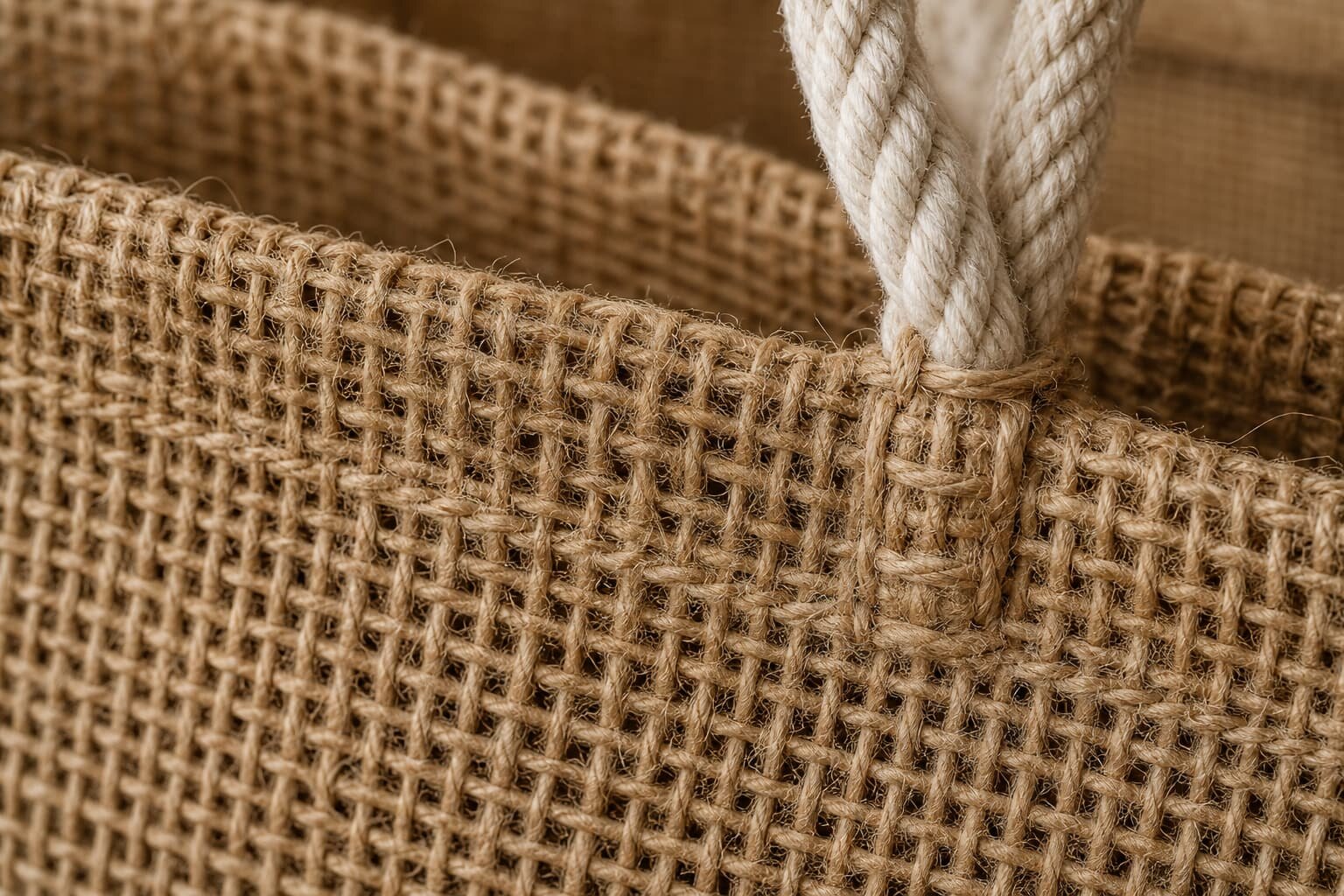
Many MOQ misunderstandings come from using broad descriptions like burlap shopping bag or eco jute tote. A laminated jute shopper with cotton webbing handles is a different production item from an unlaminated burlap tote with rope handles. The fabric behavior, cutting loss, sewing speed, print result, and packing volume are not the same. If the RFQ is not clear, suppliers may quote different constructions while appearing to quote the same product.
For procurement teams, the first step is to lock the construction family. A structured retail bag normally uses laminated jute because it stands better and reduces loose fibers inside the bag. A rustic gift bag or pouch may use unlaminated burlap because buyers want a softer, natural texture. A bottle bag needs stronger bottom construction and handle reinforcement because the load is concentrated. These construction choices affect both MOQ and failure risk.
- For retail shopping bags, specify laminated jute, gusseted bottom, and reinforced handles.
- For rustic packaging, specify unlaminated burlap and accept more natural fiber variation.
- For wine or bottle bags, confirm bottle diameter, bottle height, bottom stitching, and handle load.
- For gift programs, confirm if a drawstring, zipper, hook-and-loop, or open-top finish is required.
3. Fabric weight and GSM: the spec that changes price and MOQ quickly
Jute and burlap are commonly described by ounce weight or approximate GSM. For many wholesale carry bags, a practical range is about 13 oz to 15 oz jute, roughly around 350-430 GSM depending on supplier measurement and construction. Lighter material can reduce cost, but it may look loose, wrinkle more, and provide less shape. Heavier fabric gives a stronger feel but increases material cost, cutting resistance, carton weight, and sometimes the factory MOQ.
Buyers should avoid only writing premium quality jute in an RFQ. Instead, specify a target weight or ask the factory to quote two options. For example, request one quote for standard 13 oz laminated jute and one quote for heavier 15 oz laminated jute, both with the same bag size and print. This makes cost comparison meaningful. Also ask whether fabric weight is measured before or after lamination, because lamination can change the hand feel and reported weight.
- Use lower weights for light gift packaging, short campaigns, or low-load retail giveaways.
- Use medium-heavy weights for reusable shopping bags, supermarket programs, and brand merchandise.
- Ask for sample swatches if natural color, weave openness, or stiffness is critical.
- Confirm whether shade variation, slubs, and small natural knots are acceptable in your inspection criteria.
4. Print method selection affects MOQ more than many buyers expect
Printing on jute and burlap is not the same as printing on smooth cotton canvas. The weave is coarse, the surface is uneven, and natural fibers absorb ink differently. Screen printing is usually the most practical method for solid logos, simple slogans, and one to three colors. Heat transfer can handle more detail but may not suit every rustic look and requires careful adhesion testing. Embroidery is possible for some styles but can distort loose weave or add backing requirements.
MOQ rises when artwork requires many screens, tight registration, metallic effects, large coverage, or very small text. A factory may accept a low MOQ for one black logo on natural jute, but not for a six-color design across two panels. The RFQ should include artwork files, print size, placement, Pantone references, and whether the buyer accepts slight texture breaks from the jute surface. Without these details, the cheapest quote may later increase after artwork review.
- Screen print: best for simple solid-color logos and controlled cost.
- Heat transfer: useful for finer artwork but must be tested for adhesion and edge lifting.
- Woven label or side label: good for small branding when direct print detail is risky.
- Embossed leather patch or PU patch: suitable for premium look but usually needs separate accessory MOQ.
5. The real MOQ logic: material rolls, screens, cutting, sewing, and packing
A factory MOQ is not only a sales policy. It comes from production math. Jute fabric is purchased in rolls or bales, not in exact bag quantities. Cutting markers are arranged to reduce waste, but very small orders waste setup time. Printing requires screen preparation, ink mixing, drying space, and operator setup. Sewing requires line allocation, thread setup, handle attachment, trimming, checking, and packing. If the order is too small, each department loses efficiency.
This is why a buyer can sometimes negotiate MOQ by simplifying the specification. Keeping natural fabric color, standard handle color, one-size production, one-color print, and flat export packing can make a first order easier. On the other hand, asking for four sizes, three handle colors, individual retail polybags, hangtags, and several printed slogans will push the factory to set MOQ per SKU. The lowest order quantity is usually achieved by reducing changeovers, not by asking for an exception.
- Standard fabric lowers procurement risk for the factory.
- One shared print color reduces ink mixing and screen washing time.
- One carton packing method reduces warehouse and QC complexity.
- Multiple SKUs can be combined only when the factory confirms shared material and shared process.
6. How to compare quotes without being misled by a lower unit price
For jute and burlap bags, two quotes with the same unit price can represent very different products. One may include laminated 15 oz jute, cotton webbing handles, reinforced cross stitching, one-color screen print, and export cartons. Another may use lighter unlaminated burlap, thinner handles, no reinforcement, and vague packing. Procurement teams should build a quote comparison sheet that separates material, construction, printing, packing, sample charges, and lead time.
Ask suppliers to provide the same data fields. Finished size, fabric weight, lamination, handle type, print method, print colors, packing quantity per carton, carton dimensions, gross weight, sample cost, setup cost, and production lead time should be visible. If a factory will not state fabric weight or carton data, the landed cost calculation is incomplete. For importers, freight can change the real cost more than a small difference in factory price.
- Compare FOB or EXW terms consistently; do not mix trade terms without adjustment.
- Separate one-time setup charges from repeat-order unit prices.
- Check if sample charges are refundable or credited after bulk order only if clearly stated.
- Use carton CBM and gross weight to estimate freight before selecting the cheapest quote.
7. Sample checks before approving a bulk MOQ order
A jute bag sample should not be approved only because the logo looks correct from the front. Check the full production behavior: fabric weight, odor, lamination quality, seam strength, bottom gusset, handle drop, handle attachment, print sharpness, and packing crease. Jute is a natural material, so small variations are normal, but your team should decide what variation is acceptable before bulk production starts.
For MOQ-sensitive orders, many buyers skip pre-production checks to save time. That is risky because one rejected bulk lot costs more than one proper sample round. Request clear sample photos and, when possible, a physical sample before final approval. If timing does not allow a full revised sample, ask for a print strike-off or fabric swatch approval. The sample should be treated as the production reference, not just a design suggestion.
- Measure finished width, height, gusset, and handle drop against your approved tolerance.
- Pull handles by hand and check if stitches stretch, tear, or expose weak reinforcement.
- Rub the print lightly after drying and check if ink flakes, cracks, or transfers.
- Smell the interior after opening the sample package; strong chemical odor should be investigated.
- Photograph approved sample details and share them with QC, merchandising, and the supplier.
8. Packing and shipping details that influence MOQ and landed cost
Jute and burlap bags are bulky compared with thin non-woven bags or flat cotton pouches. A gusseted laminated jute shopper can take more carton volume, especially if the factory avoids crushing the bag shape. Buyers who only negotiate unit price may later find that freight cost is higher than expected. Packing style, pieces per carton, carton size, and compression level should be part of the quote, not an afterthought.
Flat packing is common for export, but over-compression can create permanent creases in laminated jute. Under-packing wastes carton space and raises CBM. If the bags are for retail shelves, you may need cleaner folding, individual polybags, hangtags, or barcode labels. Those details add labor and can increase MOQ because packing lines must separate SKUs. State your packing requirement early so the factory does not quote a basic bulk carton price and revise later.
- Request pieces per carton, carton dimensions, net weight, gross weight, and total CBM.
- Confirm whether bags are packed flat, folded, nested, or individually polybagged.
- Ask if moisture protection, desiccants, or inner liners are recommended for long sea freight.
- Check carton strength if bags are heavy or if cartons will be stacked in distribution warehouses.
9. Lead time planning: sample, material purchase, printing, sewing, and inspection
Lead time for wholesale jute and burlap bags depends on more than sewing capacity. The normal sequence is artwork review, sampling or strike-off, sample approval, material purchase, cutting, printing, drying, sewing, trimming, QC, packing, and shipment booking. If the order includes custom dyed fabric, special handles, labels, or retail packaging, those accessories can become the longest lead-time item.
Procurement teams should ask for lead time by stage, not only one final production number. A supplier may quote bulk production after sample approval, but your calendar also needs artwork correction time, sample courier time, approval meetings, inspection scheduling, and export document preparation. For seasonal retail programs, build a decision deadline into the RFQ. Late artwork approval is one of the most common reasons a low-MOQ order misses the delivery window.
- Ask for sample lead time separately from bulk production lead time.
- Confirm whether production starts after deposit, artwork approval, sample approval, or all three.
- For custom components, ask if materials are already in stock or need outside sourcing.
- Plan final inspection before balance payment and before the factory books final shipment.
10. A cleaner RFQ structure for MOQ negotiation
The best way to negotiate MOQ is to make the RFQ easy to produce. Start with one target style, one finished size, one fabric option, one print method, and one packing method. Then ask the factory for price breaks at several quantities, such as a trial order quantity, standard MOQ, and improved price quantity. This gives your team a commercial view without forcing the supplier to guess.
If your business needs multiple versions, group them logically. For example, keep the same bag size and fabric but change the logo color, or keep the same print plate but change hangtags. Ask the factory which changes create a new MOQ and which changes can be combined. This discussion is more useful than simply requesting the lowest MOQ because it reveals the production constraints behind the quote.
- Provide a spec sheet with size, fabric, lamination, handle, print, packing, and inspection requirements.
- Attach vector artwork and mark logo size and placement clearly.
- Ask for price breaks at realistic quantities instead of only one target quantity.
- State your repeat-order expectation if the first order is a market test.
- Request written confirmation of what happens if bulk material or print differs from the approved sample.
Specification comparison for buyers
| Spec decision | Recommended option | When it fits | Buyer risk to check |
|---|---|---|---|
| Fabric weight | 13 oz to 15 oz jute or about 350-430 GSM equivalent | Retail shopping bags, supermarket promos, gift packaging, and reusable carry bags | Too light may collapse or show loose weave; too heavy raises freight cost and may need higher MOQ |
| Inner finish | Laminated jute for shopping bags; unlaminated burlap for rustic pouches | Lamination helps shape retention, dust control, and sharper stitching on structured bags | Confirm lamination thickness and odor; low-grade lamination can crack or smell during storage |
| Handle type | Cotton webbing or padded jute handles for higher load use | Grocery, retail, trade show, and repeat-use promotional bags | Rope handles and thin webbing can fail pull tests if not reinforced correctly |
| Print method | Screen print for 1-3 solid colors; heat transfer for fine detail; woven label for low-risk branding | Most wholesale jute and burlap bag branding programs | Ink can bleed into coarse weave; small text and gradients need sample approval before bulk |
| MOQ structure | One base MOQ per bag size plus higher MOQ for dyed fabric, custom trim, or all-over print | Standard natural jute bags with logo printing and standard handles | Do not compare quotes unless MOQ includes the same fabric, print, packing, and color split |
| Packing method | Flat pack in export cartons with moisture control where required | Most importers and distributors shipping by sea or consolidated air cargo | Over-compression can crease lamination; under-packed cartons raise freight volume |
Buyer checklist before sampling
- Define the exact bag type: laminated jute shopper, unlaminated burlap tote, bottle bag, gift bag, pouch, or promotional carry bag.
- State finished size in width x height x gusset, not only capacity or approximate retail description.
- Specify fabric weight or approve a GSM/oz range instead of leaving the factory to choose the lowest-cost material.
- Confirm whether the MOQ is per size, per fabric color, per print design, per handle color, or per shipment.
- Send artwork as vector files and state Pantone references, logo size, print location, and acceptable print tolerance.
- Request handle construction details including material, width, length, reinforcement stitching, and load test expectation.
- Confirm inner lamination, lining, or no lining, including odor, stiffness, and crease tolerance requirements.
- Ask for sample photos of seams, bottom gusset, handle attachment, print edge, and carton packing before shipment.
- Require carton dimensions, pieces per carton, gross weight, net weight, and packing style in the quote.
- Set approval rules for pre-production sample, bulk fabric color, print strike-off, and final inspection.
Factory quote questions to send
- What is your MOQ for this exact bag size and fabric weight, and does it change by print design or handle color?
- Is the quoted jute laminated or unlaminated, and what is the approximate fabric GSM or ounce weight?
- Which print method are you quoting, and what artwork limitations apply to small text, gradients, and multi-color logos?
- What handle material, handle length, handle width, and reinforcement stitching are included in the price?
- Are setup charges, screen charges, sample charges, and inner packing costs included or listed separately?
- How many pieces are packed per export carton, and what are the estimated carton dimensions and gross weight?
- What is the normal sample lead time and bulk production lead time after artwork and sample approval?
- Can you support a lower first order MOQ if we accept standard fabric, standard handle color, and one-color printing?
- What inspection standard do you recommend for seam strength, print alignment, stain marks, odor, and carton condition?
- If the order has multiple SKUs, can the MOQ be combined by shared material or must each SKU meet MOQ separately?
Quality-control points to confirm
- Finished size tolerance should be agreed before production, especially on gusset depth and handle drop.
- Fabric weight and texture should match the approved sample, with no large shade difference between production lots.
- Lamination should be bonded evenly without cracking, bubbling, delamination, sharp odor, or visible glue marks.
- Seams should be straight with secure backstitching; handle joints should not pull out under agreed load testing.
- Print registration, logo position, ink coverage, and color should match approved strike-off within agreed tolerance.
- Natural jute knots, slubs, and shade variation should be classified as acceptable or rejectable before inspection.
- Bags should be dry and clean before packing to reduce mildew risk during sea freight.
- Cartons should match the quote data and withstand export handling without over-compressing the bags.