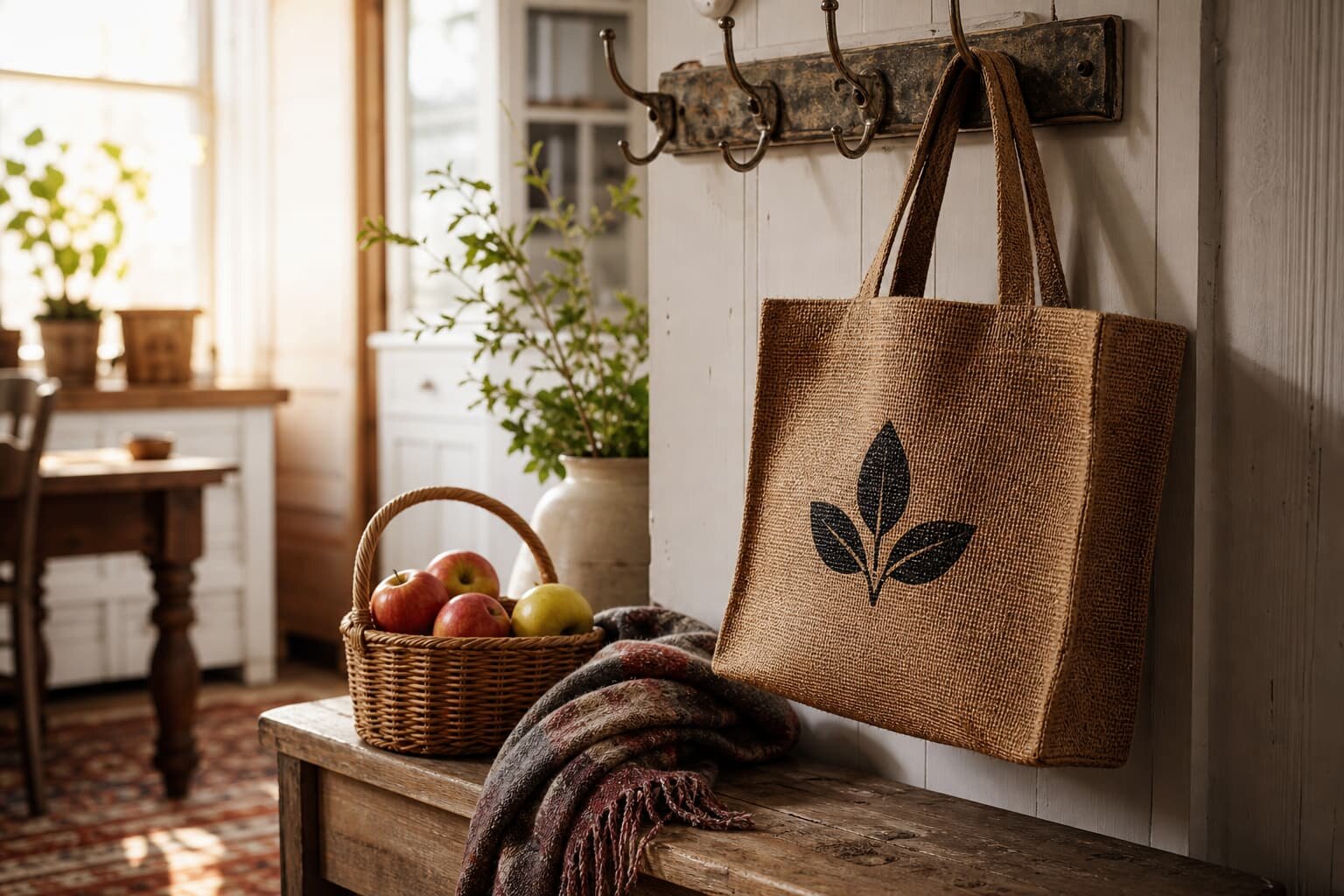
1. The buying problem: similar-looking jute bags are not equal
Most bad wholesale jute and burlap bag purchases start with an RFQ that is too short. A buyer asks for a natural jute shopping bag with logo, three suppliers reply with three attractive unit prices, and the cheapest quote wins. The problem appears later: the bag is softer than expected, the print looks broken, the handles feel weak, the carton packing creates deep creases, or the bag cannot stand upright on a retail shelf.
This wholesale jute & burlap bags buyer guide 07 focuses on one practical issue: how to make supplier quotes comparable before you approve a sample or issue a purchase order. Jute and burlap are natural, textured, and less uniform than cotton canvas or non-woven PP. That means small specification gaps can create large differences in cost, appearance, load performance, and customer complaints.
- Do not compare only by bag size and logo quantity.
- Always define GSM, lamination, handle construction, print method, and packing.
- Ask the factory to state quote assumptions in writing, not only unit price.
- Use one approved sample as the production standard for both buyer and factory.
2. Choose the right jute or burlap material before asking for price
In bag sourcing, the words jute and burlap are often used loosely. Jute is the fiber; burlap normally refers to the coarse woven fabric made from jute or similar natural fibers. Some suppliers use these terms interchangeably, while others quote different qualities. A 260 GSM open-weave burlap bag and a 360 GSM tighter jute bag can both look natural in a photo, but they will not carry, print, or stand the same way.
For standard promotional shopping bags, many buyers use around 260-320 GSM. For heavier retail packaging, grocery bags, wine bags, or gift bags that need more body, 340-380 GSM is a more realistic range. Higher GSM usually improves stiffness and perceived value, but it also increases material cost, carton weight, and sometimes minimum fabric purchase quantity. If the bag must fold flat for cheap storage, very stiff laminated material may not be ideal.
- 260-280 GSM: economical promotional use, lighter hand feel, more flexible structure.
- 300-320 GSM: common middle range for branded retail and event shopping bags.
- 340-380 GSM: stronger body, better shelf presence, higher freight weight.
- Above 380 GSM: possible for special projects, but confirm machine capability and seam bulk.
- Always request actual GSM tolerance, for example plus or minus 5%, instead of a vague heavy jute description.
3. Decide on lamination early because it changes price and performance
Lamination is one of the most important cost and construction decisions for jute and burlap bags. Unlaminated jute has a dry, breathable, rustic feel and is often preferred for natural brand positioning. Laminated jute has an inner or outer film layer, commonly PE or PP, that adds body, improves shape retention, and can help the bag stand upright. It may also reduce fiber shedding and support cleaner printing depending on the print process.
However, lamination is not a free upgrade. It changes hand feel, folding behavior, odor risk, and environmental claims. If your sales team plans to describe the bag as plastic-free, biodegradable, or fully natural, do not approve laminated material without checking the claim. If your product is food-related, confirm whether the bag contacts packaged goods only or direct food contact is expected. Most promotional jute bags are not designed for direct unpackaged food contact unless specifically sourced and tested for that purpose.
- Use unlaminated jute for dry retail packaging, rustic gift bags, and natural branding.
- Use laminated jute when the bag needs more stiffness, moisture resistance, or standing structure.
- Specify whether lamination is inside, outside, or between layers.
- Ask about lamination thickness if comparing two close quotes.
- Check odor after sealing bags in a carton for several days, not only when the sample is fresh.
4. Build the bag around the product it must carry
A jute bag RFQ should start with the product and use case, not only the outside dimensions. A wine bottle bag, a grocery bag, a cosmetics gift bag, and a trade show giveaway bag require different bottom strength, handle drop, seam reinforcement, and carton packing. Even when two bags share the same width and height, a 10 cm side gusset will behave differently from a flat envelope-style bag.
State the finished size as width x height x gusset and specify whether you need a box bottom, sewn bottom, folded bottom, or simple flat pouch construction. For shopping bags, a box bottom with side gussets improves usable capacity and display appearance. For low-cost packaging, a flat burlap pouch may be enough. If the bag must carry a fixed load, tell the supplier the product weight and how the bag will be handled: hand carry, shoulder carry, shelf display, or e-commerce insert.
- For grocery and retail bags, confirm load target such as 5 kg, 8 kg, or another realistic internal standard.
- For wine bags, specify bottle diameter, bottle height, and whether a divider is required.
- For gift bags, confirm whether tissue paper, hangtags, and rigid bottom inserts are needed.
- For event bags, check whether A4 documents, catalogs, or product samples must fit without bending.
- For display bags, ask for a sample photo showing the bag standing with actual or simulated contents.
5. Handle construction is where many cheap quotes cut corners
Handles often fail before the jute body fabric fails. A low quote may use narrow handles, shorter handle drop, fewer stitches, or no reinforcement patch. These details are easy to miss in quotation photos. For procurement teams, the RFQ should define handle material, width, color, length, drop height, and sewing method. Cotton webbing is common because it feels more comfortable than rough jute when carrying heavier items. Jute handles keep a more natural look but may feel scratchier.
For standard hand-carry shopping bags, handle widths around 2.5-3.8 cm are common. Wider handles increase comfort and perceived quality but add cost. Handle drop should match the intended use: short hand carry for gift bags, longer drop for shoulder carry. Ask for box stitching, cross stitching, or reinforcement patches where the handle joins the bag. If the bag will carry heavy products, do not accept only a visual approval; include a practical pull or load test in your quality plan.
- Specify handle material: cotton webbing, jute webbing, rope, padded handle, or self-fabric handle.
- Define handle width and finished handle drop, not just total handle length.
- Ask whether the handle ends are folded, heat cut, taped, or hidden inside the top hem.
- Require reinforced stitching for grocery, wine, and heavier retail bags.
- Check that handle color and texture are approved together with the body fabric, not separately.
6. Printing on rough jute needs realistic artwork decisions
Jute and burlap are not smooth print surfaces. The weave is coarse, fiber color varies, and small gaps in the yarn can break fine lines. Screen printing works well for bold logos, simple text, and one to three solid colors. It is usually the best balance of cost and durability for wholesale custom jute bags. But small text, thin outlines, gradients, and photo-style artwork will not reproduce like they do on coated paper or polyester.
If the brand requires fine detail, consider a printed cotton patch, woven label, heat transfer on a smoother panel, or laminated material that supports cleaner print. Always approve artwork at actual size. A 6 cm logo may look perfect on a PDF proof but weak on a 35 x 40 x 15 cm jute grocery bag. Pantone matching also needs tolerance because natural jute color affects the visual result. White underbase may be needed for bright colors, and that changes setup and cost.
- Use screen print for large solid logos and simple brand messages.
- Use woven labels when the logo is small and must stay sharp.
- Use a cotton patch when the brand wants a clean print but still likes a jute body.
- Avoid gradients, fine serif fonts, and small QR codes directly on coarse burlap.
- Request a print strike-off or pre-production sample using the actual fabric, not a digital mockup only.
7. MOQ logic: why the same bag can have different minimums
MOQ for wholesale jute and burlap bags is not only a factory rule. It is affected by fabric procurement, lamination setup, printing setup, handle color, cutting efficiency, and packing labor. A standard natural jute bag with stock cotton handles and one-color screen print can often be produced at a lower MOQ than a custom-dyed jute bag with special webbing, full-panel print, and individual retail packaging.
When comparing quotes, ask what part of the specification drives the MOQ. Sometimes the bag sewing MOQ is manageable, but custom handle dyeing or a special fabric roll creates a higher minimum. Sometimes a factory can accept a smaller trial order if you use stock fabric, standard sizes, and simple print. If your launch forecast is uncertain, design the first order around standard components rather than forcing custom details that push MOQ and sampling time up.
- Lower MOQ is easier with stock natural jute, standard bag sizes, and one-color screen print.
- Higher MOQ is likely with custom fabric color, special lamination, dyed handles, or all-over print.
- Ask whether MOQ is per design, per size, per print color, or total order quantity.
- For multiple SKUs, confirm whether fabric can be combined across sizes.
- Check if the factory charges a small-order surcharge instead of refusing the order.
8. Sample approval should check construction, not only logo appearance
Many buyers approve a jute bag sample because the logo looks acceptable, then discover bulk issues in size, odor, creasing, handle strength, or carton packing. A useful sample process separates the stages. First review fabric swatches and handle options. Then approve a print strike-off if artwork is important. Finally approve a full pre-production sample with the correct fabric, lamination, handle, stitching, label, and packing method.
For natural jute, expect some shade variation and fiber irregularity. The goal is not plastic-like uniformity; the goal is controlled variation that matches the approved sample range. Keep one signed sample with the supplier and one with your inspection team. If the bulk goods are inspected at the factory, the inspector should compare against the approved sample and written specification, not only against photos in an email thread.
- Measure finished width, height, gusset, handle drop, and print placement on the sample.
- Fold and unfold the bag to check creasing, lamination cracking, and shape recovery.
- Load the bag with intended product weight and hold it by the handles for a practical stress check.
- Rub the print lightly with a dry and damp cloth if the bag will be handled often.
- Place the sample in a closed carton or bag for 48-72 hours to check trapped odor before approval.
9. Packing and lead time affect landed quality, not just logistics
Jute is a natural fiber, so moisture control matters. Bags should be properly dried before packing, and export cartons should be suitable for sea or air movement. If bags are packed too tightly, laminated panels can crease and handles can deform. If they are packed while damp, odor and mildew risk increases. Procurement teams should ask for units per carton, carton dimensions, gross weight, net weight, and packing orientation before confirming the order.
Lead time should be counted from the last approval point, not from the first inquiry. A realistic timeline includes artwork confirmation, material booking, sample making, sample shipping or photo approval, bulk cutting, printing, sewing, trimming, packing, inspection, and export handover. If your delivery date is fixed for a retail launch or event, give the factory the required ex-factory date and final destination date separately. This helps avoid a quote that looks fast but ignores approval delays.
- Ask whether bags are packed flat, folded, nested, or individually polybagged.
- Confirm if desiccants, inner liners, or moisture-resistant cartons are required for long sea shipments.
- State carton marking requirements, barcode labels, retail labels, and mixed-carton rules early.
- Do not finalize freight estimates without carton size and gross weight.
- Build approval buffer into the schedule when print color or custom material is new.
10. How to compare factory quotes without choosing the wrong low price
A good quotation for wholesale jute and burlap bags should read like a production summary. It should include finished size, material GSM, lamination, handle details, print method, number of colors, logo size, packing method, MOQ, sample cost, production lead time, payment terms, and quote validity. If two quotes differ by a large percentage, the first step is not negotiation; the first step is finding which specification is different.
Ask suppliers to list exclusions clearly. Common missing items include screen setup charges, custom label cost, barcode sticker labor, special carton marks, pre-shipment inspection support, inner polybags, and pallet packing. For importers and distributors, these items affect landed cost and warehouse efficiency. A slightly higher unit price can be better if it includes stronger fabric, proper handles, stable packing, and fewer claim risks.
- Compare quoted GSM and lamination before comparing unit price.
- Check whether print setup, sample fee, and artwork adjustment are included or separate.
- Confirm whether the quote is based on the same packing method and carton quantity.
- Ask for photos of comparable previous samples only as reference, not as proof of your production quality.
- Record all final specifications in the purchase order so the approved quote becomes enforceable.
Specification comparison for buyers
| Spec decision | Recommended option | When it fits | Buyer risk to check |
|---|---|---|---|
| Fabric weight | 260-320 GSM jute for standard shopping bags; 340-380 GSM for heavier retail or gift packaging | Use lighter GSM for promotional giveaways and stronger GSM for wine, grocery, and premium retail bags | Two quotes may both say natural jute but use different yarn density, stiffness, and actual GSM tolerance |
| Inside finish | Unlaminated for breathable rustic look; PE or PP lamination when structure, moisture resistance, or sharper print is needed | Unlaminated suits dry goods and natural branding; laminated suits retail bags that must stand upright | Lamination changes hand feel, recyclability claims, odor, folding behavior, and print adhesion |
| Handle type | Cotton webbing 2.5-3.8 cm wide or jute handles with reinforced box stitching | Cotton webbing gives better comfort for heavier loads; jute handles keep a fully natural look | Handle drop, stitch density, and reinforcement patch often cause failures before the body fabric does |
| Print method | Screen print for solid logos; heat transfer or laminated-panel print for fine detail; woven label for small branding | Screen print is cost-effective for simple brand marks on medium to large runs | Rough burlap texture breaks small text and gradients; artwork must be approved at actual size on the chosen material |
| Bag structure | Box bottom gusset with side gussets for shopping bags; flat pouch style for low-cost packaging | Box bottom improves standing display and usable capacity for retail and grocery use | Factories may quote the same width and height but different gusset construction, changing capacity and carton size |
| Packing method | Flat pack in export cartons with moisture control; avoid over-compression for laminated bags | Best for importers managing warehouse receiving, relabeling, or retail distribution | Poor drying, tight packing, or damp cartons can create odor, mildew risk, creasing, and claims at destination |
Buyer checklist before sampling
- Confirm exact bag size in width x height x gusset, and state whether measurements are external finished size or cutting size.
- Specify fabric material clearly: jute, burlap, jute-cotton blend, laminated jute, or laminated burlap, with target GSM and tolerance.
- Decide whether the bag must stand upright, fold flat, carry a specific product weight, or hang on retail display.
- Provide logo artwork in vector format and define print size, Pantone colors, placement, and acceptance limits for color variation.
- State handle material, handle width, handle drop length, reinforcement method, and required carrying weight test.
- Ask for pre-production sample photos and physical sample approval before bulk cutting when artwork or construction is new.
- Request carton dimensions, units per carton, gross weight, net weight, carton marking, and palletization requirements if applicable.
- Confirm whether unit polybags, hangtags, barcode stickers, inner packs, or retail labels are required before comparing quotes.
- Define inspection standard, acceptable defect level, and who pays for rework if bulk goods do not match the approved sample.
- Ask the supplier to separate tooling, sample, printing setup, unit cost, packing cost, and freight-related charges in the quotation.
Factory quote questions to send
- What actual GSM range will be used for the quoted jute or burlap, and can you provide a fabric swatch before sampling?
- Is the quoted material laminated or unlaminated, and what is the lamination type, thickness, and side of application?
- What is the maximum printable area on the selected bag size, and which print method is included in the unit price?
- How many colors are included in the quote, and are screen setup charges or plate charges listed separately?
- What handle material, width, length, and reinforcement stitching are included in the quoted construction?
- What MOQ applies to the bag body, fabric procurement, print setup, and custom color handles if used?
- What sample types are available: existing sample, material swatch, digital proof, strike-off, or full pre-production sample?
- What are the standard carton packing details, and will the bags be fully dry before packing for sea shipment?
- What is the estimated production lead time after artwork approval, deposit, and material confirmation?
- Which quote assumptions will change the unit price if the buyer later modifies GSM, lamination, print size, packing, or inspection requirements?
Quality-control points to confirm
- Check finished size tolerance on width, height, and gusset after stitching, not only cutting panel size.
- Verify fabric GSM, weave density, odor, color shade, and lamination consistency against the approved sample.
- Inspect print registration, ink coverage, edge sharpness, rubbing resistance, and color match under consistent lighting.
- Pull-test handles and inspect reinforcement stitching, especially at the top hem and side seam intersections.
- Check whether the bag stands upright, folds as expected, and carries the intended product weight without distortion.
- Review loose fibers, broken yarns, stains, oil marks, mildew spots, and excessive shedding on natural jute surfaces.
- Confirm carton quantity, carton strength, moisture control, export marks, barcode labels, and packing orientation.
- Compare bulk production to the signed pre-production sample before final shipment release.