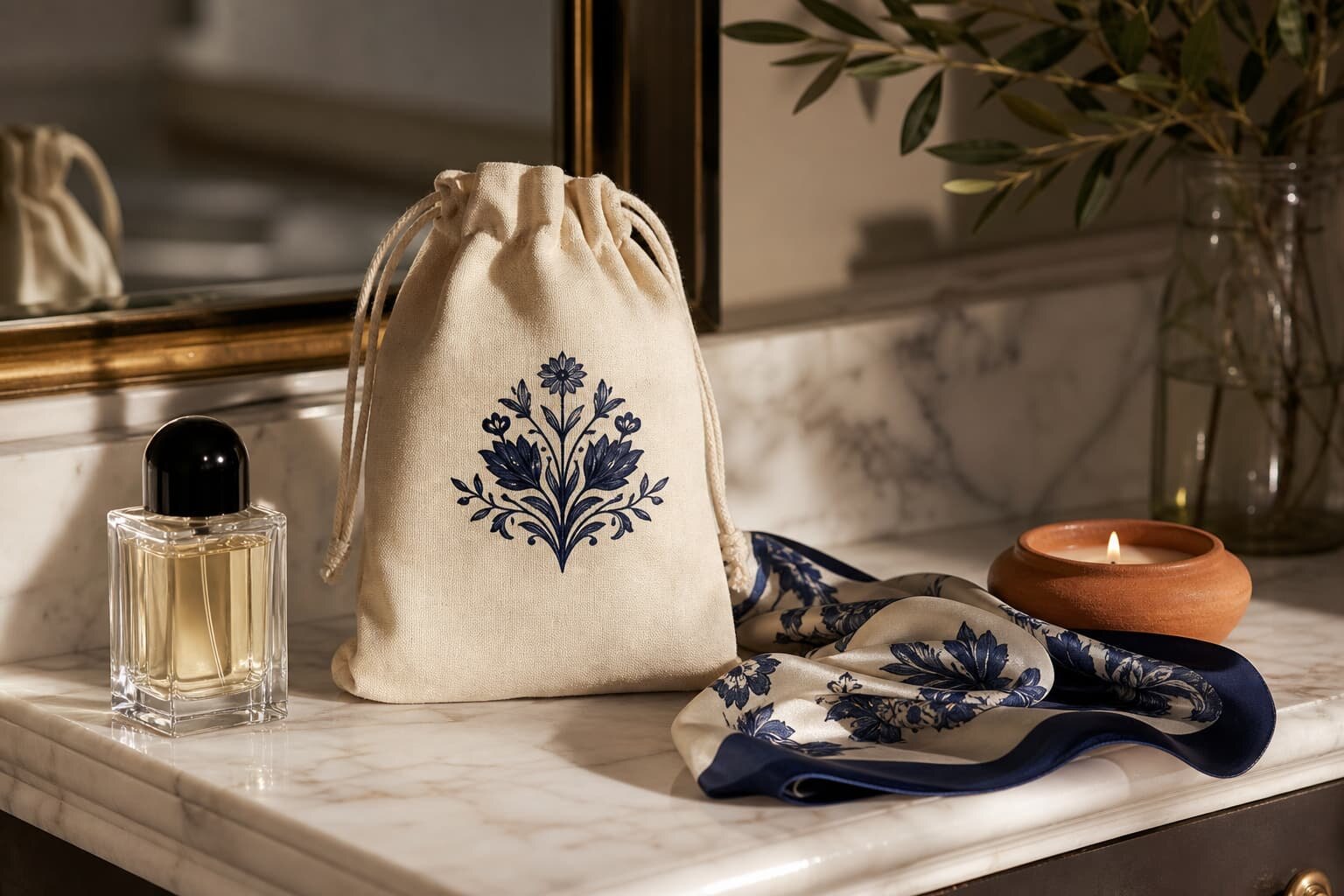
1. The buying problem: quotes look similar, but approval risk is not
Wholesale drawstring pouches are often treated as a simple packaging item, so buyers send a short RFQ: size, quantity, fabric, and logo. The problem is that two suppliers can quote the same 15 x 20 cm cotton pouch and still be building very different products. One quote may use 120 GSM sheeting fabric with single cotton cord and one-color screen print. Another may use 200 GSM canvas, double cord, tighter stitching, and individual packing. If the RFQ does not create approval gates, the cheapest quote usually hides the most assumptions.
For procurement teams, the goal is not to make the RFQ longer for its own sake. The goal is to force each supplier to price the same construction and to confirm the same production process before bulk cutting. Drawstring pouches are small, but mistakes multiply quickly because the unit cost is low and the order quantity is often high. A 2 mm logo shift, weak cord channel, or wrong GSM can affect every pouch in the carton.
- Use approval gates when the pouch is part of retail packaging, brand presentation, subscription boxes, gift sets, or distributor stock.
- Do not approve bulk production from a photo of a similar item; approve from actual material, actual print, and actual cord.
- Treat pouch sourcing as a controlled packaging project, not a generic commodity purchase.
2. Start with finished size and use-case, not only fabric name
The most common drawstring pouch RFQ mistake is giving only a size and fabric name. A buyer may write 10 oz canvas pouch or 5 oz cotton pouch without explaining the product going inside, the filling height, or the closure requirement. Pouches behave differently when filled. A flat 18 x 24 cm sample may look correct on a table, but once a candle jar, bottle, jewelry box, or cosmetic kit is inside, the top opening may not close cleanly.
Always specify finished size, usable internal area, and the product dimensions that the pouch must hold. Finished size means the pouch after sewing, not the cut panel size before seam allowance and drawstring channel folding. If the supplier quotes from cutting size, the final pouch can be smaller than expected. This is a serious issue for rigid products because even a 5 mm loss in width can make loading difficult.
- State finished pouch width x height in centimeters or inches, plus acceptable tolerance such as +/-5 mm for small pouches or +/-8 mm for larger pouches.
- Define whether height includes the drawstring channel or whether usable storage height must be measured below the channel.
- Provide product dimensions and target fit: tight, standard, or loose gift-pack fit.
- Ask the supplier to confirm recommended pouch size if your product is rigid, heavy, or unusually shaped.
3. Fabric GSM controls hand feel, closure, cost, and freight
For drawstring pouches, GSM is more useful than vague fabric descriptions such as natural cotton, muslin, canvas, or eco fabric. A natural cotton pouch can be 90 GSM, 120 GSM, 150 GSM, or 180 GSM, and each option has a different hand feel and opacity. Lightweight fabric closes easily and costs less, but may look thin when used for retail packaging. Heavy canvas feels premium, but can create bulky seams and a stiff mouth that does not gather smoothly.
Buyers should request two GSM options when they are unsure. For many retail packaging uses, 120-180 GSM cotton is a practical range. For a premium reusable pouch, 200-280 GSM canvas can work, but the supplier must adjust the drawstring channel and cord size. If the pouch is very small, heavy canvas may be the wrong choice because the top opening becomes too rigid and the side seams become thick.
- 90-110 GSM: light dust bags, low-cost inserts, simple event giveaways, not ideal for heavy or sharp products.
- 120-180 GSM: common range for cotton drawstring pouches used in cosmetics, jewelry, accessories, and retail gift packaging.
- 200-280 GSM: premium canvas feel, better structure, higher cost and freight impact, requires careful closure testing.
- Jute or burlap: rustic appearance, but rougher surface and more variation; check print clarity and fiber shedding.
- Velvet, satin, or specialty fabric: useful for presentation pouches, but MOQ, color consistency, and sewing behavior must be checked separately.
4. Lock the drawstring construction before comparing prices
The cord is not a small detail. Drawstring material, diameter, length, and single or double pull construction affect user experience and production cost. A single drawstring may be acceptable for very low-cost packaging, but double drawstring closure usually feels better and closes more evenly. For retail buyers, the opening and closing action should be tested with the actual product inside the pouch.
Cord choice should match the fabric. Cotton cord gives a natural look and is common with cotton pouches, but color consistency can vary more than polyester. Polyester cord is stronger and easier to match in bright colors. Ribbon can look premium, but it changes the channel design and may fray if the ends are not heat cut or finished properly. If the pouch will be opened repeatedly, cord pull strength and channel stitching are more important than saving a fraction of cost.
- Specify single drawstring or double drawstring; do not leave this to the factory.
- Confirm cord diameter, such as 3 mm, 4 mm, or 5 mm, based on pouch size and channel width.
- Ask for cord color reference and whether dyed cord has a higher MOQ than natural cord.
- Define cord end finish: knot, metal tip, plastic aglet, sewn end, heat cut, or no special finish.
- For small pouches, test whether the cord knot looks bulky and whether it scratches the packed product.
5. Choose print method based on artwork and fabric surface
Screen printing is usually the most practical option for wholesale cotton drawstring pouches with one to three solid colors. It gives stable cost, good opacity, and clean branding when the artwork is not too fine. However, screen print quality depends on fabric surface, ink choice, mesh, curing, and operator control. Fine lines can break on coarse cotton or jute. Large solid print areas may feel stiff or show cracking if applied too heavily.
Heat transfer, digital print, embroidery, woven labels, and patch labels can also be used, but each has trade-offs. Heat transfer can handle gradients and full color artwork, yet it may change hand feel and must be tested near the draw area because the fabric gathers. Embroidery feels premium but can pucker lightweight fabric and is usually better for heavier canvas or small logo marks. Woven labels reduce print risk and can be sewn into the seam, but label MOQ and lead time must be added to the sourcing plan.
- Screen print: best for solid logos, simple artwork, and larger quantities; request Pantone reference and print strike-off.
- Heat transfer: useful for full color or gradients; check edge marks, stretch behavior, and rubbing resistance.
- Digital print: flexible for small batches and complex artwork; confirm color brightness on natural or dark fabric.
- Embroidery: premium but not ideal for very thin fabric or tiny detailed text.
- Woven label or cotton label: good for minimalist branding and repeat programs; check label size, fold type, and sewing position.
6. Build MOQ logic around size, color, print, and packing
MOQ is often misunderstood in pouch sourcing. A supplier may say the MOQ is 1,000 pieces, but that may apply to one fabric color, one size, one artwork, and bulk packing. If your order has four sizes, three fabric colors, and eight different printed logos, the factory has multiple setup changes. The true MOQ is not only the total quantity; it is the quantity per production combination.
For importers and distributors, this matters when building assortments. A low MOQ quote may be possible if fabric is in stock and the print is simple, but custom dyed fabric, special cord color, woven label, individual barcode labels, and retail packing can increase the minimum. Ask the factory to separate standard MOQ, below-MOQ surcharge, and custom material MOQ. This makes the quote easier to compare and prevents a supplier from accepting an order that later becomes unstable in production.
- Confirm MOQ per pouch size because pattern setup and cutting efficiency change by size.
- Confirm MOQ per fabric color, especially for dyed cotton, canvas, velvet, satin, or jute.
- Confirm MOQ per logo design and print color count because screens or transfers may be prepared separately.
- Confirm MOQ impact of individual polybag, hangtag, barcode sticker, and retail carton.
- For trial orders, ask whether stock fabric and standard cord can reduce MOQ without changing the approved quality.
7. Use sample gates instead of one final sample approval
A single pre-production sample can be too late if the buyer has not already approved fabric and print. By the time a full pouch sample is made, the supplier may have already ordered fabric or prepared printing materials. A better sourcing workflow uses approval gates: material swatch, print strike-off, construction sample, full pre-production sample, and packing confirmation. Each gate removes one production risk.
The PP sample should represent the final product as closely as practical. It should use the quoted fabric GSM, actual drawstring, actual print size and position, actual label if any, and actual packing components if retail-ready packaging is part of the order. If the PP sample uses substitute fabric or a different cord, mark it clearly as a reference sample only and do not allow it to become the bulk approval standard.
- Material swatch: approve fabric weight, color, texture, and shrinkage expectation before pouch sewing.
- Print strike-off: approve logo color, line clarity, hand feel, and rub resistance on the actual fabric.
- Construction sample: check size, channel, cord movement, seam strength, and product fit.
- PP sample: approve the final combination of fabric, size, cord, print, label, and packing.
- Sealed sample: keep one approved sample with the buyer and one with the factory for inspection reference.
8. Require quote data that explains the price, not just a unit cost
A professional quotation for wholesale drawstring pouches should include enough data for the buyer to compare suppliers and estimate landed cost. Unit price alone is not sufficient. The quote should state fabric type and GSM, finished size, cord specification, print method, artwork size, packing method, carton quantity, carton dimensions, gross weight, sample cost if any, tooling or setup charges, lead time, and trade term.
This information also helps identify quote gaps. If one supplier’s unit price is much lower, check whether the fabric GSM is lower, the pouch is single cord instead of double cord, the print size is smaller, or packing is bulk instead of individual. If one supplier quotes much higher, it may include better fabric, retail packing, or a more durable print process. Good quote data turns price negotiation into specification negotiation.
- Ask suppliers to quote at least two quantity breaks, for example 1,000 pieces and 5,000 pieces, if your forecast is uncertain.
- Request separate line items for print setup, sample cost, labels, hangtags, individual polybags, and special carton marks.
- Ask for CBM and carton weight because bulky individual packing may increase air or sea freight cost.
- Confirm whether the quote is based on EXW, FOB, CIF, DDP, or another trade term.
- Record the quote validity period, especially if cotton fabric, exchange rates, or freight are moving.
9. Packing details affect damage, labor, and warehouse receiving
Drawstring pouches can be packed in several ways: loose bulk in cartons, bundled in inner polybags, individually polybagged, or packed with retail hangtags and barcode labels. Bulk packing is efficient and often suitable when the buyer will use the pouches as packaging inserts. Individual packing protects the pouch and supports retail handling, but it adds labor, material cost, volume, and inspection points.
For distributors and retail buyers, packing errors can be more expensive than pouch defects. If different sizes, colors, or logos are mixed in one shipment, the carton mark and inner pack structure must be clear. A warehouse team should be able to identify SKU, color, size, quantity, purchase order, and destination without opening every carton. If pouches are used in fulfillment operations, carton weight and bundle quantity should match handling limits.
- Define bulk pack, inner bundle quantity, or individual polybag before final quote.
- State whether each pouch needs barcode sticker, hangtag, insert card, warning label, or retail-ready folding.
- Confirm carton quantity and carton size for each pouch size; do not assume one carton plan fits all sizes.
- Use clear carton marks showing item number, size, color, quantity, gross weight, net weight, and carton number.
- For mixed-SKU orders, require an assortment packing list and photos of open cartons before shipment.
10. Lead time should start after approvals, not after inquiry
Lead time problems often come from unclear start dates. A supplier may quote 25 days production, but that usually means after deposit, final artwork, material confirmation, and PP sample approval. If the buyer delays Pantone confirmation or barcode files, the factory cannot responsibly start bulk production. On the other hand, if the factory starts without approval, the buyer carries quality and branding risk.
A workable schedule separates sample time, approval time, material preparation, bulk sewing, printing, packing, inspection, and shipment booking. For urgent orders, ask which steps can run in parallel and which cannot. For example, a factory may prepare blank fabric while waiting for final print approval, but it should not print bulk logos before the strike-off is approved. The schedule should also include time for inspection correction if loose threads, packing errors, or print defects are found.
- Ask for sample lead time after artwork and material confirmation.
- Ask for bulk lead time after written PP sample approval and deposit.
- Confirm whether fabric is stock, greige fabric to be dyed, or custom woven material.
- Add approval buffer for your internal brand, legal, retail, or distributor review process.
- Plan final inspection before the cargo is sealed, not after the shipment has already been booked.
Specification comparison for buyers
| Spec decision | Recommended option | When it fits | Buyer risk to check |
|---|---|---|---|
| Fabric weight for cotton pouch | 120-180 GSM cotton for light to medium retail packaging | Jewelry, cosmetics, accessories, candles, event gifts, and small merchandise | Too light may show product shape and feel cheap; too heavy may reduce draw closure and increase freight |
| Fabric choice for premium feel | 200-280 GSM canvas or brushed cotton | Gift sets, reusable packaging, higher-value accessories, and brand merchandise | Thick seams can become bulky; confirm drawstring channel width and top opening flexibility |
| Print method for logo | Screen print for solid one to three color artwork | Most wholesale drawstring pouches where logo color matching and unit cost matter | Fine lines may fill in on coarse fabric; request printed sample or strike-off before bulk |
| Print method for full color | Heat transfer or digital print depending on fabric and artwork | Gradient logos, illustrations, small MOQ launches, and multiple SKU artwork | Check hand feel, wash/rub resistance, edge marks, and whether the print cracks when pouch is gathered |
| Cord material | Cotton cord for natural look; polyester cord for color consistency and lower fray risk | Cotton for eco-positioned retail packaging, polyester for promotional orders and bright colors | Cord diameter must match channel size; stiff cords can make small pouches hard to close |
| Closure construction | Double drawstring for better closure and user experience | Retail packaging, reusable gift pouches, and pouches opened repeatedly by end users | Single drawstring may quote cheaper but can leave uneven mouth closure and lower perceived quality |
| MOQ structure | Base MOQ by fabric color plus artwork/colorway MOQ | Orders with multiple pouch sizes, printed logos, or assorted colors | A low total MOQ can hide setup charges, fabric dye surcharge, or inefficient carton packing |
| Packing method | Bulk flat pack in export carton unless retail-ready packing is required | Distributors and importers repacking locally, ecommerce brands using pouches as inserts | Individual polybags, barcode labels, and hangtags add labor time and carton volume |
Buyer checklist before sampling
- Lock pouch finished size with tolerance, not only nominal cutting size.
- Confirm fabric type, GSM, color, shrinkage expectation, and whether fabric is greige, dyed, bleached, or washed.
- State drawstring type, diameter, color, length, knot finish, and single or double cord construction.
- Specify print method, artwork size, print position from seams, Pantone references, and acceptable color tolerance.
- Ask whether print is applied before or after sewing and how registration is controlled on small sizes.
- Request one pre-production sample using actual fabric, actual cord, actual print, and actual packing components.
- Define approval gates: material swatch, print strike-off, PP sample, carton mark, and pre-shipment inspection.
- Check MOQ logic by fabric color, pouch size, logo version, and packing style, not only total order quantity.
- Require quote data to separate pouch cost, print setup, label, packing, inland freight if any, and export carton details.
- Confirm lead time from deposit and final artwork approval, not from first inquiry date.
Factory quote questions to send
- What fabric construction and GSM are included in this quote, and can you send a weight swatch from current stock or production lot?
- Is the quoted size the finished pouch size after sewing, and what tolerance do you apply for length, width, and drawstring channel height?
- Is the drawstring single or double pull, what is the cord material and diameter, and how is the cord end finished?
- Which print method is quoted, what is the maximum artwork size included, and are setup, screen, plate, or film charges separated?
- Can you quote the same pouch in two GSM options so we can compare hand feel, closure behavior, and freight impact?
- What is your MOQ by pouch size, fabric color, and printed logo design, and what surcharge applies for below-standard MOQ?
- What sample types do you provide: blank sample, material swatch, print strike-off, and full pre-production sample?
- How many days are needed for sampling after artwork confirmation, and how many days for bulk production after PP sample approval?
- How will the pouches be packed: bulk, inner bundle, individual polybag, barcode sticker, hangtag, or retail carton?
- What carton quantity, carton dimensions, gross weight, and estimated CBM are used in your quotation?
Quality-control points to confirm
- Measure finished pouch width, height, and drawstring channel height after sewing and pressing.
- Check fabric GSM by cutting a measured sample or using a GSM cutter when practical.
- Inspect fabric for stains, weaving slubs, holes, color shading, oil marks, and odor before packing.
- Pull test both cords to confirm channel stitching does not open and knots do not slip.
- Check drawstring closing action on filled pouches, not only on empty flat samples.
- Rub test printed logo with dry and slightly damp white cloth to check ink transfer.
- Review print position against seams and pouch centerline, especially on small sizes.
- Confirm seam allowance, stitch density, back tack, and loose thread trimming.
- Check barcode labels, hangtags, inner packs, assortment ratios, and carton marks against purchase order.
- Open random cartons during final inspection to confirm mixed colors and sizes are not swapped.