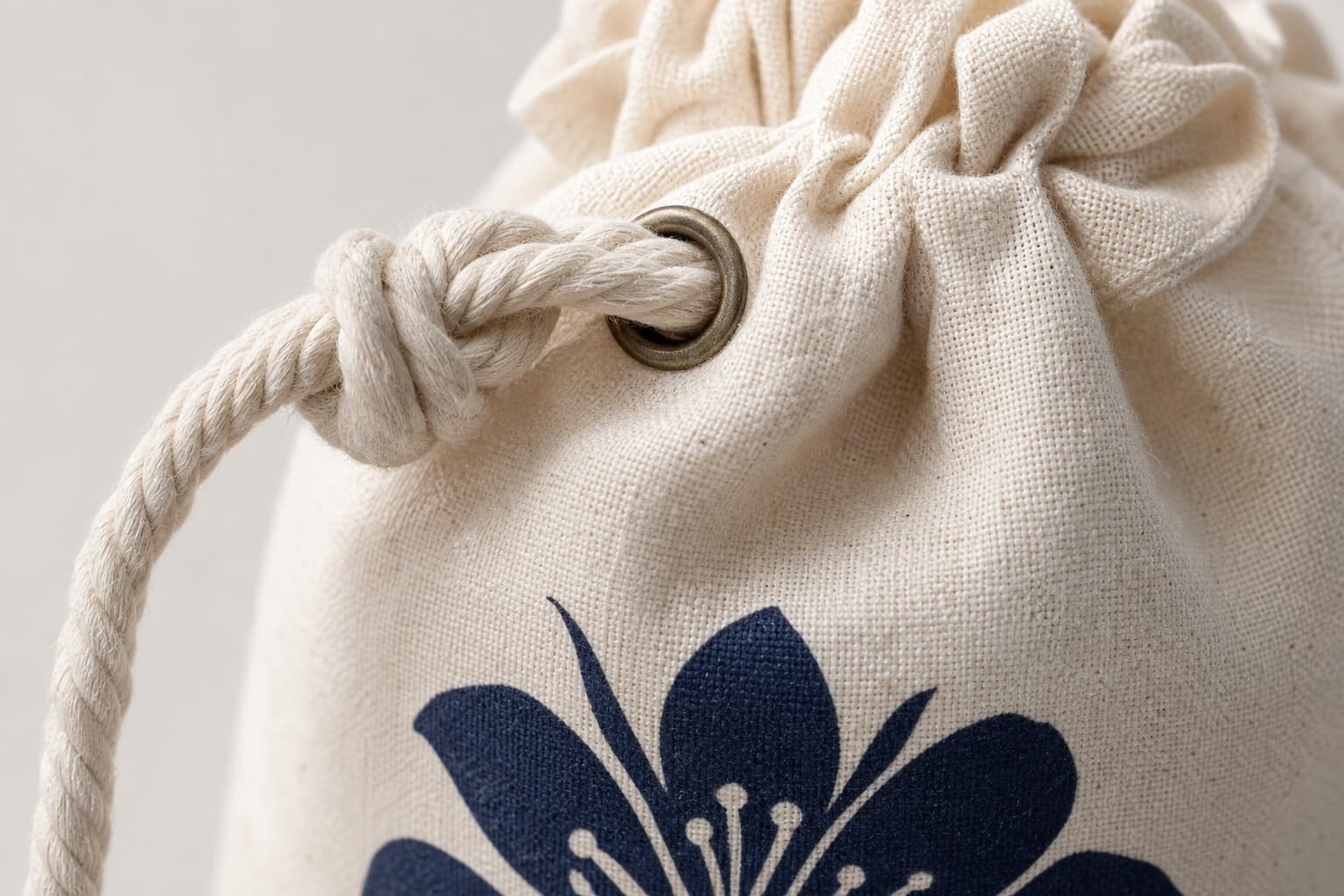
1. Define the pouch role before requesting a price
A useful wholesale drawstring pouches shipping plan starts with the business use, not the generic product name. “Cotton pouch” is not enough for a factory, forwarder, warehouse, or inspector. Procurement should define what the pouch must hold, how it will be presented, how it will be counted, and how it will move through the freight chain. The same outside size can perform differently depending on GSM, weave, seam allowance, drawcord type, print area, fold method, and carton density.
For B2B buyers, the pouch is usually part of a larger commercial system. It may be a low-cost dust bag, a retail gift-set component, a promotional giveaway, an ecommerce insert, or reusable branded packaging. Each use has different priorities. A dust bag may prioritize cost and flat packing. A premium pouch may need better opacity, smoother print, tighter shade control, and cleaner cord finishing. A fulfillment insert may need barcode accuracy and carton segregation more than decorative details.
Shipping should be included from the first specification draft. Freight cost is shaped by fabric thickness, folding, inner packing, carton dimensions, and pallet rules. A low unit price can become less attractive if the cartons are oversized, loosely packed, too heavy for warehouse handling, or missing required labels.
- Define contents: item weight, shape, sharp edges, retail value, and whether fit must be loose or snug.
- Define presentation: promotional, retail-ready, gift packaging, dust protection, ecommerce insert, or reusable brand packaging.
- Define movement: supplier to forwarder, consolidation warehouse, port, distribution center, retailer, or direct fulfillment site.
- Define receiving rules: SKU separation, carton marks, barcode labels, pallet height, appointment delivery, and count verification.
2. Use “shipping plan 01” as a controlled first version
The keyword phrase wholesale drawstring pouches shipping plan 01 can be treated as an internal version name: the first controlled plan for a bulk pouch order. That matters because many order problems come from uncontrolled changes. A buyer approves one fabric, a merchandiser changes the cord, a supplier adjusts carton quantity, and the forwarder receives old dimensions. A versioned plan helps keep the purchase order, sample approval, inspection checklist, and shipment data aligned.
Plan 01 should freeze the minimum information required to quote, produce, inspect, and ship. It does not need to be complicated, but it must be specific. If the supplier makes an exception, the exception should be visible in writing before deposit. If the buyer changes artwork or packing after approval, the supplier should confirm cost, lead time, MOQ, and carton impact before production continues.
For repeat orders, version control also improves reordering. Plan 01 can become the baseline for Plan 02 if the buyer changes GSM, adds a new SKU, moves from bulk pack to retail pack, or changes from FOB to DDP. Keeping those changes separate reduces disputes and makes landed-cost comparison more accurate.
- Assign one version name to the order plan and use it across RFQ, PO, sample approval, QC checklist, and booking notes.
- List revision triggers: artwork change, fabric change, cord change, label change, case-pack change, Incoterm change, or warehouse requirement change.
- Require supplier confirmation when a revision affects price, production lead time, MOQ, carton data, or shipment date.
- Store the approved sample photos, tolerance sheet, carton mark file, and document drafts with the same plan version.
3. Write an RFQ suppliers can quote consistently
A strong RFQ makes quotes comparable. If one factory quotes 140 GSM natural cotton in loose bulk cartons and another quotes 180 GSM dyed canvas with individual polybags, the price gap is not a negotiation gap; it is a different product. The RFQ should tell suppliers which assumptions to price and ask them to identify deviations line by line.
The core request should include finished dimensions, tolerance, fabric, construction, cord, artwork, label requirements, packing, inspection expectations, and Incoterms. Ask suppliers to separate one-time charges from recurring unit cost. Print screens, embroidery digitizing, sample fees, custom dyeing, barcode setup, and special carton marks can make a first order look more expensive than a repeat order if they are not separated.
Quote validity and material availability also matter. Cotton fabric, dyed lots, specialty cord, and labels may change in cost or lead time between sampling and production release. If approval may take several weeks, ask which inputs are reserved, which are estimated, and when pricing must be reconfirmed.
- Product line: SKU, finished size, fabric, color, cord, print, label, and order quantity by SKU.
- Cost line: pouch unit cost, print cost, setup cost, label cost, packing cost, sample cost, and optional pallet cost.
- Logistics line: Incoterm, ship-from location, export port, carton quantity, carton dimensions, gross weight, net weight, and CBM.
- Approval line: sample type, sample lead time, production lead time after approval, inspection window, and shipment-ready date.
- Exception line: any deviation from requested GSM, tolerance, print method, packing format, document requirement, or warehouse rule.
4. Select fabric and construction for load, opacity, and packing behavior
Fabric is one of the largest cost and performance levers in a wholesale pouch order. Cotton in the 130–150 GSM range can work for lightweight promotional pouches, small accessory bags, or low-load inserts where opacity is not critical. For retail presentation or reusable packaging, many buyers prefer 160–200 GSM cotton canvas or twill because it gives more body, improved print definition, and less show-through. Heavier fabric is not automatically better because it increases product cost, shipping weight, and carton volume.
Construction details deserve the same attention as GSM. A narrow seam allowance may reduce fabric consumption but weaken the side seam when filled. A shallow channel may close poorly or bunch at the top. A single drawcord is economical, while a double drawcord can feel easier to open and close. If the pouch will hold a rigid or heavy item, test whether the bottom seam sits correctly and whether corners strain under load.
Natural cotton may show specks, slubs, shade movement, and wrinkles. That may be acceptable for an eco-style program, but it should be approved intentionally. If the brand expects a cleaner retail look, state whether bleached cotton, dyed cotton, canvas, twill, lining, or a different fiber blend is required. Do not rely on product photos alone; request swatches or a physical reference sample before issuing the PO.
- For light inserts: consider 130–150 GSM, simple seam, single drawcord, and flat bulk packing.
- For retail gift packaging: consider 160–180 GSM, controlled shade, cleaner stitch finish, and stronger print testing.
- For heavier contents: review seam allowance, bottom seam strength, cord diameter, and whether lining or reinforcement is justified.
- For premium appearance: check opacity, hand feel, wrinkle behavior, thread color, label finish, and consistency across production lots.
5. Manage print, labels, and artwork as production risks
Branding decisions change cost, lead time, MOQ, and defect risk. One-color screen print on a flat cotton pouch is usually straightforward at volume, but multi-color artwork requires registration control, more setup, and more inspection attention. Heat transfer or digital print may suit short runs or detailed artwork, but buyers should confirm hand feel, adhesion, rub expectations, and how the print behaves when pouches are stacked. Embroidery and woven labels can support premium programs, but they add coordination and may introduce separate MOQs.
The artwork file should not be a loose logo attachment buried in email. It should be controlled with a placement drawing that identifies print size, distance from top edge, distance from side seam, color reference, and whether the pouch is printed before or after sewing. Printing before sewing can help flat registration but requires cutting and seam allowances. Printing after sewing may be simpler for some factories but can be harder near seams, channels, and bulky areas.
The pre-production sample should show the final method, not only a digital mockup. Approve physical print color, line sharpness, placement, curing, and appearance after folding. If the pouch is natural cotton, evaluate the logo on the actual fabric texture rather than on a clean white digital background.
- Screen print: suitable for simple art and repeat orders; check screen charges, color count, curing, and registration tolerance.
- Heat transfer: useful for detailed art or shorter runs; check edge feel, adhesion, cracking risk, and stacking marks.
- Digital print: flexible for complex artwork; check color consistency, fabric compatibility, and repeatability.
- Embroidery: premium but slower; check thread color, backing, stitch density, puckering, and needle marks.
- Woven or side label: subtle branding option; check label MOQ, sewing placement, edge fray, and colorfastness expectations.
6. Evaluate MOQ, price breaks, and landed-cost tradeoffs
MOQ is rarely only a factory preference. It may be driven by fabric roll yield, dye lot minimum, print setup, cord purchase, label production, sewing-line efficiency, carton setup, or SKU segregation time. A supplier may accept a low total MOQ but still require minimums by size, fabric color, artwork, or packing format. This matters for assortments, seasonal colors, and multiple brand variants.
Price breaks should be reviewed with freight. Moving from 5,000 to 10,000 pieces may reduce unit cost, but it can also change the freight mode, carton count, storage requirement, or pallet configuration. The correct comparison is landed cost per usable pouch, including product cost, setup charges, inspection, inland freight, ocean or air freight, duties and taxes where applicable, destination handling, and warehouse receiving cost.
Overage and shortage rules should be clear before production. Fabric pouch orders can lose pieces through cutting errors, sewing defects, print rejects, and QC sorting. Some suppliers may ship a small tolerance over or under the ordered quantity unless the PO prohibits it. For exact retail bundles, define whether overages are allowed, how shortages are credited or replaced, and whether rejected pieces must be remade before shipment.
- Ask for price breaks at realistic levels such as 1,000, 3,000, 5,000, 10,000, and 25,000 pieces if those quantities fit the program.
- Separate recurring unit price from one-time setup fees so repeat-order economics are clear.
- Confirm whether the quote is for blank pouches, printed pouches, labeled pouches, or fully packed retail-ready pouches.
- Compare landed cost per SKU, because small SKUs may carry disproportionate setup, inspection, and packing costs.
- Define acceptable quantity variance, defect replacement policy, and whether the supplier can hold balance inventory for later release.
7. Vet suppliers beyond the sample photo
Supplier vetting should confirm that the factory can make the pouch repeatedly, document it correctly, and prepare it for shipment. A good sample photo does not prove production control. Procurement should review business legitimacy, production capability, quality systems, compliance readiness, export experience, and communication discipline. The objective is to reduce late production, inconsistent materials, rejected cartons, and document problems.
Clarify the supplier’s operating model. Is the supplier a manufacturer, trading company, print shop, sewing contractor, or integrated operation? None of these models is automatically wrong, but each has different controls. If sewing is subcontracted, who checks workmanship? If printing is outsourced, who owns color approval and rework? If fabric is custom dyed, who approves lab dips and shade bands? If packing is done in a separate warehouse, how are counts protected?
For higher-value programs, request a factory profile or relevant audit information. A site check should look at cutting tables, sewing capacity, needle control, fabric storage, print curing area, finished-goods segregation, carton sealing, cleanliness, and how rejected goods are marked. For retailer or brand programs, confirm social compliance, restricted substance declarations, labeling rules, and country-of-origin marking before deposit.
- Business check: legal company name, address, bank beneficiary match, export capability where applicable, and experience with sewn textile packaging.
- Capability check: sewing, printing, label application, packing line, weekly capacity, subcontracted processes, and peak-season limits.
- Compliance check: material declarations, restricted substance statements, retailer requirements, social compliance documents, and origin marking ability.
- Audit check: production flow, QC records, measuring tools, needle control, rejected-goods segregation, carton storage, and safety basics.
- Communication check: accurate replies, clear exceptions, consistent documents, and ability to provide carton data before shipment.
8. Build the shipping plan into the production timeline
Shipping planning should run in parallel with sourcing. Waiting until production is complete to ask for carton dimensions, packing list drafts, or pickup details creates booking delays and revised freight costs. The production timeline should show each milestone from quote to shipment handoff and identify who owns the next action.
A practical workflow starts with the RFQ and ends when the forwarder or carrier receives correct shipment data. After quote comparison, the buyer approves the supplier, confirms specifications, and requests a pre-production sample. Once the sample is approved, the supplier releases materials and production. During production, status updates should be tied to material arrival, cutting, printing, sewing, finishing, and packing rather than vague messages such as “in progress.”
Freight booking depends on accurate carton data. Early estimates are useful for budgeting, but final booking should use confirmed carton count, dimensions, gross weight, net weight, and CBM after a packing trial or final packing. If the order ships on pallets, confirm pallet configuration before pickup. If goods consolidate with other suppliers, carton marks and delivery windows become critical because mislabeled cartons can disappear inside mixed freight.
- Step 1: RFQ includes product spec, packing spec, Incoterms, document needs, and requested freight-ready data.
- Step 2: Supplier quote is compared on landed-cost assumptions, not only pouch unit price.
- Step 3: Buyer approves supplier, deposit terms, sample type, and production timeline.
- Step 4: Pre-production sample is reviewed for fabric, construction, print, cord, label, dimensions, and packing behavior.
- Step 5: Production release freezes approved sample and tolerance sheet; any change requires written approval.
- Step 6: Supplier reports milestones for material arrival, cutting, printing, sewing, finishing, QC, and cartonization.
- Step 7: Pre-shipment inspection checks product quality, count, packing, carton marks, and shipment documents.
- Step 8: Supplier sends final packing list, invoice draft, carton photos, dimensions, gross weight, net weight, and CBM.
- Step 9: Forwarder or carrier books pickup based on confirmed handoff terms and ready date.
- Step 10: Handoff is completed with pickup record, export documents, and final document set sent to the buyer.
9. Specify packing, cartons, palletization, and receiving rules
Packing can make a pouch order more expensive or more difficult to receive than expected. Fabric pouches are flexible, so factories may pack tightly to reduce volume or loosely to avoid creasing. Neither choice is always correct. Procurement should define the acceptable balance between carton efficiency and product presentation. A retail gift pouch may fail visual standards if it arrives heavily creased or print-marked. A commodity insert may benefit from maximum carton density.
Case pack affects receiving accuracy. A carton of 487 pouches might be workable for a one-time project, but it is inefficient for repeat receiving and cycle counts. Standardized quantities such as 100, 200, 500, or another agreed count make inventory checks easier. Inner bundles improve counting but add labor and material. Individual polybags protect premium pouches but increase cost and may conflict with packaging-reduction goals.
Palletization should be decided before final quote if the destination warehouse has rules. Pallets may reduce carton damage and improve handling, but they increase volume and cost. Some import routes use loose cartons for ocean freight and palletize after arrival; others require export pallets from origin. Confirm pallet dimensions, maximum height, carton orientation, stretch wrap, corner boards, labels on two sides, and any wood packaging rules for the destination.
- Define inner pack: loose bulk, counted bundles, paper bands, polybags, retail sleeves, or barcode-labeled units.
- Define master carton: quantity per carton, carton grade, sealing method, maximum gross weight, and whether mixed SKUs are allowed.
- Define carton marks: buyer code, PO, SKU, color, size, quantity, carton number, gross/net weight, country of origin, and handling marks.
- Define anti-damage controls: avoid overfill, keep cartons dry, protect printed faces, prevent ink transfer, and avoid crushing bottom cartons.
- Define receiving rules: appointment requirement, pallet label format, ASN needs, barcode placement, and warehouse rejection rules.
10. Inspect before shipment and control documents after handoff
Quality control for drawstring pouches should be measurable. Phrases such as “good stitching” or “nice printing” are too subjective for a claim. The PO should define acceptance criteria, defect categories, sample size, and inspection timing. For most bulk orders, a pre-shipment inspection after final packing gives the buyer the best chance to catch count errors, print problems, sewing defects, carton damage, and document mismatches before goods leave the factory.
AQL inspection is useful when order size justifies statistical sampling. Many buyers use zero tolerance for critical defects, AQL 2.5 for major defects, and AQL 4.0 for minor defects, adjusted for retailer requirements and product value. Critical defects may include contamination, unsafe foreign objects, mold, or completely wrong product. Major defects may include open seams, wrong size, wrong print, unreadable barcode, mixed SKUs, or carton marks that do not match the packing list. Minor defects may include small loose threads or slight wrinkles within the approved standard.
The final handoff is also a quality-control point. The commercial invoice, packing list, carton marks, PO, SKU list, and booking details should match. Differences in carton count, gross weight, consignee name, or product description can delay pickup, customs clearance, or warehouse receiving. After departure, keep the approved sample record, inspection report, invoice, packing list, freight documents, and supplier correspondence together. These records support claims, reorders, and continuous improvement for the next plan version.
- Measurement checks: finished width, finished height, usable opening, channel depth, cord length, and print position against tolerance sheet.
- Functional checks: open-close cycle test, seam pull, bottom seam load check where relevant, and cord knot/slip check.
- Print checks: color against approved reference, placement, edge clarity, adhesion, rub resistance, contamination, and transfer marks.
- Packing checks: carton count, inner bundle count, carton marks, barcode scan, SKU segregation, gross weight, carton condition, and moisture exposure.
- Document checks: Incoterm, pickup address, contact, ready date, invoice, packing list, carton data, pallet details, booking number, and final shipment photos.
- Release rule: do not authorize shipment until inspection result, rework status, final carton data, and document drafts are approved.
Specification comparison for buyers
| Landed-cost driver | Lower-cost choice | Higher-control choice | What procurement should verify |
|---|---|---|---|
| Incoterms | EXW or FOB when the buyer controls freight and consolidation | CIF, DAP, or DDP only when service scope, insurance, duties, and destination charges are clear | Confirm what is included in the unit quote, who books freight, who pays origin charges, and whether destination fees are excluded. |
| Fabric specification | Natural cotton 130–150 GSM for light products and promotional use | 160–200 GSM cotton canvas/twill or lined construction for retail sets, heavier contents, or premium hand feel | Lock GSM tolerance, shrinkage expectation, opacity requirement, fabric color standard, and whether weight is measured before or after finishing. |
| Print setup | One-color screen print on one side with standard placement | Multi-color screen print, heat transfer, digital print, woven label, or embroidery with approved artwork proof | Confirm setup charges, color matching method, print curing, placement tolerance, rub resistance, and whether rejected print pieces are replaced at supplier cost. |
| MOQ logic | One size, one fabric color, one artwork, bulk packed | Mixed sizes, multiple fabric colors, SKU-specific labels, barcodes, or retail bundles | Ask whether MOQ is per fabric lot, per print screen, per pouch size, per colorway, or per packing configuration. |
| Carton efficiency | Flat bulk pack with uniform case quantity | Inner bundles, barcode segregation, retail-ready packs, or anti-crease protection | Request case pack, carton dimensions, gross weight, net weight, CBM, and carton compression suitability before confirming freight. |
| Palletization | Loose cartons for small LCL or courier shipments | Export pallets for warehouse receiving, cross-dock handling, or retailer compliance | Confirm pallet size, pallet height limit, cartons per pallet, stretch wrap, corner protection, and pallet fumigation or treatment requirements if applicable. |
| Freight mode | Courier or air for urgent samples and small replenishment | Sea LCL/FCL or consolidated freight for planned wholesale orders | Compare landed cost per pouch, not freight cost alone; include chargeable weight, CBM, local fees, handling, and delivery appointment requirements. |
| Sample and approval cost | Factory stock sample or blank size sample | Pre-production sample using final fabric, final print, final cord, and final packing method | Clarify sample fee, print setup fee, sample lead time, refund policy, and whether sample approval freezes production specs. |
| Quality inspection | Factory self-inspection with shipment photos | Pre-shipment inspection using AQL, carton checks, measurement checks, and functional tests | Define inspection level, defect classification, sample size, acceptance limit, rework process, and who pays for reinspection. |
Buyer checklist before sampling
- Build the RFQ around finished pouch size, usable internal opening, seam allowance, channel depth, cord type, fabric GSM, print method, and packing format.
- Ask suppliers to quote by SKU and to separate product cost, print/setup cost, label cost, packing cost, and freight or origin-charge assumptions.
- Confirm MOQ logic: per size, per fabric color, per artwork, per print color, per packing format, and per shipment release.
- Request a pre-production sample made with final fabric, final cord, final print, final label, and intended fold or packing method.
- Approve a tolerance sheet before production: finished width and height, print placement, stitch density, cord length, channel opening, and carton quantity.
- Require freight-ready data before order placement: carton count, carton dimensions, gross weight, net weight, estimated CBM, and cartons per pallet if palletized.
- Define carton marking rules with PO number, SKU, color, size, quantity, carton number, gross/net weight, country of origin, and handling marks where needed.
- Set inspection criteria using AQL or agreed sample-size checks for dimensions, sewing, print, contamination, cord function, count accuracy, and carton condition.
- Request supplier documents before shipment booking: proforma invoice, commercial invoice draft, packing list draft, carton mark file, production schedule, and final shipment photos.
- Confirm handoff responsibility under the chosen Incoterm, including origin pickup, export clearance, freight booking, insurance, destination clearance, and warehouse delivery appointment.
Factory quote questions to send
- What finished pouch size are you quoting, and what are the tolerances for width, height, usable opening, seam allowance, and drawcord channel depth?
- What fabric construction, fiber content, GSM, weave, color standard, and GSM tolerance are included in the quote? Is the GSM measured before or after dyeing/finishing?
- Is the fabric pre-shrunk, washed, bleached, dyed, or untreated? What level of shrinkage, color variance, odor, or natural cotton speckling should we expect?
- What cord type, cord diameter, cord length, knot method, and end finishing are included? Can the cord withstand repeated open-close use without fraying or slipping?
- Which print method is included, how many colors are included, and what are the separate charges for screens, films, digital setup, embroidery, woven labels, or artwork changes?
- What print placement tolerance can you hold in mass production, and what curing or adhesion check do you use before packing printed pouches?
- What is the MOQ per size, per fabric color, per print design, per print color, and per packing configuration? Can mixed SKUs share one fabric lot or shipment?
- What is your normal production capacity for this pouch type per week after material arrival and sample approval?
- What packing method is quoted: loose bulk, inner bundles, individual polybags, retail sleeves, barcode labels, hangtags, or master cartons?
- What is the planned case pack, carton size, gross weight, net weight, and estimated CBM for each SKU? Will these numbers be confirmed after a packing trial?
Quality-control points to confirm
- Finished width and height should match the approved specification within the agreed tolerance, commonly ±3 mm for small pouches and ±5 mm for larger fabric pouches unless the product requires a tighter retail fit.
- Usable internal opening should be checked separately from outside width; the pouch must accept the intended product without forcing the seams or drawcord channel.
- Fabric GSM should match the approved sample or agreed tolerance, commonly within ±5% when measured with an appropriate fabric weight method on representative pieces.
- Fabric color should match the approved lab dip, swatch, or reference sample under consistent lighting; obvious shade variation within the same carton should be treated as a major defect for retail orders.
- Stitch density should be consistent at side seams, bottom seam, and channel; loose tension, skipped stitches, open seams, and broken threads in functional areas should be classified as major defects.
- Seam strength should be checked by moderate manual pull at the side seam and bottom seam; any seam opening, thread breakage, or fabric tearing during normal handling should fail the sample piece.
- Drawcord function should pass repeated open-close cycles, for example 20 cycles on sampled units, without channel tearing, cord slippage, knot failure, or excessive fraying.
- Cord length and symmetry should match the approved sample; cords should close the pouch fully without leaving a distorted mouth or unsafe loose ends for the intended use.
- Print placement should remain within the approved tolerance from the top edge, side seam, and centerline; common tolerance is ±3 mm to ±5 mm depending on pouch size and artwork complexity.
- Print quality should show clean edges, correct color, no smearing, no pinholes beyond the approved standard, no ink contamination, and no transfer marks from stacking before curing.