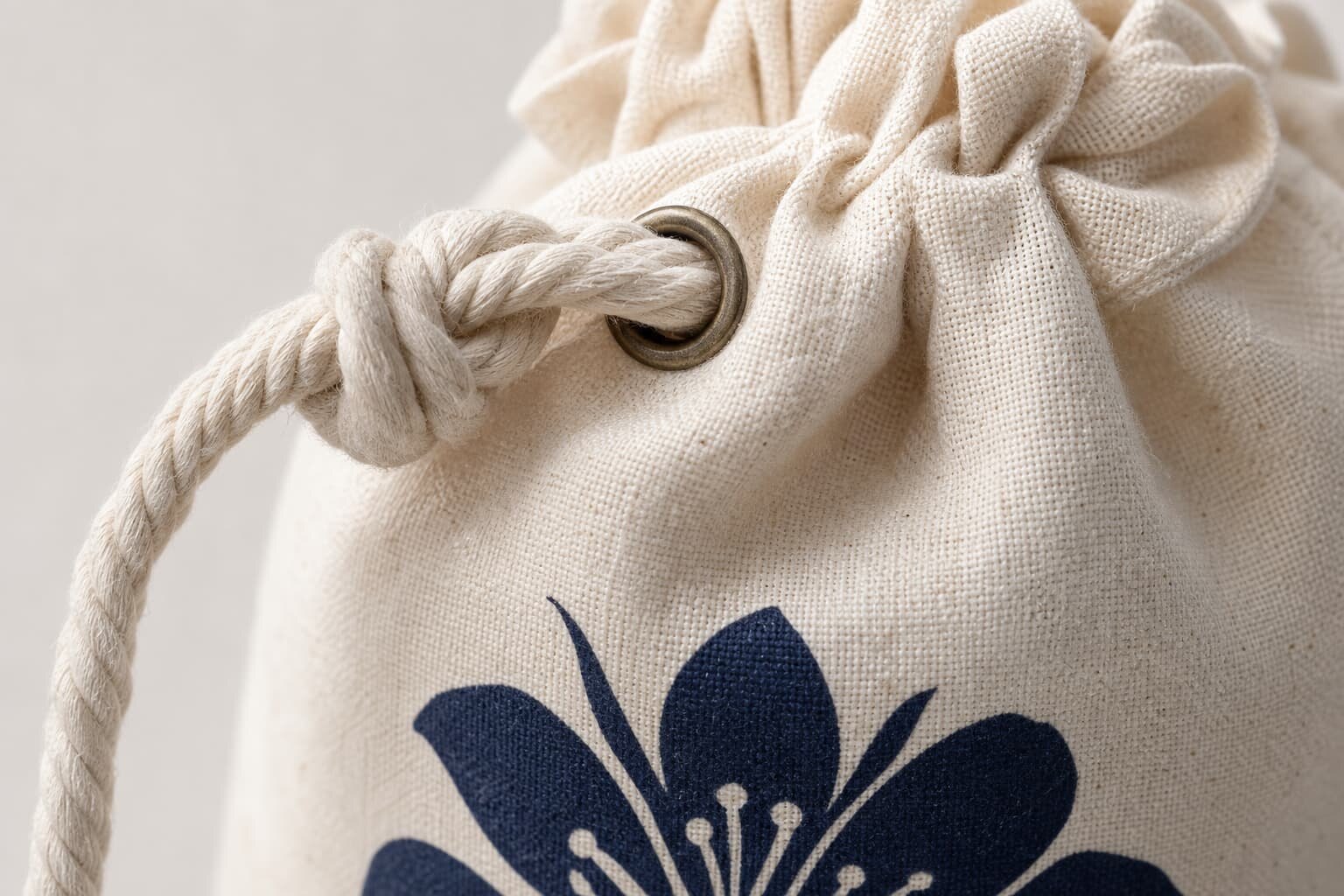
1. The buying problem: samples look simple, bulk pouches fail in details
Wholesale drawstring pouches are often treated as easy items because the shape is simple: two fabric panels, a top channel, side seams, and a cord. In production, most problems come from details that are not written clearly in the RFQ or not checked during sample review. A pouch can look acceptable in a photo but still have the wrong usable size, weak cord channel, thin fabric, poor print curing, or packing that creates unnecessary labor at the buyer's warehouse.
The purpose of a sample review is not to admire one neat sample. It is to confirm that the supplier understands the exact construction and can repeat it at bulk scale. Procurement teams should use the sample stage to remove assumptions from the quote. If the factory quote says cotton drawstring pouch, that is not enough. The buyer needs to know fabric weight, finished size, drawcord type, print method, seam construction, packing method, MOQ logic, and production lead time.
- Main sample risk: approving a pouch without testing it with the real product inside.
- Main quote risk: comparing suppliers when each one quoted a different fabric weight or print method.
- Main production risk: bulk pouches pass visual inspection but fail in drawcord function, size fit, or print durability.
2. Start with the pouch use, not the cheapest fabric
Before asking factories for prices, define what the pouch must do. A small jewelry pouch, a tea sample pouch, a hotel amenity pouch, and a retail canvas pouch for a gift set should not use the same construction. The item inside determines the fabric weight, seam strength, cord choice, and acceptable tolerance. A pouch for a lightweight cosmetic sample may work well in 4 oz or 5 oz cotton. A pouch holding a candle jar, glass bottle, hardware part, or reusable retail kit normally needs a heavier canvas and stronger seam.
Many inaccurate quotes happen because the buyer asks only for size and logo. The supplier then fills in missing details with the cheapest workable option. That may create a low unit price, but it also creates surprise when the sample feels too thin. A better RFQ states the product weight, product dimensions, required handfeel, expected retail environment, and whether the pouch is single-use packaging or a reusable branded item.
- For small jewelry, soap, or cosmetics: 4-6 oz cotton is often enough if the buyer accepts a softer, lighter handfeel.
- For premium gift sets or reusable packaging: 8-10 oz canvas gives better structure and stronger brand presentation.
- For dusty or loose contents: consider tighter weave fabric or lining, because plain cotton can allow powder or fibers to escape.
- For food-contact or cosmetic-contact programs: clarify whether the pouch touches the product directly or only holds a sealed unit.
3. Fabric GSM and ounce weight: what to verify on the sample
Fabric weight is one of the biggest cost drivers for cotton and canvas drawstring pouches. Suppliers may quote in ounces, GSM, or vague descriptions such as natural cotton, muslin, or canvas. For procurement comparison, convert the specification into a measurable range. As a rough reference, 5 oz cotton is often around 140-170 gsm depending on weave and finishing, while 8 oz canvas is commonly around 260-280 gsm. The exact conversion is not always identical, so the sample should be judged by actual handfeel and weight, not only the number on the quote.
When reviewing a sample, cut a small swatch only if you have a duplicate sample or approved permission from the supplier. Otherwise, use a fabric scale or compare against a known reference swatch. Check whether the fabric feels open and loose, whether it becomes transparent when held to light, and whether the weave distorts around the printed logo. A pouch can meet a stated GSM but still feel low grade if the yarn count and weave are poor.
- Ask whether the GSM is measured before or after dyeing, washing, or finishing.
- For natural cotton, check seed specks and color variation; these may be normal but should be agreed.
- For dyed fabric, ask for acceptable shade tolerance and whether the bulk uses one fabric lot.
- For heavy canvas, confirm whether the sewing machines can handle bottom corners cleanly without skipped stitches.
4. Size review: finished size, usable size, and tolerance are not the same
Drawstring pouch size disputes usually happen because the buyer, supplier, and end user are measuring different things. A factory may quote cut size before sewing. A buyer may expect finished flat size. A pack-out team may care about usable inside space after the drawcord is closed. These are three different measurements. If the pouch must fit a product box, bottle, cable set, or sample kit, the sample must be tested with that actual item or a dummy with the same dimensions and weight.
For small pouches, even a 5 mm difference can affect usability. For example, a 100 x 150 mm pouch may look correct on a table but become difficult to close if the product is rigid and nearly the same width. For larger pouches, a +/-10 mm tolerance may be practical, but the buyer should still define whether height includes the top channel or only the area below the drawcord. If the drawcord channel consumes too much height, the pouch may close above the product in an untidy way.
- Measure flat width from side seam to side seam after pressing.
- Measure height from bottom seam to top edge, and separately note usable height below the drawcord channel.
- Check bottom corner shape; bulky corners reduce internal space for rigid products.
- Confirm whether shrinkage is expected if fabric is washed or dyed before sewing.
5. Drawcord and channel checks that prevent returns
The drawcord system is the functional part of the pouch. A sample can look fine when open, but fail when the user pulls the cord. The channel may be too narrow, the cord may twist, or the side opening may tear because there is no reinforcement. Procurement teams should test the drawcord repeatedly during sample review. Open and close the pouch 20 to 30 times, then inspect the channel stitching and side openings.
Cord material also changes the buyer experience. Cotton cord matches natural cotton pouches and has a soft handfeel. Polyester cord can be stronger and more color stable, but may look less natural. Flat cotton tape can create a premium look, but it needs a wider channel and cleaner stitching. For small pouches, cord diameter matters: a thick cord on a tiny pouch looks bulky and may not close tightly.
- Specify cord material: cotton, polyester, jute, satin ribbon, flat tape, or braided cord.
- Specify cord diameter or tape width, not only color.
- Check cord end finishing: knotted, heat sealed, metal tip, plastic tip, or left raw.
- Check whether the pouch uses one single drawcord, two-way drawcords, or a drawstring plus stopper.
- Reject samples where the cord pulls into the channel and cannot be recovered easily.
6. Print method: match artwork to fabric, not only to unit price
For most wholesale drawstring pouches, screen printing is the practical choice for simple logos, brand names, and one to three solid colors. It gives a clean result on cotton and canvas when the artwork is not too fine and the ink is properly cured. The buyer should check ink coverage on the actual fabric, especially on natural cotton or coarse canvas where the surface is not perfectly smooth.
Heat transfer and digital printing can work for small details, gradients, or full-color artwork, but they change the handfeel and may not suit every brand position. Embroidery can look premium but may pucker light fabric and is usually not ideal for very small pouches. Woven labels are useful when the pouch body should remain plain or when the logo detail is too fine for printing. The sample review should confirm not only the logo appearance but also durability during handling and packing.
- For screen print: check registration, edge sharpness, ink thickness, and curing.
- For heat transfer: check film edge visibility, peeling risk, and handfeel after folding.
- For embroidery: check backing, thread tension, and puckering around the logo.
- For woven labels: check label size, fold type, stitch position, and whether it irritates the product inside.
- Ask for Pantone references, but expect fabric base color and weave to affect visual result.
7. Stitching and construction: where low-cost samples hide problems
Pouch construction affects both appearance and durability. Low-cost samples sometimes use a single fold at the top channel or loose overlock inside the seam. This may pass a quick photo review, but it can fray in bulk handling. A better construction for most cotton drawstring pouches is a double-fold top channel with neat side openings and overlocked or enclosed side seams. The correct choice depends on target cost, but the buyer should know what is being quoted.
Inspect the sample inside and outside. Look at the bottom corners, side seam alignment, channel openings, and backstitching. Pull gently at stress points. If the pouch uses a side label, check whether the label is caught securely in the seam without distorting the side edge. Loose threads are not only cosmetic; they can suggest poor machine control and weak final trimming.
- Specify stitch density if important, for example stitches per inch or centimeter.
- Check if side seams are overlocked, French seamed, bound, or raw with pinking.
- Confirm whether the top channel is single-fold or double-fold.
- Review bottom corner strength if the pouch holds hard or heavy items.
- Include loose thread and skipped stitch limits in the inspection criteria.
8. MOQ logic: why the lowest number may not be the real minimum
MOQ for drawstring pouches is not based only on sewing time. It is affected by fabric purchasing, dyeing minimums, printing setup, label production, cord color, packing labor, and cutting efficiency. A natural cotton pouch with one-color print may have a lower MOQ than a dyed canvas pouch with custom cord and woven label. If a supplier gives one MOQ without explaining the reason, the buyer should ask what changes when size, color, or print design changes.
For distributors and retail buyers, MOQ should be calculated by SKU, not only by total order quantity. An order of 10,000 pieces split across five sizes, four fabric colors, and ten print designs is not the same as 10,000 identical pouches. Each variation can create setup time, material leftovers, print screens, and packing complexity. A clear MOQ discussion prevents suppliers from accepting the order first and then pushing changes after sampling.
- Natural stock fabric plus simple screen print usually has the most flexible MOQ.
- Custom dyed fabric may require a higher fabric mill minimum and longer lead time.
- Each logo color may require a screen setup and extra print pass.
- Custom woven labels, metal tips, stoppers, or special cords can create separate accessory MOQs.
- Mixed-size or mixed-color cartons should be priced as an extra handling requirement if needed.
9. Packing and carton data: check this before the warehouse complains
Packing is often left until the end, but it affects cost, lead time, freight volume, and warehouse receiving. Bulk packed pouches are efficient for distributors who will unpack and process stock later. Individual polybags can protect printed surfaces and keep units clean for retail or kitting, but they add labor, material cost, and carton volume. Paper bands or bundle packing may be a useful compromise for brands reducing plastic use.
During sample approval, ask the factory to show the proposed folding method and inner packing. Heavy folding can create print marks if ink is not cured or if pouches are packed too soon after printing. For natural cotton, avoid packing while fabric is damp or warm. Carton data should be included in the quote so the buyer can estimate freight and compare suppliers on landed cost, not only unit price.
- Confirm pieces per inner bag, pieces per carton, carton dimensions, gross weight, and net weight.
- Specify whether pouches are packed flat, folded once, bundled, or individually bagged.
- Check whether carton marks include PO number, SKU, color, size, quantity, and country of origin if required.
- Ask whether desiccants are needed for sea shipment, especially for humid seasons or long transit.
- Avoid mixed cartons unless the receiving warehouse specifically wants them.
10. Quote comparison: build a line-by-line approval record
The best way to compare wholesale drawstring pouch quotes is to make every supplier quote the same specification sheet. If one supplier quotes 5 oz cotton with one-color screen print and another quotes 8 oz canvas with woven label and individual polybagging, the cheaper price is not a better deal; it is a different product. Procurement teams should require quote data that can be checked against the approved sample.
After selecting the supplier, create a sample approval record. This does not need to be complicated, but it must be specific. List the approved fabric, GSM, finished size, drawcord, print method, logo size, print position, stitching, label, packing, MOQ, sample date, and revision number. Keep one signed sample with the buyer and one with the factory. Bulk inspection should compare production against this record, not against memory or email photos.
- Ask for unit price by quantity tier, not only one quantity.
- Separate tooling, screen, sample, label, and packing charges from unit price.
- Record sample lead time and bulk lead time after sample approval.
- Confirm whether price includes export carton, inner packing, and standard QC.
- Request estimated CBM and carton weight before confirming shipping method.
Specification comparison for buyers
| Spec decision | Recommended option | When it fits | Buyer risk to check |
|---|---|---|---|
| Fabric weight | 5 oz / 140 gsm cotton for light gifts; 8 oz / 270 gsm canvas for heavier retail use | Choose lighter cotton for cosmetics, jewelry, candles, small kits; choose canvas for reusable premium packaging | Thin fabric may show contents and wrinkle after printing; heavy fabric may increase freight and MOQ |
| Pouch construction | Double-fold top channel with overlocked side seams | Best for general wholesale drawstring pouches where clean finish and low defect rate matter | Single-fold channel can fray; narrow channel may make the drawcord hard to pull |
| Drawcord type | Cotton cord 3-5 mm or flat cotton tape for natural pouch programs | Good for eco-positioned packaging and apparel accessories | Cord color variation, loose cord ends, and poor knotting can cause buyer complaints |
| Print method | Screen print for 1-3 solid colors; heat transfer for detailed small logos | Screen print fits most brand logos and stable repeat orders; transfer fits gradients or tiny artwork | Ink bleeding on loose weave fabric, poor curing, and inaccurate Pantone matching |
| Size tolerance | Agree finished size tolerance of +/-5 mm for small pouches and +/-10 mm for larger pouches | Useful when the pouch must fit a boxed product, bottle, cable set, or retail kit | Unclear measurement point causes disputes because flat size, usable inside size, and cut size differ |
| Packing method | Bulk packed by size/color with inner polybag or paper band, then export carton | Works for distributor stock, kitting warehouses, and retail pack-out operations | Individual polybagging increases labor and carton volume; mixed cartons can slow receiving |
| Sample approval | Approve sealed pre-production sample with fabric, drawcord, print, stitching, and packing confirmed | Needed before mass production when logo, size, or material is custom | Approving only a photo sample leaves fabric handfeel, color, and draw function unchecked |
Buyer checklist before sampling
- Confirm finished pouch size, not only cut size, and check whether the supplier measures flat width by height excluding the drawcord.
- Weigh and feel the fabric sample; compare stated GSM or ounce weight against the intended product weight and retail positioning.
- Pull the drawcord 20-30 times to check smooth closing, channel width, knot security, and whether the cord slips back into the seam.
- Inspect print position, ink coverage, curing, edge sharpness, and whether the print cracks when the pouch is folded.
- Check side seams, bottom corners, backstitching, overlock quality, loose threads, and any needle holes around labels.
- Place the real product or a dummy with the same dimensions into the pouch to confirm usable capacity.
- Request the same packing method that will be used in bulk production, including carton marking and inner quantity.
- Compare the approved sample against the quote line by line: fabric, GSM, size, color, print, drawcord, label, packing, MOQ, and lead time.
- Record acceptable tolerances for size, print placement, color variation, and sewing before paying the bulk deposit.
- Keep one signed sample with the buyer and one with the factory as the production reference.
Factory quote questions to send
- Is the quoted fabric weight the finished fabric GSM after dyeing and washing, or the greige fabric weight before processing?
- What is the finished pouch size tolerance, and where exactly will width and height be measured?
- Which drawcord material, diameter, color, and end finishing are included in the quote?
- Is the print cost based on screen print, heat transfer, digital print, embroidery, woven label, or another method?
- How many print colors are included, and are screen setup charges or artwork charges listed separately?
- What is the MOQ by size, fabric color, print design, and packing style?
- Will bulk production use the same fabric lot, drawcord, ink, and sewing construction as the approved sample?
- What is the sample lead time, bulk lead time after sample approval, and expected queue time before cutting starts?
- What are the carton dimensions, gross weight, net weight, pieces per carton, and total estimated CBM?
- What inspection standard will be used before shipment, and which defects are considered critical, major, or minor?
Quality-control points to confirm
- Fabric GSM and color must match the approved sample within agreed tolerance.
- Finished size must stay within the approved measurement tolerance and be measured after sewing and pressing.
- Drawcord channel must allow smooth opening and closing without cord jamming or seam tearing.
- Side seams and bottom seams must be secure, straight, and free of skipped stitches.
- Print must be correctly positioned, cured, and resistant to light rubbing and folding.
- Labels, if used, must be placed in the approved seam position and sewn without puckering.
- No visible stains, oil marks, needle damage, broken yarns, or heavy loose threads on the finished pouch.
- Packing quantity per inner bag and carton must match the purchase order and packing list.