1. The buying problem: low pouch quotes often hide changed specs
A wholesale drawstring pouch looks simple, so many buyers treat it as a low-risk packaging item. In practice, the cost can move sharply when fabric weight, cord type, print area, packing, and MOQ rules are not fixed before quoting. A supplier can reduce the unit price by changing from 180 GSM cotton to 120 GSM, replacing cotton cord with thin polyester cord, reducing seam allowance, quoting single drawstring instead of double, or excluding individual retail packing.
This cost report focuses on one practical problem: how to compare drawstring pouch quotations without being misled by incomplete specifications. It is written for procurement teams, brand owners, importers, distributors, and retail buyers who need a clean RFQ, realistic supplier comparison, and fewer approval delays before bulk production.
- Do not compare pouch quotes by unit price only; compare the material, print, sewing, packing, and lead time assumptions behind the price.
- Ask every supplier to quote the same finished size, GSM, drawstring structure, artwork, packing method, and inspection requirement.
- Treat a very low quote as a signal to check fabric weight, cord diameter, MOQ allocation, and whether setup charges are excluded.
2. Start with finished size, not flat fabric consumption guesses
The first cost driver is size, but many RFQs describe size too loosely. A pouch stated as 10 x 15 cm may mean finished outside size, usable inside size, cut panel size, or approximate size after drawstring channel folding. The difference matters because small pouches lose a high percentage of fabric to seams and channel allowance. For a jewelry pouch, 5 mm in height can change the position of the logo and the way the product sits inside.
For buying control, define the finished outside dimensions when the pouch is laid flat and closed, then separately state the usable product area if important. If the pouch must hold a bottle, candle jar, gift box, cosmetic tube, or electronic accessory, give the product dimensions and weight. A factory can then confirm whether the pouch needs wider side clearance, deeper bottom space, heavier fabric, or stronger channel stitching.
- State finished size as width x height in centimeters or inches, with the drawstring channel included or excluded clearly noted.
- Add tolerance: small pouches often need tighter control, such as +/-5 mm; larger pouches may accept +/-10 mm if logo placement remains acceptable.
- If the pouch will hold a rigid item, provide item dimensions and request a fit sample instead of approving only a flat pouch.
- Confirm whether the pouch has a flat bottom, boxed bottom, gusset, or simple flat construction; each changes material consumption and labor.
3. Fabric GSM is the most common hidden cost lever
Fabric GSM controls handfeel, opacity, print result, durability, and price. For drawstring pouches, common cotton ranges are roughly 100-120 GSM for light promotional packaging, 140-160 GSM for better retail presentation, and 180-220 GSM for more durable reusable pouches. Canvas-style pouches may go heavier, but they become bulkier, more expensive to ship, and less suitable for very small drawstring openings.
The danger is that suppliers may quote different GSM while using the same wording, such as 'cotton pouch' or 'canvas pouch.' One supplier's 6 oz cotton may not match another's 160 GSM cotton if fabric construction and measurement method differ. Procurement should request GSM, fabric composition, weave type, and shade tolerance in writing. For natural cotton, confirm whether cotton seeds, dark specks, and slubs are acceptable because removing or controlling them can add cost.
- 100-120 GSM: suitable for light packaging and short-term promotional use, but may feel thin and show contents more easily.
- 140-160 GSM: balanced option for branded gift, cosmetics, jewelry, and retail accessory pouches.
- 180-220 GSM: stronger handfeel for reusable packaging, heavier products, or premium brand presentation.
- Recycled cotton blends: useful for sustainability positioning, but require clear approval of shade variation and fiber specks.
- Dyed fabric: confirm colorfastness expectations, dye lot control, and MOQ because custom dyeing usually increases both cost and lead time.
4. Drawstring and sewing details decide whether the pouch feels cheap
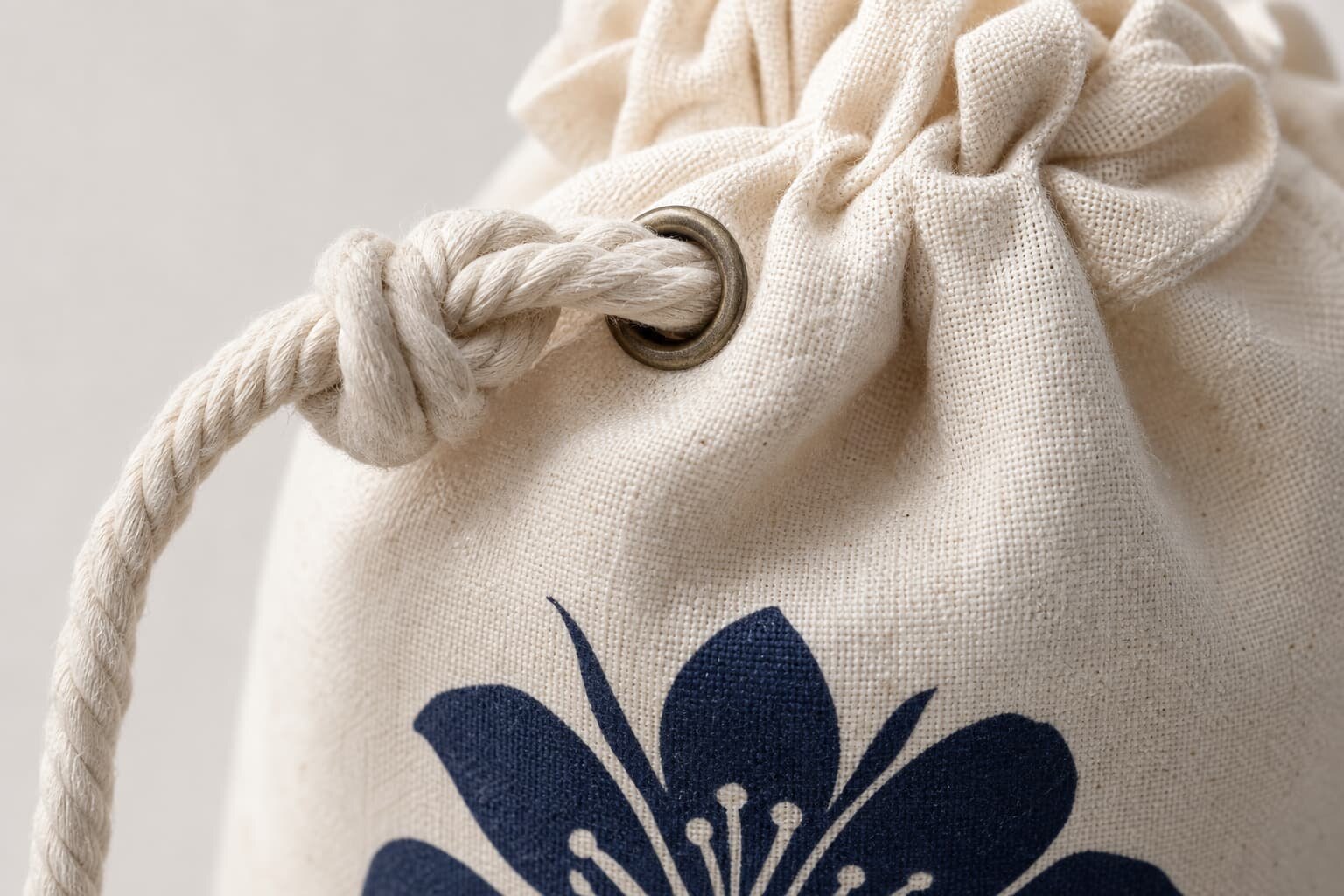
The drawstring is small, but it affects both cost and user experience. Cotton cord gives a natural look and matches cotton or canvas pouches well. Polyester cord is often smoother and cheaper, but it can look less premium on unbleached cotton. Cord diameter also matters. A 2 mm cord may close easily on a small pouch, while a 5 mm cord may look better on a larger gift pouch but require a wider channel and more careful stitching.
Sewing should not be treated as a generic line item. The drawstring channel needs enough width for smooth movement, the cord exit points need reinforcement, and side seams should not unravel after repeated opening. If the pouch carries heavy contents, the bottom seam and corner stress points should be checked. For very small pouches, bulky seams can reduce usable space and distort the logo area.
- Single drawstring is lower cost and acceptable for small pouches or simple packaging.
- Double drawstring improves opening balance and user feel, especially on gift packaging and reusable retail pouches.
- Cotton cord supports natural branding but may have more shade variation than synthetic cord.
- Polyester cord can reduce cost and improve smoothness, but confirm whether the visual style fits the brand.
- Request photos of the channel seam, cord exit, inside seam finishing, and bottom corners during sample approval.
5. Print method: compare artwork-based cost, not a generic logo price
Print cost depends on method, color count, print size, ink coverage, fabric color, and registration tolerance. Screen printing is usually the practical choice for one to three solid logo colors on cotton drawstring pouches. It gives a clean result and stable unit cost at volume. Heat transfer can handle gradients, small details, and full-color artwork, but it changes handfeel and may not suit every fabric texture. Embroidery and woven labels add premium value but also add labor, MOQ, and approval complexity.
The mistake is asking for 'logo print included' without giving final artwork. A 5 x 5 cm one-color logo is not the same cost as a 15 x 20 cm solid ink block. Printing on dark dyed cotton may need an underbase or different ink system. Printing over seams or too close to the drawstring channel can cause registration issues. A serious supplier should quote against the actual artwork file and confirm maximum print area for the pouch size.
- Screen print: best for solid logos, simple typography, and repeat orders where cost stability matters.
- Heat transfer: useful for gradients and detailed graphics, but confirm adhesion, edge feel, and washing expectations.
- Woven label: good for premium reusable pouches, but needs label MOQ, label lead time, and sewing placement approval.
- Embroidery: durable and premium, but not ideal for very thin fabric or very small pouches because puckering can occur.
- Ask for print position tolerance; on small pouches, even a few millimeters of drift can look obvious.
6. MOQ logic: the minimum is usually not one simple number
Many buyers ask, 'What is your MOQ?' and receive a number that sounds simple. For drawstring pouches, the real MOQ can be split by fabric color, pouch size, cord color, print design, print color, and packing format. A supplier may accept 5,000 pieces total, but only if all pieces use one fabric color and one print design. If the buyer splits the order into five SKUs of 1,000 pieces, the cost and production efficiency change.
MOQ also depends on whether the fabric is in stock. Natural cotton, black cotton, and common GSM fabrics may be easier to source at lower quantities. Custom dyed fabric, special cord color, unusual GSM, and custom woven labels can push MOQ higher. Procurement teams should ask suppliers to show the MOQ rule behind the quotation so merchandising can decide whether to reduce SKU count, standardize fabric, or accept a higher unit cost for smaller runs.
- Ask for MOQ per finished size, not only total order quantity.
- Ask for MOQ per fabric color and whether natural cotton stock fabric has a lower minimum.
- Ask whether each artwork version requires separate setup charges and minimum production quantity.
- For assortment programs, request a price grid by quantity break and SKU count.
- If a supplier accepts a low MOQ, confirm whether they are using leftover fabric, substitute GSM, or manual printing with looser tolerance.
7. Packing decisions can change both unit cost and freight cost
Packing is often ignored until after price approval, but it can add material, labor, carton volume, and compliance work. Bulk flat packing is usually the lowest cost and best for importers who will repack locally. Inner bundles can help counting and warehouse handling. Individual polybags protect the pouch but add plastic cost, labor, barcode control, and possible plastic restriction issues depending on the destination market.
For retail buyers, packaging may require hangtags, barcode stickers, suffocation warning bags, carton labels, or master carton markings. Each requirement should be quoted separately. Carton dimensions also matter because drawstring pouches are soft, but cord bulk and individual packing can increase carton cube. A quote with a slightly lower unit price may become more expensive after ocean or air freight if packing is bulky.
- Bulk flat pack: lowest cost and efficient for B2B shipment, but not retail-ready.
- Bundle packing: useful for counting, distribution, and warehouse receiving.
- Individual polybag: improves cleanliness but increases cost, plastic use, and packing time.
- Retail-ready packing: requires barcode, hangtag, warning text, and carton labeling control.
- Always request pieces per carton, carton size, gross weight, and net weight before comparing landed cost.
8. Lead time should be broken into production steps
A drawstring pouch lead time can look short when the supplier has stock fabric, available printing capacity, and simple packing. It becomes longer when fabric must be dyed, artwork needs color matching, labels are custom woven, or the order has many SKUs. The most common delay points are artwork approval, fabric arrival, print sample correction, and packing material confirmation.
Procurement should not accept only a single lead time number. Ask for a timeline showing sampling, material preparation, printing, cutting, sewing, finishing, inspection, packing, and shipment readiness. This helps the buyer understand which approval delay will affect the ship date. It also allows the buyer to place carton label and barcode approvals early instead of discovering packing issues during final inspection.
- Sample development: allow time for fabric swatch, print strike-off, and fit check if the pouch holds a specific product.
- Material preparation: stock fabric is faster; custom dyed or special GSM fabric needs more planning.
- Printing: multi-color screen print needs registration checks and may need more drying or curing time.
- Sewing: small pouches require handling accuracy; many sizes or SKU splits can slow line efficiency.
- Packing: individual packing, barcode labeling, and assortment packing can become a real bottleneck.
9. Sample checks: approve the production standard, not just a nice prototype
A sample is not only for appearance. It is the physical contract for fabric weight, seam construction, drawstring feel, print quality, and packing method. The problem is that some approval samples are made from available sample-room fabric, not actual bulk fabric. The sample may look good, but bulk production may shift in shade, GSM, cord thickness, or print handfeel.
For custom drawstring pouches, request a pre-production sample made with confirmed bulk fabric, actual cord, final artwork, and intended sewing construction. If timing does not allow full sample approval, at least approve a fabric swatch, print strike-off, and construction sample separately. Keep one signed or sealed approval sample with the buyer and one with the factory so inspection teams can compare bulk production against the same reference.
- Measure sample size laid flat and confirm whether it matches the finished dimension standard.
- Weigh or test fabric GSM if the order depends on a specific weight.
- Pull the drawstring repeatedly to check channel width and cord friction.
- Check logo size, print position, ink sharpness, and color under neutral light.
- Place the actual product inside the pouch and confirm fit, closure, and appearance.
- Review packing sample if the pouch will be sold or distributed in retail packaging.
10. Build a quote comparison sheet that exposes hidden differences
A useful quote comparison sheet should show more than supplier name, unit price, and lead time. It should list finished size, fabric GSM, composition, fabric color, cord material, cord diameter, closure type, print method, print size, color count, setup charges, sample cost, MOQ rules, packing method, carton data, and payment terms. When these fields are visible, the cheapest quote may no longer be the best commercial choice.
For procurement approval, separate product cost from tooling or setup cost. A supplier may offer a lower unit price but charge separately for screens, labels, packing, barcode stickers, or sample courier. Another supplier may include those charges in the unit price. If the buying team only compares unit price, the landed cost calculation becomes unreliable. Use the same specification sheet for every supplier and require them to confirm exceptions in writing.
- Compare total order value, not only unit price, especially when screen charges or label charges apply.
- Convert all quotes into the same Incoterm and currency before internal review.
- Add estimated freight using carton dimensions and gross weight, not only piece count.
- Flag any quote that does not state GSM, print area, packing method, or MOQ split.
- Before PO release, send a final specification confirmation sheet and require supplier signature or written confirmation.
Specification comparison for buyers
| Spec decision | Recommended option | When it fits | Buyer risk to check |
|---|---|---|---|
| Fabric weight | 120-160 GSM cotton for light retail packaging; 180-220 GSM for reusable gift or accessory pouches | Cosmetics, jewelry, candles, small apparel, amenity kits, electronics accessories | Supplier may quote lower GSM or looser weave to win price; request actual GSM tolerance and pre-production swatch |
| Fabric construction | Plain weave cotton or recycled cotton blend with declared composition | Most branded packaging orders where print clarity and sewing stability matter | Recycled blends can have specks and shade variation; confirm acceptance limit before bulk |
| Drawstring cord | Cotton cord 3-5 mm for natural look; polyester cord for lower cost and smoother pulling | Cotton cord fits eco-positioned brands; polyester fits promo and high-volume retail | Cord diameter affects cost, pull feel, and carton cube; ask whether quote includes knotted ends |
| Print method | Screen print for 1-3 solid colors; heat transfer for complex artwork; woven label for premium repeat orders | Screen print is best for clean logos and stable cost; transfer fits gradients and small detail | Print area, ink coverage, and setup charges can change unit cost; request artwork-based quote, not verbal estimate |
| Closure style | Single drawstring for lowest cost; double drawstring for better opening balance | Single cord works on small pouches; double cord is better for gift sets and frequent reuse | Some suppliers quote single cord while samples show double cord; define closure in RFQ |
| MOQ basis | Negotiate by fabric color, size, and print design instead of total order only | Multi-SKU retail programs with several pouch sizes or logo versions | A headline MOQ may hide per-color or per-artwork minimums; confirm allocation rules |
| Packing method | Flat packed in export carton; inner polybag only if required by retail handling | Best for bulk importers and distributors controlling freight cube | Individual polybags add labor, material cost, plastic compliance burden, and packing time |
| Sample approval | Approve fabric, size, cord, print, and packing sample before bulk cutting | All custom pouches, especially repeat retail packaging programs | Photo approval alone can miss GSM, handfeel, drawstring function, and seam strength |
| Lead time control | Separate fabric readiness, printing, sewing, finishing, and inspection dates | Orders with launch windows, seasonal gifting, or consolidated shipment plans | Suppliers may quote one overall lead time without showing bottlenecks; printing and dyed fabric are common delays |
Buyer checklist before sampling
- Define pouch size as finished outside dimensions and include acceptable tolerance, usually +/-5 mm for small pouches and +/-10 mm for larger drawstring bags.
- State fabric composition, GSM, color, weave, and whether unbleached specks or recycled fiber variation are acceptable.
- Specify single or double drawstring, cord material, diameter, color, knotting method, and whether cord ends need metal tips or heat sealing.
- Attach final artwork with print size, placement, Pantone references, ink coverage, and whether print must pass rub or wash testing.
- Ask suppliers to quote setup charges, sample charges, printing plate or screen charges, and packing costs separately from unit price.
- Confirm MOQ by size, fabric color, drawstring color, and artwork version, not only total order quantity.
- Request carton dimensions, gross weight, pieces per carton, and packing method before comparing freight cost.
- Require a pre-production sample made with the confirmed bulk fabric, bulk cord, and final artwork before mass production.
- Set inspection points for fabric GSM, cutting size, seam strength, drawstring function, print position, and carton labeling.
- Compare quotes using one landed-cost sheet, including product cost, setup, packing, inland handling, freight cube, duty basis, and inspection cost.
Factory quote questions to send
- What exact fabric GSM, composition, and width are included in this quotation, and what GSM tolerance will you accept in bulk?
- Is the quoted fabric stock greige, stock dyed, or custom dyed, and how does that affect MOQ and lead time?
- Does your unit price include one-color screen print, and what print size and ink coverage did you assume?
- Are screen charges, artwork adjustment, sampling, courier cost, and bulk print setup included or charged separately?
- Is the closure single drawstring or double drawstring, and what cord material, diameter, and color are included?
- What is your MOQ per pouch size, fabric color, cord color, and logo design?
- What packing method is included: bulk flat pack, inner bundle, individual polybag, barcode sticker, or retail-ready packing?
- What are the planned carton dimensions, pieces per carton, and estimated gross weight for the quoted specification?
- Can you provide a pre-production sample using actual bulk fabric and final print before cutting all units?
- Which production step controls the quoted lead time: fabric procurement, dyeing, printing, sewing capacity, or packing materials?
Quality-control points to confirm
- Check fabric GSM by cutting and weighing a measured sample, not only by reading the supplier's fabric label.
- Measure finished pouch width and height after sewing and pressing; compare against approved sample and RFQ tolerance.
- Open and close the drawstring ten times on random samples to check cord friction, channel width, knot security, and seam drag.
- Inspect print position using a simple placement template; small pouches can look defective with only 3-5 mm logo drift.
- Conduct dry rub testing on dark prints and wet rub testing when the pouch will contact light-colored retail goods.
- Pull-test side seams and drawstring channel seams by hand, especially near the cord exit points where tearing often starts.
- Review shade consistency between pouch fabric, cord, label, and approved sample under neutral light.
- Check loose threads, skipped stitches, broken needles, fabric holes, oil marks, and print smears before packing.
- Verify inner quantity, carton quantity, carton markings, barcode labels, and packing direction against the purchase order.
- Retain one approved sample and one sealed production sample for claim handling and repeat-order comparison.