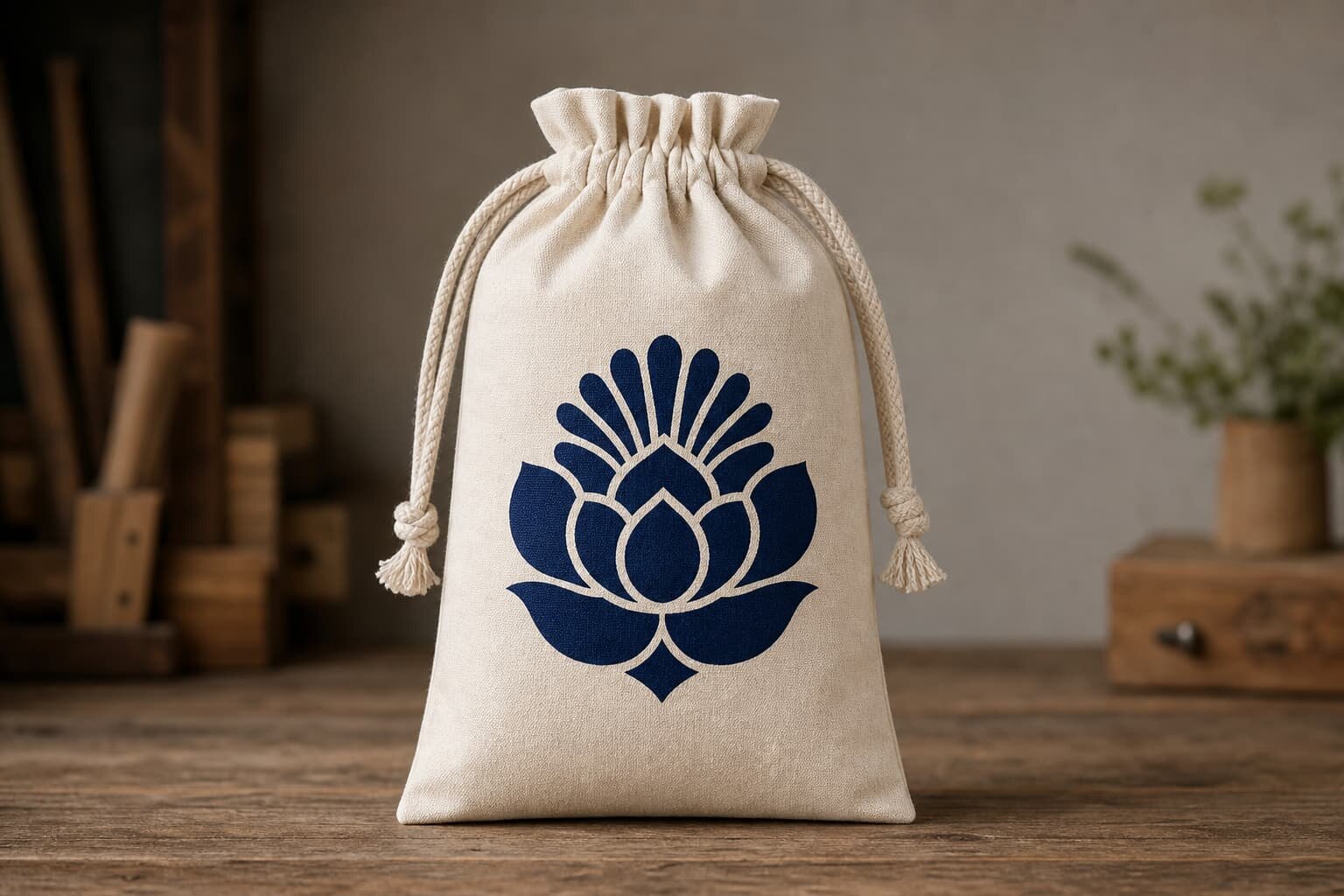
1. Start With the Buying Problem, Not the Pouch Name
Most poor wholesale drawstring pouch quotations come from a vague RFQ such as 'cotton drawstring bag, 10 x 15 cm, logo printed.' That description is not enough for a factory to quote accurately. The pouch may be used for jewelry, soap, a candle accessory, electronics, food-adjacent packaging, or a subscription box insert. Each use changes the fabric weight, closure strength, seam construction, printing method, and packing format.
Before comparing suppliers, define what the pouch must protect, how it will be presented, and how it will be handled after delivery. A pouch used only as a dust cover can be lighter and simpler. A pouch sold as part of a retail product must look consistent across cartons, open smoothly, and carry the logo cleanly. The clearer your use case, the easier it is to reject unrealistic low quotes that leave out fabric quality, setup cost, or packing labor.
- For jewelry and cosmetics, focus on soft handfeel, clean seams, and precise logo position.
- For candles, ceramics, glass, or accessories, confirm the item weight and whether the pouch needs thicker fabric.
- For promotional giveaways, cost control matters, but the drawcord must still run smoothly during fast packing.
- For retail packaging, barcode labels, individual packing, and carton consistency may matter as much as the pouch itself.
2. Size Specification: Flat Size, Usable Space, and Tolerance
Drawstring pouches are normally quoted by finished flat size: width x height measured when the pouch is empty and lying flat. This does not equal the usable internal space. The side seams, bottom seam, top tunnel, fabric thickness, and drawstring closure all reduce the space available for the product. If the packed item is thick, the pouch will lose more height and width when filled.
A common mistake is to provide only the product dimensions and ask the factory to choose the pouch size. The supplier may choose a tight size to win the unit price comparison, but your warehouse team may later struggle to insert the product. For RFQs, provide both the target pouch flat size and the product dimensions. If you are not sure, request two size options and ask the factory to explain the difference in packing efficiency and appearance.
- State size as finished flat width x finished flat height, for example 12 cm W x 18 cm H.
- Clarify whether the top drawcord tunnel is included in the total height; it usually is.
- For thick products, ask for a fitting test sample instead of relying only on flat measurement.
- Typical size tolerance may be around plus or minus 0.5 cm for small pouches and higher for larger fabric bags, but confirm with the factory.
- If the pouch must fit into an outer carton or retail box, provide those dimensions early.
3. Fabric GSM: Where Buyers Often Overpay or Under-Spec
Fabric weight is one of the main cost drivers for wholesale drawstring pouches. Light cotton around 90-110 GSM can work for simple packaging, but it may look thin, especially in natural or white fabric. A more balanced range for many branded pouches is 120-180 GSM cotton. It gives better opacity, a nicer handfeel, and more stable printing without making small pouches too bulky.
For premium or heavy-duty uses, buyers often move to canvas, such as 10 oz or 12 oz cotton canvas, roughly in the 280-400 GSM range depending on construction. Canvas gives a stronger retail feel but changes the sewing and closing behavior. Small canvas pouches can become stiff, and thick seams may make the top closure less neat. Do not choose the heaviest fabric just to sound premium; choose the weight that matches product value, pouch size, and user handling.
- 90-110 GSM cotton: budget packaging, light giveaways, single-use presentation where transparency is acceptable.
- 120-180 GSM cotton: common choice for retail gift pouches, cosmetics, jewelry, accessories, and subscription products.
- 200-240 GSM cotton: stronger feel, better opacity, useful for larger pouches or higher perceived value.
- 10-12 oz canvas: suitable for heavier contents, reusable packaging, and premium accessories, but confirm drawcord movement.
- Jute or linen-blend looks natural but may print less sharply than smoother cotton fabric.
4. Drawcord and Tunnel Construction Affect Real Use
The drawstring is not a decoration; it is a working component. If the cord is too thin, the pouch can feel cheap and knots may slip. If the cord is too thick, it may jam inside a narrow tunnel. Cotton cord matches natural cotton pouches and is often preferred for eco-style branding. Polyester cord is smoother and may run better for repeated opening and closing, but it has a different visual feel.
The tunnel height and seam finishing should be reviewed on the sample, especially for small pouches. A narrow folded top may look fine when empty but become difficult to close after the product is inserted. Double drawstring construction gives a better user experience because the pouch can be pulled closed from both sides. Single drawstring construction can reduce cost and is acceptable for simple packaging, but buyers should confirm the look after closing.
- Ask for cord material, diameter, length, and color in the quotation.
- Check whether cord ends are knotted, heat sealed, metal tipped, or left plain.
- For children-related products, confirm safety expectations for cord length and small parts with your compliance team.
- For heavier items, ask whether the side openings are reinforced or bartacked.
- For dyed fabric, check whether cord color is stock color or custom dyed; custom cord may affect MOQ and lead time.
5. Logo Printing: Choose the Method Based on Artwork, Not Habit
Screen printing is often the practical choice for wholesale drawstring pouches with simple artwork, solid colors, and medium to large order quantities. It can be cost-efficient and durable when ink is matched correctly to the fabric. However, fabric texture affects edge sharpness. Very small text, thin lines, and large solid ink areas need sample testing. A logo that looks perfect on a PDF may look rough on coarse cotton or jute.
Heat transfer can handle finer detail, gradients, and multi-color artwork, but buyers should check handfeel and wash or rub performance if the pouch is reusable. Embroidery gives a premium textile effect but can pucker lightweight fabric and is usually not suitable for very small pouches. Woven labels or sewn side labels are good for repeat retail programs because the label can be standardized, but placement tolerance and label MOQ must be understood before order confirmation.
- Screen print: best for solid logos, simple icons, slogans, and one to three colors.
- Heat transfer: useful for fine detail, gradients, or full-color artwork, but check edge adhesion and feel.
- Embroidery: premium look on heavier cotton or canvas, not ideal for tiny type or thin fabric.
- Woven label: consistent branding across multiple pouch colors and sizes, but requires label production planning.
- Debossing or embossing is generally more relevant to leather-like materials, not standard cotton pouches.
6. MOQ Logic: Why the Lowest MOQ May Not Be the Best Quote
MOQ for drawstring pouches is not only a sales rule. It usually reflects fabric procurement, dyeing lot, cutting efficiency, print setup, sewing line changeover, label purchasing, and packing labor. A supplier may accept a low MOQ for stock natural cotton fabric with one-color printing, but custom dyed fabric, special cord color, woven labels, or several pouch sizes can each create separate minimums.
Procurement teams should ask suppliers to explain the MOQ structure instead of only negotiating the number down. Sometimes the best commercial solution is to keep one fabric, one size, and one cord across several logo versions. In other cases, splitting into several sizes is unavoidable because the packed products are different. A transparent MOQ discussion helps you compare quotes on the same basis and avoid paying hidden setup costs later.
- Same fabric plus same size plus different prints may be easier to combine than different sizes.
- Custom fabric dyeing usually needs a higher minimum than natural or stock color cotton.
- Multiple print colors can increase setup time and make small runs less efficient.
- Individual retail packing can create a labor-based MOQ even when the pouch itself is simple.
- If testing a new program, ask for a pilot run option and then a reorder price at higher quantity.
7. Quote Data You Need Before Comparing Suppliers
A useful quotation should do more than show a unit price. It should state the fabric, GSM, size, print method, logo size, cord type, packing method, MOQ, sample cost, setup cost, lead time, carton quantity, carton dimensions, and estimated gross weight. Without this data, a low quote may simply mean the supplier assumed lighter fabric, smaller print, bulk packing, or no pre-production sample.
When comparing suppliers, build a quote sheet with the same fields for every factory. If one factory quotes 140 GSM cotton and another quotes 180 GSM cotton, the difference is not just price; it is product positioning. If one quote includes individual polybags and barcode labels while another includes only bulk packing, the warehouse cost shifts to you. Accurate quote data reduces arguments after deposit and helps finance, logistics, and merchandising teams align.
- Separate unit pouch cost from printing setup, label setup, sample cost, and packing surcharge.
- Ask whether the price is based on your artwork size or a standard assumed print area.
- Request estimated pieces per carton, carton size, net weight, and gross weight for freight planning.
- Confirm Incoterms separately from production cost; do not mix FOB, EXW, and delivered cost in one comparison.
- Ask whether the quote remains valid if final sample adjustments change fabric weight, cord, or packing.
8. Sampling: What to Approve Before Bulk Production
A drawstring pouch sample should not be approved only by looking at the logo. Check the finished size, fabric handfeel, opacity, seam quality, tunnel width, cord movement, print color, print placement, and packing method. If the pouch will hold a real product, insert the product into the sample and close it several times. Many problems appear only after filling, especially tight openings, distorted logos, and weak side seams.
For custom dyed fabric or strict brand colors, a material swatch or lab dip should be approved before the full sample. For printed pouches, a pre-production sample is important when the artwork has fine detail or when the logo placement must align with retail packaging. Make approval comments in writing and keep one signed sample or photo record as the reference standard for inspection.
- Check size at three points if the pouch is larger: top width, middle width, and height.
- Rub the print lightly with a white cloth to screen for obvious curing or transfer issues.
- Pull the cord repeatedly to check tunnel smoothness and seam stress.
- Compare sample fabric against the quoted GSM and handfeel, not only the color.
- Confirm that the packed sample matches the intended carton or retail presentation.
9. Packing and Logistics: Small Pouches Still Need Careful Carton Planning
Drawstring pouches are often small, but packing choices can change cost and delivery performance. Bulk packing flat in bundles is usually the most efficient for B2B programs and assembly lines. Individual polybags improve cleanliness and counting but add labor, material, carton volume, and environmental concerns. Paper bands, tissue wrapping, or barcode labels may be useful for retail distribution, but they must be specified before quote comparison.
Carton planning matters when order quantities are high or when pouches ship to fulfillment centers with receiving rules. Ask for pieces per inner bundle, pieces per export carton, carton dimensions, gross weight, carton marks, and barcode requirements. If multiple SKUs are packed in the same shipment, define whether cartons are single-SKU, mixed-SKU, or master cartons with inner separation. Wrong carton labeling can create more warehouse cost than the pouch savings from a cheaper quote.
- Bulk flat packing is cost-effective for factory assembly or later kitting.
- Individual polybags help with cleanliness and unit control but increase plastic use and volume.
- Retail barcode labels need artwork approval and placement instructions.
- Carton gross weight should be practical for manual handling and your warehouse limits.
- Moisture protection may be needed for sea freight, especially for natural cotton or jute materials.
10. Lead Time and Acceptance Criteria: Prevent Last-Minute Disputes
Lead time should be linked to clear approvals. A factory may quote production as 20 to 30 days, but that clock may start only after deposit, artwork confirmation, fabric approval, label approval, and pre-production sample approval. If your launch date is fixed, include time for sample shipping, internal review, possible revision, production, inspection, export packing, freight booking, and customs clearance.
Acceptance criteria should be agreed before mass production. Define practical tolerances for size, logo placement, print color, fabric color, and defect rate. Cotton fabric is not plastic; minor variation can happen. But the buyer and factory should agree what is acceptable and what requires rework. This is especially important when several factories are quoting similar-looking pouches but using different QC standards.
- Confirm when production lead time starts and which approvals are required first.
- Reserve extra time for custom dyed fabric, woven labels, special cords, or peak season capacity.
- Set written tolerance for finished size and logo placement before approving the sample.
- Request inspection photos showing size measurement, print checks, seam checks, and packed cartons.
- For urgent projects, simplify the specification instead of forcing a complex custom pouch into an unrealistic schedule.
Specification comparison for buyers
| Spec decision | Recommended option | When it fits | Buyer risk to check |
|---|---|---|---|
| Fabric weight | 120-180 GSM cotton for most gift and retail pouches | Cosmetics, jewelry, candles, small accessories, subscription items | Too light may look transparent; too heavy may increase freight and make small pouches stiff |
| Premium fabric option | 10-12 oz canvas or 220-340 GSM cotton canvas | Tool kits, wine accessories, reusable retail packaging, heavier gifts | Thick seams can reduce usable internal space and require stronger drawcord |
| Drawcord type | Cotton cord for natural look; polyester cord for smoother running | Cotton cord suits eco-style branding; polyester cord suits repeated opening | Cord diameter must match tunnel width; tight tunnels slow packing and fail pull tests |
| Logo method | Screen print for solid one to three color artwork | Medium to large orders with simple logos and repeat graphics | Ink coverage, color migration, and fabric texture can change final logo sharpness |
| Small detailed logo | Heat transfer or woven label depending on brand position | Fine lines, gradients, small type, or premium retail packaging | Transfer durability and label placement tolerance must be approved before bulk |
| Closure construction | Single or double drawstring with folded top tunnel | Single cord for low-cost packaging; double cord for better user feel | Weak bartacks or narrow tunnel openings can cause tearing during filling |
| MOQ planning | Group orders by same fabric and size before separating logo versions | Distributors and retail programs with multiple SKUs | Different fabrics, sizes, cords, or print colors may each trigger separate MOQ |
| Packing method | Bulk pack flat in export cartons unless retail-ready units are required | B2B inserts, gift packaging, fulfillment centers, assembly lines | Individual polybags add cost, labor, carton volume, and may conflict with plastic reduction rules |
Buyer checklist before sampling
- Confirm the pouch use case: retail packaging, gift bag, protection pouch, refill pouch, event giveaway, or component bag.
- State the exact flat size in width x height, and clarify whether the size is before or after sewing tolerance.
- Specify fabric type and GSM or ounce weight; do not request only 'cotton pouch' without weight.
- Define natural, bleached, dyed, or custom Pantone fabric color requirements.
- Provide expected product weight and dimensions that will be packed inside the pouch.
- Confirm single or double drawstring, cord material, cord diameter, and color.
- Attach vector artwork and define logo size, print location, number of colors, and Pantone references.
- Decide whether screen print, heat transfer, embroidery, woven label, or sewn side label is required.
- Ask for seam type, tunnel height, hem fold, and reinforcement details for larger or heavier pouches.
- Define packing: bulk, inner bundle quantity, individual polybag, paper band, barcode label, or carton mark.
Factory quote questions to send
- What fabric composition and GSM are included in your quotation, and what tolerance applies to the actual fabric weight?
- Is the quoted size measured flat before packing, after sewing, or as a finished usable internal size?
- What is the minimum order quantity for this pouch size, fabric, cord type, fabric color, and print method?
- Can the MOQ be shared across multiple logo versions if fabric, pouch size, and cord are the same?
- Which print method do you recommend for our artwork, and what are the risks for fine lines, small text, or heavy ink coverage?
- What is the maximum print area for this pouch size without distortion near seams or drawcord tunnel?
- Are screen setup, plate charges, artwork adjustment, sample making, and pre-production sample freight included or separate?
- What sample types can you provide: blank size sample, printed sample, material swatch, color lab dip, or pre-production sample?
- What are your standard tolerances for finished size, logo placement, fabric color, print color, and cord length?
- How will the pouches be packed, how many pieces per inner bundle and export carton, and what are the estimated carton dimensions and gross weight?
Quality-control points to confirm
- Finished pouch width and height measured flat against approved sample and stated tolerance.
- Fabric weight, handfeel, color, shrinkage behavior, and obvious weaving defects checked before cutting.
- Drawstring tunnel height, cord movement, cord length, and knot security checked for functional use.
- Seam strength, skipped stitches, loose threads, seam allowance, and corner finishing checked during sewing.
- Logo color, print position, ink coverage, curing, edge sharpness, and rubbing resistance checked before packing.
- Dyed fabric or dark ink checked for color transfer against light products or retail packaging inserts.
- Packing quantity per bundle, barcode position, carton marks, carton strength, and gross weight checked against buyer instructions.
- Random cartons opened before shipment to verify mixed SKU ratio, correct labels, and no moisture or odor issue.