1. The buying problem: a drawstring backpack sample can look fine but fail in bulk
Drawstring backpacks are simple products, so many buyers review the sample too quickly. The risk is not the bag shape. The risk is hidden in fabric weight, cord quality, top channel construction, bottom corner reinforcement, print curing, and packing pressure. A sample may look acceptable on a desk, but the same design can fail when a student loads books, an event attendee carries bottles, or a distributor compresses thousands of bags into cartons.
For procurement teams, the sample review should answer one clear question: is this specification stable enough to repeat in bulk at the quoted price? If the sample is approved only by photo or by general appearance, the factory may continue with unclear materials, substitute cord, change print ink, or pack the goods in a way that damages the logo. This guide focuses on practical checks before approving wholesale drawstring backpacks for mass production.
- Review the sample against the quote, artwork, and packing instruction at the same time.
- Do not approve a sample only because the logo placement looks correct.
- Separate cosmetic comments from function-critical issues such as seam strength and cord pull.
- Ask the supplier to confirm which sample details are included in the bulk unit price.
2. Start with the sample type: sales sample, logo sample, or pre-production sample
Not every sample has the same purpose. A sales sample usually shows factory workmanship and an approximate construction. It may use stock fabric, stock cord, or a similar size. A logo sample checks artwork size, print position, and print method. A pre-production sample should represent the exact bulk specification, including fabric GSM, color, drawcord, reinforcement, label, packing fold, and carton information if available.
Many disputes happen because the buyer assumes the first sample is the production standard, while the factory treats it only as a reference. Before approving anything, mark the sample status clearly. If your order includes a custom Pantone fabric, custom cord color, inner label, retail barcode, or special packing, the approval sample should include these details or list them as pending items.
- Sales sample: useful for checking general sewing capability, not final approval.
- Logo sample: useful for print size, color, and position approval.
- Pre-production sample: should match bulk fabric, cord, trims, stitching, and packing.
- Shipment sample: pulled from bulk production to compare with the sealed approval sample.
3. Fabric selection: GSM, denier, coating, and hand-feel matter more than the product name
A drawstring backpack quote that only says polyester, cotton, or nonwoven is not enough. For polyester, buyers should ask for denier and approximate weight, such as 210D polyester with PU coating or uncoated 210D. For cotton and canvas, use GSM or ounce weight, such as 140 GSM cotton, 220 GSM cotton canvas, or 6 oz canvas. For nonwoven, GSM is critical because a 70 GSM bag and a 100 GSM bag can look similar in photos but perform differently under load.
Fabric weight also affects print result, folding, freight volume, and perceived value. Lightweight polyester is common for event giveaways because it folds small and keeps cost controlled. Cotton and canvas feel more retail-friendly but require attention to shrinkage, color variation, and lint on dark fabric. Coated polyester may improve water resistance, but coating can create odor, stiffness, and print adhesion issues if not specified correctly.
- Budget event bag: 210D polyester is common, but check coating and tear resistance.
- Retail cotton bag: 140-220 GSM cotton gives better hand-feel but higher cost and weight.
- Heavier canvas bag: 6-8 oz canvas supports premium positioning but needs stronger cord and seams.
- Nonwoven bag: specify GSM and whether the stress points are reinforced.
- Ask whether fabric color is dyed to order, stock color, or close-match substitution.
4. Drawcord and top channel checks: comfort, movement, and load safety
The drawcord is both the closure and the shoulder strap, so it should not be treated as a minor trim. A cord that is too thin can dig into the shoulder and cut into the corner seam. A cord that is too thick can jam inside the top channel, making the bag hard to close. For promotional polyester backpacks, a 5-6 mm polyester cord is common. For cotton or canvas backpacks, buyers often prefer thicker cotton or polyester cord depending on the brand look and durability target.
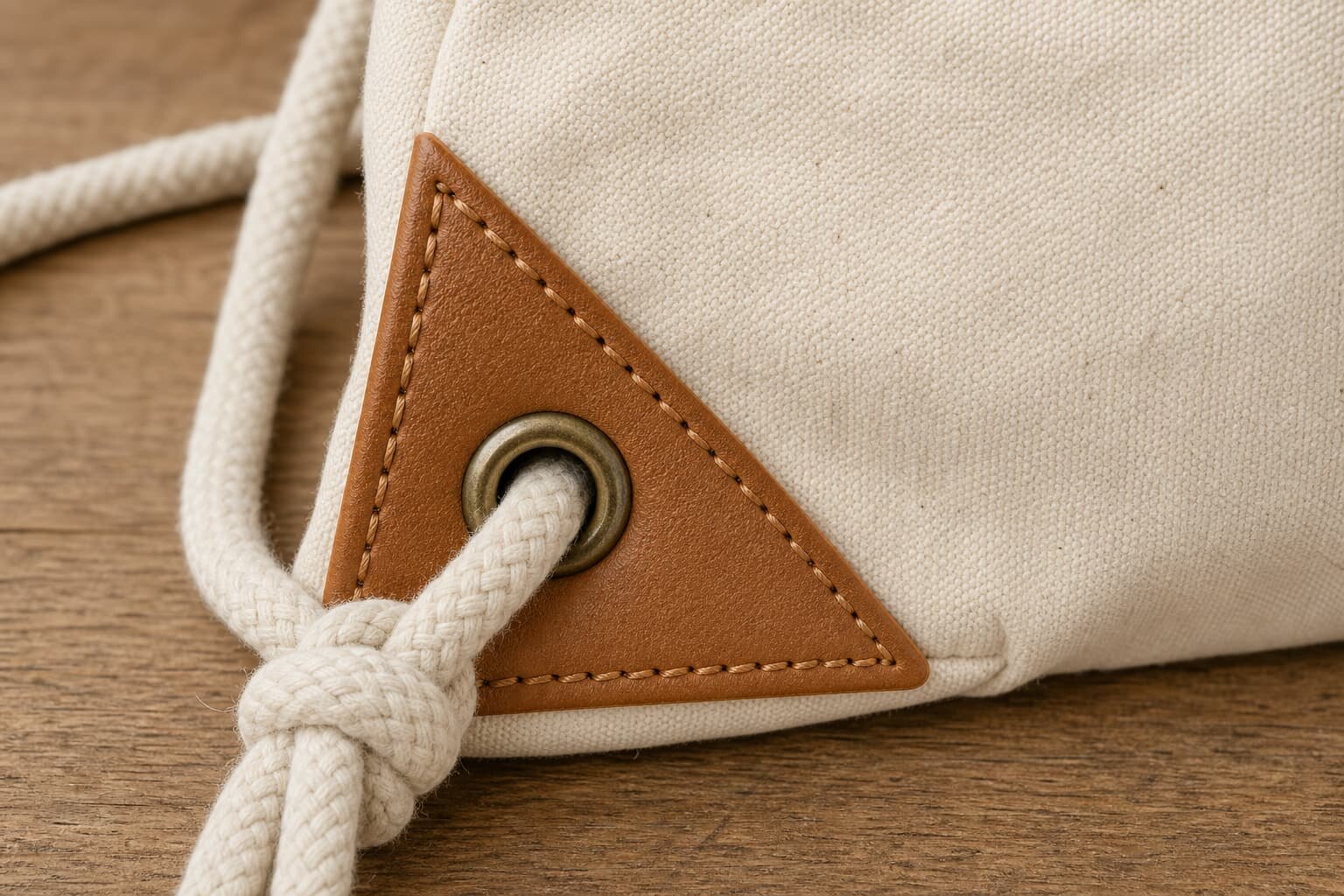
When reviewing the sample, pull the cord from both sides at least twenty times. Check whether the channel twists, whether the cord sheds fibers, and whether both strap lengths are equal when the bag is closed. Also inspect the entry and exit points. If the cord passes through metal eyelets, confirm the eyelets are smooth and firmly attached. If the cord is sewn into corner tabs, check bar tacks and reinforcement patch size.
- Cord should move smoothly without tearing the top seam.
- Cord ends should be knotted, tipped, heat-sealed, or finished according to the approved design.
- Both sides should be balanced so the backpack does not hang unevenly.
- The top channel must have enough seam allowance to resist pulling.
- If children will use the bag, review safety expectations for long cords in your market.
5. Seam construction and reinforcement: where low-cost backpacks usually fail
Most drawstring backpack failures occur at the bottom corners, top channel, or cord attachment points. These areas receive repeated pulling, not just static weight. The sample should be turned inside out and inspected. Look for seam allowance, stitch density, backstitching, overlocking, and whether the raw edge is controlled. A clean outside appearance is not enough if the inside seam is narrow or the stitches are loose.
For bags expected to carry shoes, gym clothes, books, bottles, or event kits, corner reinforcement should be specified. Options include triangular fabric patches, metal eyelets with backing, reinforced stitched loops, or bar tack stitches. Each option changes cost and appearance. If the factory quote is very low, confirm whether reinforcement is included or whether the cord is simply sewn into the side seam without extra support.
- Check stitch length and consistency, not only whether the seam is straight.
- Pull the bottom corner by hand to see if stitches open or fabric distorts.
- Ask for bar tack positions to be shown on the technical drawing.
- Avoid approving raw inside seams for higher-value retail programs unless intentional.
- For heavy canvas, confirm needle size and thread strength are suitable.
6. Logo printing: match method to fabric, artwork, and packing pressure
The most common print method for wholesale drawstring backpacks is screen printing. It is practical for one to three spot colors, bold logos, and event quantities. However, screen print quality depends on mesh, ink type, curing temperature, fabric surface, and operator control. A logo that looks sharp on the first sample can crack if the ink film is too thick, under-cured, or folded sharply during packing.
Heat transfer or digital transfer is useful for gradients, detailed art, and multi-color logos, but buyers should review hand-feel and edge bonding. On coated polyester, some transfers may peel if the adhesive and fabric surface are not compatible. On cotton, ink absorption and fabric texture affect sharpness. For every method, the sample review should include dry rub, damp rub, tape pull, fold, and scratch checks that match the actual use and packing method.
- Screen print: cost-efficient for simple logos; check curing and registration.
- Heat transfer: good for detailed graphics; check peeling, gloss, and plastic hand-feel.
- Digital print: useful for complex artwork; check color consistency and wash expectation.
- Reflective print: requires extra testing because performance depends on material quality.
- Embroidery: possible on heavier fabric but may pucker lightweight polyester.
7. MOQ logic: why the same backpack has different minimums
A realistic MOQ is not only about total pieces. It depends on fabric availability, fabric color, print setup, cord color, label, packing, and production line efficiency. A factory may accept a low MOQ for stock black 210D polyester with a one-color print, but require a higher MOQ for custom dyed cotton canvas, custom cord, woven label, and individual retail packing. Buyers get better quotes when they separate must-have customizations from flexible details.
When comparing supplier quotes, ask each factory to state MOQ by component. If one supplier quotes 1,000 pieces and another quotes 3,000 pieces, the lower MOQ may use stock fabric, a smaller logo, or simpler packing. That is not automatically bad, but it must be transparent. For distributors running mixed artwork programs, confirm MOQ per design and per color, not only total order quantity.
- Lowest MOQ usually uses stock fabric colors and standard cord.
- Custom fabric dyeing increases MOQ and lead time.
- Multiple logo designs may trigger separate screen charges or setup minimums.
- Custom woven labels or printed side labels may have their own minimum order.
- Retail packing often increases handling cost and may slow production.
8. Packing review: prevent print damage, carton deformation, and warehouse confusion
Packing is often discussed after the product is approved, but it can change the final result. A drawstring backpack with a large front logo may be folded directly through the print area. If the print is thick, glossy, or not fully cured, this can create cracks or blocking marks. If bags are packed too tightly, corners may crease and the front panel may arrive distorted. If cartons are too large or weak, bottom cartons can crush during storage and transport.
For wholesale programs, buyers should approve the folding method, inner packing, carton quantity, carton size, gross weight, and carton marks before production. Individual polybags protect the product but add plastic cost and may conflict with sustainability policies. Paper bands or bulk packing reduce packaging waste but require better control of dust, moisture, and print-to-print contact. If the goods are going directly to retailers or fulfillment centers, barcode and carton label accuracy is as important as sewing quality.
- Ask for a packed sample or packing photo using the final folding method.
- Avoid folding sharply across thick print or transfer edges.
- Confirm whether desiccants are needed for long sea freight or humid seasons.
- Use carton marks that match purchase order, SKU, color, and quantity.
- Check carton gross weight limits for your warehouse handling rules.
9. Lead time and approval workflow: where buyers lose schedule control
Lead time should be counted from the correct starting point. A factory may say production takes 25 days, but that may begin only after deposit, final artwork, approved sample, confirmed fabric color, and packing instruction are complete. If the buyer delays artwork approval or changes the logo after the screen is made, the production clock may reset. For importers working with event dates, this difference is critical.
A practical workflow is to approve the blank construction first, then approve artwork and print, then confirm packing and carton data. For complex orders, request a pre-production sample before bulk cutting. If time is tight, ask the factory which parts can be prepared in parallel, such as sourcing stock fabric while the logo sample is produced. Do not ask for rushed production without also agreeing on inspection timing, because a rushed order with no final check can become more expensive than a delayed order.
- Separate sample lead time from bulk production lead time.
- Confirm whether fabric is in stock before promising delivery dates to customers.
- Ask when final inspection can happen and how long rework would take if needed.
- Keep a dated approval record for sample, artwork, packing, and carton marks.
- For event orders, include a latest acceptable ship date in the RFQ.
10. Quote comparison: make suppliers price the same backpack
The fastest way to receive confusing quotations is to send only a logo and quantity. A proper RFQ should state finished size, fabric type and weight, color standard, cord material and diameter, reinforcement method, print method, logo size, label requirement, packing method, carton requirement, inspection expectation, and shipping term. Without these details, every factory will quote a different product while using the same product name.
When comparing quotes, check what is included and what is excluded. One price may include screen setup, sample cost, individual polybag, export carton, and reinforced corners. Another may quote only the simplest sewing construction with bulk packing. A higher unit price can be cheaper in practice if it prevents rework, claim handling, repacking, or customer rejection. Ask for a line-by-line quote where possible, especially for large retail or distributor orders.
- Request unit price based on exact quantity tiers, such as 1,000, 3,000, 5,000, and 10,000 pieces.
- Ask whether print setup, artwork adjustment, sample fee, and courier cost are included.
- Confirm incoterm, export carton details, and whether local charges are excluded.
- Ask for estimated carton dimensions and gross weight to calculate freight.
- Require the supplier to list any assumed substitutions, such as stock color instead of Pantone match.
Specification comparison for buyers
| Spec decision | Recommended option | When it fits | Buyer risk to check |
|---|---|---|---|
| Main fabric for budget promotion | 210D polyester, around 90-110 GSM equivalent depending on coating | Events, school promotions, sports giveaways, low unit cost programs | Too-thin fabric can show stress whitening at corners and may tear near eyelets under load |
| Main fabric for retail or reusable positioning | 6-8 oz cotton canvas or 140-220 GSM cotton | Brand merchandise, museum shops, lifestyle retail, eco-positioned campaigns | Cotton shrinkage, color shade variation, and print hand-feel need approval before bulk |
| Cord construction | 5-6 mm polyester cord for synthetic bags; 6-8 mm cotton cord for cotton canvas bags | Balanced comfort, common availability, acceptable strength for daily light carry | Cord may slip, fray, or feel rough if the diameter and braid quality are not confirmed |
| Bottom reinforcement | Triangular corner patches or reinforced eyelet area with bar tack | Backpacks expected to carry shoes, books, bottles, or gym items | Unreinforced corners are a common failure point even when the main fabric looks acceptable |
| Logo method for simple artwork | Screen print with approved ink type and curing standard | One to three spot colors, large logo, promotional orders | Poor curing causes ink cracking, odor, transfer marks, and wash failure |
| Logo method for detailed artwork | Heat transfer or digital transfer after artwork and wash test approval | Gradients, small text, multi-color brand graphics | Transfer film may feel plastic, crack on folded packing, or peel near drawcord stress zones |
| Packing for import cartons | Individual polybag or paper band by buyer requirement, then export carton with carton marks | Retail distribution, warehouse receiving, mixed SKU shipments | Oversized cartons deform bags; tight packing can crease prints and cause ink blocking |
Buyer checklist before sampling
- Confirm the received sample matches the latest approved spec sheet, not an earlier quotation version.
- Measure finished bag size at top width, bottom width, height, and corner reinforcement position; record tolerance separately for fabric and finished product.
- Weigh the fabric or verify GSM from the factory if the sample cannot be cut; compare against quoted fabric weight.
- Load test the backpack with realistic contents for your market, such as 3-5 kg for promotional use or higher only if specified.
- Pull the drawcord through both channels several times and check for cord dust, fraying, uneven length, and rough friction at the top seam.
- Inspect bottom corners, eyelets, grommets, or stitched cord loops for reinforcement and bar tack quality.
- Rub the printed logo dry and damp; check whether ink transfers, scratches, cracks, or changes gloss.
- Open and close the bag repeatedly to confirm the channel is not too narrow and the cord does not twist badly.
- Check sewing SPI, skipped stitches, loose thread ends, seam allowance, and whether the inside edges are raw, overlocked, or bound.
- Review packing method by folding the sample as it will ship; confirm the logo is not folded sharply unless accepted.
Factory quote questions to send
- What is the exact fabric type, yarn style, coating if any, and GSM or denier used for this drawstring backpack?
- Is the quoted GSM based on actual test result, fabric supplier nominal data, or previous production experience?
- What finished size tolerance do you apply after cutting and sewing, and does it change for cotton versus polyester?
- What cord diameter, material, color, and breaking strength are included in the quote?
- Are bottom corner reinforcements, eyelets, grommets, or bar tacks included, or are they extra cost items?
- Which print method is quoted, what ink or transfer type is used, and what logo size is included in the unit price?
- Can you confirm the MOQ by fabric color, logo design, print color, and packing style rather than only total order quantity?
- What is the sample lead time for plain sample, logo sample, and pre-production sample after artwork confirmation?
- What is the bulk lead time after deposit, sample approval, and receipt of final packing instructions?
- What packing method, pieces per carton, carton size, gross weight, and carton marking are included in the quotation?
Quality-control points to confirm
- Fabric GSM or denier must match the approved quote within agreed tolerance.
- Finished dimensions should be measured flat without pulling the drawcord tight.
- Drawcord length must be even on both sides and long enough to function as shoulder straps.
- Top channel width must allow smooth cord movement without tearing the seam.
- Bottom corners must show reinforcement if the bag is sold for sports, school, or daily carry use.
- Screen print must be cured and pass basic dry rub, damp rub, tape pull, and fold checks agreed before production.
- Heat transfer edges must be fully bonded without lifting, bubbles, scorching, or adhesive marks.
- Seams should not have skipped stitches, broken stitches, loose backstitching, or exposed sharp thread ends.
- Packing must prevent print-to-print blocking, moisture trapping, and carton crushing during ocean or truck transport.
- Production sample, sealed approval sample, and shipment sample should be compared before final release.