1. Start the QC plan from the real use, not the catalog photo
A wholesale drawstring backpack looks simple, but the failure points change depending on how the bag is used. A 210D polyester event giveaway carrying a brochure and water bottle does not need the same fabric, cord, or reinforcement as a retail gym sack carrying shoes and sports gear. The most expensive mistake is to quote only by size and logo, then discover during inspection that the bag cannot carry the intended load.
Before asking factories for pricing, define the use case in practical terms: what will be placed inside, how often the consumer will reuse it, whether it is sold at retail or given free, and whether the logo must survive repeated friction. This information helps the supplier recommend the right fabric GSM, drawcord diameter, bottom reinforcement, and packing method. It also gives your procurement team a fair way to compare quotes.
- Light giveaway: 210D polyester, simple screen print, bulk packing, cost-driven inspection focus.
- School or sports use: 300D or 420D polyester, stronger cord, reinforced corners, higher seam strength requirement.
- Lifestyle or retail use: cotton canvas or heavier polyester, cleaner stitching, better folding, individual packing, stricter cosmetic standard.
- Apparel packaging: soft handfeel, colorfastness, low odor, clean logo execution, and no sharp metal parts unless approved.
2. Specify fabric by type, weight, and risk level
Many RFQs say only “polyester drawstring backpack,” which is too vague for accurate costing. A supplier may quote 190T polyester, 210D polyester, 300D polyester, or 420D polyester, and the price difference can be significant. The buyer may think the factory is cheaper, but the supplier may simply be using a thinner cloth. The QC plan should record the fabric type, approximate GSM, coating if any, color, and acceptable shade tolerance.
For promotional backpacks, 210D polyester around 65-75 GSM is common. It is lightweight, folds easily, and keeps freight volume low. For more durable bags, 300D or 420D polyester gives better structure and abrasion resistance. Cotton canvas is usually described by ounce weight, such as 6 oz, 8 oz, or 10 oz, but buyers should also ask for approximate GSM. Natural fabrics need more attention to shrinkage, shade variation, and moisture control during packing.
- Ask for fabric swatches before sample approval, especially for repeat programs.
- Check whether light colors are see-through when the bag is filled.
- Confirm whether polyester has PU coating, PVC coating, or no coating because coating affects handfeel and print adhesion.
- For cotton canvas, request pre-shrunk or controlled-shrinkage fabric if exact finished size matters.
3. Control size, construction, and drawcord function
The common size range for drawstring backpacks is around 33 x 43 cm, 35 x 45 cm, or 40 x 50 cm, but the important number is finished size after sewing, not the cut panel size. If the factory quotes from cutting dimensions, the delivered bag may be smaller after seam allowance and top channel folding. Procurement teams should state finished width and height, plus tolerance, in the RFQ and purchase order.
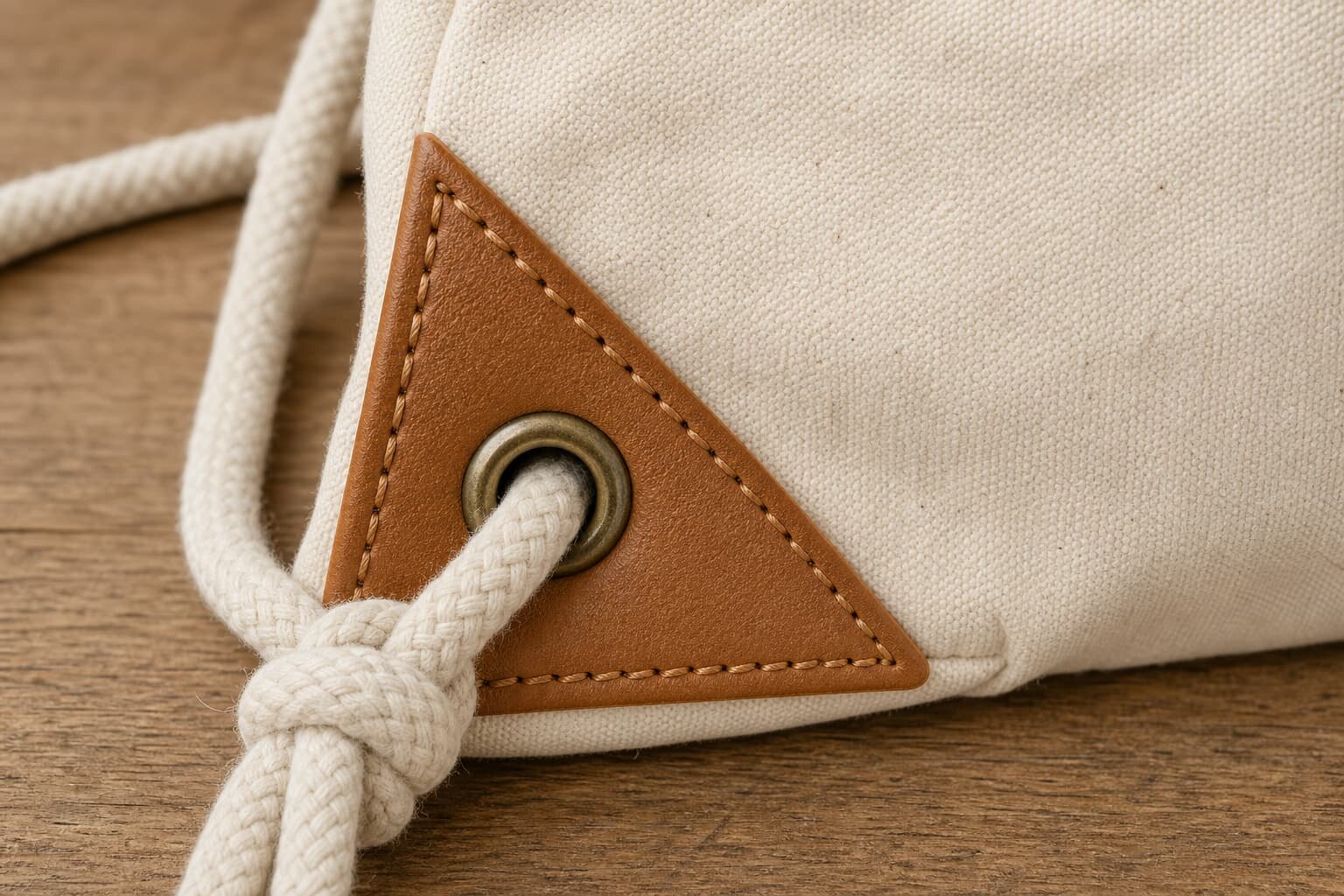
The cord design is also a construction decision. In many drawstring backpacks, the same cord closes the top and becomes the shoulder strap. That means the bottom attachment point is under repeated tension. If the bag uses metal eyelets on thin polyester, the fabric may tear around the eyelet unless there is reinforcement. Sewn triangular tabs or reinforced bottom corners can improve strength, but only if the tab material, stitch pattern, and seam allowance are controlled.
- Measure width at the middle of the bag, not only at the top edge.
- Measure height from bottom seam to top finished edge, excluding protruding cord.
- Confirm top channel width so the cord slides smoothly without bunching.
- For backpack-style straps, check cord length on a real adult or youth size target if fit matters.
4. Choose the print method before comparing unit prices
Logo decoration can change the unit price more than the base sewing cost. Screen printing is usually the best choice for one to three solid colors on polyester or cotton drawstring backpacks. It gives good cost control at wholesale quantities and works well for simple logos. However, the buyer must specify Pantone colors, print area, print position, curing requirement, and whether the artwork has fine lines that may fill in during production.
Heat transfer is useful for multi-color artwork, gradients, or small quantities, but buyers should check transfer handfeel, edge visibility, and cracking risk after folding. Sublimation is suitable for polyester when the design covers a large area or uses full-color graphics, but it generally works best on white or light fabric. Embroidery is possible on heavier fabric but may pucker thin polyester and is often less practical for large front-panel logos.
- Provide vector artwork such as AI, EPS, or PDF with outlined fonts.
- Specify print size in centimeters, not only “large front logo.”
- Require a printed sample using the actual fabric color because ink looks different on black, navy, natural cotton, and white polyester.
- Add a rub test or tape test if the bag will be handled heavily or packed tightly.
5. Build MOQ logic into the sourcing decision
MOQ is not only a factory policy. It is linked to fabric availability, dye lot, print setup, cord color, packing labor, and production line efficiency. A supplier may accept a low MOQ for stock 210D polyester in black with one-color screen print, but require a higher MOQ for custom dyed fabric, custom cord, full-panel sublimation, or multiple color assortments. Buyers should ask what drives the MOQ instead of only pushing for a lower number.
For distributors and retail buyers, split-color orders are a common hidden cost. An order of 5,000 pcs sounds efficient, but five body colors at 1,000 pcs each may require more material handling, more print setup, and higher risk of color mixing. If the project has many SKUs, the QC plan should include color-by-color approval, packing separation, carton marking, and barcode control.
- Lowest MOQ is usually possible with stock fabric colors and standard cord.
- Custom dyed fabric or cord needs higher MOQ because of dye house minimums.
- Multiple print colors may require separate screens and setup cost.
- Assorted colors need a clear packing ratio and carton marking plan.
6. Use samples to approve the process, not only appearance
A photo sample is not enough for wholesale drawstring backpacks. The buyer should approve a physical pre-production sample made with the actual fabric, actual cord, actual print method, and actual packing when possible. This sample becomes the reference for bulk inspection. If the supplier sends a sample from a different material just to show shape, mark it as a fit or construction sample only, not a production approval sample.
During sample review, do not look only at logo position. Pull the cord through the channel several times, load the bag with the expected weight, check the bottom attachment, and inspect the inside seams. Also check whether folded packing damages the print. Some heat transfers look acceptable when flat but show lines after tight folding. These issues are easier to fix before mass production than after cartons are packed.
- Keep one approved sample with the buyer and one sealed sample with the factory.
- Record any approved deviations in writing, such as print position tolerance or slightly different cord shade.
- Photograph key measurements with a ruler and attach them to the approval email.
- Reject vague sample comments such as “quality should be good”; use measurable acceptance points.
7. Define 11 inspection checks before production starts
The inspection checklist should be written before bulk production, not during a dispute. For drawstring backpacks, the main defects are usually fabric flaws, wrong size, poor print, weak corner reinforcement, skipped stitches, loose threads, dirty marks, wrong packing, mixed colors, odor, and carton damage. If these are not defined, the factory and buyer may disagree about what is acceptable.
A practical QC plan uses the approved sample as the standard, then adds measurable inspection rules. For example, “print centered” is weaker than “print centerline within +/- 5 mm of bag centerline.” “Strong stitching” is weaker than “no skipped stitches longer than 2 consecutive stitches and no open seam after light manual pull test.” Buyers do not need to over-engineer every point, but the important risks should be measurable.
- 1. Fabric type, GSM, color, and visible defects match the approved sample.
- 2. Finished width and height are within agreed tolerance.
- 3. Top channel width is consistent and cord slides smoothly.
- 4. Logo method, size, color, and position match approval.
- 5. Print has no obvious pinholes, cracking, smearing, ghosting, or poor registration.
- 6. Side seams and bottom seams have no open seams or skipped stitch clusters.
- 7. Bottom eyelets or tabs resist normal manual pull without tearing.
- 8. Cord length, diameter, color, and knot security are consistent.
- 9. Bag is clean, low odor, and free from oil marks, stains, or metal contamination.
- 10. Packing quantity, polybag, barcode, and carton marks follow PO instructions.
- 11. Carton condition and gross weight are suitable for export handling.
8. Set realistic packing and shipping requirements
Packing affects both cost and complaint rate. Bulk packing is cheaper and common for giveaway bags, but it can create wrinkles, dirty marks, and mixed-color issues if the factory does not separate SKUs properly. Individual polybags protect the bag and make warehouse handling easier, but they add material cost, labor, and sometimes sustainability concerns. Retail buyers may also need barcode stickers, warning text, insert cards, or carton-specific labels.
Carton planning should be included in the quote request. Drawstring backpacks are light, so the shipment may be charged by volume rather than weight. A thicker fabric, larger size, individual polybag, or rigid insert can increase carton volume. Ask for estimated carton dimensions, pieces per carton, gross weight, and net weight. These data help your logistics team calculate landed cost and prevent surprises after production.
- Define folding method to protect the print area from hard creases.
- Use moisture control for cotton canvas, jute-blend panels, or long sea shipments.
- Require color and SKU separation inside cartons if assortments are involved.
- Confirm carton strength if cartons will be handled by distributor warehouses or courier networks.
9. Read supplier quotes by cost drivers, not only unit price
Two drawstring backpack quotes may look similar but include different materials, print setup, packing, and inspection assumptions. A professional quote should show enough data for comparison: fabric type and GSM, bag size, print method and color count, cord type, reinforcement, packing, carton information, MOQ, sample cost, tooling or screen cost, payment terms, and lead time. If these are missing, the lowest price may not be the best price.
Lead time should also be broken into stages. A typical sourcing workflow includes artwork confirmation, sample making, sample shipping, buyer approval, material booking, mass production, final inspection, and export booking. If the buyer changes artwork after sample approval or adds barcodes late, the schedule can move. The QC plan should connect lead time to approval dates, not only to deposit date.
- Ask whether the price is based on stock fabric or custom production fabric.
- Separate one-time setup charges from repeat-order unit price.
- Confirm if quoted lead time starts after deposit, artwork approval, sample approval, or all three.
- Request carton data early so freight forwarders can estimate shipment cost.
10. Write acceptance criteria that prevent shipment disputes
Acceptance criteria protect both buyer and factory. They tell the inspector what to check and give the factory a clear target before production starts. For most wholesale drawstring backpacks, buyers can use AQL general inspection level II with a defined critical, major, and minor defect list. Critical defects may include sharp metal, mold, wrong logo, or safety issues. Major defects may include open seams, wrong size outside tolerance, poor print adhesion, or incorrect packing. Minor defects may include small loose threads or slight wrinkles within the agreed standard.
The final inspection should compare bulk goods against the approved sample, the purchase order, and the artwork file. If the buyer has a strict retail standard, consider an inline inspection when 20-30% of goods are finished. This allows correction before the entire order is packed. For simple giveaway orders, final random inspection may be enough, but only if the sample approval and defect list were clear.
- Use the approved pre-production sample as the physical master standard.
- Attach artwork, measurement sheet, packing instruction, and defect list to the PO.
- Do not release final balance or shipment until inspection results match the agreed plan.
- Keep retention samples from bulk production for repeat-order comparison.
Specification comparison for buyers
| Spec decision | Recommended option | When it fits | Buyer risk to check |
|---|---|---|---|
| Main fabric for lowest landed cost | 210D polyester, approx. 65-75 GSM | Promotional giveaways, event packs, school campaigns, light contents | Thin fabric can look transparent in light colors; confirm tear strength and colorfastness before approval |
| Main fabric for better handfeel | 300D polyester or 420D polyester | Retail programs, sports clubs, repeat-use gift packs | Higher fabric cost and slightly bulkier packing; check if drawcord still slides smoothly through the top channel |
| Natural fabric option | 6-8 oz cotton canvas, approx. 200-270 GSM | Eco-positioned campaigns, boutique retail, craft or lifestyle brands | Cotton shrinkage, shade variation, and heavier freight; pre-production sample should be washed or tested if required |
| Budget drawcord | PP rope, 4-5 mm | Standard promotional orders and large quantity distributor programs | Can feel stiff; check end finishing, color match, and whether cord burns or frays after cutting |
| Premium drawcord | Cotton cord, 5-6 mm, or polyester braided cord | Retail bags, apparel packaging, or premium gift sets | Cotton cord may absorb dye and shrink; confirm cord length after knotting and loading |
| Logo printing | Screen print for 1-3 solid colors | Most wholesale drawstring backpack logos with flat artwork | Confirm Pantone, print size, curing, rub resistance, and registration tolerance on the approved sample |
| Full-color artwork | Heat transfer or sublimation on suitable polyester | Gradients, photos, sports graphics, high-detail brand designs | Transfer edges, cracking, and handfeel; sublimation needs white or light polyester base |
| Bottom reinforcement | Metal eyelets or sewn triangular corner tabs | When the cord also works as backpack shoulder straps | Eyelets can pull out on thin fabric; corner tabs need bar-tacking and enough seam allowance |
| Packing method | Individual polybag or 10-25 pcs per master polybag | Retail-ready orders or distributor warehouse handling | Individual bags add cost and labor; bulk packing increases risk of dirt, wrinkles, and mixed colors |
Buyer checklist before sampling
- Confirm finished bag size with tolerance, not only cutting size; specify width, height, and acceptable variation such as +/- 0.5 cm or +/- 1 cm.
- Lock the fabric type, construction, and weight: for example 210D polyester at 65-75 GSM, 300D polyester, 420D polyester, or 6-8 oz cotton canvas.
- Decide whether the drawcord is only a closure cord or also a backpack strap; this changes the required cord strength and bottom reinforcement.
- Specify cord material, diameter, length after knotting, color, end treatment, and whether cord ends must be heat sealed or knotted.
- Provide logo artwork in vector format and state print method, Pantone colors, print position, print size, and tolerance.
- Approve a physical pre-production sample with actual fabric, actual print, actual cord, and actual packing before mass production.
- Define acceptable seam appearance: straight stitch, no skipped stitches, no broken thread, no loose thread longer than agreed tolerance.
- Check load performance using the intended product weight; promotional samples that carry only paper may fail when used for bottles, shoes, or sports gear.
- State packing requirements: folding method, individual polybag or bulk pack, carton quantity, carton marks, barcode labels, and moisture control.
- Ask the supplier to show quote data separately: fabric, printing, accessories, packing, tooling or plate cost, sample cost, lead time, and MOQ.
Factory quote questions to send
- What fabric construction and GSM are included in your quote, and can you provide a fabric swatch from the same supplier used for bulk production?
- Is the quoted size based on finished measurement after sewing, and what tolerance do you accept for width, height, and drawcord length?
- Which print method is included: screen print, heat transfer, sublimation, digital print, or embroidery, and what artwork limitations apply?
- Are print setup charges, screen charges, film charges, mold charges, or sample printing costs included or listed separately?
- What is your MOQ for the bag style, fabric color, print color count, and custom dyed cord if required?
- What bottom reinforcement is included: metal eyelet, sewn tab, reinforced corner, or direct cord-through-channel construction?
- What packing is included in the unit price: bulk pack, individual polybag, retail insert, barcode, carton mark, or export carton only?
- What is the estimated sample lead time and bulk lead time after sample approval, artwork approval, and deposit receipt?
- Which defects are considered critical, major, and minor under your internal QC process for drawstring backpacks?
- Can you provide production photos or an inline inspection report before final packing for orders above the agreed quantity?
Quality-control points to confirm
- Fabric weight, weave, color shade, handfeel, and defects such as holes, stains, slubs, coating marks, or uneven dyeing.
- Finished size and panel symmetry after sewing, especially top channel width and bottom corner alignment.
- Print color, position, registration, curing, adhesion, rub resistance, cracking, and edge cleanliness.
- Stitch density, seam strength, skipped stitches, broken stitches, backstitching, and loose thread trimming.
- Drawcord length, cord diameter, color match, sliding performance, knot security, and end sealing.
- Bottom eyelet or corner tab pull strength, especially when the cord functions as a shoulder strap.
- Load test based on intended use, including repeated opening and closing of the drawstring channel.
- Colorfastness risk for dark fabrics, bright cords, and cotton canvas orders that may contact light garments.
- Packing accuracy, folding consistency, barcode placement, carton strength, carton weight, and mixed-color control.
- Final AQL inspection with buyer-defined critical, major, and minor defects before shipment release.