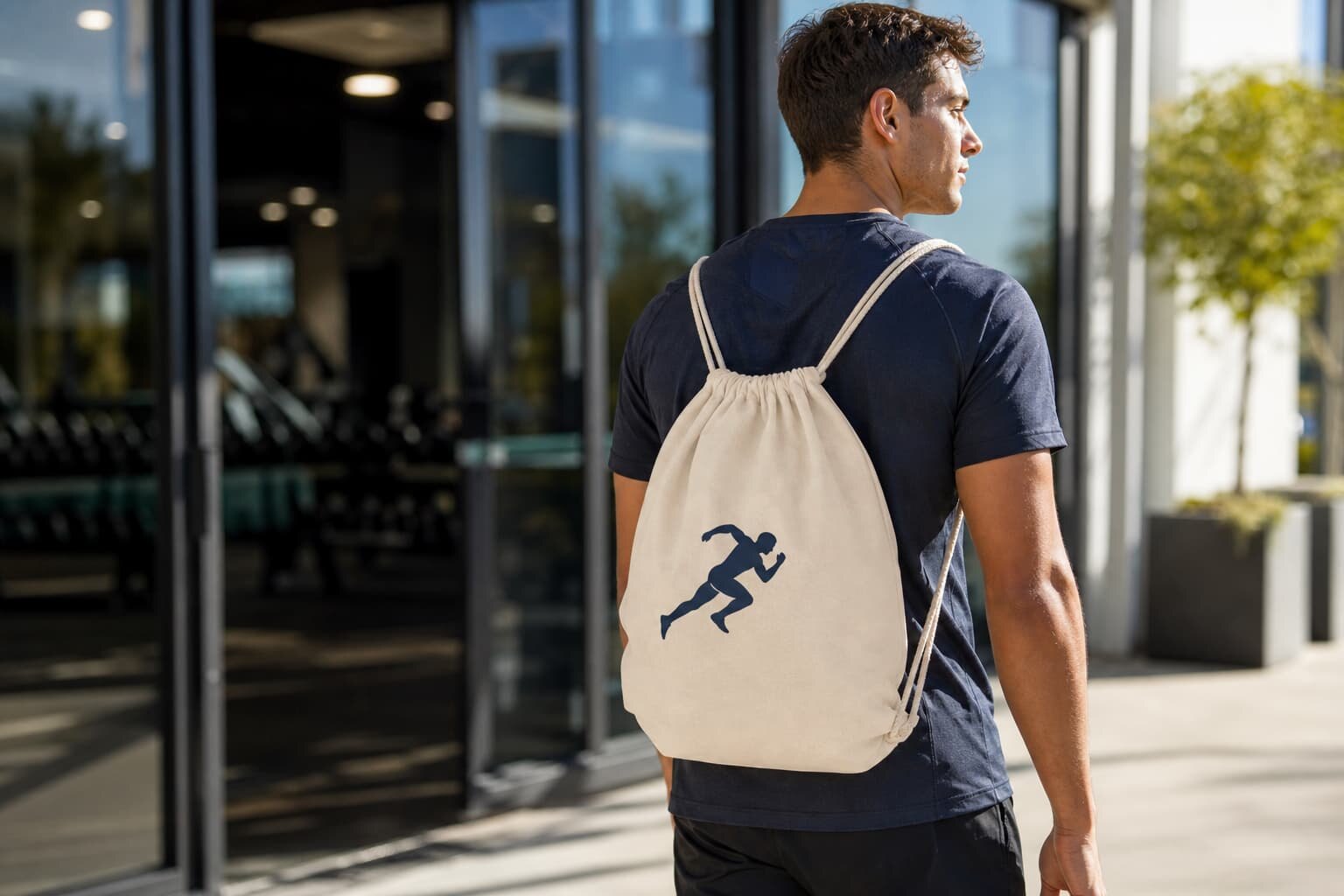
1. MOQ is a specification result, not just a supplier policy
A wholesale drawstring backpack looks simple, but its MOQ changes as soon as the order creates different materials, colors, artworks, labels, or packing versions. A 10,000-piece order in black 210D polyester with one white screen print can run as one continuous production job. The same 10,000 pieces split into five body colors, five cord colors, three sponsor logo versions, and separate barcodes becomes a much more complex factory order.
For procurement buyers, the useful question is not only “What is your MOQ?” but “Which part of our specification is creating the MOQ?” The answer may be stock fabric availability, dye lot minimums, print setup, cord sourcing, woven label minimums, barcode sorting, or carton marking. This is why this wholesale drawstring backpacks MOQ guide 03 treats MOQ as an RFQ structure issue, not a single number to negotiate down.
A very low MOQ can be legitimate when the factory has stock material and the buyer accepts standard construction. It can also be a warning sign if the supplier has not checked fabric weight, print method, packing, or SKU splits. Before approving a quote, ask the factory to state the assumed specification behind the MOQ.
- Total MOQ: minimum pieces for the full order.
- Color MOQ: minimum pieces per fabric color or dye lot.
- Artwork MOQ: minimum pieces per logo version or print setup.
- Cord MOQ: minimum pieces if cord color or cord type changes.
- Label MOQ: minimum pieces for woven labels, care labels, hangtags, or barcode labels.
- Packing MOQ: minimum pieces per polybag, carton mark, destination, or retail SKU.
2. Build the RFQ around end use before negotiating price
Drawstring backpacks are sourced for very different reasons: trade show giveaways, school events, gym promotions, staff kits, charity walks, retail merchandise, subscription boxes, and travel accessories. Each use case changes the acceptable fabric, seam strength, print quality, and packing level. If the RFQ only says “drawstring backpack, 5,000 pcs, logo printed,” suppliers will quote different constructions and the lowest price may not represent the product you need.
A one-day event bag can usually tolerate lighter fabric, simpler bottom corners, and bulk packing. A school or gym bag should have better cord comfort, stronger corner reinforcement, and more reliable stitching. A retail bag needs cleaner presentation, consistent color, accurate barcodes, and packaging that supports warehouse receiving. The end use should be the first line of the RFQ because it tells the factory where durability and quality control matter most.
Procurement teams should also define the expected load. A bag carrying flyers and a T-shirt is not the same as a bag carrying shoes, a water bottle, and books. If heavier use is expected, the supplier should quote stronger fabric, reinforced corners, and a wider or smoother cord instead of only reducing unit price.
- Event giveaway: prioritize stock fabric, simple print, bulk packing, and fast production.
- School or sports use: request stronger corners, smooth cord, and pull-tested seams.
- Retail resale: require cleaner sewing, individual packing, barcode accuracy, and stricter inspection.
- Eco-positioned campaign: define whether cotton, organic cotton, rPET, or another material is required.
- Outdoor promotion: ask about water resistance, coating, and colorfastness rather than assuming all polyester is waterproof.
- Multi-destination program: specify carton marks and packing lists for each destination early.
3. Fabric and GSM: where most MOQ differences begin
Fabric is usually the largest MOQ driver. Common drawstring backpack materials include 210D polyester, 300D polyester, non-woven polypropylene, cotton canvas, and rPET polyester. Stock black, navy, red, or royal blue polyester often allows lower MOQ because fabric is already available by roll. Custom Pantone fabric, certified recycled material, or dyed canvas may require a mill order, lab dip approval, and a larger minimum per color.
The RFQ should include fabric weight, not only a fabric name. For polyester, 210D commonly falls around 75-85 GSM depending on yarn and coating, while 300D may be around 120-160 GSM. For cotton canvas, 6 oz, 8 oz, and 10 oz are common buyer references, roughly around 200-340 GSM depending on weave. Heavier fabric improves handfeel and perceived value, but it also increases unit cost, carton weight, freight cost, and sometimes fabric purchase minimums.
Cotton canvas has a natural look but needs shade and shrinkage control. Natural cotton can vary between lots, and small dark specks or slubs may be part of the fabric character unless the buyer specifies a cleaner grade. Polyester is more color-stable in stock colors, but coating quality affects print adhesion, odor, crease marks, and water resistance. rPET can be useful for recycled-content programs, but buyers should ask what documentation is available before making marketing claims.
- 210D polyester: good for budget promotional bags and high-volume event orders.
- 300D polyester: stronger handfeel for sports, school, and longer-use promotions.
- Non-woven polypropylene: low-cost option for light use, but less durable and less premium.
- 6 oz cotton canvas: natural appearance for gift programs and light retail use.
- 8 oz cotton canvas: balanced choice for reusable merchandise and sharper print surface.
- 10 oz canvas: stronger retail feel but higher freight and sewing stress.
- rPET polyester: suitable for recycled-positioned programs if documentation and MOQ are acceptable.
4. Realistic MOQ bands to discuss with suppliers
MOQ bands vary by factory, market, material availability, and season, so buyers should treat them as discussion ranges rather than fixed promises. Still, procurement teams need practical reference points. For a standard stock 210D polyester drawstring backpack with one simple logo, many factories are willing to discuss lower MOQs than they would for custom dyed canvas, full-color sublimation, or many SKU splits.
A useful RFQ asks for a tiered quote: for example 500, 1,000, 3,000, 5,000, and 10,000 pieces. This shows where the setup cost, fabric purchase, and sewing efficiency improve. It also helps buyers decide whether consolidating colors or reducing artwork versions is more valuable than forcing the factory into an inefficient low-volume run.
The most important rule is to request MOQ per scenario. If your order has one total quantity but ten SKUs, the effective MOQ may be the per-SKU quantity, not the order total. This is especially true for custom fabric, custom cords, separate print screens, woven labels, retail packaging, and barcode-controlled cartons.
- Stock 210D polyester, one color, one logo: often the most flexible MOQ scenario; ask from about 500-1,000 pcs if stock is confirmed.
- Stock polyester split across colors: ask minimum per color and whether small color splits carry a surcharge.
- Custom Pantone fabric: expect the fabric dye lot to drive MOQ, often several thousand pieces per color depending on mill terms.
- Cotton canvas natural color: may be more flexible than dyed canvas if fabric is stocked, but shade tolerance must be approved.
- Custom dyed canvas: usually higher MOQ and longer lead time because lab dip and bulk dyeing are involved.
- rPET with documentation: ask MOQ after supplier confirms available certified fabric, not before.
- Full-color or all-over print: ask MOQ by print process and panel layout, because printing before sewing changes production flow.
- Retail packing by SKU: ask MOQ per barcode and carton mark, even if the bag itself is unchanged.
5. SKU matrix: the fastest way to prevent MOQ surprises
Factories think in production batches. Buyers often think in total purchase quantity. A SKU matrix bridges that gap. Before requesting final pricing, list every version of the backpack and every variable that changes: body color, cord color, logo artwork, print colors, label, packing, barcode, carton mark, and destination. This reveals whether a 6,000-piece order is one production batch or twelve small batches.
SKU complexity affects cost even when the physical bag is similar. Changing only a barcode can add packing control. Changing only cord color can create a separate material purchase. Changing print artwork creates new screens, transfer files, or embroidery programs. Changing carton marks can require warehouse sorting and separate final inspection counts.
A well-built matrix also helps suppliers suggest consolidation. If two colors can share the same white print, the screen cost may be shared. If several destinations can use the same inner packing but different outer carton labels, the factory can plan packing more efficiently. Procurement buyers should use the matrix as a negotiation tool: simplify where it does not affect sales value, and keep complexity only where it matters commercially.
- Create one row per SKU and include quantity, color, cord, artwork, print size, label, packing, barcode, and destination.
- Highlight which components are shared across SKUs and which are unique.
- Ask the supplier which SKUs can be produced together and which require separate setup.
- Confirm if the MOQ applies to each artwork, each fabric color, each cord color, or each packing version.
- Avoid adding late SKU changes after sample approval unless you accept revised cost and lead time.
- Use the matrix as the reference document for sampling, production, inspection, and carton labeling.
6. Print method choices and the defects they can create
Screen printing is the common choice for wholesale drawstring backpacks because it is efficient for simple logos, solid artwork, and large quantities. It works on polyester and cotton when the correct ink and curing conditions are used. The common risks are poor opacity, cracking, ink bleeding, misregistration between colors, and print migration on coated polyester. The pre-production sample should use the actual fabric and actual ink system, not a temporary sample print.
Heat transfer is useful for gradients, small sponsor logos, and full-color designs. It can reduce the need for many screen setups, but the buyer must approve handfeel, edge line, heat mark, flexibility, and wash or rub resistance. Sublimation is suitable for white or light polyester and all-over graphics, often printed on fabric panels before sewing. It is not a solution for dark cotton canvas. Embroidery can look premium, but dense stitches can pucker thin 210D polyester and may require backing.
Print method also affects MOQ. A one-color screen print may have an efficient setup once quantity is large enough. Multiple artwork versions may each need separate screens or transfer sheets. All-over sublimation changes cutting and sewing flow. Woven labels have a separate label MOQ, even if the bag MOQ is lower. Buyers should request the supplier’s recommended method, then ask what defects that method is most likely to create.
- Screen print: best for 1-3 color logos, strong shapes, and controlled Pantone colors.
- Heat transfer: good for gradients and full-color sponsor blocks; check handfeel and edge marks.
- Sublimation: best on white or light polyester panels; check color shift and seam alignment.
- Embroidery: suitable for small premium marks; avoid large dense embroidery on lightweight fabric.
- Woven label: stable for brand ID, but label MOQ and sewing position must be confirmed.
- Reflective print: useful for sports promotions; test reflectivity, adhesion, and flexibility.
7. Construction details that should be specified, not assumed
A drawstring backpack has few parts, yet failures usually happen at the same stress points: top channel, bottom corners, cord exits, seams, and print area. If the cord pulls out or the bottom corner tears, the fabric weight alone cannot save the product. Buyers should specify the stress-point construction based on use case rather than letting the factory choose the cheapest method.
Standard finished sizes often range around 33 x 43 cm to 38 x 46 cm, but exact size should be written in the RFQ. The top drawstring channel must be wide enough for smooth opening and closing. Bottom corners can be simple folded fabric, triangular reinforcements, metal grommets, or bartacked anchors. Metal grommets may improve durability when well pressed, but poorly set grommets can loosen, rust, scratch, or cut the cord.
Cord selection affects both comfort and durability. A thin cord lowers cost but can dig into the shoulder and wear through stress points. A 5 mm polyester cord is a common standard for many promotional cinch backpacks. Cotton cord works visually with canvas but can absorb moisture and show shade variation. If the product is for retail or heavier use, ask for pull testing on the cord channel and bottom anchors before approving production.
- Specify finished size, tolerance, and whether dimensions are measured flat before or after packing.
- Define cord material, diameter, color, end treatment, and knot method.
- Choose bottom construction: folded corner, reinforced patch, grommet, bartack, or combined reinforcement.
- Ask whether seams are single stitch, double stitch, overlock, bound, or folded.
- Confirm drawstring channel height and smooth cord movement.
- For canvas, check inside fraying and seam allowance because loose yarns become visible after use.
- For polyester, check needle holes, coating damage, and heat-sealed cord ends.
8. Sample approval should represent production, not a showroom version
The sample stage should prove the final production method. A shape sample made with substitute fabric is useful for size and construction review, but it should not release mass production. A pre-production sample should use the actual fabric weight, actual body color, actual logo method, actual cord, actual labels, and intended packing. If anything is substituted, mark it clearly and decide whether a second approval sample is required.
A strong sample review is practical and measurable. Measure width and height. Check print placement from the top edge and side seams. Pull the cord at the bottom corner and channel. Open and close the bag repeatedly. Fold the printed area and check whether the ink cracks. Rub the logo with a dry and slightly damp white cloth to check curing and color transfer. For cotton canvas, check weave, shrinkage, and print edge sharpness. For polyester, check coating smell, heat marks, crease recovery, and print adhesion.
Procurement teams should record sample approval in writing. Photos alone are not enough. The approval should include specification sheet, sample comments, approved swatches, artwork file version, Pantone references, packing files, and any allowed deviations. This prevents arguments later when final inspection compares bulk goods against a vague email approval.
- Approve finished size with tolerance, commonly +/- 1 cm unless otherwise agreed.
- Approve print size, position, Pantone color, opacity, registration, and edge quality.
- Approve cord diameter, cord color, knot, end finish, and sliding performance.
- Approve label position, care label content, hangtag, barcode, and polybag warning text if applicable.
- Approve carton quantity, carton mark, and whether cartons are mixed or single SKU.
- Keep one signed or sealed approval sample with the supplier and one with the buyer or inspection team.
- Do not release bulk production if the sample uses substitute fabric or temporary printing unless risk is accepted in writing.
9. QC plan: sampling, AQL, and defect classification
Quality control for drawstring backpacks should cover measurement, appearance, print performance, construction strength, packing accuracy, and carton condition. For professional procurement, the inspection plan should be agreed before production finishes. Many buyers use AQL-style sampling, but the exact inspection level and acceptance limits should be confirmed with the supplier or third-party inspector. If AQL is not used, define the sampling quantity and pass/fail rules in writing.
Defects should be classified by severity. Critical defects are issues that create safety, legal, or severe compliance risk, such as sharp metal parts, mold, wrong warning labels where required, or foreign contamination. Major defects affect function, saleability, or receiving accuracy: broken cord, loose grommet, wrong logo, poor print adhesion, wrong barcode, wrong color, open seam, or incorrect carton quantity. Minor defects are small issues that do not normally affect use, such as a short loose thread, light crease, or small cosmetic mark within tolerance.
Pre-shipment inspection should not only look at the bag surface. Inspectors should open cartons, verify SKU counts, scan barcodes if applicable, check master carton marks, measure carton dimensions, and take photos. Pull tests and repeated open-close checks should be done on sample pieces. If the order is split by color or destination, each SKU should be represented in the inspection sample.
- Confirm inspection timing: in-line inspection, final random inspection, or both for higher-risk orders.
- Agree AQL level or written sampling plan before mass production is completed.
- Classify critical, major, and minor defects so rejection decisions are not subjective.
- Check size, fabric color, print color, print placement, cord length, and seam strength by SKU.
- Perform functional checks: open-close cycle, cord pull, grommet security, and seam stress at corners.
- Inspect packing: correct polybag, barcode, carton mark, piece count, mixed-carton rule, and carton sealing.
- Check storage condition: odor, moisture, mildew, dust, oil stains, and carton crushing.
- Request inspection photos of product, labels, carton marks, open cartons, and sealed cartons for records.
10. Packing, lead time, and quote comparison before issuing the PO
Packing can change both cost and delivery performance. Bulk packing is efficient for a single event shipment, but it can increase wrinkling and make color counts slower at destination. Individual polybags improve cleanliness, counting, and retail presentation, but add labor, material, carton volume, and sometimes warning-label requirements. Barcode labels, hangtags, inserts, retail cartons, and pallet requirements should be quoted from the beginning, not added after price approval.
Lead time should be broken into sample, material, production, inspection, and shipping handover. Stock fabric and one-color screen printing can move faster than custom dyeing, rPET documentation, woven labels, full-color artwork, or retail packing. Low MOQ does not always mean fast delivery; a small but complicated order can wait behind larger factory runs or suffer delays from late artwork, late barcode files, or unresolved sample comments.
When quotes arrive, compare them line by line. A cheaper quotation may be based on thinner fabric, smaller print, bulk packing, no reinforcement, or stock shades that are close but not exact. A higher quotation may include stronger construction, individual packing, barcode control, better inspection support, and clearer documentation. The best supplier is not always the lowest MOQ supplier; it is the supplier whose assumptions match your required product and whose risks are visible before the purchase order is issued.
- Ask for tiered pricing at several quantities to see where cost becomes efficient.
- Compare fabric weight, coating, color source, print method, print size, cord, reinforcement, label, and packing.
- Confirm Incoterm, payment terms, export port, documents, sample courier, inspection support, and local transport exclusions.
- Request carton dimensions, gross weight, net weight, pieces per carton, and loading estimate for freight comparison.
- Freeze artwork, Pantone colors, packing files, barcode files, carton marks, and SKU matrix before deposit.
- Require written approval of pre-production sample before bulk production.
- Keep final quote, approved sample comments, inspection standard, and packing specification attached to the PO.
Specification comparison for buyers
| Spec scenario | Typical MOQ range to discuss | Cost and lead-time impact | Buyer risk to check |
|---|---|---|---|
| Stock 210D polyester, one color, one 1-color screen print | Often the lowest range; commonly discussed from about 500-1,000 pcs per design when stock fabric is available | Lowest setup complexity, short material lead time, efficient cutting and sewing | Confirm actual GSM, coating, print curing, and whether low MOQ uses leftover fabric shades |
| Stock 210D or 300D polyester split across several colors | Usually MOQ per color or a minimum color split; small splits may start around 300-500 pcs per color if fabric is stocked | More cutting, sorting, packing, and inspection time; unit cost can rise even if total order is large | Check whether all colors are current stock and whether cord colors match or substitute |
| Custom Pantone polyester or canvas color | Often driven by dye lot MOQ; can be several thousand pieces per color depending on fabric width and mill terms | Longer material booking and lab dip approval; higher risk of schedule delay | Approve lab dip, bulk color tolerance, and overage/shortage rules before deposit |
| Natural cotton canvas, 6 oz to 8 oz, one logo | Moderate MOQ; sometimes lower than custom dyed canvas if natural greige or natural canvas is in stock | Higher fabric cost and carton weight than 210D polyester; print surface is better but shade can vary | Confirm oz/GSM, shrinkage, weave slubs, odor, and print edge sharpness |
| rPET polyester with recycled-content claim | MOQ depends on certified material availability; usually higher than generic stock polyester | Documentation, traceability, and material sourcing can add cost and lead time | Ask what certification or transaction documents are available and whether claims are suitable for your market |
| Full-color heat transfer or sponsor artwork | MOQ may be lower per artwork than screen setup, but transfer sheet MOQ and artwork handling still apply | Good for gradients and multi-logo layouts; unit cost higher than simple screen print | Check transfer handfeel, edge marks, cracking, washing resistance, and heat pressure marks |
| Sublimation on white or light polyester panels | Best discussed by panel or fabric run; not suitable for all materials | Can support all-over artwork but usually requires printing before sewing and careful color management | Check base fabric color, color shift, seam alignment, and whether all panels are printed consistently |
| Individual polybag, barcode, and carton label by SKU | Packing MOQ may apply per label version or retail SKU | Adds material, labor, carton volume, and receiving accuracy controls | Verify barcode scan, label placement, suffocation warning, carton mark, and mixed-carton rules |
Buyer checklist before sampling
- Define the commercial use first: event giveaway, school kit, gym promotion, retail resale, subscription box, employee merchandise, or travel accessory.
- Specify finished size in width x height and include tolerance, such as +/- 1 cm unless tighter control is required.
- State the target fabric and weight: for example 210D polyester 75-85 GSM, 300D polyester 120-160 GSM, 6 oz cotton canvas, 8 oz canvas, 10 oz canvas, or rPET polyester.
- Separate total order quantity from SKU quantity. List every fabric color, cord color, artwork version, label version, packing version, barcode, and destination.
- Ask for MOQ by total order, fabric color, artwork, cord color, label, and packing SKU rather than accepting one vague MOQ number.
- Send vector logo files and specify print size, location, Pantone colors, number of print colors, and whether artwork changes by SKU.
- Confirm whether printing is done on flat fabric panels before sewing or on finished bags, because placement tolerance, waste, and setup differ.
- Define cord material, cord diameter, cord color, metal grommet or fabric corner reinforcement, knots or tipped ends, and any bartack requirement.
- Request a pre-production sample using actual fabric, actual logo method, actual cord, labels, packing, barcode, and carton mark before mass production.
- Ask for carton dimensions, gross weight, net weight, pieces per carton, carton quantity, and loading estimate before comparing freight quotations.
Factory quote questions to send
- What is your MOQ for this drawstring backpack by total order, by fabric color, by print design, by cord color, and by packing SKU?
- Is the proposed fabric stock fabric, made-to-order fabric, or custom dyed fabric? If custom dyed, what is the dye lot MOQ and extra lead time?
- What exact fabric weight will be used in GSM or oz, and can you provide a cutting swatch or supplier test record before production approval?
- What print method do you recommend for our artwork and fabric: screen print, heat transfer, sublimation, embroidery, woven label, or reflective print?
- Will the logo be printed on flat fabric before sewing or printed on finished bags? What placement tolerance should we expect in bulk production?
- What cord material and diameter are included in the quote? Is the cord color stock matched, approximate matched, or custom dyed?
- Are corner reinforcements, grommets, bartacks, double stitching, or seam binding included, or are they optional upgrades?
- What is the sample cost and sample lead time for a correct pre-production sample using our fabric, logo, cord, label, packing, and carton mark?
- What is the mass production lead time after written sample approval and deposit, assuming all materials are available?
- What packing is included in the quoted unit price: bulk pack, individual polybag, barcode label, carton mark, insert card, hangtag, or retail carton?
Quality-control points to confirm
- Measure finished width, height, cord length, drawstring channel height, and print placement against the approved sample and technical sheet.
- Check fabric weight by cutting swatch, supplier test record, or internal weighing method; do not rely only on fabric names such as 210D or canvas.
- Compare fabric color and printed logo color under consistent lighting against approved swatch, lab dip, or Pantone reference.
- Pull-test cord channel, bottom corner seams, grommets, bartacks, and reinforced areas to confirm they can handle normal shoulder carry.
- Inspect print adhesion, curing, cracking, ink bleeding, transfer edge marks, color registration, opacity, and print position tolerance on random pieces.
- Check inside seams for loose threads, skipped stitches, raw edges, fraying, needle damage, and seam allowance, especially around top channel and corners.
- Open and close the backpack repeatedly to confirm the cord slides smoothly and does not snag fabric, eyelets, grommets, or seam edges.
- Confirm each SKU has correct fabric color, cord color, artwork, label, barcode, polybag, carton mark, and piece count.
- Check odor, moisture, mildew marks, oil stains, dust, and foreign matter before packing, especially for cotton canvas and natural fabrics.
- Verify carton strength, carton dimensions, gross weight, net weight, export marks, and carton numbering before shipment booking.