1. The PO Risk: A Cheap Drawstring Backpack Quote Can Hide Spec Changes
When procurement teams compare wholesale drawstring backpack quotes, the largest risk is not always the unit price. The real risk is that each factory may be quoting a different bag while using the same simple product name. One quote may be based on 210D polyester with reinforced corners, another on lighter 190T polyester with thin cord, and another on nonwoven PP with no backing patch. On the spreadsheet, all three look like drawstring backpacks. In production, they perform very differently.
A factory audit for this product should therefore start before the PO is issued. The purpose is not only to check whether the supplier has sewing machines. It is to confirm whether the quote, sample, material, print process, packing method, and lead time assumptions match the buyer’s real use case. For importers, distributors, and retail buyers, this avoids the common situation where the pre-production sample looks acceptable but bulk goods fail on cord pull, seam strength, print durability, or packing compliance.
- Do not approve a quote that only says “drawstring bag” or “backpack bag” without material weight and accessory details.
- Treat price differences above 8-12% as a signal to compare hidden specification gaps before negotiating.
- Use the audit to verify what the factory will actually produce, not only what appears in the catalog photo.
2. Define the Use Case Before Auditing Factory Capability
A drawstring backpack for a one-day marathon giveaway does not need the same construction as a retail canvas gym bag. The audit should begin with the load and use environment. Will the bag carry shoes, uniforms, books, water bottles, samples, or only leaflets? Will the user wear it once, for a semester, or as a paid merchandise item? These answers decide fabric GSM, cord diameter, corner reinforcement, seam strength, and print durability.
Factories often ask for a target price first, but procurement teams should reverse the process. Define the minimum acceptable performance and then ask the factory to cost it. Otherwise the supplier may remove reinforcement, downgrade cord thickness, reduce GSM, or use a cheaper print method to hit the budget. That creates a low quote but also creates customer complaints, returns, or brand damage after distribution.
- Event giveaway: 210D polyester or 80-100 GSM nonwoven may be acceptable if load is light.
- School or sports use: request stronger polyester, reinforced eyelets, and a realistic load test.
- Retail merchandise: consider cotton canvas, heavier cord, neat inner finishing, and stricter print standards.
- Eco program: verify whether the material is cotton, RPET, recycled cotton, jute blend, or only described as “eco style”.
3. Fabric Weight and Material Checks: Do Not Audit by Hand Feel Only
Fabric is the main cost driver and the easiest place for quotes to differ. For polyester drawstring backpacks, 210D is a common promotional grade, but suppliers may quote different actual GSM, coating, yarn quality, and finishing. For cotton canvas versions, 8oz, 10oz, and 12oz can all be sold as canvas, yet the finished bag strength and retail feel are not the same. If the RFQ only says “canvas drawstring backpack,” the factory has too much room to interpret.
During the audit, ask how the factory controls incoming fabric. A practical factory should be able to show fabric rolls, weight checking, shade lot separation, and cutting records. You do not need a laboratory report for every small order, but you do need a written specification that prevents silent downgrades. If the approved sample uses 12oz canvas and the bulk uses lighter fabric, the issue may not be visible until the bag is loaded or the print begins to distort.
- Polyester: request denier, finished GSM range, coating type if used, and fabric color code.
- Cotton canvas: specify oz or GSM, washed or unwashed finish, shrinkage expectation, and natural color variation.
- Nonwoven: specify GSM tolerance clearly; 70 GSM and 100 GSM bags should not be compared as equal.
- RPET fabric: ask for material composition and whether certification documents are required by your market.
- Dark colors: check crocking risk, especially black, navy, red, and strong promotional colors.
4. Cord, Eyelet, and Reinforcement Are the Main Failure Points
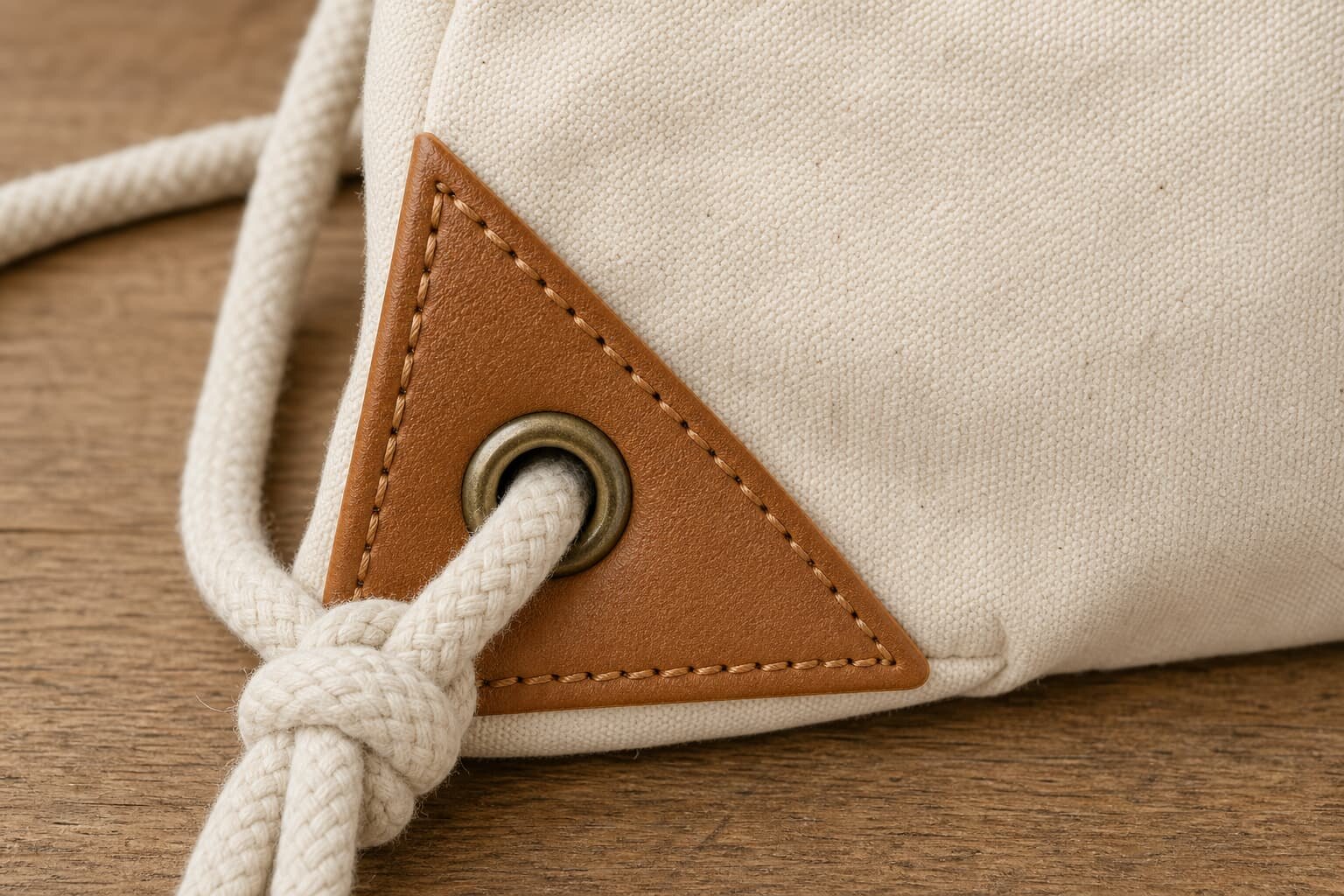
Most drawstring backpack complaints come from the bottom corner, not the front panel. The user pulls the cord through the top channel and the load transfers to the lower eyelets, fabric loops, or reinforced patches. If the patch is thin, the stitching is short, or the eyelet is pressed without enough backing, the corner can tear even when the main fabric looks strong. This is why a factory audit must include accessory construction, not only fabric and print.
The cord also affects both cost and user experience. A 3 mm thin cord may be acceptable for a light giveaway bag, but it feels poor on the shoulder and can fray quickly. A 5-6 mm polyester cord is more comfortable and stronger for general promotional backpacks. Cotton tape or flat webbing may suit heavier canvas bags, but it changes the channel size and sewing process. The quote should state the cord diameter, material, color, and finishing method.
- Check whether the eyelet has a backing patch on the inside or only bites into the main fabric.
- Request bar tacks at stress points if the bag is intended for heavier daily use.
- Confirm cord length after knotting; uneven cords make the bag sit badly on the back.
- Ask whether cord ends are heat sealed, knotted, capped, or left raw.
- For children’s products, review market safety rules for cords, choking hazards, and packaging warnings.
5. Print Method Audit: The Cheapest Logo May Not Survive Handling
Printing is often where low quotes become expensive later. Screen print is usually the best option for simple spot-color logos on polyester, cotton, or nonwoven drawstring backpacks. It is cost-effective at volume and can produce strong coverage if the ink, mesh, curing, and underbase are handled correctly. However, a white logo on black polyester may require an underbase or thicker ink deposit, which affects both cost and hand feel.
For full-color artwork, heat transfer, sublimation, or digital print may be considered depending on fabric and design. Sublimation works on suitable light polyester, but not on cotton canvas. Heat transfer can handle gradients, but the buyer must check cracking, edge adhesion, and temperature marks on the fabric. During the audit, review actual printed samples made on the same material, not only paper proofs or previous unrelated samples.
- Specify print size in centimeters, not only as “front logo”.
- Provide Pantone references and confirm tolerance for color deviation on different fabric bases.
- Define print position from top seam, side seam, or centerline with acceptable tolerance.
- Ask whether dark fabric requires underbase and whether it is included in the quote.
- Rub the print surface after curing and check whether ink transfers, cracks, or feels undercured.
6. MOQ Logic: Why One Factory’s Minimum Is Not the Same as Another’s
MOQ for wholesale drawstring backpacks is not a random number. It depends on fabric roll quantity, stock color availability, print setup, labor planning, accessory purchase, and packing method. A factory may accept a lower MOQ for stock 210D polyester in black, navy, or red because fabric is already available. The same factory may require a much higher MOQ for custom-dyed cotton canvas, special RPET fabric, matched cord color, or woven labels.
Procurement teams should audit MOQ by component instead of asking for one blanket minimum. If a distributor wants five colors with one logo, the factory may need to split cutting, printing, sewing, and packing by color. That increases setup time and error risk. If a retail buyer needs individual barcode labels by SKU, the MOQ may also be affected because packing becomes slower and carton sorting becomes more complex.
- Ask MOQ per fabric color, not only total order quantity.
- Separate MOQ for custom dyeing, custom cord, custom label, and special packing.
- Check whether the quoted MOQ assumes one print design or multiple logo versions.
- For mixed-color orders, confirm whether overrun and underrun tolerance applies per color.
- If you need repeat orders, ask whether the factory can reserve fabric or match shade lots later.
7. Sample Approval: What to Check Before You Release the Bulk PO
The sample should be treated as a production control tool, not a sales decoration. A correct pre-production sample should use the same fabric weight, cord, eyelet, stitching thread, print method, label, and packing approach planned for bulk. If the factory says the sample is only for shape and the bulk material will be different, procurement should not use that sample as the final approval standard. It may still help with size and layout, but it does not control production quality.
A useful sample review is physical and measurable. Measure the bag, weigh it, pull the cords, inspect the corners, rub the print, check the seam tension, and fold it as it will be packed. If the sample has a CTM or buyer logo, record exact print size and position. Keep one signed sample at the buyer side and one sealed sample at the factory. The PO should state that bulk goods must match the approved sample and written spec.
- Measure finished size after sewing, including drawstring channel position.
- Check top channel opening and whether cords slide smoothly without tearing the seam.
- Load the sample with realistic contents for several minutes, then inspect corners and stitching.
- Compare print color under normal light and check for smearing or poor curing.
- Confirm final packing by folding the sample into the intended polybag or carton bundle.
8. Packing and Carton Audit: Small Decisions That Affect Cost and Claims
Packing is often ignored until final inspection, but it affects landed cost and retail readiness. Bulk packed drawstring backpacks may be fine for event distribution, but retail buyers often need individual polybags, barcode stickers, suffocation warnings, size labels, hang tags, or inner cartons by SKU. These tasks add labor, material cost, carton volume, and inspection time. If they are not included in the quote, the final invoice or production schedule may change.
Carton specification also matters. A low-cost export carton may collapse during sea shipment if the bags are heavy canvas or packed too tightly. Overpacked cartons can deform the product and make counting difficult. Underpacked cartons increase freight volume. During the audit, ask for the proposed carton dimensions, quantity per carton, gross weight, and carton mark layout. For distributors, consistent carton quantity is important because warehouse receiving and resale allocation depend on it.
- Define whether bags are flat packed, folded once, rolled, or bulk bundled.
- State if individual polybags are required and whether recycled polybag material is acceptable.
- Confirm barcode location and whether the factory will scan-test labels before packing.
- Ask for carton size and estimated gross weight before confirming freight plans.
- Use carton marks that match the PO, SKU, color, quantity, and destination requirement.
9. Lead Time Audit: Separate Material, Print, Sewing, and Packing
A supplier’s stated lead time is only useful if the assumptions are clear. For a basic stock-fabric order, production may move quickly after artwork and sample approval. For custom fabric color, heavy canvas, RPET material, special labels, or multi-SKU packing, the schedule becomes longer and has more risk points. Procurement teams should ask the factory to break down the timeline instead of accepting one total number.
The biggest schedule mistakes usually happen before sewing starts. Artwork approval is delayed, Pantone colors are not confirmed, sample revisions take longer than expected, or fabric arrives with shade problems. Printing can also become a bottleneck if the order has many colors or large front panels. A proper audit checks whether the factory has enough capacity for cutting, printing, sewing, and packing during the requested production window.
- Separate sample lead time from bulk lead time.
- Ask when fabric will be booked and when it will arrive at the factory.
- Confirm whether printing happens in-house or through a subcontractor.
- Check whether the order needs inline inspection before full sewing is completed.
- Leave time for final inspection, rework if needed, carton marking, and export documents.
10. Quote Data: How to Compare Suppliers Without Guessing
A good wholesale drawstring backpack quote should be detailed enough that another merchandiser can understand exactly what is included. At minimum, it should show material, fabric weight, finished size, cord details, reinforcement, print method, number of print colors and positions, packing, carton quantity, MOQ, sample cost, lead time, payment terms, and validity. If a supplier gives only a unit price and product photo, procurement cannot fairly compare it with a factory that quoted a stronger bag.
When quotes are very close, compare the risk items first: fabric GSM, corner construction, print setup, packing labor, and carton strength. When quotes are far apart, ask each supplier to restate the same spec in a quotation sheet. Many price gaps disappear when the lower quote adds individual packing, underbase printing, thicker cord, reinforced eyelets, and barcode labels. The best audit result is not always the cheapest supplier; it is the supplier whose quote matches the approved specification and can repeat it in bulk.
- Request quotation in a table format, not only email text.
- Attach artwork, packing instruction, and inspection standard to the RFQ.
- Ask suppliers to list exclusions clearly, including testing, sample freight, barcode printing, and palletizing.
- Use one master spec sheet when comparing multiple factories.
- Do not release deposit until the final quote, sample comments, and PO specification match.
Specification comparison for buyers
| Spec decision | Recommended option | When it fits | Buyer risk to check |
|---|---|---|---|
| Main fabric for low-cost event bags | 210D polyester around 70-80 GSM | Mass promotion, school events, sports giveaways, short-use campaigns | Check if quote uses thinner 190T or light nonwoven instead of true 210D; confirm tear strength and color fastness |
| Main fabric for retail or reusable brand bags | 10oz-12oz cotton canvas, approximately 280-340 GSM | Brand merchandise, gift-with-purchase, campus stores, boutique retail | Confirm whether weight is finished GSM or greige fabric weight; shrinkage can affect final size and print registration |
| Economy eco-positioned option | 80-100 GSM nonwoven PP or RPET nonwoven | Budget promotions where lightweight structure is acceptable | Ask for actual GSM tolerance and handle stress test; low GSM often fails at corner eyelets |
| Cord structure | 5-6 mm polyester round cord or flat cotton tape for heavier bags | Daily-use backpacks and retail orders | Low quotes may use 3-4 mm cord that cuts into shoulders or frays after knotting |
| Corner reinforcement | Self-fabric triangle with bar tack or metal eyelet with patch | Any order expected to carry books, shoes, bottles, or sportswear | Eyelets without backing patch can pull out; ask for load test and photos of reverse side |
| Print method for solid logo | Screen print with approved ink type and curing control | One to four spot colors, most bulk promotional orders | Check print hand feel, rub resistance, and whether dark fabric requires underbase |
| Print method for full color artwork | Heat transfer or sublimation depending on fabric | Gradient logos, photo graphics, sports themes, multicolor retail designs | Confirm wash/rub test and whether artwork edges crack on folded drawstring channels |
| Packing method | Flat packed in individual polybag or bulk bundle with carton liner | Retail orders need individual bags; event giveaways may use bulk packing | Packing choice changes carton size, labor cost, barcode handling, and inspection speed |
Buyer checklist before sampling
- Confirm bag size after sewing, not only cutting size; request tolerance such as +/- 1 cm for width and height.
- Specify fabric material, construction, and weight: for example 210D polyester 70-80 GSM or 12oz cotton canvas around 340 GSM.
- Ask whether GSM is tested on incoming fabric and whether the factory can share fabric weight records for bulk lots.
- Define cord material, diameter, color, knot style, and whether cord ends are heat sealed or capped.
- Require corner reinforcement details: eyelet size, backing patch, bar tack length, and minimum load acceptance.
- Lock print method, print size, Pantone colors, position tolerance, curing requirement, and rub test expectation.
- Review pre-production sample using the same fabric, cord, eyelet, stitching thread, and print method planned for bulk.
- Confirm MOQ logic by fabric stock color, custom dyeing, print setup, and packing requirements instead of accepting one general MOQ.
- Ask for carton dimensions, units per carton, gross weight, inner packing, barcode location, and palletization if needed.
- Check lead time split: material purchase, sample approval, printing, sewing, inline QC, final inspection, and packing.
Factory quote questions to send
- What exact fabric are you quoting, including material, denier or yarn count, weave, coating if any, and finished GSM tolerance?
- Is the quoted fabric from stock, or does it require custom dyeing? What MOQ applies to each color?
- What cord material and diameter are included in the quote, and can you provide a close-up photo of the cord and knot?
- What corner reinforcement is included: metal eyelet, stitched fabric loop, triangle patch, bar tack, or another method?
- Which print method are you quoting, and how many colors, positions, and setup screens are included?
- Does the print quote include an underbase for dark fabric, curing, and normal rub resistance testing?
- What is the sample cost and sample lead time if we require the exact bulk fabric and final print method?
- What is your standard cutting and sewing tolerance for drawstring backpacks, and how is it controlled during bulk production?
- What individual packing, carton size, carton strength, and carton marking are included in the unit price?
- What are the production lead time assumptions after sample approval and deposit, and what can delay the schedule?
Quality-control points to confirm
- Measure finished bag width, height, bottom fold, and drawstring channel width against approved sample and PO tolerance.
- Weigh fabric or verify GSM report for each bulk fabric lot before cutting, especially when price was negotiated tightly.
- Check cord diameter, color, length balance, knot security, and whether ends are sealed to prevent fraying.
- Inspect eyelets, patches, and bar tacks by pulling the cord path under load; weak corners are the most common failure point.
- Review print registration, color, edge sharpness, curing, rub resistance, cracking, and position from top and side seams.
- Check seam allowance, skipped stitches, thread tension, backstitching, and loose thread trimming on drawstring channels and side seams.
- Confirm label placement, barcode readability, polybag warning text if required, and carton marks against the packing instruction.
- Perform random load test using realistic contents such as books or shoes, not only a light visual inspection.
- Check odor, stains, fabric shade variation, coating marks, and storage dust before final packing.
- Verify carton quantity, gross weight, carton strength, and carton sealing method before release.