1. The cost problem this report solves
Most wholesale drawstring backpack quotes look simple: one bag size, one logo, one unit price. In practice, procurement teams often receive prices that are not comparable because each factory has assumed a different fabric weight, reinforcement method, print process, packing format, or MOQ rule. A low quote may be based on thin 210D polyester without corner reinforcement, bulk packing only, and a smaller print than the artwork you actually need.
This wholesale drawstring backpacks cost report 04 focuses on RFQ control. The buying problem is not how to find the cheapest bag. The real problem is how to compare factory quotes on the same technical basis so your final landed cost, sample approval, and production quality do not drift after the PO is placed.
- Bad RFQ wording usually creates three hidden costs: re-sampling, print change charges, and carton/freight surprises.
- The biggest quote differences usually come from fabric GSM, reinforcement, print method, and packing volume.
- A proper quote should let you compare unit cost, setup cost, MOQ logic, lead time, and inspection risk line by line.
2. Start with the use case before choosing fabric
A drawstring backpack for a one-day marathon giveaway does not need the same fabric as a retail merchandise bag sold in a campus store. If the RFQ only says drawstring backpack with logo, suppliers will quote the most price-competitive option they think can win the order. That may be acceptable for a short-term promotion, but it is risky for retail, school, sports, or repeated-use programs.
For polyester drawstring backpacks, common options include 190T polyester, 210D polyester, 300D polyester, and sometimes 600D polyester for heavier versions. For natural-fiber programs, buyers may consider cotton, canvas, or recycled cotton blends, usually specified by GSM or ounces. Each fabric choice changes the handfeel, print result, tear resistance, packing volume, and perceived value.
- 190T polyester: very light, low cost, suitable for simple giveaways, but less durable and less premium in handfeel.
- 210D polyester: common promotional level, often around 70-85 GSM depending on coating and supplier source.
- 300D polyester: better body and durability, useful for higher-grade brand programs and repeat-use bags.
- 6 oz cotton canvas: natural look, good for lifestyle branding, but higher unit cost and more weight in freight.
- 8 oz cotton canvas: stronger and more retail-feeling, but may need higher MOQ and more careful shrinkage control.
3. Fabric GSM and construction details that change the quote
Fabric weight should never be treated as a loose description. Two suppliers may both quote 210D polyester, but one may use a lighter coated fabric while another uses a denser fabric with better tear resistance. The same applies to cotton canvas: a bag described as cotton drawstring backpack could be 120 GSM muslin, 6 oz canvas, or heavier canvas. The price, durability, and print surface are completely different.
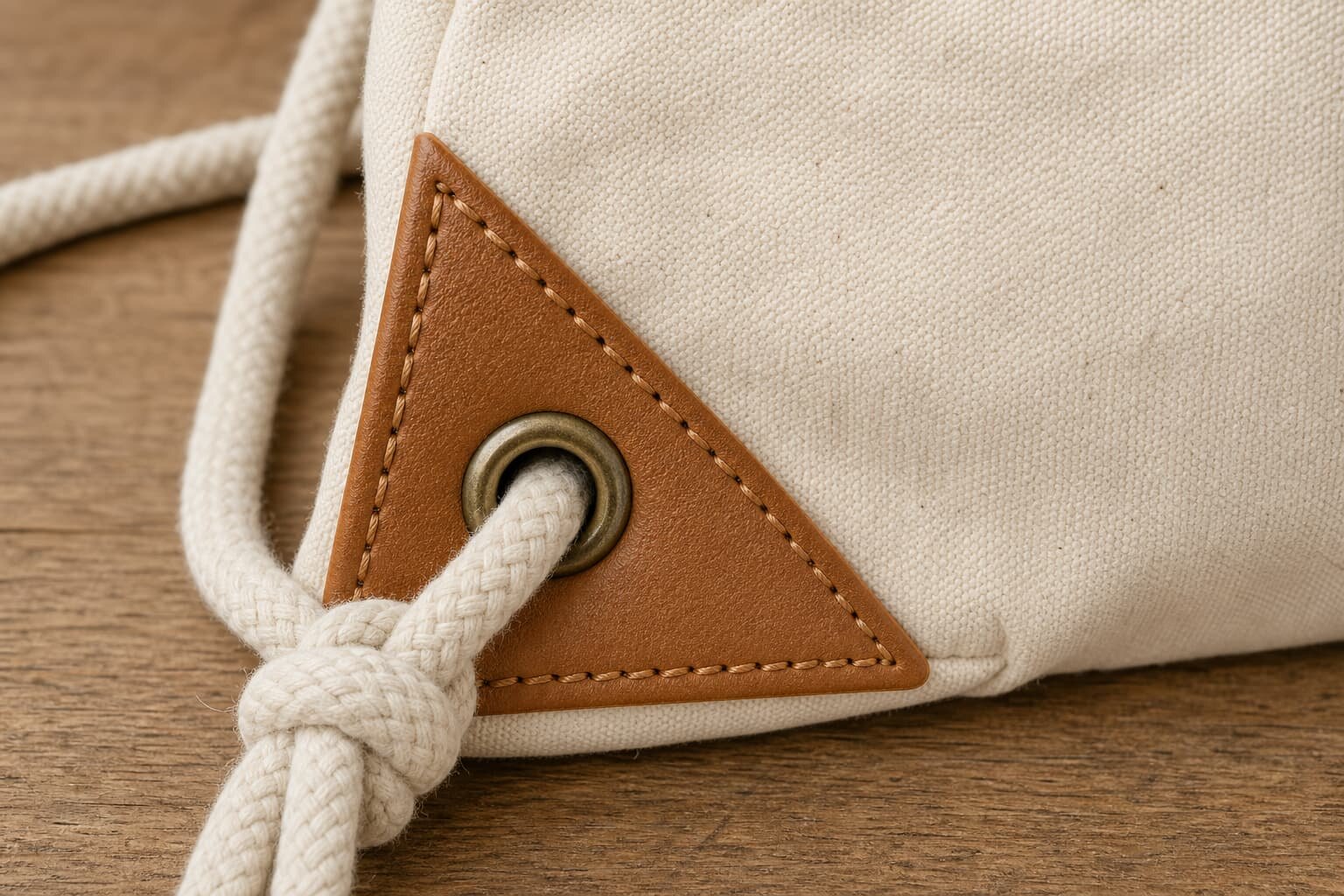
Construction also changes cost. A simple drawcord passing through the bottom seam is cheaper than a bag with stitched triangular corner tabs. Metal eyelets may look clean, but poor eyelet setting can cut the fabric under load. PU or fabric patches add material and labor but usually improve strength. If your bag will carry shoes, bottles, books, or event kits, reinforcement should be specified, not left to the factory.
- Ask for material name, denier or fabric weight, GSM range, coating, and whether fabric is from stock or custom dyed.
- Specify whether the backpack has a flat body, bottom gusset, front pocket, zipper pocket, lining, or only one main compartment.
- State seam allowance and stitch density expectations when the bag is intended for heavier loading.
- Confirm cord diameter and material; a thin cord reduces cost but can cut into the shoulder and fail earlier.
- Require corner reinforcement photos during sampling, including inside seam and outside stitch view.
4. Print method: where many cheap quotes become expensive
Logo printing is often the biggest variable after fabric. Screen printing is usually the best cost-control method for one to three solid colors, especially at medium and high quantities. Heat transfer works better for gradients, full-color artwork, small details, or logos that are difficult to separate into solid screens. Embroidery is less common on lightweight drawstring backpacks because it can pucker thin fabric, but it may work on heavier canvas or premium versions.
The RFQ should define logo size, print position, print color count, artwork file type, and color standard. A supplier quoting a 10 cm one-color logo is not comparable with another supplier quoting a 28 cm full-front print. Also consider the fabric color. White ink on dark polyester may need an underbase. Some coated polyester fabrics can create adhesion problems, and dark fabric can cause dye migration into light transfers if the wrong material is used.
- For screen print, ask whether setup is charged per color, per design, and per print position.
- For heat transfer, ask whether the price includes transfer sheet production, cutting, application, and testing.
- For reflective print or metallic print, require a production sample because cost and durability vary widely.
- For cotton canvas, ask about ink absorption and whether the final print will look slightly textured.
- For polyester, require a print adhesion and rub test on the same fabric color used for bulk production.
5. MOQ logic: total quantity is not the only minimum
Many buyers ask, what is your MOQ for drawstring backpacks? The better question is, what are the MOQs for fabric color, print design, logo color, and packing format? A supplier may accept 1,000 pieces total, but if you divide that across five fabric colors and three logo versions, the factory may need to charge extra setup, use stock fabric only, or reject custom dyeing.
MOQ is also affected by fabric availability. Stock polyester colors allow lower minimums and faster lead time. Custom-dyed polyester or custom cotton canvas usually requires a fabric mill minimum. For distributors and retail buyers managing multiple SKUs, it is important to show the supplier the quantity per color and per artwork at the RFQ stage, not only the total program quantity.
- Separate your RFQ quantity by bag color, logo design, print color, and delivery destination.
- Ask if the quoted MOQ is based on stock fabric or custom fabric production.
- Confirm whether sample cost can be refunded after bulk order, but do not assume it will be.
- For repeat programs, ask whether the supplier can hold fabric or repeat the same color in later batches.
- If you need assorted colors, ask the factory to quote the assortment clearly rather than averaging quietly.
6. Quote data you need before comparing suppliers
A professional factory quote should include more than a unit price. Procurement teams need enough data to estimate landed cost, check whether the supplier understood the specification, and prevent change claims later. At minimum, request the bag specification, print method, MOQ rules, sample charge, production lead time, packing method, carton size, carton weight, payment terms, and quote validity.
FOB unit price alone can be misleading. A lighter bag may have a lower unit cost but higher defect risk. A bag packed with individual polybags may look safer but increase carton volume and packaging waste. A thicker 300D version may cost more per unit but reduce replacement claims for repeat-use programs. The correct choice depends on the full cost picture, not the first number in the quote.
- Bag cost: base sewn product without print, if possible.
- Logo cost: setup, print run charge, and any extra cost for oversized artwork.
- Sampling cost: prototype, pre-production sample, courier, and revision fees.
- Packing cost: bulk, individual polybag, hangtag, barcode label, master carton, and carton marks.
- Export data: carton dimensions, pieces per carton, gross weight, net weight, and total CBM.
- Commercial data: Incoterm, payment terms, quote validity, lead time, and production capacity for your delivery window.
7. Sampling checks that prevent bulk production mistakes
A drawstring backpack sample should not be approved only because the logo looks correct in a photo. Physical handling matters. Check fabric thickness, transparency, cord comfort, seam strength, corner reinforcement, print feel, and packing behavior. If the bag will hold a specific kit, test it with the actual contents. A backpack that looks fine empty may distort or tear when loaded with a bottle, brochure set, or sports shoes.
For new designs, request a pre-production sample made with the actual fabric, actual cord, actual reinforcement, and actual print method. If the factory first sends a substitute fabric sample, mark it as reference only. Do not let bulk production start until the approved sample and written specification match. This is especially important when a sales sample is made from stock fabric but the order uses custom color fabric.
- Measure finished bag size flat and compare with the tolerance agreed in the RFQ.
- Pull each cord firmly at the bottom reinforcement and top channel to check slipping or tearing.
- Rub the print with a dry white cloth and, if relevant, a slightly damp cloth.
- Fold and stack printed bags face-to-face to check whether ink blocks or transfers.
- Check whether the top opening closes smoothly and whether the cord length is comfortable for the target user.
- Photograph approved details: fabric texture, corner construction, print position, side seams, and packing method.
8. Packing and freight: the hidden cost in bulky programs
Drawstring backpacks are soft goods, but packing still affects landed cost. Bulk packing keeps unit cost and carton volume lower, but bags can wrinkle, cords can tangle, and light-colored fabrics can pick up dirt if the carton is not lined properly. Individual polybags improve cleanliness and distribution control, but they add labor, material cost, time, carton volume, and sometimes compliance concerns for retailers.
Before approving a quote, ask for pieces per carton, carton dimensions, gross weight, and total CBM at the quoted quantity. For large event or retail orders, the difference between compact bulk packing and oversized individual packing can change sea freight or warehouse handling cost. If your distribution center requires carton weight limits, barcode labels, or inner packs by store quantity, those requirements must be included in the RFQ.
- Bulk pack is usually suitable for wholesale distribution when the bags are not customer-facing at arrival.
- Individual polybag is useful for retail kits, clean handling, barcode scanning, or pre-packed giveaways.
- Inner cartons or bundles help store allocation but add material and labor.
- Light-colored cotton or canvas may need moisture protection and clean carton liners.
- Carton marks should include PO number, SKU, color, quantity, gross weight, net weight, and destination details when required.
9. Lead time planning and approval gates
Lead time depends on fabric availability, artwork complexity, sample approval speed, order quantity, and factory production load. A simple stock-color polyester drawstring backpack with one-color screen print can move faster than a custom cotton canvas bag with dyed fabric, multiple logo placements, and retail packing. However, buyers should avoid relying on verbal lead time without approval milestones.
Set approval gates in the purchase schedule. The supplier should know when artwork must be final, when the sample must be approved, when fabric cutting can start, when printing begins, and when final inspection is planned. If the buyer delays artwork confirmation or changes the logo after screens are made, the factory may need extra time and cost. Clear gates protect both sides.
- Gate 1: written specification and artwork file approved before sampling.
- Gate 2: physical pre-production sample approved before bulk material cutting or printing.
- Gate 3: first finished pieces reviewed by photo or video at the start of production.
- Gate 4: inline check after sewing and printing are both active.
- Gate 5: final inspection after packing but before shipment release.
- Gate 6: carton data confirmed for forwarder booking and warehouse receiving.
10. How to compare two quotes without being misled
When two suppliers quote different prices, do not immediately choose the lower one. Put both quotes into a comparison sheet and normalize the specification. Match fabric GSM, bag dimensions, reinforcement, cord size, print size, print method, packing, carton data, MOQ, lead time, and sample policy. If one supplier left any field blank, ask for clarification before shortlisting.
The best supplier for a drawstring backpack program is usually the one who can explain the cost drivers clearly and flag risks before production. A factory that asks about load weight, print size, fabric color, and packing is not being difficult; it is trying to quote the real job. Procurement teams should reward quote accuracy because it reduces change orders, rejected samples, and shipment disputes.
- Reject vague quotes that say standard material, normal print, or regular packing without measurable detail.
- Treat unusually low prices as a prompt for questions about fabric weight, reinforcement, and print size.
- Compare landed cost impact using carton CBM and packing method, not only FOB unit price.
- Ask for a quote revision number and make the PO reference the final approved revision.
- Keep the approved sample, specification sheet, and quote together as the production control file.
Specification comparison for buyers
| Spec decision | Recommended option | When it fits | Buyer risk to check |
|---|---|---|---|
| Main fabric for event giveaway | 210D polyester, approx. 70-85 GSM | Low-cost campaign orders, school events, races, and short-use promotions | Too thin fabric can look transparent, wrinkle badly, or tear at eyelets; approve GSM and handfeel from a physical sample |
| Main fabric for retail or reusable program | 300D polyester or 6-8 oz cotton canvas | Higher perceived value, repeat-use backpacks, paid retail bundles, and brand merchandise | Quote may hide fabric downgrade; require fabric weight, yarn type, and colorfastness check |
| Cord system | 5-6 mm polyester cord with reinforced bottom tabs | Most adult promotional and retail drawstring backpacks | Cord length and tab stitch strength affect comfort and failure rate; test loaded pulling before approval |
| Logo print | Screen print for 1-3 solid colors; heat transfer for gradients or small detail | Screen print controls unit cost on larger quantities; transfer suits detailed artwork | Ink cracking, color migration, and registration shift; confirm print test on actual fabric color |
| MOQ structure | Separate fabric MOQ, print MOQ, and color MOQ | Multi-SKU programs where buyers need several bag colors or logo versions | Supplier may quote one MOQ but charge setup for each print/colorway; request line-item MOQ rules |
| Packing method | Bulk pack 100-200 pcs per export carton, or individual polybag only when required | Bulk packing for wholesale distribution; polybag for retail kit assembly or clean handling | Overpacking increases carton CBM and landed cost; underpacking causes dirt marks and cord tangling |
Buyer checklist before sampling
- Define the use case before asking for price: one-day event, retail merchandise, school program, sports club, or reusable brand giveaway.
- State exact bag size with tolerance, not only an image reference; include width, height, bottom gusset if any, and cord length requirement.
- Specify fabric type and weight in GSM or ounces; do not accept a quote that only says polyester, cotton, or nonwoven.
- Confirm whether reinforced corners use metal eyelets, stitched fabric triangles, PU patches, or rope-through seam construction.
- Provide logo artwork size, color count, print position, Pantone references, and whether the print must pass rub or wash testing.
- Ask the supplier to separate bag cost, print setup, sample fee, packing cost, export carton data, and optional inspection cost.
- Request production sample photos and one physical pre-production sample before bulk cutting for new designs or new fabrics.
- Check carton dimensions, gross weight, and pieces per carton before comparing FOB quotes because freight can change the true cost ranking.
- Lock approval criteria for print placement, color tolerance, seam strength, cord pull strength, stains, loose threads, and packing count.
- Make the PO match the approved sample and quote revision number, including fabric GSM, print method, accessories, packing, and lead time.
Factory quote questions to send
- What exact fabric are you quoting, including material, denier or yarn count, GSM, coating if any, and available color stock?
- Is the MOQ based on total order quantity, each bag color, each logo design, each print color, or each fabric dye lot?
- What is the bag size after sewing, and what production tolerance do you use for width, height, and cord length?
- Which reinforcement method is included at the bottom cord exit: metal eyelet, stitched triangle, PU patch, or folded seam only?
- Which print method is included in the unit price, and what are the setup charges for each logo color or transfer mold?
- Can you print the logo on the actual fabric color for sample approval before mass production, especially on dark or coated fabric?
- What are the export carton dimensions, pieces per carton, gross weight, and estimated CBM for the quoted quantity?
- What sample lead time, bulk lead time, and approval deadline are assumed in the quote?
- What defects are considered critical, major, and minor during final inspection for this bag style?
- If fabric, cord, or ink must be changed after sampling, how will you update the quote and approval sample?
Quality-control points to confirm
- Measure fabric weight against the approved specification using a GSM cutter or agreed lab method for each production fabric lot.
- Check bag dimensions after sewing on random samples from early, middle, and late production, allowing only the agreed tolerance.
- Pull-test drawcords and bottom reinforcement because most field failures occur at eyelets, tabs, and seam exits.
- Inspect print adhesion, registration, color matching, and edge sharpness on the actual fabric, not on a separate print swatch only.
- Rub-test dark prints and light prints to check ink transfer, especially when bags may be packed face-to-face in cartons.
- Check seam density, backstitching, skipped stitches, loose threads, and raw-edge fraying at the top channel and side seams.
- Confirm packing count per carton, inner packing method, barcode or carton mark placement, and moisture protection before shipment.
- Open cartons after compression to check whether prints block, cords tangle, bags crease permanently, or light colors pick up dirt.