Start With the Bookstore Use Case
University bookstore buyers usually do not need a generic cotton pouch. They need a pouch that fits a specific selling or distribution job: freshman orientation kits, graduation gift packs, art supply bundles, campus tech accessories, alumni merchandise, or department-branded retail items. The correct material depends on what the pouch must carry, how long it will stay on display, and whether students will reuse it after purchase.
Before requesting quotes, define the load and presentation standard. A pouch for earbuds or ID accessories can be lighter and softer. A pouch that holds a water bottle accessory kit, folded T-shirt, lab goggles, or multiple stationery items needs stronger seams, better fabric opacity, and a wider drawcord channel. If the pouch is sold as merchandise rather than used as packaging, the fabric and print must feel retail-grade in hand.
- Accessory pouch: prioritize smooth closure, small size accuracy, and clean print registration.
- Welcome kit pouch: prioritize unit cost, consistent shade, fast packing, and carton organization.
- Retail gift pouch: prioritize fabric hand feel, print finish, label detail, and low defect rate.
- Apparel add-on pouch: prioritize higher GSM, larger opening, stronger side seams, and carton compression resistance.
Choose Fabric Weight by Contents
For wholesale cotton drawstring pouches, fabric weight is the first commercial decision because it affects price, opacity, sewing speed, print result, and shipping volume. Many factories quote cotton pouches in ounces, while some quote GSM. As a practical reference, 4 oz cotton is light and economical, 5 oz to 6 oz is common for small to medium pouches, 7 oz has a more retail-ready feel, and 8 oz or above is better reserved for heavier kits or premium merchandise.
A university bookstore should not select the heaviest fabric automatically. Heavy cotton on a small pouch can look bulky, create thick seams at the drawcord channel, and raise freight cost without improving the customer experience. For most bookstore programs, 5 oz to 7 oz cotton gives the best balance. Move to 8 oz only when the pouch carries a heavier bundle, needs stronger opacity, or is positioned as a reusable product rather than packaging.
- 4 oz cotton: suitable for low-cost giveaways, but contents may show through and seams feel lighter.
- 5 oz cotton: good for pencils, pins, cords, badges, small stationery, and event kits.
- 6 oz to 7 oz cotton: better for bookstore retail, gift bundles, and licensed logo merchandise.
- 8 oz cotton: useful for premium pouches, apparel kits, and heavier contents, but confirm channel thickness and freight impact.
Natural, White, Dyed, or Organic Cotton
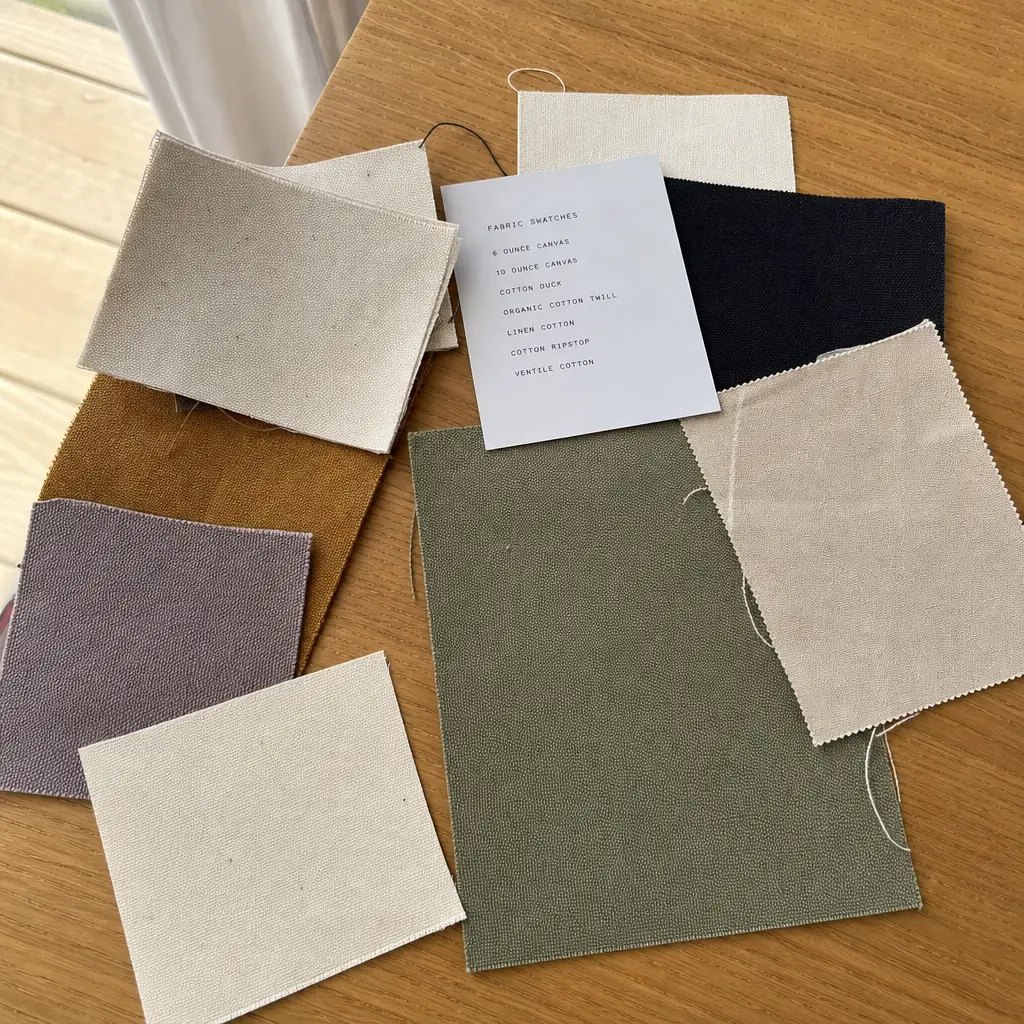
Natural unbleached cotton is popular for campus bookstores because it has a sustainability-friendly look and pairs well with simple one-color printing. It also hides light handling marks better than bleached white cotton. The tradeoff is shade variation. Natural cotton can vary from cream to beige between fabric rolls, so the approved sample should define an acceptable shade range rather than one exact color expectation.
Bleached white cotton gives cleaner logo contrast and more predictable print color, especially when university brand standards are strict. Dyed cotton works for school colors, but dye lot consistency and colorfastness become more important. Organic cotton can be a strong selling point for retail merchandise, but it changes the quote structure because fabric sourcing, MOQ, and documentation may not match standard cotton. Buyers should separate real product requirements from marketing preferences before locking the specification.
- Natural cotton: best for earthy retail style, simple prints, and cost-sensitive campus programs.
- Bleached white cotton: best for crisp artwork, bright logo colors, and official brand presentation.
- Dyed cotton: best for school-color collections, but require lab dip or fabric swatch approval.
- Organic cotton: best when the bookstore can accept higher MOQ, longer material sourcing time, and documentation review.
Size, Shape, and Drawcord Function
A drawstring pouch fails commercially when the product fits on paper but not in real use. Finished size, opening width, seam allowance, fabric thickness, and drawcord channel depth all reduce usable internal space. For a bookstore bundle, send the supplier the exact contents or a measured layout. If physical contents are unavailable, provide product length, width, height, stacked thickness, and whether the pouch should close fully or show part of the item.
Shape also affects packing speed. A tall narrow pouch may look good for pens, but it can be slow to fill during orientation kit assembly. A wider opening improves production packing and bookstore staff handling. For repeated student use, a two-sided draw closure usually feels better and closes more evenly. For very small pouches, one-sided pull may reduce bulk and cost, but it should be tested because tight channels make closure feel cheap.
- Set finished size tolerance before sampling, especially for small pouches where 5 mm changes matter.
- Allow enough opening width for staff to insert the bundled item quickly without folding or forcing.
- Match cord diameter to channel width so the pouch closes smoothly without wrinkling the top edge.
- Use a physical fit test with the real bookstore product before approving bulk cutting.
Printing Method and Logo Control
Most university bookstore cotton pouches use screen printing because it is reliable for one to three spot colors, gives a clean retail look, and keeps repeat orders predictable. Screen printing works well for school names, mascots, department marks, and simple event graphics. Fine lines, small type, halftones, and large ink blocks need extra attention because cotton texture can soften edges and absorb ink differently from paper or synthetic fabric.
Heat transfer and digital transfer can be useful for short runs, full-color artwork, or designs with gradients, but they change the hand feel. On a small pouch, a large transfer patch may feel stiff and reduce the natural cotton effect. Embroidery is possible, but it is usually better for thicker canvas pouches than light cotton drawstring pouches because stitch tension can pucker the fabric. For licensed university artwork, approve a printed strike-off, not only a digital proof.
- Screen print: best for repeatable bookstore quantities, spot colors, and cost control.
- Heat transfer: useful for detailed graphics, but test flexibility, edge feel, and wash resistance.
- Digital print: suitable for complex artwork, but confirm color depth and fabric pre-treatment requirements.
- Embroidery: premium look, but only practical when fabric weight and design size can support it.
MOQ Logic and Cost Drivers
MOQ is not only a sales policy. It is tied to fabric purchasing, cutting efficiency, print setup, color changes, and packing complexity. A factory may accept a lower quantity for natural cotton in a standard size because the material is common. The same quantity in dyed school colors, organic cotton, mixed logo versions, or custom labels can become inefficient. Buyers get better quotes when they separate total order quantity from the number of versions.
The largest cost drivers are fabric weight, pouch dimensions, print color count, print area, drawcord type, label or hangtag requirements, inspection standard, and packing method. A small pouch with four print colors and individual barcode bags can cost more than a larger plain pouch. For university bookstore programs with multiple departments, it is often better to standardize size and fabric, then vary only the front print. That gives the supplier more efficient fabric cutting and keeps version control manageable.
- Lower MOQ is easier with stock natural cotton, standard cord colors, and one-color screen print.
- Higher MOQ is likely for dyed cotton, organic cotton, custom woven labels, and many artwork versions.
- Setup costs should be separated from unit price so repeat-order economics are visible.
- Quantity breaks should show whether savings come from fabric purchase, print setup spread, or packing efficiency.
Sample Approval That Prevents Bulk Problems
A useful sample process has stages. A blank size sample confirms dimensions, fabric weight, drawcord function, and content fit. A print strike-off confirms ink color, coverage, artwork scale, and position. A pre-production sample combines final fabric, final construction, final print, and final packing. For licensed university programs, the pre-production sample should be the approval standard for bulk production.
Do not approve a pouch only because the logo looks correct. Fold it, pull the cord repeatedly, insert the planned bookstore contents, place it in the planned inner bag, and compress it like it will sit in a carton. Look for print cracking, cord snagging, fabric distortion, lint, odor, and seam stress. If the pouch will be sold at retail, also check how it looks after being handled because cotton wrinkles and creases more visibly than synthetic materials.
- Approve fabric weight with a measured GSM or oz reference, not only by hand feel.
- Approve print placement with a dimension from the top edge and side edge.
- Approve drawcord length after the pouch is fully closed, including knot style and tail length.
- Approve packing with the same folding method and inner bag style planned for bulk shipment.
Factory Evidence Worth Requesting
For cotton drawstring pouches, supplier evidence should focus on production capability, not general company claims. A practical supplier should be able to show fabric roll inspection, cutting table setup, print workshop conditions, sewing line output, trimming process, needle control if required, and final carton packing. Production photos are not a substitute for inspection, but they help catch mismatched fabric, wrong cord, and print placement issues early.
Buyers should also request evidence that relates to the specific order. If the quote includes 6 oz natural cotton, ask for the fabric source and tolerance. If the pouch has a licensed logo, ask how screens and artwork files are controlled. If the order ships to a distributor or campus warehouse, ask for carton labels and packing list format before production ends. The goal is to verify whether the supplier understands bookstore receiving and SKU control, not just sewing.
- Fabric evidence: roll photos, GSM range, shade range, and whether material is pre-shrunk or washed.
- Print evidence: strike-off photos, ink type, curing method, and print position measurement.
- Sewing evidence: seam type, stitch density reference, drawcord channel construction, and trimming standard.
- Packing evidence: inner pack quantity, carton label sample, carton dimensions, and gross weight estimate.
QC Thresholds for Bookstore Orders
Bookstore buyers need QC thresholds that are simple enough for inspection teams to apply. Critical defects include wrong logo, wrong size, wrong fabric, open seams, mildew odor, severe stains, and incorrect carton quantity. Major defects include visible print misalignment, skipped stitches, loose drawcord channels, shade mismatch beyond the approved range, and heavy creasing on printed panels. Minor defects include small loose threads or slight natural cotton slubs that do not affect retail appearance.
Acceptance criteria should be written into the purchase order or inspection instruction. For example, print position tolerance can be plus or minus 3 mm on small pouches and plus or minus 5 mm on larger pouches, depending on artwork. Finished size tolerance may be plus or minus 0.5 cm for small sizes and plus or minus 1 cm for larger sizes. Natural cotton slubs should be accepted within reason, but oil marks, dark stains, and odor should not be treated as normal fabric character.
- Critical: wrong artwork, wrong material, wrong quantity, mildew smell, severe contamination, or unusable closure.
- Major: open seams, poor print curing, strong shade mismatch, cord failure, or obvious print placement error.
- Minor: removable loose threads, slight cotton slubs, small wrinkles away from the printed area.
- Measurement: inspect finished size flat, print position from fixed edges, and closure function after repeated pulls.
Packing and Carton Planning
Cotton pouches look simple, but packing errors create real receiving problems for university bookstores and distributors. Mixed designs, sizes, or department logos should not be placed in unmarked cartons. Inner polybags or paper bands should identify SKU and quantity when there are multiple versions. Carton labels should include purchase order number, item name, size, color, print version, quantity, net weight, gross weight, and carton number sequence.
Packing method also affects product appearance. Flat packing reduces wrinkles and keeps print panels cleaner, but it uses more carton area. Folding can reduce carton volume, but folded print areas may crease or block if ink is not fully cured. Heavy carton compression can distort drawcord channels and leave marks on natural cotton. Buyers comparing quotes should review carton dimensions and gross weight because a cheaper unit price can lose value if the supplier packs too loosely or creates excessive cubic volume.
- Use separate cartons or clearly separated inner packs for each logo version and size.
- Avoid folding directly across large printed logos when the pouch is sold as retail merchandise.
- Confirm carton strength when export cartons will be stacked for ocean freight or warehouse storage.
- Request estimated CBM per quantity break to compare landed cost, not only ex-factory unit price.
Specification comparison for buyers
| Spec decision | Recommended option | When it fits | Buyer risk to check |
|---|---|---|---|
| Fabric weight | 5 oz to 7 oz cotton for most bookstore pouches; 8 oz only for heavier retail kits | Works for stationery sets, tech accessories, campus welcome gifts, and light apparel add-ons without making the pouch feel cheap | Low GSM may show contents and distort after printing; high GSM can increase freight and make small pouches bulky |
| Cotton type | Unbleached natural cotton for eco-style programs; bleached white only when brand color accuracy is critical | Natural cotton fits campus sustainability positioning and hides handling marks better in busy retail stockrooms | Natural cotton has shade variation between lots; white cotton needs better stain control during sewing and packing |
| Construction | Double-fold drawcord channel with lockstitch side seams and bar tack or reinforced seam ends | Best for repeated opening and closing by students and bookstore staff during merchandising | Single-fold channel or weak seam ends can fray after cord tension, especially on small high-use pouches |
| Drawcord | Cotton cord for natural look; polyester cord when smoother sliding and lower lint are priorities | Cotton cord suits gift pouches and campus merchandise; polyester cord suits frequent-use tech or sports accessory pouches | Cord diameter must match channel width; thick cord in a narrow channel slows packing and feels rough to open |
| Print method | Screen print for one to three spot colors; heat transfer only for detailed full-color artwork or short trials | Screen print is cost-stable for bookstore repeats and handles simple mascots, logos, and department marks well | Ink coverage on textured cotton can reduce fine detail; heat transfer may feel stiff on small pouches |
| Size grading | Use three standard sizes before making custom dimensions: small accessory, medium kit, and large apparel add-on | Standardized sizes improve MOQ leverage and reduce cutting mistakes across semester programs | Custom sizes without a tolerance plan can cause SKU fit problems when the buyer changes bundled products later |
| Packing | Flat pack in inner polybags by SKU, carton-marked with size, fabric, print version, and quantity | Useful for bookstore backrooms, campus events, and distributor receiving where mixed cartons create delays | Over-tight carton packing can crease printed panels; mixed versions without carton marks cause allocation errors |
| Approval route | Pre-production sample with final fabric, cord, print ink, and packing method before bulk cutting | Necessary when the pouch carries a licensed university logo or is sold as branded merchandise | Approving only a digital mockup misses shrinkage, print hand feel, drawcord function, and cotton shade variation |
Buyer checklist before sampling
- Define the pouch use before quoting: retail sale, welcome kit, stationery bundle, tech accessory pouch, or gift-with-purchase.
- List the exact item or bundle that must fit inside, including product dimensions and target packed appearance.
- Specify fabric weight in oz or GSM, not only the word cotton; include whether natural, bleached, dyed, or organic cotton is required.
- Set finished size tolerance, usually plus or minus 0.5 cm for small pouches and plus or minus 1 cm for larger pouches.
- Confirm drawcord material, diameter, color, knot style, and whether both sides or one side pulls closed.
- Provide print artwork as vector files with Pantone references and the maximum print area in millimeters.
- Decide if the bookstore needs hangtags, barcode labels, UPC stickers, inner polybags, or carton routing labels.
- Request a pre-production sample using final fabric and final print method before mass cutting.
- State inspection criteria for seam strength, print position, shade variation, loose threads, stains, and carton count.
- Ask the supplier to quote by quantity breaks, carton dimensions, gross weight, sample cost, mold or screen cost, and estimated lead time.
Factory quote questions to send
- What cotton weight in GSM or oz do you recommend for this pouch size and intended contents, and what is the actual fabric tolerance?
- Is the quoted fabric greige, natural washed, bleached white, dyed cotton, recycled cotton blend, or certified organic cotton?
- What is the minimum order quantity by size, fabric color, and print design, and can different bookstore department logos share one fabric lot?
- Which print method is included in the quote, how many colors are included, and what is the maximum print area before cost changes?
- What are the setup charges for screens, digital files, cutting dies, woven labels, hangtags, or barcode stickers?
- What sample types are available: blank size sample, printed strike-off, pre-production sample, and sealed production sample?
- What finished size tolerance, fabric shrinkage allowance, and print position tolerance will the factory accept in writing?
- How many pieces are packed per inner bag and export carton, and what are the estimated carton size, gross weight, and cubic meters?
- What production lead time starts after sample approval, deposit, or artwork confirmation, and which step is the usual bottleneck?
- Can the factory provide production photos for fabric cutting, printing, sewing, trimming, and final packing before shipment?
Quality-control points to confirm
- Finished pouch size should match the approved sample within the agreed tolerance, measured flat before packing.
- Fabric weight should be verified against the quoted GSM or oz range, not judged only by hand feel.
- Drawcord channel must allow smooth closure without fabric bunching, cord snagging, or seam tearing.
- Side seams should be straight, secure, and free from skipped stitches, open seams, and loose thread bundles.
- Print color, placement, opacity, and edge sharpness should match the approved strike-off under consistent light.
- Printed panels should not crack, peel, block, or transfer after normal folding and carton compression.
- Natural cotton shade variation should stay within the approved lot range and not mix visibly different rolls in one retail set.
- Pouches must be clean, dry, odor-free, and free from oil marks, needle stains, mildew smell, and excessive lint.
- Carton labels should identify SKU, size, color, print version, quantity, net weight, gross weight, and purchase order number.
- Random carton counts should match the packing list, especially when multiple university logos or bookstore departments are shipped together.