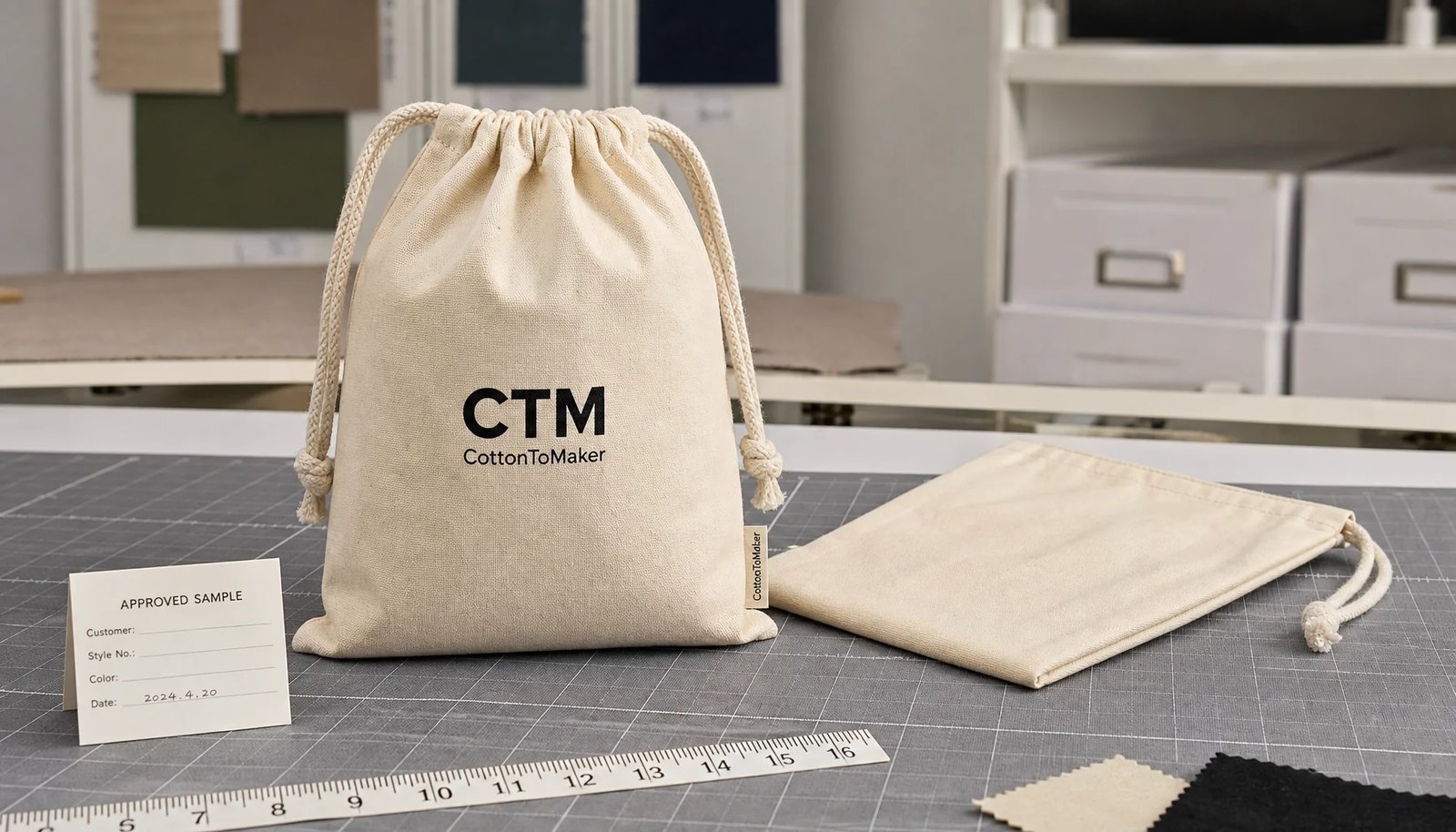
Start With the Show Workflow, Not the Logo
Wholesale cotton drawstring pouches for trade show exhibitors should be sourced as a packaging and logistics item first, and a branding item second. The right pouch depends on what goes inside it, how it will be handed out, how long it needs to survive after the event, and whether the team wants the recipient to reuse it. A pouch for a brochure, badge lanyard, or charging cable can be lighter and simpler than a pouch for cosmetics, sample jars, or a sponsor kit that needs to look presentable on a desk after the show.
The most common sourcing mistake is starting with artwork instead of use case. If procurement only sends a logo file, the factory will usually quote a generic pouch and fill in the missing details with whatever is standard for them. That is how buyers end up with a bag that looks fine in a photo but does not fit the insert, does not stay closed, or arrives with a print area that is too small for the actual brand mark. Before asking for price, define how the pouch will move from factory to venue to attendee. That path determines the spec more than the logo does.
- Define the largest item the pouch must carry, not just the average one.
- State whether the pouch is meant to be kept, reused, or used once and discarded.
- Identify where the handout happens: one booth, multiple show floors, or a fulfillment house.
- Confirm whether the pouch must hold its shape when empty or only when filled.
Write the Spec in Procurement Terms Before You Ask for Pricing
A useful quote starts with a fixed product definition. On cotton drawstring pouches, small changes in size, fabric weight, cord construction, and seam finish can change both price and appearance. If one supplier is quoting 5 oz fabric with bulk packing and another is quoting 6 oz fabric with individual polybags and a tighter tolerance, those are not comparable offers. The RFQ should separate the base pouch from the decoration and packing so each supplier is quoting the same job.
The minimum spec should include finished size after sewing and pressing, fabric weight in oz or GSM, cotton color, cord material and diameter, seam construction, and whether the top channel is double-folded. If the pouch will be seen up close at a booth or in a VIP kit, add stitching density, top edge finish, and whether the pouch will ship flat or display-ready. The goal is not perfection for its own sake. The goal is to remove enough ambiguity that the quote tells you something you can actually buy against.
- Quote finished width and height after sewing and pressing, not cut size.
- Ask for fabric weight in oz or GSM instead of light, medium, or heavy.
- Specify cord diameter and end finish instead of assuming factory standard.
- State whether the pouch is natural, bleached, or dyed cotton.
Choose Fabric Weight and Color Based on Contents and Brand Feel
Fabric weight is the fastest way to move a pouch from disposable to credible. For most trade show programs, 5 oz to 6 oz cotton, roughly 170-200 GSM, is the practical default. It is heavy enough to support screen printing, better at hiding the contents, and still efficient to sew, pack, and freight. Lighter cotton can work for very low-cost promotional use, but it is more likely to wrinkle, distort around the print area, and show the insert through the fabric. That usually makes the handout feel less deliberate than the brand intended.
Color matters as much as weight. Natural cotton gives a warm, uncoated look that works well for minimalist branding, wellness campaigns, and programs where the buyer wants a softer presentation. It also brings visible flecking and shade variation, which should be treated as normal unless the buyer requires tighter fabric selection. Bleached or dyed cotton gives a cleaner background for small logos, sharper text, or higher-contrast artwork. If the brand is color-sensitive, ask the factory to quote the same pouch in natural, bleached, and dyed options before locking the artwork. That gives procurement a real cost and appearance comparison instead of a guess.
- Use 4 oz cotton only for very light giveaways and low visual expectations.
- Use 5 oz to 6 oz cotton for the most common exhibitor sample-kit use case.
- Use 8 oz cotton canvas when the pouch must feel premium or carry heavier contents.
- Ask the supplier to identify normal natural-fiber variation so acceptable flecks are not later treated as defects.
Place the Logo Where It Still Reads When the Pouch Is Closed
Logo placement on a drawstring pouch is different from placement on a flat print panel. Once the cord is pulled, the top edge gathers, the side seams curve the front panel, and a logo that looked centered in a mockup can disappear into folds. For trade show buyers, the safest default is a centered or lower-center front-panel logo with enough clearance from the side seams, bottom seam, and top channel to survive closure. The real question is not whether the logo fits when the pouch is flat. It is whether the brand mark still reads when the pouch is cinched, stacked, or photographed in use.
A good placement guide should define a safe area, not just an artwork size. For most medium pouches, that means roughly 15-25 mm away from side seams and bottom seam, plus 20-30 mm away from the top channel. Narrow pouches or pouches with larger cords need more room. If the artwork includes a tagline, sponsor line, event date, or QR code, ask for the minimum readable size on actual fabric and require a strike-off. Small text that is legible on screen can blur once it is printed on woven cotton, especially when the fabric weave is visible.
- Keep critical artwork out of the gathered top zone if the pouch will be shown closed.
- Test QR codes on real fabric, because texture and ink spread can reduce scan reliability.
- Use center or lower-center placement when the pouch will be photographed or handed out quickly.
- Request the factory's printable area in millimeters, not a rough visual estimate.
Match the Print Method to the Artwork and Order Volume
Screen printing is still the default for many wholesale cotton drawstring pouch programs because it is predictable and cost-efficient for simple artwork. It works well for one to three spot colors, clean logos, sponsor marks, and event branding that needs to stay consistent across a large run. The limitation is detail. Thin lines, tiny text, tight negative space, and subtle gradients can soften or fill in on cotton texture if the ink deposit is too heavy or the mesh is not appropriate for the art. For simple procurement, that is usually acceptable. For precise brand control, it needs proofing.
Digital direct print and transfer are used when the artwork is more complex or when the buyer needs multiple versions quickly. Digital print is better for multicolor graphics, QR-heavy designs, sponsor panels, and short runs where screen setup would be inefficient. Transfer can work for short orders or when the artwork changes often, but the buyer should pay attention to hand-feel, adhesion, and durability after repeated folding. The right question is not which method looks more modern. It is which method best fits the order size, the logo complexity, and the expected handling after the trade show.
- Use screen print for simple, durable branding at larger quantities.
- Use digital print when the art has many colors, gradients, or multiple sponsor versions.
- Use transfer only when the supplier can prove adhesion quality and the buyer accepts the surface feel.
- If the logo includes metallic ink, puff ink, or other special effects, require a physical strike-off before bulk approval.
Build the RFQ So Suppliers Quote the Same Job
Many sourcing problems start because the RFQ is too generic. If the buyer asks for a cotton pouch with logo printing, each factory will fill in the blanks differently. One may quote lighter fabric, another may include individual polybags, and a third may assume a standard logo size that does not match the brand's actual artwork. The result is a stack of prices that cannot be compared cleanly. A usable RFQ removes assumptions. It should make the supplier quote the same size, the same construction, the same print method, the same packing format, and the same delivery milestone.
The RFQ should also separate product cost from logistics cost. Ask for pieces per carton, carton dimensions, gross weight, and net weight so freight is visible early. If the pouches will go to more than one show destination, include the destination matrix in the request. If the order requires labeling by booth number, department, sponsor, or region, that should be treated as packing labor and quoted explicitly. Strong procurement does not chase the lowest line item. It asks which supplier can quote the exact job with the fewest assumptions and the cleanest change control.
- Include finished size, GSM or oz, fabric color, cord type, print size, print method, and quantity by artwork version.
- Ask for setup charges separately from unit price so repeat runs are easier to estimate.
- Request carton size, weight, and pieces per carton to compare freight impact.
- Clarify whether sample fee, barcode labels, inner bags, or kitting labor are included or excluded.
Use Samples to Validate Production, Not Just Design
A digital mockup is not a production approval. Cotton behaves differently from a screen image. It can shrink, the weave can absorb ink unevenly, and the seam allowance can change the usable print panel. The sample process should therefore have two steps: a print strike-off for the artwork and a full pre-production sample for the final pouch. The strike-off checks color, line clarity, and surface finish. The pre-production sample checks finished size, cord function, logo position, and how the pouch looks when closed. If the buyer approves only a mockup, the factory still has too much freedom on the details that matter most.
The sample approval should be tied to one decision owner and one written reference. Keep one approved sample with the buyer and one with the factory. If a third-party inspector is involved, give that inspector the same sample and the same tolerances. This prevents the common problem where email comments drift away from the physical approval standard. For trade show buying, the sample is not a suggestion. It is the production reference. If the approved sample is not final enough to release as a benchmark, it is not ready for bulk order approval.
- Approve the final fabric, not a substitute fabric.
- Record logo size, logo position, finished size, and cord specification on the approved sample.
- Photograph the sample flat, closed, and filled with the intended insert if possible.
- Cycle the drawstring several times to catch tight channels or weak knots before production starts.
Set QC Tolerances and Defect Rules Before the Run Starts
Trade show pouches do not need luxury-goods inspection standards, but they do need practical acceptance rules. The defects that matter are the ones a booth team or attendee will notice immediately: wrong logo, wrong fabric color, open seam, broken cord channel, heavy stains, bad odor, or a pouch that tears during stuffing. Good QC begins before production, not after shipment. The buyer should define major defects, minor defects, and acceptable variation so the factory knows what will be rejected and what can stay within tolerance.
Natural cotton needs special handling in the QC conversation because some variation is normal. Small slubs, visible fiber texture, and slight shade differences across lots are common and should not automatically be treated as defects. The issue is uncontrolled variation that makes the finished cartons look inconsistent. If the order is going to retail resale after the show, the acceptance criteria should be tighter than a one-day giveaway. In that case, procurement should require closer logo placement tolerances, cleaner stitching, and tighter stain rejection because the pouch is no longer just packaging. It is a consumer-facing product.
- Set finished size tolerance, commonly plus or minus 5 mm for small and medium pouches and plus or minus 7 mm for larger ones unless a tighter spec is priced.
- Set logo placement tolerance, commonly plus or minus 3-5 mm depending on size and print method.
- Reject wrong logo, wrong color, open seam, cord pull-out, heavy stain, and bad odor as major defects.
- Define acceptable natural flecks and slubs so normal cotton character is not disputed after production.
Plan Packing, Cartons, and Event Logistics Together
Packing is part of the product because it affects how the pouches are used once they reach the venue. Bulk packing is usually the best choice when the team is handing out empty pouches and wants quick access at the booth. Individual polybags are better when the pouch needs a cleaner presentation, when it is being shipped with other retail-style items, or when the buyer wants to reduce handling before final kitting. The wrong packing decision can create extra labor on move-in day, and that is where low-cost sourcing becomes expensive very quickly.
Carton labeling should support the actual event workflow. At minimum, the carton marks should show PO number, item code, size, color, logo version, quantity, and carton number. If the order is split across destinations, cartons should be segregated by destination instead of being sorted later by the warehouse team. If pouches are pre-stuffed, ask for a packing trial or carton-count check because a filled pouch changes volume and can shift freight cost and stacking stability. Good logistics is not separate from QC. It is the last chance to catch a problem before the goods leave the factory.
- Use bulk inner packs for booth stuffing and lower packing cost.
- Use individual polybags for cleaner presentation or retail-style kits.
- Use carton numbers and logo-version marks when multiple versions are in the same PO.
- Request a final packing photo and carton mark layout before shipment release.
Compare Suppliers on Risk, Lead Time, and Change Control
The lowest quote is not automatically the best quote for wholesale cotton drawstring pouches. Procurement should compare suppliers on the things that create risk after the PO is issued: how they handle placement changes, whether they can provide a real sample on final fabric, how they document tolerances, and what they do if the first strike-off is off-color or the logo is misaligned. A supplier that gives a slightly higher unit price but a tighter approval process can save more money than a cheaper supplier that forces a reprint or a last-minute air shipment.
Lead time should also be measured from the right milestone. Some factories start counting from deposit, others from artwork approval, sample approval, or fabric arrival. That distinction matters when the trade show date is fixed and the buyer cannot absorb slippage. Ask each supplier to state the critical path in writing and to identify what can be changed after sample approval without restarting the schedule. The best vendor is not the one that promises the fastest turnaround. It is the one that can explain exactly what happens if the buyer changes logo size, fabric color, or packing format after the order has been placed.
- Compare sample quality, not just unit price.
- Ask which milestone starts production lead time and which milestones can delay shipment.
- Request written change-control rules for logo adjustments, fabric substitutions, and packing changes.
- Choose the supplier who can explain the risks in plain language and document the tolerances clearly.
Specification comparison for buyers
| Spec decision | Recommended option | When it fits | Buyer risk to check |
|---|---|---|---|
| Finished pouch size | Quote finished width x height after sewing and pressing, with a stated tolerance of plus or minus 5 mm for small and medium pouches and plus or minus 7 mm for larger pouches unless tighter control is required | Best when the pouch must fit a defined insert such as a brochure, badge pack, cable kit, or sample set | Cut size, not finished size, creates avoidable disputes if the factory shrinks or trims differently |
| Fabric weight for trade show use | 5 oz to 6 oz cotton, roughly 170-200 GSM, as the default sourcing range | Good balance for exhibitor giveaways, sample kits, and reusable handouts that need better body than very light muslin | Below about 140 GSM can look thin, show contents, and distort around the print area |
| Premium reusable feel | 8 oz cotton canvas, roughly 220-280 GSM depending on weave | Useful for higher-perception sponsor kits, retail-style handouts, or heavier contents | Heavier fabric raises print cost, freight weight, and folding bulk |
| Logo placement | Centered or lower-center front panel placement with 15-25 mm clearance from side seams and bottom seam, and 20-30 mm from the top channel | Best when the pouch will be photographed, stacked, or handed out quickly at a booth | Artwork too close to the channel or seams can disappear when the pouch is cinched closed |
| Print method for simple branding | Screen print with 1-3 spot colors, ideally on fabric panels with a strike-off approved before bulk | Best for logos, event marks, and clean sponsor branding at scale | Fine type and thin rules below about 0.4-0.5 mm can fill in on cotton texture |
| Print method for complex art | Digital direct print or transfer, depending on artwork, hand-feel, and order volume | Best for multicolor graphics, gradients, short runs, or multiple versioning needs | Transfers can feel plasticky and may crack if the film or cure is poor |
| Cord specification | Braided cotton or polyester cord around 3-4 mm diameter with a clear end finish and consistent knotting | Useful when the pouch will be opened and closed repeatedly by booth staff or attendees | Thin cord can cut into hands or fray; oversized cord can jam the channel |
| Construction | Double-fold top channel, lockstitch side seams, and reinforced stress points at the top corners | Appropriate for repeated handling, pre-stuffing, and event distribution | Weak backstitching can lead to seam opening or cord pull-out during packing |
| Sample approval route | Approve a print strike-off plus a full pre-production sample using the final fabric, cord, size, and logo position | Needed when the pouch is visible in a brand kit, VIP pack, or reseller-style handout | Approving only a digital mockup leaves shrinkage, seam allowance, and placement unresolved |
Buyer checklist before sampling
- Define the pouch use case first: empty giveaway, sample carrier, badge pack, cable pouch, cosmetics pack, or retail gift-with-purchase.
- State the finished size in width by height after sewing and pressing, not the cutting size, and include the acceptable tolerance.
- Choose fabric weight by contents and brand feel: 4 oz for very light promo use, 5 oz to 6 oz for standard trade show kits, and 8 oz for premium reuse.
- Set a print-safe zone with minimum distance from the side seams, bottom seam, and drawstring channel.
- Provide vector artwork, Pantone references if color match matters, and the required logo size in millimeters.
- Confirm whether the logo must stay visible when the pouch is fully closed, not only when it is laid flat.
- Require a physical strike-off when the art includes fine text, QR codes, gradients, or tight registration.
- Specify cord material, cord diameter, knot style, and whether the cord color must match the pouch or the logo.
- State how the pouches should ship: flat, folded, pre-stuffed, individually polybagged, or bulk packed by carton count.
- Request carton dimensions, gross weight, net weight, pieces per carton, and carton marks before freight is booked.
Factory quote questions to send
- What is the finished pouch size tolerance after sewing and pressing?
- What fabric weight, weave, yarn type, and shrinkage range are included in the quote?
- Is the logo printed before sewing or after sewing, and how does that affect placement tolerance?
- What is the maximum printable area for this pouch size without seam or channel distortion?
- What print method is quoted, how many colors are included, and what setup charges apply per logo version?
- What MOQ applies per pouch size, fabric color, and artwork version?
- Can you provide a print strike-off and a full pre-production sample using the final fabric and cord?
- What is the sample fee, sample lead time, courier cost, and whether any of those are credited against bulk production?
- What packing method is included, and what extra cost applies for individual polybags, barcode labels, inserts, or kitting labor?
- What production lead time starts after which milestone: deposit, artwork approval, sample approval, or fabric arrival?
Quality-control points to confirm
- Finished pouch size stays within the agreed tolerance, commonly plus or minus 5 mm for small and medium pouches unless a tighter spec is purchased.
- Logo placement stays within the approved centerline and safe zone, commonly plus or minus 3-5 mm depending on pouch size and print method.
- Logo distance from the bottom seam, side seams, and top channel matches the approved sample.
- Print color matches the approved strike-off under consistent lighting, with no heavy bleeding, pinholes, ghosting, or obvious registration shift.
- Drawstring moves smoothly through the top channel and does not pull loose during normal opening and closing.
- Side seams and bottom seams are secure, with no open stitches, skipped stitches, or weak corner reinforcement.
- Fabric surface is free from oil marks, mildew smell, loose contamination, or handling stains beyond the agreed fabric character.
- Cartons are labeled by PO number, logo version, color, size, and carton number so booth allocation errors are less likely.
- Packing counts match the packing list, with any inner-bag count or carton count verified before shipment release.
- QR codes or small text are tested on the actual fabric, not just on a flat artwork proof, to confirm legibility and scanability.