Start With the Event Failure Mode
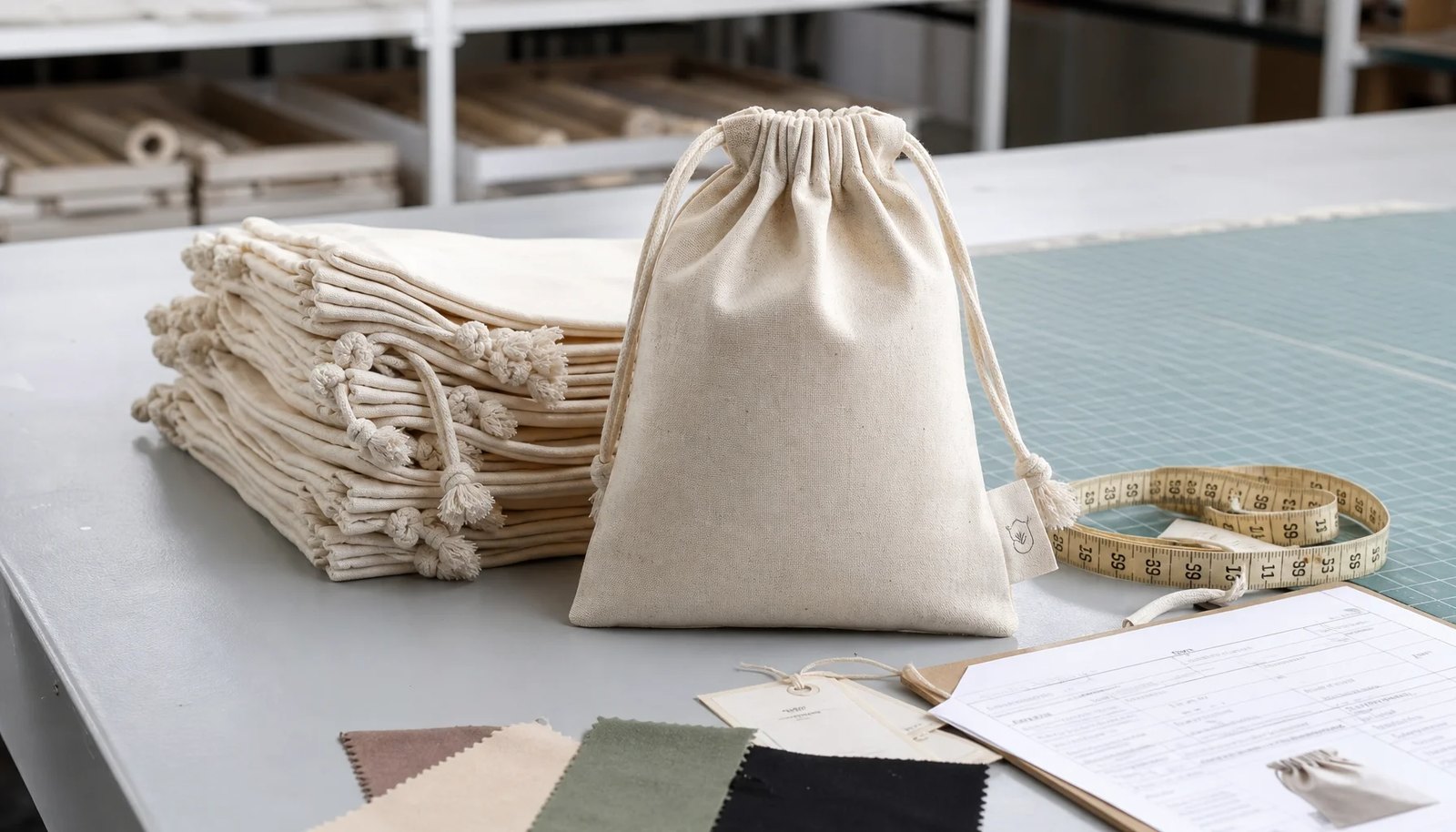
Wholesale cotton drawstring pouches for trade show exhibitors should be sourced as working event packaging, not as generic gift bags. One pouch may pass through a factory packer, freight forwarder, receiving warehouse, kitting line, booth manager, sales rep, visitor, and final recipient before the event closes. It may be packed flat, compressed in a carton, reopened during booth setup, filled with literature or product samples, cinched shut, moved across regional teams, and carried around a crowded hall. The specification needs to match that journey.
Most failures are not mysterious. Side seams open when hard-edged contents push outward. Bottom corners pop when a filled kit settles in the carton. Drawcord tunnels tear when the channel is too narrow or the exit is not reinforced. Thin cords fray, slip into the tunnel, or feel cheap after a few pulls. Decoration can crack, smear, or transfer when the logo sits across a fold or when ink cure is not controlled. Cartons can arrive crushed, damp, or odor-contaminated if packing is treated as a last-minute detail.
A better RFQ starts with the event job. A pouch holding two postcards and a badge ribbon does not need the same build as one holding a sample jar, bottle, charger, tile, cable set, cosmetic item, or press kit. That difference affects fabric GSM, weave, seam type, cord diameter, tunnel width, decoration placement, carton count, and inspection method. If the RFQ only says cotton drawstring pouch with logo, suppliers will quote from different assumptions. The lowest price may simply be the weakest pouch.
- Define the fill: actual contents, estimated filled weight in grams, hard edges, fragile items, and whether the pouch will be carried by the cord.
- Define the handling: one-time giveaway, repeated booth replenishment, exhibitor kit packing, premium reusable gift, or resale insert.
- Define the stress points: cord tunnel, tunnel exit, side seam, bottom seam, printed face, label edge, and carton fold line.
- Define the failure threshold: seam gap size, cord slip, print transfer, odor, stains, wrong logo, and size outside tolerance.
- Define the inspection owner: factory QC, buyer receiving team, or third-party inspection before shipment release.
Turn the Use Case Into a Quotation Spec
A strong B2B pouch specification lets two suppliers quote the same product. Start with finished flat size, usable internal size, and opening width. Finished size alone can mislead because seam allowance, tunnel height, cord thickness, and bulky contents reduce the space available inside the bag. A pouch that looks large enough on a drawing can become tight once the top is folded into a drawcord channel. Ask the factory to state its measurement method, then repeat that method in the PO.
Use practical tolerances instead of soft language. For many small and medium cotton pouches, a flat finished-size tolerance of +/-5 mm is workable. Larger pouches may need +/-8 mm or another agreed range, depending on fabric behavior and sewing method. Logo placement needs its own tolerance because a pouch can be the correct size while the print sits visibly off center. For branded trade show displays, specify whether placement is measured from the pouch edge, printable face, or center line.
The load specification matters as much as the dimensions. Avoid words such as lightweight, standard, or premium unless they are backed by a number. Give the supplier the approximate filled weight and, when possible, the actual kit list. A 250 g soft textile insert behaves differently from a 250 g sample jar because hard edges concentrate pressure at the corners. If the event team will pre-fill the pouches, test the pouch with the real content arrangement, not just loose weights.
- Finished size: state width by height in millimeters or inches, plus a clear flat-measurement tolerance.
- Usable size: account for seam allowance, drawcord tunnel height, cord bulk, and the shape of intended contents.
- Opening width: confirm that booth staff can insert contents quickly without forcing the pouch mouth.
- Load target: specify actual contents or a filled-weight test target, including hard edges and concentrated loads.
- Cosmetic standard: define acceptable natural cotton flecks, shade variation, wrinkles, lint, thread tails, and minor creasing.
Specify Fabric by GSM, Weave, and Surface
Fabric GSM is important, but it is not the whole specification. For wholesale cotton drawstring pouches used by trade show exhibitors, 120-140 GSM is often suitable for light flat giveaways such as coupons, postcards, small cards, ribbon badges, pins, or soft inserts. A 150-180 GSM fabric is a stronger fit when the pouch needs a denser hand feel, better opacity, a more stable print surface, or repeated use. For heavier sample kits, ask whether seam reinforcement is needed instead of assuming more GSM alone will solve the problem.
Weave changes performance. Plain weave is common, cost-efficient, and suitable for many promotional pouches. Twill can feel more structured and premium. Canvas-like cotton can add body for counter display or reusable merchandise. Still, two pouches with the same GSM can drape, shrink, print, and feel differently if the weave is different. A fair quote should state GSM and weave together, not only fabric weight.
Natural cotton appearance also needs buyer alignment. Unbleached cotton can show seed flecks, slubs, and shade variation. Those details may support an eco-minded presentation, but they can surprise a brand team expecting a clean white print field. Bleached or dyed cotton can create a more controlled background, but it may add color-matching work, dye-lot risk, minimums, and lead time. A physical swatch is the right control point because photos often hide thickness, texture, and natural flecking.
Set a written tolerance for bulk fabric. Many promotional textile buyers use a GSM tolerance such as +/-5% or define an approved swatch with an acceptable bulk roll range. The exact tolerance should be agreed with the factory based on construction and order size. The purpose is simple: prevent silent substitution. If a 150 GSM approved sample becomes a noticeably lighter production roll, the buyer may receive a pouch that looks similar online but performs worse in use.
- 120-140 GSM: practical for light literature, coupons, cards, pins, small soft goods, and low-stress giveaways.
- 150-180 GSM: better for premium feel, denser contents, repeated handling, improved opacity, and stronger print presentation.
- Weave type: specify plain weave, twill, canvas-like cotton, brushed cotton, washed cotton, bleached cotton, dyed cotton, or natural cotton.
- Swatch approval: review shade, fleck level, hand feel, thickness, opacity, odor, and print surface before sampling.
- Bulk control: require GSM, weave, and color confirmation before cutting if the factory changes fabric lot or supplier.
Engineer the Cord, Tunnel, and Seams
The drawcord system is a frequent failure point because it takes repeated friction and pull force. A cord may look fine in a static sample photo yet feel thin, drag through the channel, fray at the ends, or slip into the tunnel. For many medium trade show pouches, a 3-4 mm cotton cord is a practical starting range. Smaller jewelry-style pouches may use thinner cords. Larger or heavier pouches may need a thicker cord, wider tunnel, or stronger tunnel exit. The right cord depends on pouch size and expected fill weight.
The tunnel should move smoothly without creating a bulky top edge. If the channel is too narrow, users pull harder and stress concentrates at the exit. If it is too loose, the pouch may not cinch cleanly and the cord can twist or bunch. Ask the factory to confirm tunnel height, fold depth, stitch line location, and reinforcement method. Back-tacking at the tunnel exits is a small detail, but it can prevent a very visible failure during booth handling.
Seam construction should be described in functional terms. Side seams need balanced tension, consistent stitch density, and enough seam allowance to resist pull-out. Bottom seams must withstand contents settling downward in cartons. As a practical purchasing reference, 8-12 stitches per inch is a common range for many cotton pouch seams, but the correct setting depends on fabric weight, needle, thread, and seam type. Inspectors should check for skipped stitches, open corners, thread nests, puckering, and needle damage, not only straightness.
Hard-edged contents raise the construction requirement. A pouch carrying a charger, glass jar, small bottle, metal part, tile, or product sample may need a stronger bottom seam or improved seam finish. Options can include overlock plus lockstitch, French seam construction, double-needle rows, or bar-tacking at stress points. These choices affect cost and production time, so evaluate them before quotation approval.
- Cord diameter: specify 3-4 mm for many medium pouches, then validate against pouch size, tunnel width, and fill weight.
- Cord material: confirm cotton, recycled cotton blend, polyester, jute, or other material because feel, shrinkage, and abrasion differ.
- Tunnel build: define channel height, fold depth, stitch line, exit reinforcement, and smoothness of cord movement.
- Seam build: specify seam type, stitch density range, seam allowance, bottom finish, corner closure, and thread trimming standard.
- Cord finish: confirm knot style, cord length tolerance, color consistency, cut-end cleanliness, and whether tipping is required.
Choose Decoration for Real Handling
Decoration is a durability choice as much as a branding choice. Screen printing is usually practical for simple one-color or two-color event logos because it is efficient at volume and works well on many cotton surfaces. It still needs correct artwork preparation, screen setup, ink selection, curing, and placement control. A logo placed too close to the cinch zone can distort when closed. A heavy ink area printed across a fold line can show abrasion or cracking earlier than expected.
Heat transfer can reproduce fine detail, full-color effects, or gradients, but it should not be approved without testing on the actual cotton surface. Transfers can feel plasticky, lift at the edges, or respond poorly to folding if the process is not matched to fabric texture. Embroidery can look premium, yet it may pucker lighter cotton, create internal backing that catches on contents, or become inefficient for large filled areas. Woven labels are durable for small brand marks or reusable pouches, but they introduce label MOQ, placement tolerance, and another sewing step.
Decoration control should be measurable. State artwork size, color reference, placement point, placement tolerance, print side, and whether the logo must remain visually centered after the pouch is filled or cinched. For multi-sponsor orders, assign a unique artwork code to each version and require separated cartons. Many event issues are not caused by poor printing. They happen because the correct logo is packed into the wrong destination carton.
- Screen print: efficient for simple logos, sponsor marks, event names, QR-free solid art, and high-volume orders.
- Heat transfer: use for detailed artwork only after adhesion, fold, dry rub, and edge-lift checks on actual fabric.
- Embroidery: test for puckering, backing feel, thread trimming, needle damage, and production speed before bulk approval.
- Woven label: durable for small marks and reusable gifts, but requires label approval, label MOQ, and placement checks.
- Placement control: keep critical logos away from drawcord bunching, seams, deep folds, and expected carton pressure lines.
Use Written Durability Pass/Fail Rules
A durability testing checklist should mirror how the pouch will be used. Many trade show orders do not need full laboratory testing, but they do need a repeatable production check that catches likely failures before the event deadline. Apply the test to preproduction samples and selected finished goods. Make it specific enough that a weak sample cannot pass on the basis that it looks acceptable.
Start with a filled-use test. Load the pouch with intended contents or a representative weight. If the actual kit has hard corners, include hard corners in the test. Open and close the pouch repeatedly, hold or hang it by the cord, push the contents into the bottom corners, and inspect the tunnel exits. This exposes weak channels, loose stitching, undersized openings, and cord drag. It also shows whether booth staff can pack the item quickly.
A practical baseline for standard promotional use is 50 open-close cycles on a preproduction sample, followed by inspection of cord abrasion, tunnel tearing, seam opening, and knot security. For reusable merchandise or VIP gifts, buyers may request 100 cycles or another agreed requirement. Loaded hang can be tested at the intended fill weight or at a modest overload such as 1.25 times the target fill weight if the pouch will be handled roughly. Agree on the overload level in writing before inspection.
Decoration should be tested after realistic handling. Fold the pouch the way it will be packed, apply light pressure similar to carton compression, reopen it, and perform dry rub strokes on the decorated area using a clean white cloth. The buyer should define the number of strokes, such as 10-20 dry strokes for a production check, and decide what level of color transfer is acceptable. If the route includes humidity, outdoor setup, or long ocean freight, discuss moisture protection and odor checks with the supplier.
- Open-close cycle test: run 50 cycles for standard giveaways or 100 cycles for reusable programs, then inspect cord, tunnel, and seams.
- Loaded hang test: fill to target weight or agreed overload, hang by the cord for the agreed time, and inspect for seam or tunnel failure.
- Cord pull test: apply steady pull to both cords and confirm knots, tunnel exits, and stitch lines do not slip or tear.
- Corner stress test: push representative contents into bottom corners to expose weak seam allowance, skipped stitches, or open gaps.
- Dry rub test: rub printed or transferred areas with a clean white cloth and check for smearing, flaking, cracking, or color transfer.
- Packing simulation: fold and compress samples as planned for cartons, then check print pressure marks, cord distortion, and permanent creasing.
Approve Samples as Production Standards
Sampling should prove the production method, not just the concept. A handmade sample can look excellent while bulk production fails because the final fabric, cord, thread, sewing machine setup, cutting method, print process, or packing fold changes. The preproduction sample should use final GSM, weave, shade, cord diameter, thread color, decoration method, label position, and packing method. If any element is not final, mark the deviation clearly and require written buyer approval before production.
A sealed sample system is one of the simplest procurement controls. Keep one approved sample with the buyer, one with the supplier, and one with the third-party inspector if inspection is outsourced. Label each sample with approval date, PO number, size, fabric description, cord details, artwork revision, decoration method, label version, and packing method. Photograph the front, back, seam close-ups, tunnel exits, cord ends, logo placement, label position, and folded packing orientation.
For orders with multiple sizes, colors, or logo versions, one sample may not cover the highest risk. Approve the most demanding variants separately: the largest pouch, smallest opening, heaviest fill, most complex logo, darkest ink on natural cotton, embroidery on lightweight cotton, or woven label placement near a seam. If every version cannot be sampled, document which approved sample controls which feature and which features remain buyer-approved by artwork proof only.
Sample approval should also lock the inspection standard. The supplier should not switch fabric lot, cord type, thread color, label material, ink system, or packing count after approval without written change approval. For event orders, this discipline matters because there may be no time to remake goods once they arrive at the venue or distribution warehouse.
- Material check: verify GSM, weave, shade, cord diameter, thread color, label material, and decoration method against the quote.
- Measurement check: record width, height, opening width, tunnel height, cord length, seam allowance, and logo placement.
- Function check: run open-close, loaded hang, cord pull, seam stress, dry rub, and packing simulation before bulk release.
- Record check: photograph critical areas and keep the approved sample sealed, labeled, and available for final inspection.
- Revision check: assign artwork and sample revision codes so outdated proofs do not reach production.
Set Inline and Final QC Thresholds
Quality control should focus on defects that disrupt the event. A small natural cotton fleck may be acceptable on an unbleached pouch, while a weak tunnel seam can cause immediate failure on the show floor. The PO or quality memo should define critical, major, and minor defects. Critical defects may include mold odor, contamination, unsafe foreign objects, incorrect logo, wrong destination carton, or severe seam failure. Major defects may include size outside tolerance, open seams, poor print adhesion, cord slip, missing labels, or mixed artwork lots. Minor defects may include short thread tails, small wrinkles, or shade variation within the approved range.
Inline inspection matters because pouch defects multiply quickly. If panels are cut too small, every pouch from that cut can be undersized. If the print jig is misaligned, hundreds of pouches may carry the same placement error. If the wrong cord diameter is loaded into production, the entire batch can feel different from the approved sample. Ask the factory to confirm first-piece cutting, first-piece sewing, first-piece decoration, and first packed carton before the run continues.
Final inspection should combine measurement, function, decoration review, and packing verification. Inspectors should measure selected pouches against the approved tolerance, open and close samples, pull cords, check seams, rub prints, inspect labels, smell for odor, and verify carton labels. If using AQL, treat it as the sampling framework, not the quality plan. AQL helps decide how many units to inspect, but the buyer still needs product-specific defect definitions and durability checks.
Traceability is especially important for multi-SKU or multi-sponsor trade show programs. Each carton should show PO number, item code, size, color, artwork version, quantity, carton number, and destination if applicable. When pouches are kitted by a third party after receipt, carton-level clarity prevents correct goods from being sent to the wrong region, booth, or sponsor.
- First-piece checks: approve cutting dimensions, stitch construction, cord movement, logo placement, and label placement before mass production.
- Inline checks: monitor seam consistency, tunnel exits, print alignment, cord length, thread trimming, and version separation during production.
- Final checks: measure finished goods, run selected durability checks, inspect decoration, verify odor and cleanliness, and confirm carton counts.
- Defect classes: separate critical, major, and minor issues so cosmetic tolerance does not hide functional failure.
- Traceability: require carton numbers, lot codes, artwork version labels, and destination marks for different sizes, colors, and sponsors.
Pack for Transit and Booth Distribution
Packing should be designed for the full route from factory to event team. Cotton pouches can absorb odor, pick up moisture, crease across decorated areas, and develop drawcord distortion when cartons are overfilled. Bulk packing in clean master cartons is efficient for many trade show programs, but carton count and gross weight must be controlled. If cartons are too heavy, handlers are more likely to drop them. If cartons are over-compressed, the drawcord channel can flatten and the printed face may show pressure marks.
Inner packs can reduce counting errors and speed booth distribution. Packs of 25, 50, or 100 are common planning units, but the right count depends on booth replenishment, exhibitor allocation, and warehouse workflow. Every extra packing step adds labor and material, so specify it intentionally. If pouches are going into exhibitor welcome kits, request labels showing size, logo version, color, quantity, PO number, carton number, and destination.
Moisture and odor control deserve attention with cotton goods. For long transit, humid routes, or extended storage, ask whether cartons should include a poly liner, desiccant, or another moisture-control method. Avoid direct contact with rough carton edges, exposed staples, broken strapping, or dirty pallets. Require dry storage before pickup and ask the supplier to flag any production or packing process that could introduce odor, such as damp cartons or poor warehouse ventilation.
Pre-shipment packing photos are useful evidence. Request an open carton view, inner pack view, carton mark, close-up of pouch orientation, and carton sealing view. These photos do not replace inspection, but they confirm that the agreed packing method was used before goods leave the factory. For event shipments with tight timelines, a packing mistake can be as damaging as a product defect.
- Bulk pack: efficient for low-cost giveaways when the receiving team can count and distribute at the warehouse or booth.
- Inner packs: useful for exhibitor kits, regional allocations, sponsor sets, controlled handouts, and fast booth replenishment.
- Carton limits: specify carton dimensions, maximum gross weight, stacking expectation, and whether compression is acceptable.
- Moisture control: consider poly liners, desiccant, dry storage, and odor checks for long transit or humid routes.
- Carton labels: include PO, item code, size, logo version, color, quantity, carton number, lot code, and destination.
Plan MOQ, Lead Time, and Change Control
MOQ is affected by more than the pouch body. Fabric color, cord color, size, print colors, woven label, embroidery, transfer artwork, packing method, and shipment split can all create separate minimums or setup charges. Natural cotton with one-color screen print is usually the simplest sourcing route because it uses common fabric and straightforward decoration. Custom-dyed fabric, specialty cords, woven labels, embroidery, and multiple sponsor logos can raise minimums or require separate production batches.
Lead time should be counted from final sample approval and production release, not from the first inquiry. Before bulk production starts, the supplier may need to confirm artwork, approve swatches, prepare screens or embroidery files, source labels, book fabric, cut panels, decorate panels, cure prints, sew, trim, inspect, pack, and arrange freight. If the brand team changes artwork after sample approval, the schedule may reset for screen setup, transfer production, or label weaving.
For trade show exhibitors, the delivery date is fixed. The timeline should include decision deadlines: artwork lock, swatch approval, sample approval, deposit or PO release, production start, inline check, final inspection, freight booking, and warehouse arrival. Procurement should leave time for receiving inspection and kitting, not only factory ship date. A pouch order that arrives the day before booth setup is operationally risky even if it technically ships on time.
Change control prevents confusion across buyer, supplier, printer, and packing team. A small change to logo size, cord color, pouch dimensions, inner pack count, or carton marks can affect cost, timing, and inspection. Require written confirmation of price, MOQ, sample need, and lead-time impact before accepting any change. The factory floor needs one current standard, not several partial instructions spread across emails and chat threads.
- MOQ drivers: pouch size, fabric color, cord color, print colors, label version, embroidery file, transfer type, and packing format.
- Schedule drivers: swatch approval, artwork approval, sample revision, fabric booking, decoration setup, sewing capacity, inspection, and freight.
- Buyer deadlines: set dates for artwork lock, sample approval, production release, final inspection, freight pickup, and warehouse arrival.
- Change control: require written impact on cost, MOQ, sample approval, QC standard, and lead time before changing specifications.
- Multi-SKU control: consolidate base fabric and cord when possible, but keep lot labels separate for each size, sponsor, and destination.
Specification comparison for buyers
| Procurement decision | Recommended specification | Best fit for trade show use | Durability or quote risk to verify |
|---|---|---|---|
| Supplier route | Factory or cut-and-sew partner that controls fabric sourcing, cutting, sewing, decoration handoff, inspection, and packing records | Custom event sizes, repeat exhibitor programs, multi-logo orders, and buyers needing lot traceability | Ask which steps are outsourced, where in-process inspection happens, and who pays for rework if seams, print, labels, or packing fail |
| Finished size tolerance | Typical flat-size tolerance of +/-5 mm for small and medium pouches and +/-8 mm for larger pouches, unless the design requires tighter control | Pouches used for fixed-size samples, literature kits, badges, chargers, bottles, or nested product inserts | Confirm whether dimensions are measured flat, unfilled, after pressing, and excluding cord; do not rely on nominal size only |
| Fabric weight | 120-140 GSM for light flat giveaways; 150-180 GSM for denser samples, premium hand feel, or reuse; define GSM tolerance such as +/-5% or buyer-approved swatch range | Brochures, insert cards, product samples, small accessories, cable kits, cosmetics, wellness samples, and sponsor gifts | Require swatch approval and roll check; a lower-GSM substitution can pass in photos but reduce seam strength and perceived value |
| Fabric construction | Plain weave for economical promotional pouches; twill or canvas-like cotton when more body, opacity, or premium feel is required | Counter displays, VIP kits, reusable attendee gifts, and pouches photographed with sponsor merchandise | Compare GSM, weave, shrinkage, opacity, and print surface together; the same GSM can behave differently by weave |
| Cord and tunnel | 3-4 mm cotton cord for many medium pouches, smooth tunnel movement, clean cut ends, secure knots, and reinforced tunnel exits | Pouches opened repeatedly by booth staff, visitors, sales reps, kitting teams, and warehouse staff | Thin cord, narrow tunnels, or weak tunnel exits cause drag, fraying, cord slip, and tearing after repeated cinching |
| Seam construction | Lockstitch or overlock-plus-lockstitch with balanced tension, 8-12 stitches per inch as a practical range, reinforced tunnel exits, and secure bottom corners | Orders carrying hard-edged contents, sample jars, chargers, bottles, tiles, metal parts, or multi-item kits | Photo approval does not prove seam strength; check stitch density, seam allowance, skipped stitches, loose thread tails, and corner gaps |
| Branding method | Screen print for simple solid art; woven label for durable small marks; embroidery only after puckering test; heat transfer only after adhesion and fold testing | Sponsor logos, event names, product launch kits, reusable merchandise, and tiered exhibitor gifts | Confirm cure, opacity, rub resistance, placement tolerance, setup fees, artwork version control, and logo placement away from cinch or fold zones |
| Sampling route | Preproduction sample using final fabric, final cord, final thread, final decoration, final label, and intended folding and packing method | First orders, new suppliers, tight-fit contents, new artwork, premium gifts, and event-date-critical shipments | Hand samples may hide production cutting and sewing risks; keep sealed buyer and factory references with revision dates |
| Durability testing | Open-close cycles, loaded hang, cord pull, seam stress, dry rub, packing compression review, odor check, and measurement review against approved sample | Trade show exhibitors that need predictable performance before a fixed show date | Define pass/fail criteria in the PO; generic visual inspection is not enough when replacement time is limited |
Buyer checklist before sampling
- Define the pouch use case before quoting: attendee giveaway, exhibitor welcome pack, sponsor gift, sample kit, press kit, resale insert, or internal kitting pouch.
- List actual contents, approximate filled weight in grams, hard edges, sharp corners, liquids or powders, and whether the pouch must be carried by the cord.
- Specify finished flat size, usable internal size, opening width, drawcord tunnel height, seam allowance expectation, and measurement tolerance.
- State fabric weight in GSM, weave type, cotton color, finish, shrinkage concern, opacity expectation, and whether the approved swatch controls bulk production.
- Set a practical GSM tolerance, such as +/-5% or a buyer-approved roll range, and require notification before any fabric substitution.
- Confirm cord diameter, cord material, cord color, cord length, knot style, tunnel width, cut-end finish, and whether tipping or special end finishing is needed.
- Require seam details: stitch type, stitch density range, seam allowance, reinforcement at tunnel exits, bottom seam finish, and loose-thread trimming standard.
- Match decoration to handling risk by confirming screen print, heat transfer, woven label, embroidery, or mixed decoration before price comparison.
- Define logo placement tolerance, acceptable print color variance, print opacity, cure requirement, and whether artwork is centered from the pouch body or the usable face area.
- Require a preproduction sample using the same fabric, cord, thread, label, decoration process, fold, inner pack, and carton method planned for bulk production.
Factory quote questions to send
- What exact cotton GSM, weave, finish, and color are you quoting, and what GSM tolerance or swatch range will be accepted in production?
- Is the quoted cotton greige, natural unbleached, bleached, dyed, washed, brushed, or canvas-like, and will bulk fabric come from the same construction as the sample?
- Can you provide a physical swatch or sample pouch from the same fabric construction before final artwork approval?
- What finished-size tolerance do you recommend for this size, and how will your QC team measure the pouch flat, unfilled, and excluding the cord?
- What usable internal size and opening width should we expect after seam allowance and drawcord tunnel construction?
- What seam construction, stitch type, stitch density, seam allowance, tunnel reinforcement, and bottom finish are included in the quoted price?
- What cord diameter, material, color, knot style, cord length, and cut-end finish are included, and have you tested the cord under repeated cinching?
- Which branding method will you use for this artwork, how many colors are included, what placement tolerance applies, and what setup, screen, transfer, embroidery, or label charges apply?
- Will the preproduction sample be made with the same machines, bulk fabric, cord, thread, print process, label, folding method, and packing method as the production order?
- What durability checks do you perform before shipment, including open-close cycles, cord pull, loaded hang, seam review, print rub, odor check, and packing compression review?
Quality-control points to confirm
- Bulk fabric GSM, weave, hand feel, opacity, shrinkage risk, and color match the approved swatch within the written tolerance.
- Finished width, height, usable opening, tunnel height, cord length, seam allowance, and logo placement match the sealed sample and approved technical sheet.
- Side seams and bottom seams are even, secure, and free from skipped stitches, open corners, puckering, needle damage, unbalanced tension, and long loose thread tails.
- Tunnel exits are back-tacked or reinforced so repeated pulling does not open the channel or tear the fabric at the cord exit.
- Cord diameter, color, material, knot position, cut-end cleanliness, and pull feel match the approved sample with no fraying, slipping, uneven lengths, or knot pull-through.
- Loaded hang and cord pull checks pass the agreed test load without seam opening, tunnel tearing, cord breakage, or visible distortion beyond the approved standard.
- Print color, registration, placement, opacity, cure, adhesion, and dry rub resistance match the approved artwork sample and do not show smearing, flaking, or transfer.
- Woven labels or embroidery, if used, are positioned consistently and do not distort the pouch, expose rough backing, create sharp internal edges, or catch on contents.
- Finished goods are clean and dry, with no oil marks, mold smell, needle staining, dye transfer, excessive lint, pest contamination, moisture damage, or foreign objects.
- Inner pack count, carton count, carton marks, lot codes, artwork version labels, destination labels, and packing photos match the purchase order before shipment release.