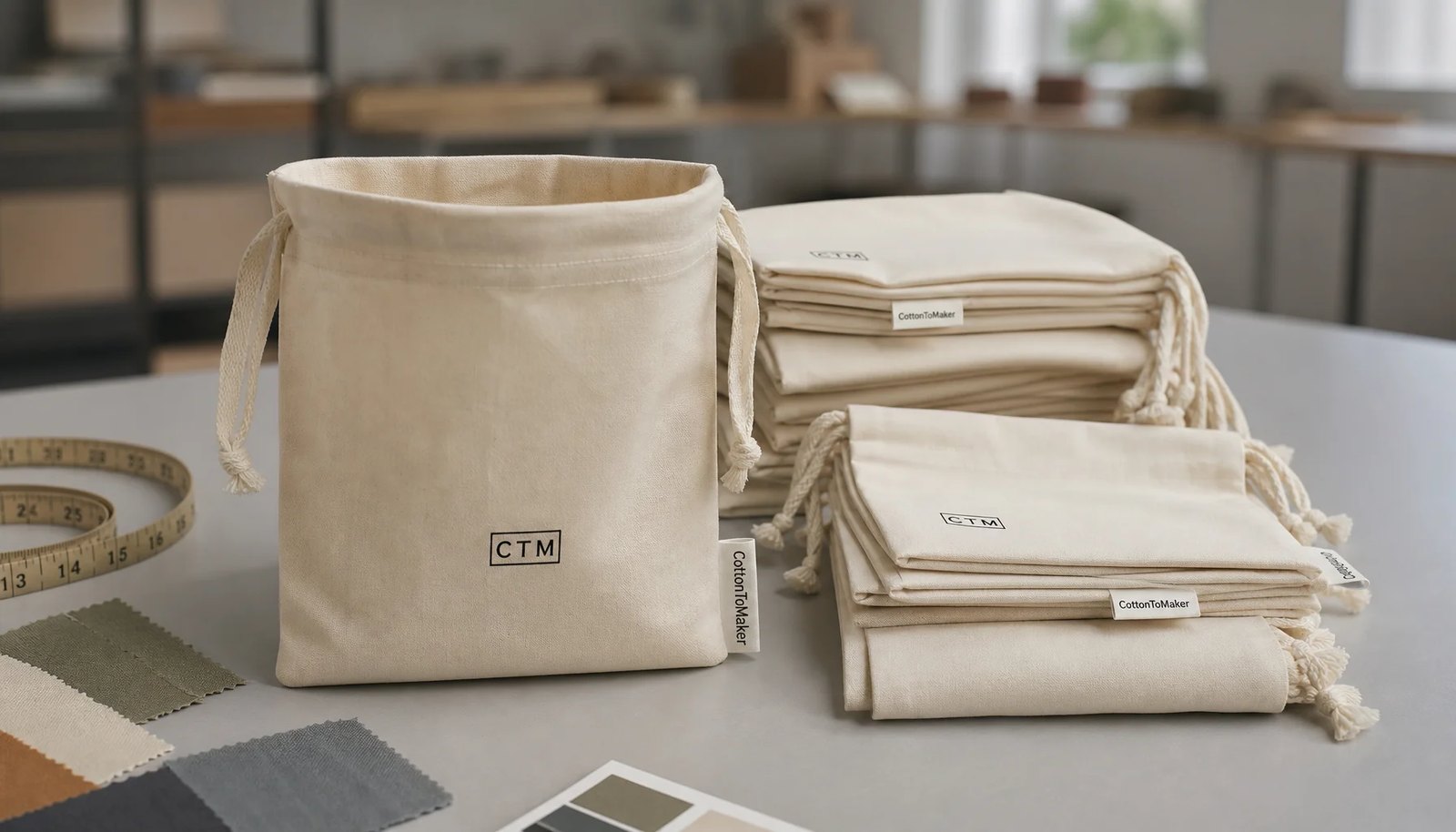
Define the pouch job before comparing wholesale prices
Cotton drawstring pouches for trade show exhibitors are usually bought under time pressure, but the buying problem is not only price. The real problem is matching a simple pouch to a fixed event date, a defined booth workflow, and a brand impression that must hold up when thousands of pieces are handled quickly. A cheap pouch that is too small, too transparent, difficult to open, or packed in unmarked mixed cartons can cost more in staff time and event failure than the saving on the unit price.
Start the RFQ with the use case. Is the pouch for a badge kit, sample pack, cable set, cosmetics sample, food-safe dry accessory, sponsor gift, or retail-style merchandise? The object going inside determines the finished size, seam strength, fabric weight, drawcord type, and packing method. Trade show exhibitors often distribute products fast, so the pouch should be easy to open, easy to count, and consistent enough that booth staff do not need to sort defects onsite.
- For flat paper inserts or badges, avoid oversized pouches that collapse and look empty.
- For heavier samples, increase fabric GSM and reinforce side seam expectations.
- For multi-sponsor events, plan artwork separation and carton marking before production starts.
- For premium giveaways, budget for better fabric handfeel and cleaner print registration rather than only larger size.
Select cotton GSM based on handfeel, opacity, and load
Fabric GSM is one of the largest cost and quality drivers. For wholesale cotton drawstring pouches used at trade shows, 120-140 GSM is a common light-to-medium range for giveaways, small samples, and badge kits. It keeps freight weight under control and still feels more substantial than very thin promotional cloth. Around 180 GSM gives a firmer, more retail-like handfeel and better opacity, but the unit cost, carton weight, and sewing resistance increase.
Do not treat GSM as a standalone quality grade. A well-woven 140 GSM cotton can look better than a loosely woven heavier cloth. Natural cotton may show seed flecks and shade variation, which many buyers accept for eco-positioned packaging. Bleached or dyed cotton gives a cleaner print background but introduces color control and dye lot considerations. If a brand has strict color standards, include fabric color targets and approve a physical swatch.
- 100-110 GSM: suitable only for very light, cost-sensitive giveaways where transparency is acceptable.
- 120-140 GSM: practical default for most exhibitor handouts and sponsor pouches.
- 160-180 GSM: better for premium kits, heavier objects, or retail-style reuse.
- 200 GSM and above: useful for structured, durable pouches but often unnecessary for single-event distribution.
Specify finished size, not a vague small, medium, or large
Many pouch mistakes start with size language. A buyer may request a 20 x 30 cm pouch and assume that is the usable space, while a factory may interpret it as cutting size or finished flat size depending on its internal process. The drawstring channel, side seams, bottom seam, and natural fabric shrinkage during finishing all reduce usable space. For any pouch that must hold a specific product, test the product inside a physical sample.
For trade shows, the pouch should also match the distribution action. If booth staff must insert brochures or samples onsite, the opening must be wide enough for fast packing. If the pouches arrive pre-filled from another vendor, confirm whether the pouch needs to stay flat in master cartons or whether it will be stuffed and then packed into larger kits. Small changes in width and height can change cutting efficiency and carton count, so include your priority: fit, appearance, or cost.
- State finished width x finished height after sewing and pressing.
- Define whether measurement includes or excludes the drawstring channel.
- Provide the product dimensions and weight that the pouch must hold.
- Use a tolerance such as +/- 0.5 cm for small pouches and +/- 1 cm for large pouches.
- Request a capacity test photo or video if samples cannot be sent quickly.
Match print method to artwork and event handling
Screen printing is usually the most practical method for cotton drawstring pouches when the logo uses one to three solid colors. It gives good opacity on natural cotton and works well for simple booth branding, sponsor marks, and promotional messages. The cost structure includes screen setup, ink color count, print size, and production quantity. A larger print area or multiple print positions can change the quote even when the pouch itself stays the same.
Heat transfer, digital transfer, or other transfer methods can handle gradients, detailed marks, and small text better than simple screen printing. The tradeoff is handfeel and durability. Transfers may feel more like a film on lightweight cotton, and poor curing can lead to edge lifting. If the pouches will be reused, rubbed inside cartons, or packed tightly for weeks before the show, include rub testing and edge adhesion checks in the approval process.
- Use vector artwork for screen printing and define Pantone targets where brand color matters.
- For natural cotton, approve actual print color on the chosen fabric, not only on white paper.
- Limit very fine lines if using rougher cotton weave.
- Keep print away from seam edges and drawstring channel to reduce distortion.
- For QR codes, test scanability on the final print method and final print size.
Understand MOQ logic before splitting artwork versions
MOQ for cotton drawstring pouches is not only a factory rule. It is tied to fabric purchasing, cutting efficiency, sewing line setup, screen setup, ink mixing, packing labels, and inspection separation. A quote for 5,000 pieces in one natural fabric, one size, and one logo is very different from 5,000 pieces split across ten sponsor logos and five cord colors. The total quantity may look large, but the production behaves like many small orders.
If multiple exhibitors, regions, or distributors need customized versions, group the specification where possible. Keep the same size, same fabric GSM, same drawcord, and same packing method, then change only the print. This makes production more stable and quote comparison easier. If each version must have a different pouch color or cord color, expect separate material planning, higher leftover risk, and more opportunities for carton mixing errors.
- One size + one fabric + one cord + one print version is the cleanest MOQ structure.
- Multiple logos can be economical if the base pouch remains identical.
- Separate pouch colors often require separate dye lots or available stock checks.
- Small artwork splits may carry separate screen fees even when the pouch MOQ is met.
- Version-specific carton marks should be listed in the purchase order, not added after packing.
Compare quotes by landed cost, not only unit price
A low unit price can hide a higher landed cost. Fabric weight affects carton weight. Individual polybags increase labor, material, carton volume, and unpacking time. Heavy cartons may be inconvenient for trade show drayage, hotel receiving, or booth setup crews. If your team ships pouches to multiple cities or exhibition halls, carton dimensions and mixed-version packing can matter as much as a few cents in unit price.
When comparing supplier quotes, normalize the specification first. Same GSM, same finished size, same print method, same number of print colors, same packing, same inspection expectation, and same Incoterm. Then compare add-ons such as sample fees, screen charges, freight basis, inland transport, customs documents, and carton labeling. A quote without packing dimensions is not ready for landed-cost comparison because freight forwarders cannot price accurately.
- Unit price: pouch production cost based on the same approved specification.
- Setup cost: screens, artwork preparation, printing plates, or special sample charges.
- Packing cost: inner bags, individual bags, inserts, labels, cartons, and version sorting.
- Freight basis: carton volume, gross weight, ship method, destination, and Incoterm.
- Event handling cost: relabeling, repacking, booth sorting, and late freight premiums.
Approve samples with acceptance criteria, not only photos
A pre-production sample should represent the actual mass production method. It should use final cotton GSM, final fabric color, final drawcord, final stitching construction, final print method, and final packing concept if packing affects presentation. A photo can confirm layout, but it cannot confirm handfeel, thickness, drawcord sliding, odor, opacity, or how the pouch fits the giveaway item. For event merchandise, a physical sample is usually worth the extra days.
The sample approval record should be specific. Instead of writing that the sample is approved, record the approved size, fabric, print color, cord, and any corrections. If print color is slightly different but acceptable, note the acceptable range. If the drawcord is too long or the logo is too close to the channel, correct it before mass production. Small sample-stage corrections are cheaper than sorting thousands of pouches after printing.
- Measure finished size flat and compare it with the RFQ tolerance.
- Place the actual giveaway item inside and test opening, closing, and appearance.
- Rub the print with a dry white cloth and check for obvious ink transfer after curing.
- Pull the drawcord several times to check channel smoothness and cord security.
- Smell the pouch after it has been sealed in a polybag for several hours.
- Take approved sample photos with a ruler and keep one sealed reference sample for inspection.
Set QC thresholds that match wholesale event risk
Cotton drawstring pouches are simple products, but defects become highly visible when they are handed directly to visitors. Common issues include uneven size, loose threads, open seams, dirty fabric, ink smears, print tilt, shade variation, odor, and wrong artwork mixed into cartons. A wholesale order does not need luxury handbag inspection, but it does need clear defect categories so the factory knows what will be rejected.
For most exhibitor orders, the most important QC threshold is consistency. A small natural cotton seed fleck may be acceptable, while an oil stain on the logo face is not. A slight size variation may pass if the product still fits, while a jammed drawcord should fail because staff and recipients interact with it immediately. Define critical, major, and minor issues in practical terms tied to booth use.
- Critical: wrong logo, wrong pouch size that cannot fit the item, mold, strong chemical odor, or unsafe contamination.
- Major: open seam, broken drawcord, severe print smear, heavy stain, large print misplacement, or mixed versions in carton.
- Minor: small loose thread, slight natural cotton fleck, tiny print pinhole, or minor measurement variation within tolerance.
- Functional test: open and close the pouch several times and load it with the intended item.
- Carton audit: count pieces by version and compare against packing list before shipment.
Plan packing for booth distribution and receiving control
Packing is often treated as an afterthought, but it affects receiving speed, freight cost, and booth setup. Bulk packing is usually efficient: for example, 50 or 100 pieces per inner polybag, then packed into export cartons. This reduces unit cost and waste. However, if different sponsor logos or regional versions are involved, inner bags and cartons must be clearly separated to prevent staff from opening cartons at the venue and finding a mixed assortment.
Individual polybags can protect premium printed pouches and make retail-style distribution cleaner, but they slow down booth preparation and add material cost. If the pouches are handed out empty, bulk packing is usually enough. If they are pre-filled, confirm whether the filling vendor requires pouches flat, bundled, counted, or arranged by orientation. Export cartons should have marks that match the event receiving documents, not just generic factory item codes.
- Use inner bundles for easy counting: 25, 50, or 100 pieces depending on pouch size.
- Keep one artwork version per inner bag whenever possible.
- Print carton marks with event name, PO number, version, quantity, carton number, and destination.
- Request carton dimensions and gross weight before freight booking.
- Avoid cartons that are too heavy for venue handling; many teams prefer manageable carton weights over maximum cube efficiency.
Build a lead time that protects the show date
Trade show dates do not move, so the production schedule should be built backward from the required delivery date. The timeline should include artwork confirmation, sample making, sample courier transit, sample review, possible correction, bulk material preparation, cutting, printing, curing, sewing, trimming, inspection, packing, export documents, freight pickup, customs clearance, and final delivery. A supplier may quote a short production lead time but exclude sample correction and freight risk.
The safest schedule includes decision deadlines. If artwork is not approved by a certain date, the delivery method may need to change from ocean to air, or the order may need to be reduced to stock fabric and simple printing. Rush orders also increase quality risk because print curing, inspection, and packing checks get compressed. For event orders, it is better to simplify the specification early than to approve an unrealistic schedule late.
- Reserve time for artwork clarification before sampling, especially for multi-color logos.
- Do not start bulk fabric cutting until finished size and fabric GSM are approved.
- Allow curing or drying time before tight carton packing to reduce odor and ink transfer.
- Schedule inspection before the goods leave the factory, not after they arrive at the warehouse.
- Keep a freight contingency plan if the show date is less than six weeks away.
Specification comparison for buyers
| Spec decision | Recommended option | When it fits | Buyer risk to check |
|---|---|---|---|
| Fabric weight for trade show giveaways | 120-140 GSM cotton for light handouts; 180 GSM for premium kits | Use 120-140 GSM for brochures, badges, pins, cables, and small samples; use 180 GSM when the pouch must feel retail-ready | Very light cotton can become transparent after printing; very heavy cotton increases carton weight and may not be needed for one-day event use |
| Pouch size and usable capacity | Specify finished size plus tolerance, such as 15 x 20 cm, 20 x 30 cm, or 30 x 40 cm with +/- 0.5 cm tolerance | Best when exhibitors need pouches to fit a defined sample, charger, cosmetic set, bottle accessory, or sponsor gift | Factories may quote cutting size instead of finished size; drawstring channel and seam allowance reduce usable internal space |
| Drawcord construction | Matching cotton cord or braided cotton cord with secured ends | Good for natural branding, reusable gift packaging, and booths promoting sustainability or handmade positioning | Loose cord ends can fray during distribution; cord length must allow easy opening without dragging below the pouch |
| Printing method | Screen printing for 1-3 solid colors; heat transfer for gradients or small detailed artwork | Screen printing fits most trade show logos and sponsor marks; transfer fits detailed badges, QR-style graphics, or full-color marks | Heavy ink can stiffen lightweight cotton; transfer films can feel less natural and need wash/rub testing if reused |
| MOQ planning | Set MOQ by fabric availability, print setup, and size grouping rather than by a single arbitrary unit count | Useful when multiple exhibitors or regional teams share one base pouch with different print versions | Small split colors or many logo versions can create separate setup charges and slower packing control |
| Sample approval | Approve one pre-production sample with final fabric, cord, print color, size, and packing method | Needed before mass production for event merchandise, sponsor kits, and distributor resale programs | A photo sample alone cannot verify fabric handfeel, thickness, drawcord sliding, or odor after printing |
| Packing method | Bulk pack 50-100 pieces per inner polybag, then export carton with carton mark by event or booth destination | Works for trade shows where staff need quick booth replenishment and easy counting during setup | Overpacked cartons become difficult to count onsite; individual polybags add cost, plastic use, and unpacking time |
| Lead time buffer | Allow artwork approval, sample making, bulk production, curing/drying, inspection, and freight booking | Best for fixed show dates where late delivery is more expensive than small unit cost differences | Fast production quotes may omit sample correction time, print drying time, customs delay, or carton relabeling |
Buyer checklist before sampling
- Define the actual item going inside the pouch and confirm the required finished size, not only the flat cutting size.
- Choose cotton GSM based on handfeel, opacity, and load weight: 120-140 GSM for light giveaways and 180 GSM or above for premium kits.
- State whether the pouch must be natural, bleached, dyed, or organic cotton, and whether shade variation is acceptable.
- Provide artwork in vector format and specify print size, Pantone or CMYK target, print position, and number of print colors.
- Decide if one artwork version or multiple sponsor versions are needed, because each version can affect screen charges, MOQ, packing, and inspection.
- Specify drawcord material, color, length, knotting or end finish, and whether the cord must slide smoothly after bulk packing.
- Request one pre-production sample using final fabric, cord, print method, and packing before approving mass production.
- Set measurable tolerances for size, print placement, color shade, stitching defects, stains, odor, and carton quantity.
- Choose bulk packing, inner bundles, or individual packing based on booth distribution workflow, not only on unit price.
- Require carton dimensions, gross weight, net weight, pieces per carton, carton marks, and pallet preference before freight quoting.
Factory quote questions to send
- What exact cotton fabric weight in GSM are you quoting, and is the fabric greige, natural, bleached, dyed, recycled cotton, or organic cotton?
- Is the quoted size the finished size after sewing, and what tolerance will you apply to width, height, and drawstring channel position?
- What drawcord material, diameter, color, and end finishing method are included in the quote?
- Which print method is included, how many print colors are allowed, and what maximum print area is covered by the quoted price?
- Are screen charges, artwork setup fees, sample charges, and courier charges included or listed separately?
- What is the MOQ for one size and one artwork, and how does MOQ change if we split the order by logo version, cord color, or pouch color?
- How many days are needed for sample making after artwork confirmation, and how many days for bulk production after sample approval?
- Can you provide carton packing data, including pieces per inner bag, pieces per export carton, carton dimensions, gross weight, and carton marks?
- What inspection standard do you use for stains, stitching defects, print defects, size tolerance, and quantity shortage?
- Can you send photos or a short video of fabric, cutting, printing, sewing, and final packing during production for remote approval?
Quality-control points to confirm
- Finished pouch size should match the approved sample within the agreed tolerance, commonly +/- 0.5 cm for small pouches and +/- 1 cm for larger pouches.
- Fabric weight should be verified by cutting and weighing a measured fabric area or by supplier mill record when lab testing is not required.
- Drawcord must pull evenly from both sides, should not jam inside the channel, and should not slip out during normal opening and closing.
- Stitching should be straight at side seams and bottom seam, with no open seams, skipped stitches, major puckering, or loose thread bundles.
- Print placement should follow the approved artwork position, with no severe tilt, ink smearing, missing ink, ghosting, or obvious color mismatch.
- Natural cotton shade variation should remain within the approved sample range; stained, oily, moldy, or strongly yellowed pieces should be rejected.
- Odor after printing and packing should be acceptable for indoor booth distribution, with enough curing or airing time before carton sealing.
- Carton count should match the packing list, and mixed artwork versions must be separated or clearly identified to avoid booth distribution errors.
- Export cartons should be strong enough for the selected shipping method, with tape, strapping, carton marks, and moisture protection as agreed.