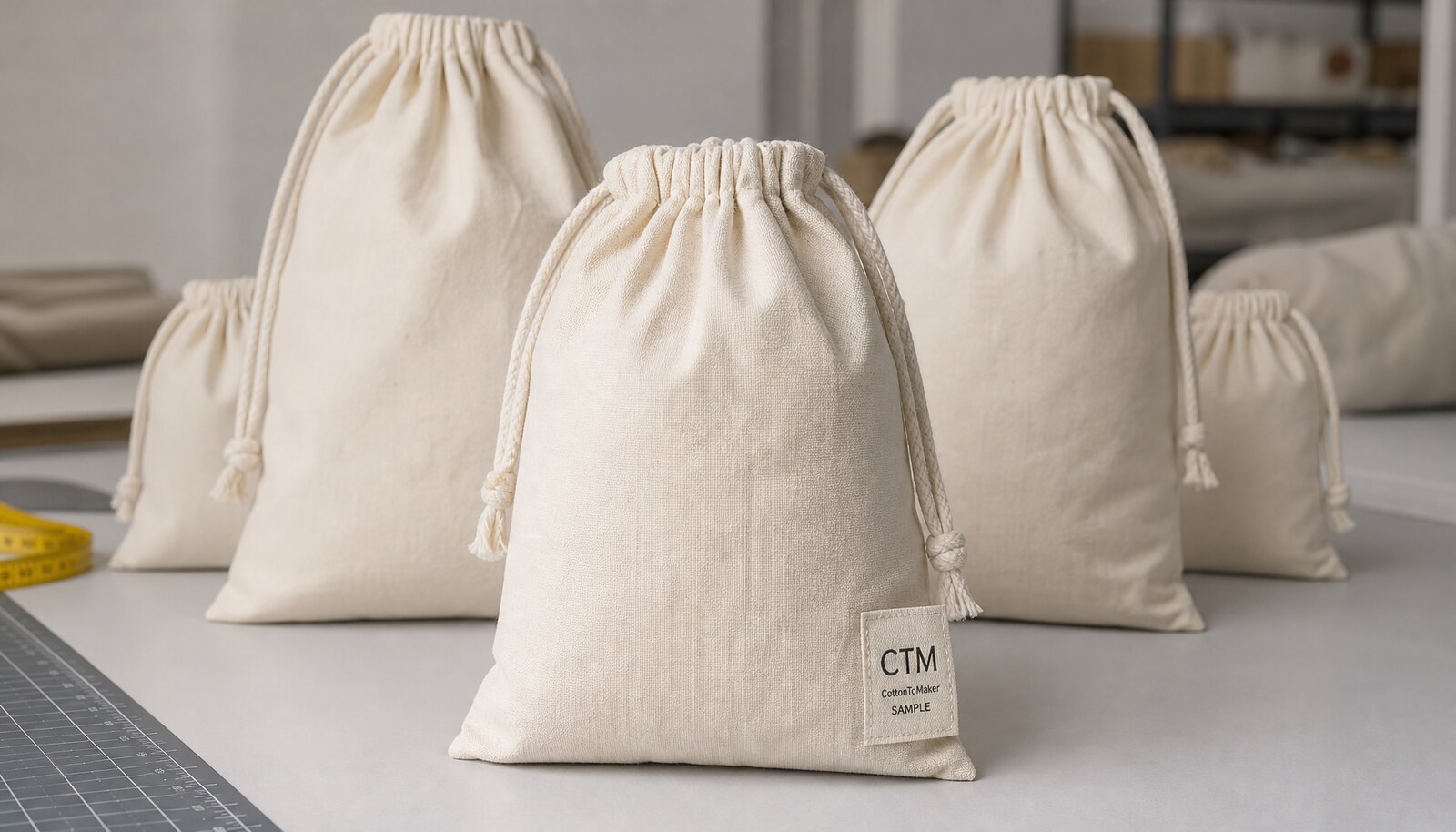
Start With the Use Case, Not the Pouch
Cotton drawstring pouches look simple, which is exactly why buyers get surprised by quote gaps. A factory can make the unit price look attractive by using lighter cloth, a weaker cord, fewer stitches, thinner ink coverage, or a packing format that shifts work back to your team after the shipment lands. In gift shop programs, that kind of saving is fragile. The pouch is handled, displayed, and often held up in the customer's hand before purchase, so visual quality and feel matter as much as function.
The fastest way to avoid noise in the buying process is to define the use case first. A pouch for jewelry does not need the same opacity or seam strength as a pouch for candles or ceramic gifts. A pouch for store shelves has different needs from one that only sits inside a gift set. When the use case is clear, the spec becomes easier to lock, the quote becomes comparable, and the supplier can stop guessing what 'good quality' means in your channel.
- Start with the item weight, the shelf role, and the channel the pouch will serve.
- Do not compare prices until the pouch size, GSM, print method, and packing format are fixed.
- Treat appearance and hand feel as part of the product, not as a soft preference.
- Write the use case down in the RFQ so every supplier is quoting the same job.
Turn the Spec Into Numbers the Factory Can Build
A useful spec sheet is short, but it is not vague. It should identify the finished width and height, seam allowance, cord style, label type, print area, and target fabric weight. For most gift shop programs, 100-120 GSM natural cotton is enough for light items, while 140-180 GSM is better when the pouch needs more opacity, a firmer hand feel, or a more premium shelf look. If the pouch will be packed with heavier goods, ask for the seam and channel to be built with that load in mind rather than assuming the standard construction will hold.
Cotton moves, so shrinkage must be handled instead of ignored. If the pouch is not prewashed, the supplier should state the expected shrinkage and how the cut size compensates for it. For a finished-goods program, a good starting point is to set a tolerance of +/-3 mm on smaller pouches and +/-5 mm on larger ones, then tighten that if your brand or product needs a very clean retail look. The goal is not to over-engineer the pouch. The goal is to keep the factory from filling in missing details with its own assumptions.
- State the finished size in millimeters, not only in general terms like small or medium.
- Set the fabric weight, construction, and expected shrinkage in the same document.
- Define the seam allowance and keep the cutting allowance consistent across reorders.
- If the pouch is used for heavier products, write the target load into the spec.
Benchmark the Supplier Before You Benchmark the Price
The lowest unit price is not always the best supplier. A direct factory usually gives better control over sewing consistency, print registration, and material continuity on reorder, while a trading company may add flexibility if you need multiple product types in one shipment. Small workshops can look cost-effective for short runs, but they are more likely to drift on stitch quality, carton discipline, or repeatability once the order grows. You are not buying a sample. You are buying a production system that needs to stay stable after the first order ships.
Normalize every quote to one baseline before comparing it. Use one finished size, one fabric weight, one print method, one pack format, and one incoterm. If one supplier is quoting flat bulk pack and another is quoting individual polybags with barcode stickers, the unit prices are not comparable. The same is true if one quote assumes stock natural cotton and another assumes custom dyed cloth. A clean comparison is less about the headline number and more about which supplier can hold the same standard at the lowest landed cost over time.
- Prefer a direct factory when the pouch spec is fixed and repeat orders matter.
- Use a trading company only if it can name the actual factory and manage QC openly.
- Do not compare quotes until packing, labels, and freight assumptions are aligned.
- Ask each supplier for the exact baseline behind its unit price so the comparison is real.
Choose Materials and Branding With a Cost-to-Risk View
For a standard natural cotton pouch, the material decision is usually about feel, opacity, and durability rather than novelty. Moving from 120 GSM to 160 GSM often improves the retail impression, but it also increases cloth cost and shipping weight. That extra spend can be justified when the pouch is part of a premium gift set, when the contents are visible through thin fabric, or when the pouch itself is expected to be reused. If the pouch is a low-cost add-on, the same upgrade may be hard to justify because the branding value does not rise with the weight.
Print method is the other place where buyers often overpay or under-spec. Simple logos are usually best served by screen print because the process is efficient and durable when the design is not too complex. Digital print can handle more detail, but it adds setup sensitivity and does not always deliver the same robustness on cotton. If the brand needs a more finished retail presentation, a woven or sewn label can be worth the extra process, but only if the placement is controlled and the label does not pull the seam or create a ridge in the pouch body.
- Use the lightest fabric that still covers the contents and meets the shelf standard.
- Pick the simplest print method that passes your artwork and rub-test requirements.
- Add a label when the pouch is customer-facing and brand recall matters.
- Treat custom dye as a brand-color decision, not as a default upgrade.
Set Measurable QC Criteria Before the Sample Arrives
If the acceptance criteria are vague, the inspection will be vague too. A practical starting point for retail gift goods is an AQL-style inspection rule such as general inspection level II with AQL 2.5 for major defects and 4.0 for minor defects, while keeping critical defects at zero tolerance. That does not mean every program must use the same numbers, but it does mean the supplier should know in advance how the lot will be judged. A pouch that fails because of a broken seam or an unreadable logo is not the same as a pouch with a barely visible thread tail, and those differences should be written down before production starts.
Use measurements, not adjectives. For most pouch programs, buyers can start with finished size tolerance of +/-3 mm on smaller pieces and +/-5 mm on larger pieces, seam density around 8-10 stitches per inch on the body seams, and a shrinkage allowance no higher than 3% on the critical dimensions unless the product is specifically prewashed or pre-shrunk. For printing, ask for a dry rub result of grade 4 and a wet rub result of grade 3-4 by AATCC 8 or ISO 105-X12, or the same level by your lab's equivalent test. These are not decorative numbers. They are the line between a pouch that looks fine at approval and one that holds up in store handling.
- Use AQL 2.5 major, 4.0 minor, and zero critical defects as a starting point unless your channel is stricter.
- Write size tolerance in millimeters and match it to the pouch size class.
- Require even stitch density and no skipped stitches on seams and channels.
- Set a rub-test target for printed logos instead of accepting a generic durability promise.
Treat the Sample as a Production Gate
A sample is not there to confirm that the product exists. It is there to prove that the production line can repeat the spec. Start with the blank pouch or fabric swatch, then review the preproduction sample with the final print, cord, label, and packing format. Measure the finished dimensions, check the opening width, pull the drawcord repeatedly, and inspect the label position against the approved artwork. If the sample is even slightly off, do not write it off as sample noise. That drift usually gets worse, not better, when the order runs at volume.
Keep one signed gold sample tied to the PO and the production file. If there are corrections, send them back as a short list with photos and measurements rather than a loose email thread. The point is to remove interpretation. The factory should know whether a line is a correction, a clarification, or an approved change. That discipline saves time later because the bulk inspector and the production supervisor can both point to the same reference.
- Approve a blank or swatch stage before the printed sample if the cloth finish matters.
- Inspect at least the finished size, cord behavior, print alignment, and label placement on the sample.
- Keep the signed sample as the gold standard for the bulk run.
- Document corrections with photos and measurements so the factory cannot misread the request.
Control Packing and Cartons as Part of Product Quality
Packing is not an afterthought for soft goods. Flat bulk packing is usually the best default because it keeps the carton dense, lowers labor, and avoids unnecessary plastic. Individual polybags make sense when the channel needs dust protection, barcode handling, or e-commerce readiness, but they should be a deliberate choice, not an automatic one. Every extra packing layer adds cost, volume, and receiving work, so the quote should show exactly what is included. If the factory leaves packing open-ended, the landed cost will not stay where the unit price suggests.
Carton planning matters because cotton pouches can look stable and still arrive crushed, damp, or mixed by size. Ask for carton dimensions, pack count, gross weight, and outer mark format before approval. For ocean freight or humid lanes, use dry cartons, a clean liner if needed, and a packing plan that keeps the load from shifting in transit. If the supplier cannot tell you the carton count per size, the marking format, or the final gross weight, the order is not ready for shipment control yet.
- Use flat bulk pack unless the sales channel needs individual retail handling.
- Confirm whether barcodes, warning labels, and inner bags are included in the price.
- Approve carton dimensions and pack count before production starts.
- Add moisture and crush protection when the shipment will travel by sea or sit in storage.
Ask Quote Questions That Expose Hidden Cost
Most supplier questions are too broad to be useful. Instead of asking whether the price is competitive, ask what exactly the supplier included. The point is to find the hidden cost items early: extra colors, label stitching, carton marks, bagging, export documents, internal repacking, and sample fees that are quietly non-refundable. If a quote is low but incomplete, the missing work will show up later as a delay or a surprise charge. That is not a discount. It is deferred cost.
Good quote questions also reveal whether the supplier can support a reorder. Ask for price breaks at realistic quantities, not only one MOQ, and ask whether the same cloth, cord, and ink sources will be kept for repeat runs. A supplier that can only quote the first order, but not the second, is a higher-risk partner than one with a slightly higher unit price and stable material control. Procurement wins when the quote answers the question of repeatability, not just one shipment.
- What is the exact baseline behind the unit price, including size, GSM, print, and pack count?
- What changes in price when I add a color, a label, or individual polybags?
- What are the price breaks at 1k, 3k, 5k, and 10k pieces?
- What is excluded from the quote, especially packing, documents, and rework?
- Can you keep the same fabric, cord, and ink sources on reorder?
- What is your lead time after sample approval and deposit, broken down by milestone?
Run Final Inspection Like a Release Decision
Final inspection should decide whether the lot ships, not just whether the lot looks acceptable. Use the agreed AQL plan, but keep the defect categories practical. A critical defect is one that makes the pouch unsafe or unusable, such as a broken seam or a cord failure. A major defect is one that hurts retail saleability, such as a crooked logo, serious stain, or visibly off-size pouch. A minor defect is cosmetic and does not change the function, but too many minors still point to process drift. If these categories are not written down, the conversation after inspection becomes subjective very quickly.
Do the final check on random cartons and not only on the top layer. Verify piece count, carton mark, seal condition, size mix, and print consistency. If the order contains multiple sizes or colors, check that the cartons are segregated and labeled the way the receiving team expects. For a gift shop buyer, a lot that arrives with the right unit count but the wrong pack mix is still a failure because the receiving work shifts back to the store or warehouse.
- Use the same defect definitions that were approved before production started.
- Inspect random cartons, not just the most accessible ones.
- Treat wrong size mix, wrong label mix, or wrong pack count as a release blocker.
- Record photo evidence for any defect that may recur on a reorder.
Lock the Reorder File Before the First Shipment Leaves
The first order should create the reorder standard, not just satisfy one purchase order. Keep one production file that contains the approved sample, the final artwork, the finishing details, the packing instruction, the carton spec, the inspection standard, and the revision log. That file is what keeps the second order from drifting. Without it, the factory will rely on memory, and memory is a weak control for a product that seems simple but is actually built from several linked choices.
The best repeat-order process is boring: the supplier quotes against the same baseline, the buyer approves the same sample family, and any changes are treated as revisions rather than informal tweaks. If the buyer needs to change the print, swap the cord, or alter the packing, the change should be written down with a date and a reason. That reduces blame later and makes supplier benchmarking possible, because you can compare one order against the same historical standard instead of a moving target.
- Keep one signed gold sample and one final spec sheet tied to the PO.
- Store artwork, carton marks, and packing instructions in the same reorder file.
- Record any change as a revision with a date, not as a casual note.
- Use the first order to define the exact standard for the next order.
Specification comparison for buyers
| Decision point | Typical cost effect vs baseline | Performance / QC effect | Buyer benchmark |
|---|---|---|---|
| Direct factory vs trading company | Factory is often lower on repeat orders; trading companies can add about 5-15% handling margin | Factory gives tighter control over cloth, sewing, and reorder consistency; traders can source faster across multiple items | Use a factory when the pouch spec is stable; use a trader only if they can identify the actual factory and own QC |
| 120 GSM natural cotton vs 160 GSM cotton | Heavier cloth often adds 10-25% to fabric and freight cost | 160 GSM improves opacity, hand feel, and shelf presentation; 120 GSM is lighter and cheaper | Choose heavier fabric only when the contents are visible, heavier, or the pouch is part of premium gifting |
| One-color screen print vs multi-color or digital print | A simple one-color screen print is the baseline; extra colors or digital setup often add 5-20% depending on run size | Screen print is strong for simple logos; more complex methods can improve detail but raise setup and failure risk | Use the simplest method that passes your artwork, rub test, and registration requirements |
| Flat bulk pack vs individual polybag | Polybagging adds labor, materials, and shipping volume, often 3-10% to packed cost | Flat packing is more efficient for wholesale; polybags help with dust control, barcodes, and e-commerce handling | Only add polybags when the receiving channel or sales channel truly needs them |
| Standard size vs custom size | Custom sizes usually add cutting waste, setup time, and 5-15% cost pressure | Standard sizes reduce lead time and simplify repeat buying; custom sizes fit specific products or shelf plans | Choose standard unless the product, gift set, or merchandising plan needs a fixed fit |
| Natural cotton vs custom dyed cotton | Custom dyeing often adds 8-20% plus 1-3 weeks of scheduling risk | Dyed cloth supports brand color matching but introduces shade management and dye-lot variance | Ask for a shade band, reorder lock, and dye-lot control if color consistency matters |
| Printed-only branding vs woven or sewn label | A sewn label adds a small per-unit cost and one more process step | A label improves retail finish, brand recall, and shelf presence, but it can distort seams if placed badly | Use a label when the pouch is customer-facing, not just transit packaging |
| FOB quote vs landed-cost quote | FOB can hide 10-20% of total order cost once packing, freight, duty, and receiving work are added | Landed cost shows the real cost of one sellable pouch at destination | Compare suppliers on the same incoterm, pack count, and carton spec |
Buyer checklist before sampling
- Define the pouch use case, the item weight, and the sales channel before you request pricing.
- Freeze the finished size, fabric GSM, seam allowance, print method, and label position in one spec sheet.
- Set a shrinkage allowance for cotton and state whether the pouch is expected to be prewashed or cut oversize.
- Approve a blank sample and then a preproduction sample with final art, cord, and packing.
- Compare all quotes on the same incoterm, the same pack count, and the same carton dimensions.
- Require price breaks by quantity, size, color, and print version instead of one global MOQ number.
- Set measurable tolerances for size, stitch appearance, cord length, and print placement.
- Agree the inspection rule in advance, including AQL level and critical, major, and minor defect definitions.
- Approve the pack format, carton marks, and moisture protection before mass production.
- Keep the approved sample, final artwork, revision log, and PO tied together in one reorder file.
Factory quote questions to send
- What exact finished size, seam allowance, and dimensional tolerance are you quoting?
- What fabric GSM, weave type, and shrinkage assumption are you using for this price?
- Is the quote based on stock natural cotton, custom dyed cotton, or a specific fabric lot?
- What print method is included, how many colors are covered, and what changes if I add another color?
- What is the MOQ by size, color, print version, and label type?
- What sample stages do you offer, and is any sample fee refundable against the bulk order?
- What dry and wet rub standard do you use for printed logos, and what result do you guarantee on approval?
- What AQL level do you inspect to, and how do you classify critical, major, and minor defects?
- What is included in the unit price, and what is excluded as a separate line item?
- What is your price break at common order levels, such as 1k, 3k, 5k, and 10k pieces?
Quality-control points to confirm
- Fabric GSM matches the approved target within the agreed tolerance, usually +/-5% unless your spec is stricter.
- Finished width and height stay within +/-3 mm for smaller pouches and +/-5 mm for larger formats, or your agreed drawing tolerance.
- Seam density is even on load-bearing seams, typically 8-10 stitches per inch or the equivalent in stitches per cm.
- There are no skipped stitches, broken threads, seam pops, or open corners on the sample or bulk run.
- Drawcord tails are even within +/-5 mm, slide smoothly, and do not twist, bunch, or cut into the channel.
- Shrinkage after agreed conditioning or a light wash test stays within the documented allowance, typically no more than 3% for critical dimensions.
- Printed logos pass a defined rub test, such as dry crocking grade 4 and wet crocking grade 3-4 by AATCC 8 or ISO 105-X12, or your equivalent standard.
- Print placement, registration, and color match the approved sample under the same lighting used for sign-off.
- Labels sit flat, are centered to the approved artwork, and do not pucker or distort the seam line.
- A load-bearing pouch passes a simple handling test at 1.5x the declared content weight for 30 seconds without seam failure.