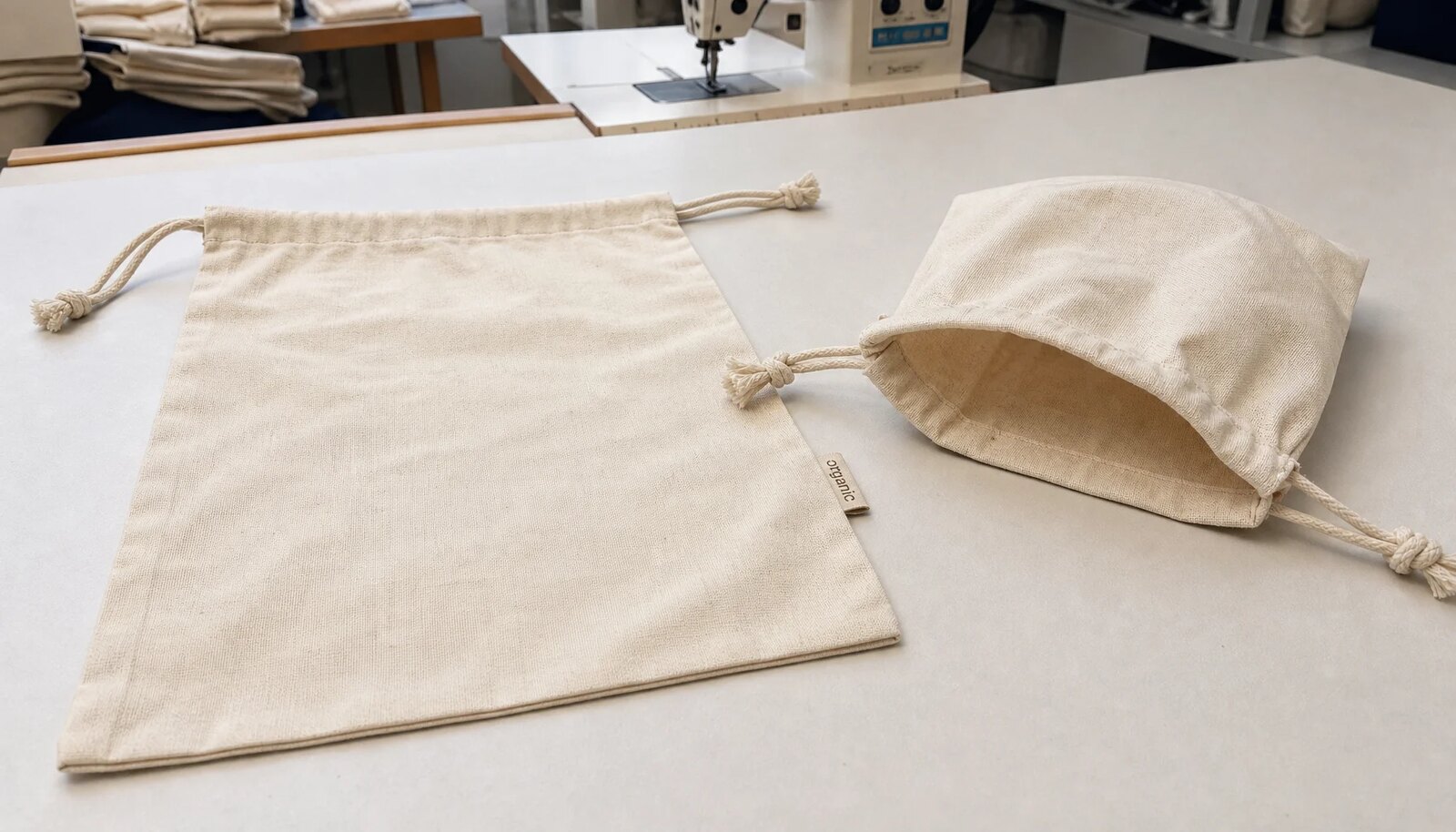
Start With the Procurement Risk, Not the Product Name
Wholesale cotton drawstring pouches look simple on a line sheet, which is exactly why they can create avoidable procurement problems. A pouch may be inexpensive compared with the apparel item it protects, but it still touches the customer experience, warehouse process, and brand claim. If the fabric feels thin, the logo is off-center, the cord jams, or the cartons arrive with inconsistent counts, the problem quickly moves from accessory sourcing into receiving delays, repacking labor, or customer complaints.
For eco apparel brands, the pouch also carries part of the sustainability message. That does not mean every pouch needs the highest-cost fabric or the most complicated finish. It means the buyer should be precise about what the pouch is supposed to do. Is it protecting garments in e-commerce shipments, holding accessories in retail, replacing a polybag for selected SKUs, or acting as a branded gift-with-purchase? Each use case creates a different quality threshold.
The most useful quality inspection checklist begins with the failure you most need to avoid. A warehouse insert pouch may prioritize count accuracy, clean fabric, and reliable closure. A resale pouch needs better print alignment, tighter stitching, and a more consistent presentation. A premium apparel program may require stronger shade control, documented material claims, and more careful packing. Once the risk is named, the RFQ and inspection plan become much easier to write.
- For apparel packing, define whether the pouch is functional packaging, customer-facing packaging, or a resale item.
- For retail or gift programs, treat appearance defects as more serious because the pouch may be judged as part of the product.
- For warehouse use, include count accuracy, carton labeling, and packing consistency in the quality plan from the beginning.
- For eco-positioned programs, verify material claims only when documentation is available and relevant to the claim you will publish.
Write a Spec Sheet Suppliers Can Actually Quote
A strong RFQ for wholesale cotton drawstring pouches does not begin with only length, width, logo, and quantity. It should tell the factory what finished product must be delivered and how it will be judged. The same pouch can be quoted at very different prices depending on fabric weight, seam finish, cord type, print method, packing, inspection level, and incoterm. If those details are missing, each supplier fills in the blanks differently, and the buyer ends up comparing guesses instead of quotes.
Start with finished dimensions rather than cut dimensions. The buying team usually cares about the size the pouch has after sewing, pressing, and resting, because that determines whether the garment or accessory fits. Include a finished size tolerance and, where fit matters, a usable internal size. For example, a pouch with a thick top hem and wide seams may technically meet outside dimensions while still feeling too small inside.
Construction language should be concrete. State the seam allowance, stitch density, thread color, top hem depth, cord channel width, and whether inner raw edges are overlocked, folded, or enclosed. If the pouch needs to carry a heavier item, ask whether corners are reinforced or whether bartacks are possible at stress points. These details do not need to make the product complicated; they simply prevent a factory from using its cheapest default construction when the brand expected something sturdier.
The spec sheet should also identify what is allowed to vary. Natural cotton can include slubs and shade variation, and some buyers welcome that look. Others need a cleaner, more uniform surface because the pouch sits next to premium apparel. Write the acceptable appearance standard before sampling. If the buyer says nothing until bulk goods are finished, the disagreement becomes subjective and harder to resolve.
- Minimum RFQ fields: finished size, internal fit need, fabric GSM, color basis, print method, cord type, construction details, packing format, inspection level, and incoterm.
- Useful tolerance fields: finished width, finished height, print placement, cord length, channel width, carton count, and carton weight.
- Avoid vague words such as premium, thick, clean, or standard unless they are supported by measurements or approved references.
- Attach artwork at final scale and include placement from fixed edges, not only a centered logo mockup.
Choose Fabric Weight, Shade, and Shrinkage With Intention
Fabric weight is one of the first cost drivers, but it is also one of the easiest places to under-specify. A 120-140 gsm cotton pouch can work for light promotional use, small inserts, or programs where the pouch is not expected to carry much weight. For many eco apparel packaging programs, 160-180 gsm is a more balanced baseline because it gives the pouch better opacity, a more stable sewing surface, and a hand feel that does not seem disposable. For premium retail, heavier accessories, or pouches intended for repeated use, 200 gsm and above may be appropriate.
GSM alone does not tell the full story. Two fabrics with the same weight can behave differently depending on weave, yarn quality, finishing, and washing. Ask whether the cloth is greige, bleached, dyed, garment-washed, enzyme-washed, or pre-shrunk. A natural unbleached cotton may carry seed specks and shade variation, which can be part of the intended aesthetic. A bleached or dyed pouch may need tighter shade control, especially if it sits near branded apparel or printed packaging.
Shrinkage should be written into the spec if the pouch may be washed, steamed, pressed, or exposed to heat during finishing. Even if the end customer is not expected to wash the pouch, heat from curing, pressing, or storage can influence dimensions. Ask the factory for its expected shrinkage range and whether the quoted size is before or after any wash or heat process. A pre-production sample should be measured after resting, not immediately after pressing when the cloth may still be temporarily shaped.
Procurement teams should also be careful with sustainability language. Cotton, organic cotton, recycled cotton, and certified organic cotton are not interchangeable claims. If the brand plans to mention organic, recycled, undyed, or certified material in customer-facing copy, the supplier should provide the relevant documentation and the buyer should confirm whether it applies to the fabric, the finished pouch, or the transaction chain. A vague eco claim is not a quality standard.
- 120-140 gsm: suitable for lightweight promotional or short-use packaging when opacity and structure are less critical.
- 160-180 gsm: practical baseline for many wholesale cotton drawstring pouches for eco apparel brands.
- 200 gsm and above: better for premium feel, heavier contents, or repeated-use positioning, with higher material and freight impact.
- Natural cotton should have an approved shade and slub reference so buyers and factories judge variation consistently.
- If washability matters, include shrinkage, print durability, and seam behavior in the sample approval process.
Specify Construction Details That Photos Do Not Reveal
Most pouch defects are not dramatic at first glance. They show up when someone pulls the cord, inserts a product, counts cartons, or compares bulk pieces side by side. A product photo can hide weak seam allowance, inconsistent channel width, uneven top hems, and loose corners. That is why construction needs its own section in the spec and inspection checklist.
The cord channel is especially important because it controls how the pouch feels in use. If the channel is too narrow, the cord drags and the pouch will not close smoothly. If the channel is too wide or uneven, the top edge can look wavy and cheap. Ask for the cord diameter, channel width, top hem depth, and closure style to be approved together. The best cord is not always the thickest one; it is the one that moves cleanly through the channel and suits the pouch size.
Seam finish should match the intended use. For simple apparel packaging, an overlocked inner seam may be acceptable if it is clean and secure. For resale or premium programs, folded or enclosed seams may give a cleaner interior, but they add labor and can reduce internal space. If the pouch has a side label, care label, or woven brand tab, check whether it is inserted into the seam cleanly and whether it creates bulk that affects the opening or print placement.
Measurement methods should be standardized before inspection. Cotton pouches can be soft and flexible, so two inspectors can get different measurements if one stretches the fabric and the other lets it relax. Define whether the pouch is measured flat, unfilled, without tension, and from which seam points. For larger pouches, allow practical tolerance; for small pouches, even a half-centimeter difference can affect fit and appearance.
- Check stitch density and seam security, not only whether the seam is visually straight.
- Measure the pouch flat without stretching unless the spec states another method.
- Confirm top hem depth and channel width because they influence both appearance and closure function.
- Review cord length after knotting or finishing, since cut cord length and usable cord length are not the same.
- Classify open seams, broken stitches, missing cords, and sharp contamination as serious defects before production begins.
Lock Branding, Print, and Label Placement Early
Branding is often the most visible part of the pouch, so it deserves more than a logo file attached to an email. For bulk cotton drawstring pouches, a one- or two-color water-based screen print is often the most practical option for simple marks because it offers repeatable color, a softer hand feel, and reasonable cost at volume. It is a strong default for apparel brands that want the pouch to feel natural rather than plastic-coated.
Other branding methods can work, but each has tradeoffs. Embroidery can feel premium, yet it may distort lighter cotton, add stiffness, and create needle holes or puckering around the design. Heat transfer can reproduce complex artwork, gradients, or small detail, but it may feel less aligned with a natural cotton position and should be tested for adhesion and hand feel. Woven labels or side tabs are useful when the printed area is small or when the logo has fine text that will not screen print cleanly.
Print inspection should be measurable. State the artwork size, color reference, placement from a fixed seam or pouch edge, acceptable placement tolerance, and whether the print must be centered visually or mathematically. A logo placed above a curved bottom seam may look different from one placed on a flat panel, so approve the print on the actual pouch, not just as a digital proof. For drawstring pouches, keep artwork away from the cord channel and heavy seam areas unless the factory confirms the print process can handle the thickness change.
Curing and rub resistance matter. A print that looks good immediately after production may transfer if the ink is under-cured or if packed goods press against each other too soon. Ask the factory how it cures the ink and what basic rub or handling check it performs. For simple procurement control, require the approved sample and bulk goods to pass a dry hand rub without obvious transfer, tackiness, or flaking. If the pouch is washable, move beyond a hand rub and include wash testing in the approval plan.
- Use final-size artwork files and avoid approving from scaled mockups alone.
- Define print placement by distance from top edge, side seam, bottom seam, or another fixed reference point.
- Ask for a strike-off or printed pre-production sample before bulk printing starts.
- Reject print defects such as heavy smearing, poor registration, obvious pinholes, tackiness, cracking, and visible transfer.
- For fine logos, consider a woven label or simplified artwork instead of forcing screen print beyond its limits.
Use Sampling as a Production Trial, Not a Decoration
A pre-production sample should prove that the supplier can make the pouch in the same way bulk production will be made. It should use the actual fabric, actual cord, actual print method, actual label if any, and proposed packing method. Substitute material may be acceptable for an early concept sample, but it should not be used for final production approval. The buyer needs to feel the fabric, test the cord, measure the pouch, inspect the print, and confirm how the product behaves after handling.
A useful sample approval sheet records more than pass or fail. It should list measured dimensions, fabric reference, cord details, print placement, print color, seam finish, pack method, and any approved deviation. If the print is approved slightly higher than the original artwork placement, write that down. If the shade is accepted as a natural cotton variation, attach photos and physical swatches where possible. Written approvals prevent reference drift later when bulk goods are judged by memory.
Golden samples should be controlled. Keep one approved sample with the buyer and one with the factory. Both should be marked by date, order number, revision, and approval status. If there are multiple sizes or artworks, each needs its own reference. Do not rely on a single sample to represent a full assortment unless the only differences are clearly non-critical and documented.
Sampling is also the right time to test usability. Insert the actual garment, accessory, or product bundle if available. Pull the cord repeatedly. Check whether the printed logo wrinkles when the pouch is filled. Look for loose lint against darker apparel. Smell the pouch after it has been packed for a short period. These checks are simple, but they reveal problems that a flat photo will not show.
- Request a concept sample only for early design direction and a pre-production sample for final approval.
- Measure the sample after resting so pressing or handling does not hide size movement.
- Test the pouch with the real contents when fit, shape, or presentation matters.
- Record approved deviations in writing instead of relying on email comments scattered across the sourcing process.
- Do not release bulk production until fabric, print, cord, construction, and packing are all approved or explicitly waived.
Turn QC Into Acceptance Criteria and AQL Rules
A quality inspection checklist becomes useful when it tells the inspector what to measure, how to classify defects, and what result allows shipment. Without acceptance criteria, inspection becomes a subjective visual review. That is risky for cotton pouches because many defects are small individually but costly in volume: short counts, off-center prints, twisted seams, oil marks, odors, missing cords, or cartons with mixed variants.
Define critical, major, and minor defects before production. Critical defects are usually safety, contamination, or compliance issues, such as sharp metal contamination, mold, strong chemical odor, or incorrect claims on labels. Major defects are problems that affect saleability or normal use, such as open seams, missing cords, wrong size outside tolerance, severe print misplacement, unreadable barcodes, or wrong carton counts. Minor defects are small appearance issues that do not affect use and fall within the agreed visual standard.
For first orders, new suppliers, or retail-facing programs, a final AQL inspection gives procurement teams an independent record before goods leave the factory. The exact sampling level depends on order size, buyer risk tolerance, and the inspection provider used. The important point is to define the plan before production: sample size, defect limits, measurement tolerance, carton sampling, and reinspection rules after rework. If a supplier only offers informal photos, treat that as production visibility, not a replacement for a structured inspection.
In-line checks are also valuable. A final inspection can catch defects, but it cannot easily fix a full production lot that was sewn or printed wrong from the beginning. Ask for early production photos and measured first pieces after cutting, sewing, printing, and packing startup. If the first 100 pieces show print placement drift or cord channel problems, the factory can correct the process before thousands of pieces are packed.
- Critical defects: contamination, mold, unsafe foreign matter, severe odor, or incorrect regulated claim.
- Major defects: missing cord, open seam, wrong size, wrong artwork, severe print defect, short count, or unreadable barcode.
- Minor defects: small loose thread, slight natural slub, minor shade variation, or small mark within the approved standard.
- Inspection stages: incoming fabric check, first-line sewing check, print strike-off check, packed-goods audit, and final AQL inspection.
- Reworked goods should be inspected again, not simply repacked and released.
Control Packing, Carton Data, and Warehouse Readiness
Packing is part of product quality for cotton drawstring pouches. The goods are soft and lightweight, but they can pick up lint, moisture, odor, and compression marks if they are handled carelessly. Buyers should decide whether the pouches ship flat, folded, banded, bulk packed, inner packed, or individually packed. For eco apparel brands, lower-plastic packing may be desirable, but the buyer still needs protection, count accuracy, and clean handling.
Specify inner pack count and master carton count. If the receiving warehouse expects 100 pieces per inner pack and 1,000 pieces per carton, the supplier should not ship mixed counts unless approved. Short counts are painful because the pouch may be paired with apparel units later. A small shortage can disrupt fulfillment if the brand planned one pouch per garment or accessory set.
Carton data belongs in the quote, not only in the shipping documents. Ask for carton dimensions, gross weight, net weight, carton count, barcode content, carton marks, and palletization plan if relevant. Freight cost depends heavily on cube for lightweight products. A pouch quote that looks low can lose its advantage if the cartons are oversized or packed inefficiently. Procurement should compare landed cost using real carton data wherever possible.
Warehouse readiness also includes labeling. Carton marks should identify PO number, item code, size, color if relevant, quantity, carton number, gross weight, net weight, and destination instructions if needed. Barcodes should be readable without opening the carton. If pouches are packed by artwork or size, avoid mixed cartons unless the warehouse can receive them cleanly and the carton label makes the mix obvious.
- State flat, folded, banded, bulk, inner pack, or individual pack requirements in the purchase order.
- Confirm whether plastic reduction goals affect inner packaging and what alternative protection is acceptable.
- Require carton labels that match the buyer's item codes, not only the supplier's internal style names.
- Ask for final packing photos before shipment release, including open carton, carton mark, barcode, and carton stack condition.
- Include moisture control when shipping through humid routes or long sea transit, especially for natural cotton goods.
Build a Lead-Time Calendar Around Approval Gates
Lead time for cotton drawstring pouches should be broken into separate stages: artwork confirmation, sample making, sample approval, fabric booking, cutting, printing, sewing, finishing, packing, inspection, and freight. A supplier may quote a short production time, but that number often assumes artwork is final, fabric is available, packing is standard, and no correction round is needed. Procurement teams should ask what starts the clock and what stops it.
Approval delays are one of the most common schedule risks. If the artwork changes after screens are prepared, the print step restarts. If the buyer changes from bulk pack to individual pack, packing labor and materials may need to be re-quoted. If the brand moves from natural cotton to dyed cotton, fabric lead time and shade approval become new constraints. The calendar should show freeze dates for fabric, artwork, cord, label, and packing.
For apparel launches, the pouch schedule should be aligned with garment production rather than treated as an afterthought. If the pouch arrives late, the apparel may sit waiting for packaging. If the pouch arrives too early without proper storage conditions, it may collect dust or absorb warehouse odor. A simple accessory can become the bottleneck when it is required for final presentation or fulfillment.
Buyers should also plan for one correction loop on new programs. Print placement, cord length, and finished size are common sample adjustments. Building a small approval buffer is more realistic than assuming the first sample will be perfect. Once a supplier has proven repeatability on reorders, the buffer may shrink, but the approval gates should still remain visible.
- Separate lead times for sample, material booking, production, inspection, and freight in the quote comparison.
- Set freeze dates for fabric, artwork, cord, labels, packing, and carton marks.
- Ask which buyer-side changes restart production timing or create new setup charges.
- For launch programs, schedule pouch delivery to match garment packing, not only the factory completion date.
- Do not treat production photos as final approval if a formal inspection or buyer signoff is still required.
Normalize Quotes Before You Negotiate Unit Price
A low unit price is only useful when every supplier is quoting the same pouch. Before negotiating, normalize the RFQ responses. Confirm fabric GSM, finished size, print color count, print method, cord type, seam construction, packing count, carton dimensions, inspection responsibility, sample charges, screen charges, incoterm, and payment terms. If one quote is significantly lower, look for the missing assumption before treating it as savings.
MOQ should be read as a setup and efficiency signal. A factory may have one MOQ for stock natural cotton, another for dyed fabric, another for multiple artworks, and another for individual retail packing. If the order combines several sizes, colors, and logo placements, the effective MOQ may rise because each variant creates setup time and waste. Buyers who need lower minimums can often simplify the first order by choosing stock fabric, one logo, one size, and standard bulk packing.
Landed cost matters more than ex-factory price. Cotton pouches are light, so carton volume can have an outsized effect on air or courier shipments. For sea freight, carton cube still affects consolidation and storage. Include freight, duties, inland transport, inspection cost, bank fees if relevant, rejected-goods allowance, and any repacking labor the buyer may need if the supplier's packing does not match warehouse requirements.
The best supplier response is not always the cheapest. A stronger quote explains assumptions clearly, lists inclusions and exclusions, provides realistic lead times, and answers quality questions without vague reassurance. For B2B procurement teams, that clarity has value because it reduces rework, receiving disputes, and late-stage surprises. Negotiation becomes more productive when the buyer can say exactly which cost driver should change instead of simply asking for a lower price.
- Normalize by fabric, construction, print, packing, carton data, incoterm, inspection, and lead time before comparing prices.
- Ask for setup charges separately: screens, labels, sample courier, special packing, and carton mark changes.
- Compare carton cube and gross weight because freight can erase a small unit-price advantage.
- Use simplified variants to reduce MOQ pressure when launching a new pouch program.
- Treat vague quote language as a risk factor, especially when the supplier cannot describe construction or inspection details.
Specification comparison for buyers
| Procurement decision | Recommended baseline | What to specify in the RFQ | Buyer risk to control |
|---|---|---|---|
| Supplier route | Direct factory with controlled sewing, cutting, and printing | Ask which steps are in-house, which are subcontracted, and who signs off each stage | Subcontracted printing or sewing can create placement drift, shade variation, and unclear responsibility |
| Fabric weight | 160-180 gsm natural cotton for most eco apparel packaging programs | State GSM tolerance, weave, color basis, shrinkage limit, and whether the fabric is greige, bleached, dyed, or pre-shrunk | Too-light fabric may show contents, twist at seams, or distort after printing and handling |
| Construction | Double-fold top hem, stable cord channel, consistent seam allowance, clean overlock or enclosed edge | Define finished size, seam allowance, stitch density, cord channel width, top hem depth, and corner reinforcement if needed | Loose seams, narrow channels, and uneven panels often pass photos but fail in actual use |
| Branding method | 1-2 color water-based screen print for simple logos and repeat programs | Include artwork size, Pantone or ink reference, placement from fixed edges, cure requirement, and rub test expectation | Fine text, heavy ink, and poor curing can crack, transfer, or feel inconsistent with an eco-positioned product |
| Sampling route | Pre-production sample made with actual fabric, cord, print, and packing method | Require measured photos, physical approval sample, and written notes for any allowed deviation | Paper proofs and substitute materials hide shrinkage, hand feel, drawstring action, and print opacity issues |
| MOQ logic | One fabric, one size, one artwork, one pack format for the cleanest launch order | Ask MOQ by size, artwork, fabric color, print color count, and packing configuration | Mixed variants can multiply setup waste and push up cost even when the total order quantity looks healthy |
| Inspection route | Factory in-line checks plus final AQL inspection for first orders or retail-facing programs | Define defect classes, sampling level, measurement tolerance, carton checks, and rework rules before production | If inspection standards are agreed after problems appear, the buyer has weaker leverage |
| Packing route | Flat bulk pack with agreed inner count, master carton count, carton marks, and barcode data | Specify folding, inner packing, moisture protection, carton dimensions, gross weight, and label position | Unclear packing causes short counts, crushed presentation, unreadable labels, and freight cost surprises |
| Lead-time route | Separate clocks for sample, material booking, bulk production, inspection, and freight | Ask what approval events start or restart the schedule, especially artwork, fabric, and packing changes | A single lead-time promise hides the real bottleneck and makes launch planning fragile |
Buyer checklist before sampling
- Define the finished size, usable internal size, seam allowance, and measurement tolerance before requesting quotes.
- State fabric GSM, weave, color basis, shrinkage limit, and whether natural shade variation is acceptable.
- Confirm whether cotton is conventional, recycled, organic, or certified, and ask for documentation only for claims you will actually make.
- Lock print method, ink type, number of colors, artwork size, and placement from fixed seams or edges.
- Approve cord type, cord diameter, cord length, knot or end finish, channel width, and opening/closing feel on a physical sample.
- Specify stitch density, thread color, seam finish, top hem depth, corner reinforcement, and loose-thread tolerance.
- Set defect classifications for holes, stains, odor, skipped stitches, broken cords, print defects, and carton count errors.
- Require a pre-production sample made with the actual fabric, actual cord, actual print process, and intended packing method.
- Agree pack count, inner pack method, carton size, carton marks, barcode content, moisture protection, and pallet or loose-carton handling.
- Ask for sample, material booking, production, inspection, and freight lead times separately instead of accepting one combined date.
Factory quote questions to send
- What exact cotton fabric, GSM range, weave, yarn count if available, and shrinkage range will you use for this pouch?
- Is the fabric stock, made-to-order, dyed, bleached, washed, or pre-shrunk, and what shade variation should we expect between lots?
- Which production steps are in-house: cutting, sewing, printing, washing, finishing, packing, and final inspection?
- What stitch type, stitch density, seam allowance, top hem depth, and cord channel width are included in your standard construction?
- Is the logo printed in-house, and what print method, ink type, screen setup, curing method, and rub-check process do you use?
- What MOQ applies per size, artwork, fabric color, print color count, and pack format, and which setup cost drives each minimum?
- Can you quote the same pouch with the same inner pack, carton count, carton dimensions, gross weight, and incoterm so landed cost can be compared fairly?
- What is the sample lead time for a pre-production sample, and will it use the actual bulk fabric, actual cord, actual print, and proposed packing?
- Which inspection standard do you follow, what AQL level can you support, and what measurement tolerances will be written into the production spec?
- How do you classify critical, major, and minor defects for sewing, printing, fabric marks, odor, packing count, and barcode errors?
Quality-control points to confirm
- Fabric GSM, weave density, shade, hand feel, and visible slub level match the approved reference within the written tolerance.
- Finished dimensions, usable internal dimensions, top hem depth, and cord channel width are measured after the sample has rested and, if relevant, after wash or heat exposure.
- Panels are symmetrical, seams are straight, seam allowance is consistent, corners are secure, and there are no skipped stitches, open seams, broken threads, or needle damage.
- Cord diameter, cord length, color, knot security, end finish, and pull action match the approved sample without snagging or channel distortion.
- Print placement, registration, opacity, edge definition, ink hand feel, and cure quality match the artwork spec and pass agreed dry rub handling without obvious transfer.
- Labels, side tabs, or care tags are positioned correctly, stitched securely, and do not interfere with the drawstring channel or usable opening.
- No holes, oil marks, mildew, stains, loose lint, strong odor, foreign fibers, or visible contamination appear on the face, reverse, seams, or packed goods.
- Pack count, inner pack configuration, folding method, barcode readability, carton marks, gross weight, carton dimensions, and moisture protection match the packing instruction sheet.
- Critical, major, and minor defects are counted against the agreed AQL plan, and reworked goods are re-inspected before shipment approval.
- Final inspection report, photo record, packing list, carton data, and any deviation approval are complete before shipment release.