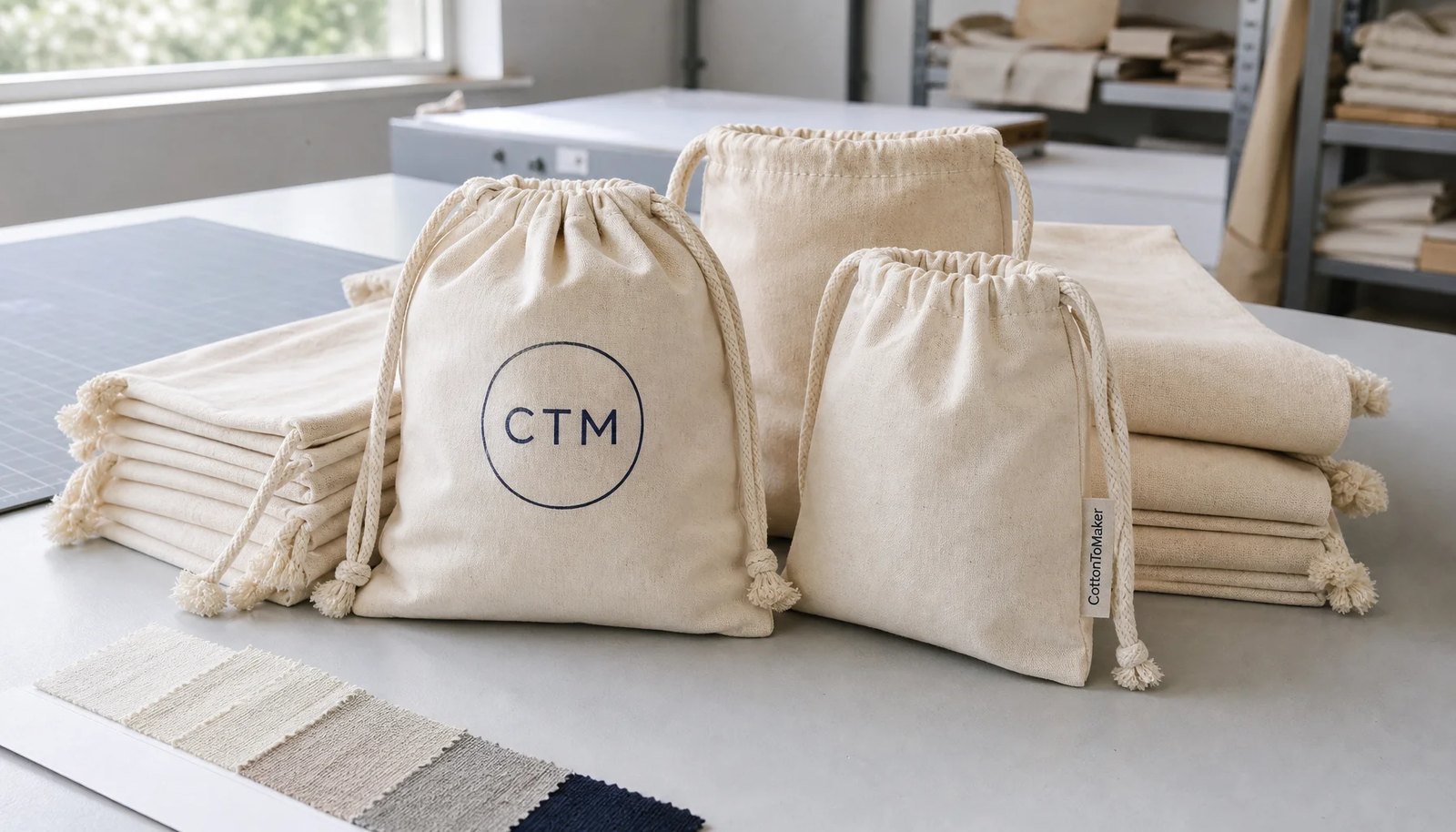
Why print proofing matters more for exhibitor pouches
Wholesale cotton drawstring pouches look simple on a quotation sheet, but they create many small approval risks for trade show exhibitors. The order may include a main brand logo, sponsor logo, event date, booth number, QR code, or giveaway message. If one mark prints too low, bleeds into the seam area, or looks weak on natural cotton, the problem is discovered when there is no time left before freight cutoff.
The main buying problem is not whether a factory can sew a pouch. Many factories can. The real problem is getting the same printable area, fabric shade, ink behavior, and packing method that the exhibitor approved. A useful RFQ should treat print proofing as a production control step, not as a decorative mockup.
- Use the final pouch size and final fabric in the proof, not a similar sample from the showroom.
- Approve logo size in millimeters, not by visual proportion on a PDF.
- Leave safe distance from drawstring tunnels, side seams, bottom gussets, and folded edges.
- Decide who approves the final sample: procurement, brand team, distributor, sponsor, or end exhibitor.
Start the RFQ from the packed use, not the pouch name
A cotton drawstring pouch for a pen and badge is a different product from a pouch used for a sample bottle set, electronics kit, candle, or premium retail-style giveaway. The fabric, cord thickness, seam strength, packing method, and carton weight all change with the packed use. If the RFQ only says cotton pouch with logo, most suppliers quote the cheapest workable construction, and later changes become cost revisions.
Before sending artwork, list the items that will go inside the pouch and their approximate weight and shape. A flat pouch may suit a scarf or brochure pack, while a thicker item may need a gusset or wider finished width. For exhibitors, the booth team also needs fast filling, so a mouth opening that looks fine on a sample can become inefficient when staff must pack thousands of kits.
- For light giveaways under 100 g, 4 oz to 5 oz cotton is often enough.
- For beauty samples, bottles, or electronics, 6 oz cotton or a gusseted construction may reduce seam stress.
- For a premium reusable feel, 8 oz canvas gives better structure but increases freight weight.
- For fast event packing, double drawstrings usually open and close faster than a single drawcord.
Choose fabric weight with printing and freight in mind
Cotton pouch fabric is commonly described by ounces or GSM. For buyer comparison, 4 oz cotton is usually around 120-140 GSM, 5 oz around 150-170 GSM, 6 oz around 180-220 GSM, and 8 oz canvas around 240-280 GSM, depending on weave and finishing. These ranges are practical references, not universal standards, so the supplier should state the actual tested fabric weight used for the quote.
Lighter cotton lowers unit cost and carton weight, but it can make the print look less solid because the surface is thinner and more flexible. Heavier cotton supports better print opacity and a more durable handfeel, but it can make small pouches stiff at the mouth and raise air freight cost. For natural cotton, small seed specks and yarn slubs are part of the look; the proof should define what level is acceptable around the printed logo area.
- Natural cotton saves dyeing cost but may vary more in shade between fabric lots.
- Bleached cotton gives cleaner print contrast but may show dirt more easily during packing.
- Dyed cotton requires better color-lot control and may need higher MOQ.
- Organic or recycled cotton should be requested early because certificates and fabric availability affect MOQ and lead time.
Match the print method to the actual artwork
Screen printing is usually the most stable option for wholesale exhibitor pouches with one to three solid colors. It offers good cost control at volume, especially when the same logo repeats across many pieces. However, cotton is not a coated paper surface. Very small text, thin outlines, distressed graphics, and reversed details can close up after ink passes through the screen and into the fabric texture.
Heat transfer and digital transfer can handle gradients, photos, multi-sponsor artwork, and short runs with many colors. The tradeoff is handfeel and durability. On natural cotton, a transfer can sit on the surface and look more like a patch than ink in fabric. Embroidery is possible for premium pouches, but it is not ideal for detailed event graphics or large low-cost giveaways because stitch count and backing affect cost and puckering.
- For screen print, provide vector artwork and Pantone references for each color.
- Avoid tiny QR codes unless the supplier tests scanning after printing on the exact fabric.
- For transfer print, request a wash and rub test if the pouch is meant for reuse.
- For embroidery, simplify artwork and avoid large filled areas on lightweight cotton.
Define a proof that can control mass production
A digital mockup is useful for layout discussion, but it is not a production proof. It cannot show ink absorption, fabric shrinkage, drawstring tunnel distortion, or how close the logo sits to the stitched edge. For trade show orders, the pre-production sample should be made with final bulk fabric, final cord, final print method, and the approved sewing construction. If the supplier changes any of these after approval, the proof loses value.
A good proof package includes the physical sample, a photo with ruler measurements, Pantone or color comments, carton packing proposal, and any known tolerances. The buyer should sign off on the sample with clear acceptance criteria. This avoids the common dispute where the factory says the product matches the visual proof while the brand team says the print color is not acceptable.
- Record print width and height in millimeters on the approval document.
- Record print position from the top edge or drawstring seam and from side edges.
- Keep one approved sample at the factory and one with the buyer or inspection team.
- Do not approve bulk printing from a phone photo when color is commercially important.
Understand MOQ logic before comparing quotes
MOQ for cotton drawstring pouches is not only a sewing quantity. It is influenced by fabric purchase, dyeing, cutting efficiency, print setup, screen making, cord inventory, label production, and packing labor. A supplier may accept a low MOQ for natural cotton stock fabric with one-color print, then require a higher MOQ for dyed fabric, custom cord, multiple pouch sizes, or many artwork versions.
When comparing quotations, separate the base pouch price from setup charges and version charges. For example, 5,000 pieces with one logo may be cheaper per unit than 5,000 pieces split across five sponsor designs because each design needs separate screens, proofing, setup time, and packing control. If the event requires multiple exhibitors or regional versions, the RFQ should show the allocation table at the beginning.
- State total quantity and quantity by artwork version.
- State quantity by pouch size if more than one size is needed.
- Ask whether overproduction or underproduction tolerance applies, such as plus or minus 3%.
- Clarify whether screen charges are one-time, repeated for reorders, or charged per color.
Use quote data that exposes hidden cost drivers
A supplier quote for wholesale cotton drawstring pouches should include more than a unit price. Procurement teams need enough data to compare landed cost and production risk. A low unit price may exclude individual packing, carton labeling, barcode application, sample freight, screen charges, inspection support, or export carton strength. These missing items often appear after artwork approval, when changing suppliers is difficult.
Request the quote in a structured line format. Include pouch size, fabric GSM, fabric color, cord type, print method, print colors, print size, packing, carton quantity, carton dimensions, gross weight, sample cost, setup cost, mass production lead time, and trade term. This allows the importer or distributor to estimate freight and event delivery risk before committing.
- Compare FOB or EXW quotes only after adding inland charges and export handling.
- For air freight, carton dimensions can matter as much as gross weight because pouches are bulky when loosely packed.
- For sea freight, confirm cartons are strong enough for stacking and not overloaded.
- For distributor programs, require version-level packing lists so mixed artwork does not delay receiving.
Set QC thresholds for print, stitching, and appearance
Quality control should be written before production, not negotiated after defects appear. For printed cotton pouches, the most common defects are stains, skewed panels, off-position print, ink smears, pinholes, color variation, skipped stitches, loose drawstrings, and wrong packing allocation. Some natural fabric variation is normal, but contamination inside the logo area should not be accepted if it affects brand appearance.
Use practical thresholds. Finished size tolerance for small pouches can often be plus or minus 5 mm, while larger pouches may need plus or minus 10 mm. Print position tolerance may be plus or minus 3-5 mm depending on loading method and pouch size. For very tight logo placement, the supplier may need jigs or slower printing, which affects cost and lead time.
- Classify defects as critical, major, or minor before inspection.
- Treat wrong artwork, unreadable QR code, mildew odor, or unsafe contamination as serious defects.
- Use the approved sample as the boundary standard for fabric slubs and shade.
- Inspect mixed-version orders by artwork version, not only by total carton quantity.
Plan packing around booth operations and receiving
Packing is often treated as an afterthought, but it affects both cost and event execution. Bulk packing is cheaper and uses less material, but pouches may arrive wrinkled and take more time to count. Individual polybags protect the print and make distribution easier, but they add labor, material cost, and plastic waste. Paper bands or bundle packing can be a good middle option for exhibitors who need counting control without full individual packaging.
Carton marks should match the trade show receiving plan. If a distributor ships to several booth locations, carton labels should show event name, booth number, pouch size, artwork version, quantity, and carton sequence. For kitting, inner packs of 25, 50, or 100 pieces can reduce counting errors. The packing method should be approved before mass production because repacking thousands of pouches near the shipping deadline is expensive.
- Use flat packing when logo surface appearance matters.
- Avoid over-compressed cartons for heavy canvas pouches because creases can be hard to remove.
- Request carton dimensions and gross weight before booking freight.
- For retail-style inserts, define barcode label position and whether the pouch must be lint-rolled or ironed.
Build a schedule that includes proofing risk
The safest lead-time plan separates artwork review, sample making, sample transit, sample approval, fabric preparation, cutting, printing, sewing, final inspection, packing, and export booking. A factory may quote 20-30 days for production after approval, but that does not include the days spent correcting artwork, waiting for sponsor approval, or shipping a physical proof across countries.
Trade show deadlines are fixed, so proofing decisions must have owners and dates. If the brand team may reject color, build one correction cycle into the schedule. If the event has multiple sponsor logos, collect final vector files before sample production begins. Rushing the proof usually moves risk into bulk production, where mistakes are more expensive.
- Freeze artwork before the supplier makes screens or transfers.
- Approve fabric shade and logo placement before cutting the full quantity.
- Schedule inspection before final payment or container loading.
- Keep a backup plan for air shipment of a partial quantity if the event date is close.
Specification comparison for buyers
| Spec decision | Recommended option | When it fits | Buyer risk to check |
|---|---|---|---|
| Fabric weight for exhibitor giveaways | 4 oz to 5 oz cotton, roughly 120-170 GSM | Lightweight promo pouches for brochures, badges, small gifts, cosmetics, chargers, or sample kits | Very light fabric can show contents and may wrinkle heavily after bulk compression |
| Fabric weight for reusable retail-style pouches | 6 oz to 8 oz cotton canvas, roughly 200-280 GSM | Premium trade show kits, influencer packs, retail packaging, heavier items, or repeated use after the event | Higher GSM increases carton weight, freight cost, and drawstring bulk at the mouth |
| Print method for simple logos | Screen print with water-based or plastisol ink after fabric pre-shrink control | One to three solid colors, clear brand marks, event logos, and large front-panel placement | Fine lines under about 0.3 mm and small reversed text may fill in on textured cotton |
| Print method for gradients or full-color artwork | Heat transfer or digital transfer tested on the exact cotton base | Photos, gradient badges, sponsor collages, and short-run multi-color orders | Transfers can feel heavier, crack if low grade, or show a boundary on natural cotton |
| Drawcord material | Matching cotton cord or twisted cotton rope sized to the pouch mouth | Natural look, plastic-free messaging, and gift packaging that buyers may reuse | Cord diameter must not jam in the tunnel; thin cord can cut into fabric on heavier contents |
| Closure construction | Double drawstring with folded tunnel and bar-tack or reinforced side seam ends | Faster opening and closing for booth staff packing kits before a trade show | Weak tunnel stitching can fail when pouches are overfilled or pulled repeatedly |
| Proof approval standard | Pre-production sample using bulk fabric, bulk cord, and final artwork size | Orders where brand color, logo position, or sponsor approval matters before mass production | Paper proofs and digital mockups do not reveal ink absorption, fabric skew, or seam interference |
| Packing method | Flat packed by inner polybag or paper band, with carton marks matching booth shipment plan | Distributor and exhibitor orders that need easy receiving, counting, and event allocation | Random bulk packing saves handling cost but slows kit assembly and increases wrinkling |
Buyer checklist before sampling
- Define the pouch use case: empty giveaway, packed sample kit, retail insert, badge holder, or VIP exhibitor pack.
- Specify finished size with tolerance, not only nominal cut size; include whether measurements are taken flat before or after ironing.
- Select fabric by GSM or ounce weight and state whether natural, bleached, dyed, recycled, or organic cotton is required.
- Match the print method to the artwork: screen print for solid colors, transfer for full-color graphics, embroidery only for simple premium marks.
- Provide vector artwork, Pantone references, print size in millimeters, and exact print position from pouch edges or drawstring seam.
- Require a pre-production sample on the final fabric and cord before bulk printing, especially for sponsor logos or event campaigns.
- Set acceptance criteria for logo clarity, color deviation, registration, print placement, seam strength, and cord operation.
- Confirm MOQ logic by size, fabric color, print color count, and packing style; mixed designs may change setup and screen charges.
- State packing needs clearly: individual bags, bundle count, carton quantity, carton marks, palletization, and whether barcodes or inserts are needed.
- Build schedule around proofing, not only production days; include artwork review, sample making, sample transit, approval, mass production, inspection, and export booking.
Factory quote questions to send
- What GSM or ounce weights are available from stock for the pouch size we need, and which weights require greige fabric purchase or dyeing MOQ?
- Is the quoted size the cut size or finished size after sewing, and what tolerance will be used during final inspection?
- Which print method is included in the quote, how many colors are included, and what is the maximum print area for this pouch size?
- Will the pre-production proof use the same bulk fabric, cord, ink, and sewing construction as mass production?
- What setup charges apply per artwork, per color, per size, or per repeated logo position?
- Can multiple pouch sizes or artwork versions be combined to reach fabric MOQ, or will each version be treated as a separate production lot?
- What packing is included in the unit price, and what is the added cost for individual polybags, FSC paper bands, barcode labels, or export cartons by allocation?
- What lead time begins after sample approval, and what schedule risk exists if the print color or fabric shade is rejected?
- What inspection standard will be used for print defects, broken stitches, stains, skewed panels, loose cords, and carton quantity shortages?
- Can the supplier provide pre-shipment photos, carton measurements, gross weight, and packing list details before balance payment or shipment release?
Quality-control points to confirm
- Finished pouch size should stay within the agreed tolerance, commonly plus or minus 5 mm for small pouches and plus or minus 10 mm for larger pouches unless tighter control is quoted.
- Print placement should follow the approved proof, with a practical tolerance such as plus or minus 3-5 mm depending on pouch size and manual loading method.
- Logo edges should be clean enough for the chosen fabric; filled-in small text, broken lines, pinholes, and heavy ink bleeding should be classified before production starts.
- Pantone matching should be judged on the actual cotton base under consistent lighting, not from a digital screen or coated paper reference only.
- Drawstring tunnels should open smoothly without skipped stitches, blocked channels, or cord ends trapped in side seams.
- Side seams and bottom seams should withstand normal hand pulling and the expected product weight without seam burst or loose thread chains.
- Natural cotton should be screened for oil spots, dark contamination, weaving slubs beyond approved standard, mildew odor, and excessive color shade variation between lots.
- Bulk cartons should match the packing list, with correct quantity per inner pack, correct artwork version, readable carton marks, and no mixed sizes unless approved.