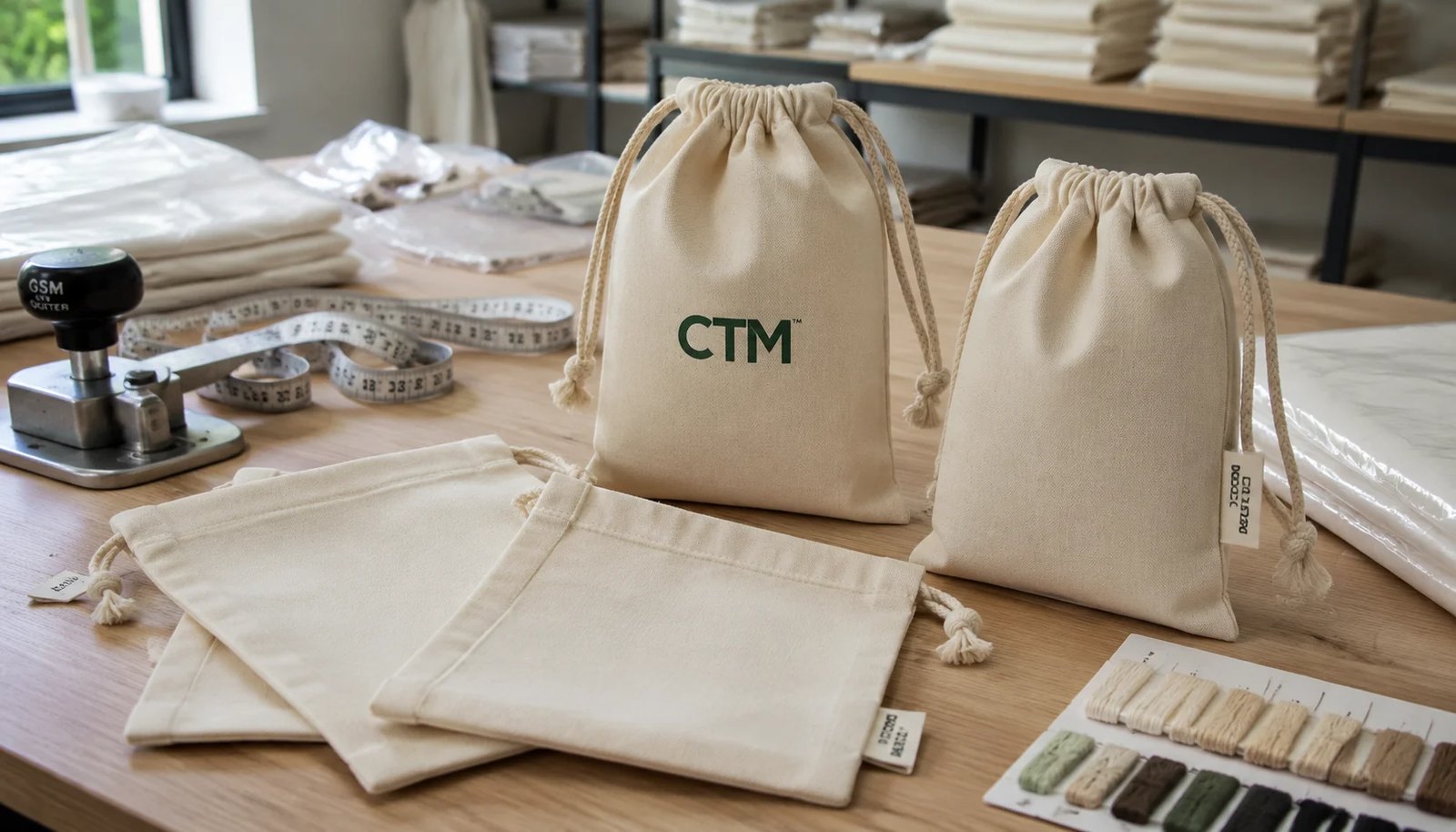
Why natural grocer pouch programs fail at inspection
Cotton drawstring pouches for natural grocers look simple, but most quality problems start long before final inspection. Buyers often approve a clean-looking prototype made from one fabric lot, then receive bulk goods with a lighter cloth, misaligned print, rough cords, or weak top channels. These defects matter because natural grocer assortments usually sit in close visual comparison with organic, refill, gift, wellness, or home goods ranges. A pouch that looks too thin or inconsistent can make even a good product feel cheap on shelf.
The main buying problem is not finding a pouch supplier. It is writing a spec and QC standard tight enough that two suppliers quote the same product and one factory cannot quietly substitute a lower-cost version. For this category, the highest-risk points are fabric weight, closure construction, print behavior on natural cotton, and packing discipline. If those are controlled at sample and inline stage, final inspection becomes a confirmation step instead of a rescue operation.
- Typical failure pattern: approved sample in 150 GSM, bulk arrives closer to 120-130 GSM
- Common retail complaint: drawstring channel puckers and the pouch does not close cleanly
- Frequent import issue: print placement varies enough that mixed shelf display looks inconsistent
- Warehouse issue: loose bulk packing creates count shortages and dirty retail-facing fabric
Choose the right base spec before you compare quotes
For natural grocers, the most commercially stable base spec is usually a natural cotton pouch in 140-170 GSM with a double-fold top hem and cotton drawcord. This range gives enough body for logo presentation and repeat handling without pushing the item into an unnecessarily heavy cost band. Below this range, pouches often feel promotional rather than retail-ready. Above this range, unit cost rises, the top channel becomes thicker, and small pouches can bunch at the opening.
A buyer should separate aesthetic preferences from functional requirements. If the pouch is for dried herbs, bath items, soap bars, tea accessories, or gift-with-purchase sets, light to medium cotton is usually enough. If it must hold glass jars, multiple products, or be reused as a utility pouch, the stitch plan and seam strength matter as much as GSM. Many quote gaps come from suppliers pricing different constructions under the same size description.
- Useful baseline spec: 15 x 20 cm or 20 x 30 cm, 140-170 GSM natural cotton, screen print, cotton cord
- Preferred hem: double-fold channel to reduce raw-edge exposure and cord abrasion
- Seam allowance reference: around 0.7-1.0 cm depending on pouch size and fabric thickness
- Stitch density reference: roughly 8-10 stitches per inch for balanced seam security and appearance
- If the pouch carries heavier contents, request reinforcement at channel ends and seam back-tacking
Fabric weight and cotton type: where quote gaps usually hide
Fabric weight should be controlled in GSM because ounce terminology is interpreted loosely across suppliers. One factory may quote 5 oz as around 140 GSM while another treats it closer to 170 GSM depending on weave and finishing. For quality inspection, it is better to approve an acceptable range, such as 145-160 GSM, and to note whether the value refers to finished fabric after washing or finishing. That avoids arguments when bulk fabric shrinks or softens after processing.
Natural grocer programs also tend to use words like natural, organic, eco, or reusable in product briefs. These words affect fabric sourcing, but they do not guarantee the same material quality. Conventional natural cotton can be perfectly suitable when the brand only needs an unbleached, low-dye appearance. Organic cotton should only be specified when the buyer can evaluate document scope and cost impact. Otherwise, a supplier may charge a premium for a claim that is not usable in retail communication.
- For a retail-ready feel, practical target bands are 140-170 GSM for most pouches and 180-220 GSM only for larger utility formats
- Open-weave cotton can meet nominal GSM but still print poorly; request close-up fabric photos or swatches
- Specify natural shade expectation because unbleached cotton can vary from off-white to cream or light beige
- If organic is required, request transaction-level paperwork and confirm whether bag conversion is inside certificate scope
- If shrinkage matters, define whether finished size tolerance applies before or after any wash process
Print method decisions that affect both shelf look and reject rate
Most natural grocer pouch programs are best served by simple screen printing in one color or two colors maximum. On natural cotton, water-based or standard textile screen print gives the most stable balance between cost, hand feel, and production repeatability. It also handles medium to large runs better than transfer methods. The main challenge is that natural cotton absorbs ink unevenly because of slubs, seed specks, and surface variation. That means buyers should avoid artwork with hairline details unless they accept some print texture.
Heat transfer or digital methods can work for highly detailed logos or pilot runs, but they create different risks. Transfers can feel too plastic for a natural-positioned retail product, and adhesion problems may appear after folding or rubbing. If the logo is small and the visual language is minimal, it is usually smarter to simplify the art for screen print than to choose a fancier process with higher unit risk.
- Best bulk option for most programs: 1-color screen print on natural cotton
- Good artwork practice: minimum line thickness and open negative space sized for absorbent fabric
- Placement tolerance should be stated, for example plus or minus 0.5 cm from approved centerline
- Request print rub test on sample if pouch will be densely packed or shipped in humid conditions
- If branding is subtle, a woven side label may reduce front-panel print variation and support a cleaner look
Sample approval should prove bulk feasibility, not just appearance
A development sample is useful for size and general appearance, but it is not enough for production approval unless it uses the same fabric, print process, cord, and stitching plan as bulk. Many inspection disputes begin because the approved sample was hand-made in the sample room with more time per unit and better operator attention than the mass-production line. The result is a sample with cleaner corners, tighter hems, and straighter print than the factory can sustain without revised pricing.
The safer approval path is to treat the pre-production sample as a micro-run representative of actual manufacturing. That sample should be measured, weighed, and packed under the same assumptions as the order. If the factory cannot provide a bulk-representative sample, the buyer should assume higher production variation and increase inline oversight.
- Approve size by flat measurement drawing with all reference points marked
- Approve fabric by swatch with GSM notation and visual shade comment
- Approve print by actual process sample, not digital artwork mockup
- Approve closure function by repeated open-close trial on filled pouch
- Approve packing by inner-bag count, fold method, and carton mark layout if retailer receiving is strict
Quality inspection thresholds that actually catch retail-facing defects
A useful QC checklist for cotton pouches should distinguish between cosmetic variation that is normal for natural fabric and defects that affect retail acceptability. Small natural specks, minor weave irregularity, and light color tone shift can be acceptable if they are consistent with the approved standard. By contrast, front-panel stains, strongly off-center print, seam grin, raw-edge exposure, or cords that do not slide are not natural-character issues. They are production defects and should be classified accordingly.
For import buyers, final inspection should focus on measurable thresholds rather than generic phrases like good quality. If pouches are sold in a visible branded retail environment, appearance standards need to be tighter on the front face than the back. State that clearly. Also note whether inner-carton assortment accuracy is treated as a major issue, especially when natural grocer chains receive by SKU count rather than open-carton piece audit.
- Major defect examples: incorrect size beyond tolerance, broken seam, unusable drawstring, severe stain, wrong print color, wrong artwork, wrong SKU packing
- Minor defect examples: slight slub on back panel, small trim thread under agreed limit, light acceptable shade variation within approved swatch range
- Front-panel print skew should have a stated limit, not a subjective visual-only rule
- Cord function should be tested on random units, especially from top, middle, and bottom cartons
- If using AQL, define what counts as major versus minor before inspection starts
Packing standards matter more than most pouch buyers expect
Because cotton pouches are soft goods, buyers sometimes underestimate how much poor packing damages sellable quality. Loose units packed without inner polybags collect lint, dust, and carton abrasion. Tight overpacking creates heavy fold memory on printed panels and can press wet or under-cured print surfaces together if goods are packed too soon. For natural grocers with clean, wellness-oriented shelf presentation, these are avoidable costs that show up only after receiving.
Packing instructions should match the buyer's warehouse and store flow. If the importer needs fast receiving and count verification, smaller inner packs with clear labels are usually worth the slight packing cost increase. If the program is e-commerce refill accessories or promotional giveaway inventory, larger bulk inners can be acceptable. The right answer depends on receiving labor and carton cube, not only factory convenience.
- Typical practical format: 25 or 50 pcs per inner polybag, then into master carton
- Recommended carton controls: dry corrugated export carton, no over-compression, gross weight kept manageable for manual handling
- Carton marks should include PO, item code, color, size, quantity, made-in statement if required, and carton sequence
- If mixed sizes are packed together, use a clear carton assortment map to avoid receiving disputes
- Do not allow freshly printed pouches to be packed before full curing and cooling period is complete
MOQ logic and cost drivers for pouch programs
Cotton drawstring pouch pricing moves less on sewing time than many buyers expect and more on material weight, print setup, and order fragmentation. A simple pouch is a straightforward sewing item, but every variation in size, artwork color, cord color, or pack assortment reduces line efficiency. This is why a quote that looks cheap at total order quantity may become expensive once the program is split across multiple SKUs for different natural grocer categories or store sets.
For budgeting, it helps to think in layers. Fabric and cutting usually form the largest share on light-print pouches. Printing can become the main driver when artwork uses multiple colors or several logo sizes. Packing costs rise when barcode labels, assortment, or retailer-specific inners are involved. If two suppliers are far apart in price, the first question is whether they are quoting the same GSM and same packing basis. That is where hidden downgrades often sit.
- Main cost drivers: GSM, pouch size, print color count, cord type, organic claim, and packing complexity
- MOQ often applies by fabric color and print setup, not only by total pouch quantity
- Mixed sizes can share fabric in some cases, but mixed print placements may still trigger separate setup costs
- A lower quote may exclude inner polybags, labels, sample revisions, or stricter carton marking
- Example budgeting logic: compare ex-factory unit cost, print setup allocation, sample cost, and packing adders separately
Lead time planning and the schedule risks buyers miss
Lead time for wholesale cotton drawstring pouches is often presented as one simple number, but the real schedule has several gates: material booking, sample approval, print screen preparation, cutting, sewing, printing, finishing, packing, and inspection. Natural grocer programs often have seasonal retail windows tied to holidays, wellness launches, or reusable packaging campaigns, so a delayed sample can hurt more than a delayed shipment booking. If the approval path is vague, production time estimates are not reliable.
The two biggest schedule risks are fabric substitution after approval and line disruption caused by late artwork or packaging decisions. If the factory starts on provisional fabric and then switches to another lot, the buyer can see color and hand-feel changes across production. If the buyer finalizes labels or carton marks late, packing stalls and ex-factory dates slide even though sewing is finished. Good RFQs separate must-have approvals from nice-to-have refinements so the critical path stays clear.
- Sample timing should be separated into development sample and pre-production sample stages
- Bulk lead time should start from final approval of sample, artwork, and pack details, not from inquiry date
- Inline inspection is especially useful when first orders use new fabric or new print position
- If booking vessels or consolidation cargo, include a buffer for carton packing and final inspection rework
- For split-SKU programs, ask whether partial completion can be packed and released while other SKUs finish
How to compare supplier quotes on a landed-cost basis
A usable quote comparison for pouches should not stop at ex-factory price. For natural grocer buyers, the practical landed-cost view includes the true spec, expected reject risk, packing density, and shipping cube. A slightly heavier pouch may cost more per unit but stack better in retail presentation and reduce returns or complaints. A cheaper supplier may quote loose bulk packing that increases receiving labor and carton contamination risk. Those costs belong in the comparison even if they do not appear on the proforma invoice.
When evaluating two or three suppliers, normalize the quote line by line. Put fabric GSM, finished dimensions, print colors, cord material, sample policy, packing method, carton data, and lead time assumptions into one sheet. Then estimate not only purchase cost but likely correction cost. A pouch program with inconsistent print and high sorting labor is not cheaper in practice, even if the FOB unit price looks lower.
- Compare unit price only after normalizing size, GSM, print method, and packing basis
- Include estimated cartons per order because shipping cube can differ on fold method and carton size
- Assign a risk cost to weak samples, vague fabric description, or missing inspection commitment
- If retailer compliance labels are required, include labeling labor and error risk in landed-cost review
- Use first order results to build a supplier scorecard for future replenishment decisions
Specification comparison for buyers
| Spec decision | Recommended option | When it fits | Buyer risk to check |
|---|---|---|---|
| Fabric weight | 5 oz to 6 oz cotton canvas, about 140-170 GSM | Best for dry grocery gifting, herbs, soap bars, produce accessories, and general retail pouch programs needing moderate structure | Below 130 GSM can look thin, print through, and crease heavily; above 180 GSM adds cost and may reduce drawstring closure smoothness on small sizes |
| Cotton type | Conventional natural cotton with clear fiber-content declaration, or certified organic only when brand policy requires traceable documents | Use conventional for value-driven promotional runs; use organic for mission-led natural grocer private label ranges | Many quotes label fabric as organic without transaction scope documents; verify certificate scope holder and whether pouch conversion is covered |
| Bag construction | Single-compartment pouch with side seams and double-fold top hem | Most cost-efficient for 1000-10000 pcs and stable for repeated open-close use | Open seam allowance, narrow hem, or single-turn channel often causes cord breakout after store handling |
| Drawstring style | Single cotton cord with one-side pull for small pouches; double cord two-side pull for medium and giftable formats | Single cord fits low-cost spice, tea, or soap pouch sizes; double cord feels neater for premium shelf presentation | Loose cord ends, uneven knot length, and fraying increase reject rate and create poor shelf appearance |
| Print method | 1-color water-based screen print for simple logos; heat transfer only for very detailed artwork and short runs | Screen print is the safest bulk option on natural cotton and gives repeatable unit economics | Registration drift, ink penetration inconsistency, and curing marks are common on unbleached fabric; heat transfer can crack or feel plastic on soft pouches |
| Size tolerance | Finished size tolerance of plus or minus 0.5 cm for small pouches and plus or minus 1.0 cm for larger pouches | Suitable for retail sets where product fit matters but hand-cut fabric variation is still realistic | Suppliers promising zero tolerance are usually quoting without production reality; too-wide tolerance causes fill-fit failures and packing inconsistency |
| Packing format | 25 or 50 pcs per inner polybag, then export carton with size and PO label | Works well for mixed-SKU warehouse receiving and retail program audits | Loose bulk-packed units can absorb dust, snag cords, and slow receiving counts; oversized cartons may crush printed panels |
| Inspection stage | Pre-production sample approval plus inline review and final AQL inspection | Best fit for importers with branded packaging or multi-SKU launch dates | Skipping inline review means fabric shade, seam quality, or print position problems are discovered only after full production |
Buyer checklist before sampling
- Define finished pouch size in centimeters, including whether measurement is taken flat before or after top channel is formed.
- State target fabric weight range in GSM, not only ounces, and specify whether tolerance is acceptable within plus or minus 5 percent or a fixed GSM range.
- Specify cotton type: conventional, recycled blend, or organic with required transaction documents if applicable.
- Attach artwork with maximum print area, print position from top and side edges, and approved print color reference such as Pantone or physical swatch.
- Clarify drawstring material, cord diameter, color, knot style, and whether one-side or two-side pull is required.
- Require pre-production sample with actual bulk fabric, actual print method, and final construction before mass cutting starts.
- Set seam allowance and stitch density expectations, especially for pouches intended to carry glass jars, soap bars, or heavier dry goods.
- List packaging format by pieces per inner bag, inners per carton, carton size limit, and carton gross weight cap for warehouse handling.
- State final inspection standard, such as AQL level, major and minor defect examples, and whether third-party inspection is needed.
- Include shipping deadline logic: ex-factory date, booking cutoff, and whether partial shipment is acceptable for split SKU programs.
Factory quote questions to send
- What exact fabric composition and finished GSM are you quoting, and what is your normal production tolerance?
- Is the quoted fabric stock greige, dyed, bleached, or enzyme washed, and how does that affect lead time and shrinkage?
- Which print method are you pricing for this artwork, and what setup cost applies by color and by size?
- What is the MOQ by size, color, and artwork, and can mixed sizes share one production order without a surcharge?
- Will you provide a pre-production sample made from bulk fabric and bulk print process, and is that sample charge refundable?
- What seam construction, top hem width, and stitch density do you normally use for this pouch size?
- What defects do you classify as major for print, size, sewing, stains, and cord function during final inspection?
- How many pieces go in each inner bag and carton, and what are the estimated carton dimensions and gross weight?
- What is the standard production lead time from sample approval and deposit, and what events usually cause delay in your line plan?
- Do quoted prices include individual polybags, carton marks, barcode labels, or retailer-specific pack assortments?
Quality-control points to confirm
- Fabric GSM within approved tolerance range and hand feel consistent across random cartons.
- Finished pouch size measured flat within approved tolerance, with opening width usable after channel construction.
- Print position centered within approved tolerance and color visually matching approved standard under neutral light.
- No visible stains, oil marks, mildew odor, heavy slubs, holes, or fabric damage on retail-facing panels.
- Top hem folded evenly with no raw-edge exposure and no skipped stitches along channel area.
- Side seams straight, secure, and back-tacked; seam opening under gentle pull test is not acceptable.
- Drawstring cord length consistent, knots secure, and channel movement smooth without snagging.
- Loose threads trimmed, but not burned in a way that scorches natural cotton fabric.
- Packing count per inner and carton matches PO, with SKU labels and carton marks readable and correct.
- Cartons dry, intact, not overfilled, and suitable for container loading without crushing printed pouch faces.