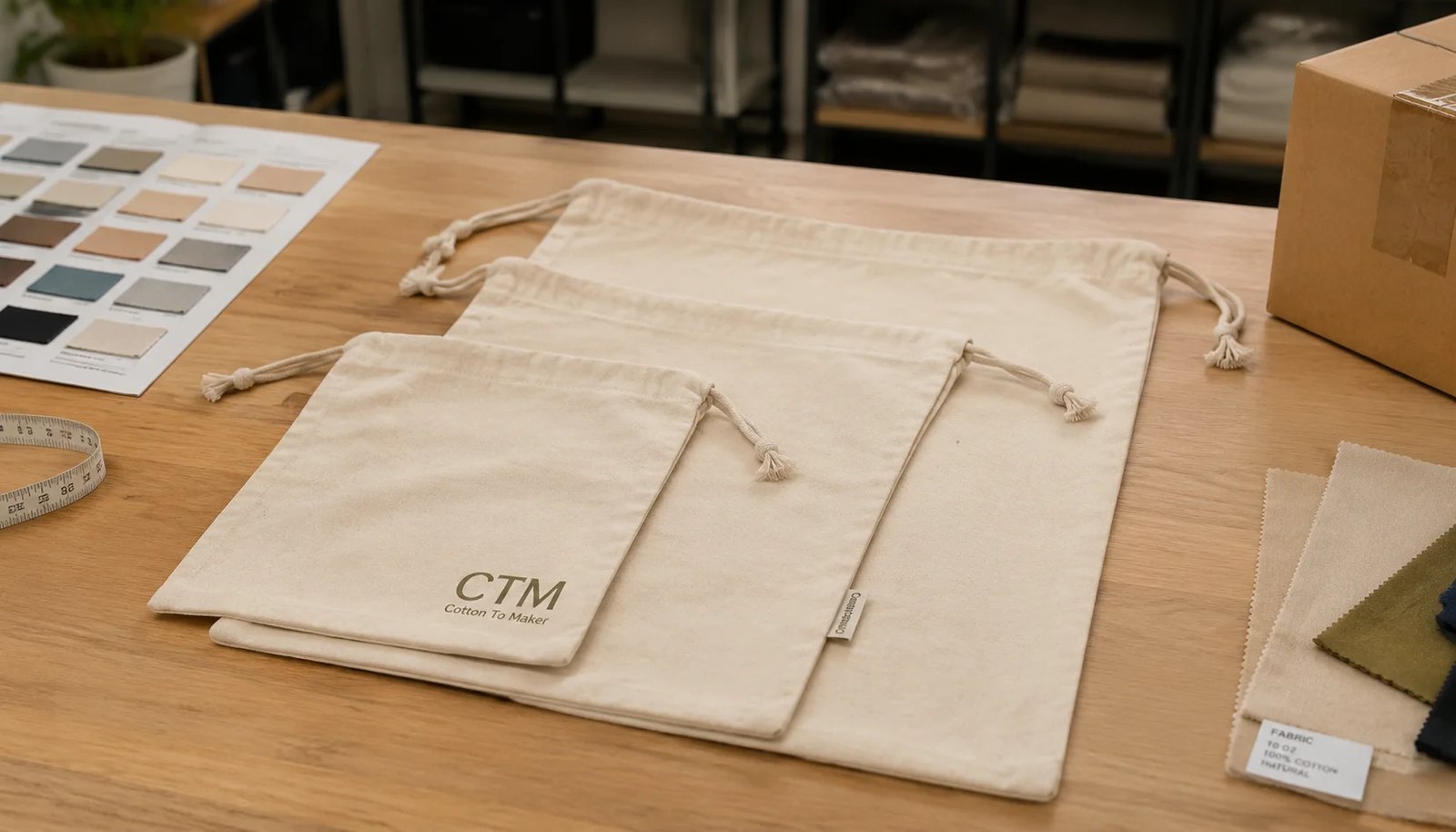
Why MOQ becomes the main cost problem on cotton drawstring pouches
For natural grocers, cotton drawstring pouches often look simple enough to buy as a low-risk accessory. In practice, MOQ becomes the point where many quotes stop being comparable. One supplier may quote based on stock fabric and plain sewing, another on fresh fabric purchase and custom print setup, and a third may hide the real minimum in the sample stage and raise it later. If your team is comparing only unit price, you can end up choosing a quote that works on paper but breaks once exact size, print, and packing are locked.
The reason is straightforward: pouches have a small material cost, but a meaningful share of the factory cost sits in setup, cutting loss, print screens, labor handling, and packing. When volume is low, those fixed costs are spread across too few units. Good MOQ negotiation is not about pushing a factory to accept an unrealistic quantity. It is about removing unnecessary variations so your order fits the way the factory plans material and labor.
- MOQ pressure usually comes from fabric purchase minimums, print setup, and labor inefficiency on small runs.
- A custom size plus custom print plus retail-ready packing creates three separate MOQ triggers.
- Negotiation works better when you simplify the build, not only when you request a lower quantity.
Start with the pouch spec that factories can actually quote correctly
A workable RFQ for drawstring pouches needs more than a rough size and logo file. Factories need the finished width and height, the fabric target, drawstring material, hem style, print method, packing plan, and shipment destination. Without these details, one supplier may quote 140 GSM cotton, another 170 GSM, and another a thinner fabric that looks acceptable in sample photos but feels weak in hand. That makes the MOQ discussion meaningless because the products are no longer comparable.
For most natural grocer programs, 140 to 170 GSM cotton is the practical range. Around 140 GSM works for lighter gift pouches, herbs, tea accessories, and promotional reuse. Around 155 to 170 GSM gives a firmer body for premium food-adjacent presentation or products that need better opacity. Below that range, print quality and shape retention can suffer. Above it, the pouch starts carrying extra material cost and freight weight without always improving the retail result.
- Usable spec line example: natural cotton, 155 GSM, finished size 15 x 20 cm, cotton drawcord, one-color screen print on front, bulk packed by 100 pcs.
- State whether dimensions are measured flat and whether seam allowance is included in finished size.
- If pouches will hold a fixed product, give internal fit requirement, not only outside dimensions.
How fabric weight and construction change MOQ logic
Fabric is where many small buyers lose leverage. If your order can run on a factory’s regular greige cotton stock, MOQ often becomes easier because the supplier is not forced to buy a fresh mill lot just for your pouch. That is one reason natural unbleached cotton is common in grocer-related packaging programs. It matches the brand look and may align better with stockable fabric. But stock availability should never be assumed. The exact weave, yarn thickness, and hand feel can still vary between factories.
When you specify a non-standard weight or a dyed fabric, the factory may need to book fabric specifically for your order. That shifts the MOQ upward or increases waste absorption in the quote. A practical negotiation move is to align your desired hand feel with a commonly used mill construction. In many cases, choosing 145 to 160 GSM natural cotton instead of a highly specific custom target keeps more suppliers in play and reduces the chance of a fabric-related surcharge on smaller runs.
- 140 to 150 GSM: lighter hand, lower fabric cost, suitable for simpler one-color printing and smaller items.
- 155 to 170 GSM: more structured feel, better opacity, usually preferred for premium-looking reusable pouches.
- Dyed fabric, brushed finish, or unusual weave can trigger separate MOQ from the mill even if the pouch quantity looks reasonable.
Print decisions that either protect or destroy your low-volume quote
On low to medium volume pouch orders, print complexity is often the fastest way to lose MOQ flexibility. One-color screen printing on one panel remains the most negotiation-friendly route because setup is simple, print speed is stable, and defects are easier to control. If your artwork has thin lines, tonal gradients, or multiple colors, the factory may shift to more screens, more alignment work, and more rejects. At that point, a supplier who looked competitive on base price may either increase MOQ or quietly accept the order and recover cost through looser quality.
Natural cotton also affects artwork appearance. The background is not bright white, so printed colors can read warmer or less crisp than on bleached fabric. If the brand team expects exact PMS matching on unbleached cotton at a small order quantity, there may be a gap between expectation and factory reality. For grocer programs, it is usually safer to define acceptable visual outcome rather than demand hard color precision that the order volume does not justify.
- Lowest-risk print route near MOQ: one-color screen print, one side, medium-sized logo area.
- Water-based inks often suit natural cotton appearance, but coverage depends on fabric texture and artwork shape.
- If logo detail is fine, request a print readability sample at actual size before PO approval.
MOQ negotiation methods that work without creating hidden factory pushback
The best MOQ negotiation tactic is SKU consolidation. Instead of forcing a supplier down on one highly customized item, keep the same fabric, same print color, same cord, and same packing method, then divide volume across two or three pouch sizes. This can allow the factory to buy one bulk fabric lot and one print setup logic while still giving the buyer an assortment. You are not really lowering production complexity; you are organizing the order so the factory can process it efficiently.
Another useful method is to separate what must be custom from what can stay standard. If the pouch size is non-negotiable because of product fit, keep print simple. If the logo treatment matters more than exact dimensions, choose a standard factory size. Trying to customize all variables at once is where small and mid-sized grocer programs lose price discipline. A factory may agree initially, but later extend lead time, reduce consistency, or limit remake support because the order economics were weak from the start.
- Best combination play: same fabric + same print color + same cord + 2 to 3 sizes.
- If order volume is borderline, choose either custom size or custom packing, not both.
- Some factories will combine MOQ across SKUs only if the artwork placement and print area stay the same.
What sample approvals should cover before you release a pouch PO
A buyer should not approve a cotton pouch from artwork only. The pre-production sample has to prove fabric hand feel, true finished size, drawcord function, seam quality, and print appearance on the actual fabric type. A photo sample made from similar cloth is useful early, but it should not become the production standard. That shortcut is one of the main causes of disputes over pouch stiffness, logo sharpness, and size loss after sewing.
For natural grocers, visual expectations are often understated but strict. Buyers may tolerate natural flecks in the cotton, but not weak stitching or badly centered logos. Sample comments should therefore be measurable. Instead of writing make logo a bit lower, give a target such as print centered horizontally, top of logo 5 cm below channel seam, tolerance plus or minus 3 mm. The more objective the approval record, the less room there is for avoidable quality debate later.
- Sample should show actual fabric weight or a clearly stated substitute if bulk fabric is not yet booked.
- Open and close the drawcord several times to test smooth movement and knot security.
- Take flat measurements from the same reference points the factory will use during final inspection.
Packing choices that change cost faster than many buyers expect
Packing is often treated as an afterthought on pouches because the item itself is soft and compact. But the labor difference between bulk export packing and retail-ready unit packing is large enough to affect both quote and MOQ. If the order ships to one distribution center and the buyer can sort locally, bulk packing by size is usually the cleanest cost structure. If each pouch needs an individual polybag, barcode sticker, insert card, or mixed-store assortment, labor goes up and the supplier may require a larger run to justify the handling complexity.
Carton planning matters too. Cotton pouches compress well, so factories can fit high piece counts into cartons, but over-compression may crease prints or distort the top channel. For grocer buyers, the right question is not only how many pieces fit per carton, but whether the packing protects print appearance and supports receiving efficiency. A slightly lower carton fill can be worthwhile if it avoids product rework at the importer warehouse.
- Cost-efficient route: bulk pack by size, counted bundles, standard export carton labels.
- Retail-ready route may include individual bagging, stickers, inserts, assortments, and shelf-ready labeling.
- Request both carton dimensions and gross weight so inbound handling and freight estimates are realistic.
Lead time risk: where pouch orders slip and how to read the schedule
Simple sewn products can still miss shipment windows when buyers underestimate pre-production steps. On cotton drawstring pouches, the common delay points are fabric booking, print approval, remake of pre-production sample, and packaging material readiness. If you need custom labels, printed insert cards, or specific carton marks approved by a retailer, those inputs can become the real critical path rather than the sewing itself.
A realistic production schedule should separate sample time from bulk time. For example, a supplier may need several days for sample preparation, then additional time after approval for fabric allocation, cutting, printing, sewing, packing, and final inspection. If a factory quotes one combined lead time without these stages, the number is hard to manage and easy to miss. Buyers should compare schedules stage by stage, not only as a single total number.
- Lead time usually changes when fabric is stock-held versus newly booked.
- Custom print and custom retail packing add more risk than plain sewing alone.
- A stage breakdown gives better control: sample approval, material readiness, production, packing, inspection.
How to compare quotes when suppliers use different assumptions
Quote comparison only works when assumptions are normalized. A pouch price can differ because one factory included thicker cotton, a denser drawcord, tighter print tolerance, individual packing, or lower carton counts. Another may offer a lower unit price but with thinner fabric, wider tolerances, or no pre-production sample. Procurement teams should convert each quote into a common view: fabric GSM, pouch size, print method, print colors, packing method, MOQ basis, sample charge policy, and lead time stages.
It also helps to evaluate cost movement by scenario instead of forcing a single best price. Ask each supplier to quote three versions: plain pouch, one-color printed pouch, and printed pouch with retail-ready packing. This reveals where their cost structure is strongest. Some factories are efficient at plain sewing but expensive in hand packing. Others can absorb print setup well but become costly when multiple sizes are introduced. That pattern is more useful than a standalone FOB number.
- Normalize by exact GSM, exact size, exact print count, exact packing, and exact MOQ basis.
- Separate sample charges, tooling or screen charges, and carton-related costs from unit price if possible.
- A quote that is slightly higher but clearer can be safer than the lowest quote built on vague assumptions.
Acceptance criteria that prevent the most common pouch disputes
Cotton drawstring pouches do not need a complex testing protocol, but they do need written acceptance criteria. Most disputes happen around finished dimensions, print placement, fabric appearance, and cord function. On natural cotton, buyers should explicitly approve the base look, including that the fabric is not bright white and may show natural specking. If that is not written into the approval, a supplier may claim the bulk matched normal natural cotton while the buyer expected a cleaner bleached appearance.
For functional quality, the pouch should open and close smoothly, seams should not unravel at stress points, and print should not appear badly offset from the approved sample. Tolerances should reflect product size. Very small pouches need tighter visual consistency because a few millimeters of shift is more obvious. Larger gift pouches can usually absorb a little more sewing variation without affecting use.
- Define measurement method and tolerance by size group.
- Define acceptable print placement tolerance from top seam and side edges.
- Record whether natural color variation is acceptable and whether seed specks are expected.
- Set packing accuracy standard by bundle and carton to avoid downstream recounting.
Specification comparison for buyers
| Spec decision | Recommended option | When it fits | Buyer risk to check |
|---|---|---|---|
| Sourcing route for plain stock pouches | Factory-held greige cotton in standard sizes with no print | Best for urgent replenishment, promo packing, or low-complexity store programs | Standard stock may vary slightly in shade, hand feel, and drawcord thickness between production lots |
| Sourcing route for custom size pouches | Made-to-order factory production using one agreed finished size and tolerance | Best when grocer display bins, soap bars, tea packs, or gift sets need exact fit | Low MOQ requests on custom sizes often raise unit cost because cutting loss and setup are spread over fewer units |
| Fabric weight selection | 4 oz to 5 oz cotton, about 140 to 170 GSM, for most grocery pouch programs | Suitable for dry goods accessories, herb packs, gifting, and reusable produce-related merchandising | Too-light fabric can distort after printing; too-heavy fabric may push MOQ and freight higher without adding buyer value |
| Print route for logo application | One-color screen print on one panel | Best balance for store-brand logos, event campaigns, and natural product packaging inserts | Very small orders with custom print can fail registration expectations if artwork includes thin lines or halftones |
| Natural vs bleached fabric base | Natural unbleached cotton for earthy retail presentation | Fits natural grocers, zero-waste sections, and brands wanting a less processed look | Natural fabric shade is not paper-white and can show seed specks; buyer must approve this appearance in pre-production sample |
| MOQ negotiation method | Keep one fabric, one color, one print position, and split quantities across 2 to 3 sizes | Useful when stores want assortment but total order volume is enough to support one bulk fabric purchase | If each size also has different artwork or different cord color, the supplier may treat them as separate MOQs |
| Packing route | Bulk pack by size in export cartons with inner poly by bundle only if needed | Good for distributors and importers repacking locally or shipping to one DC | Retail-ready individual polybagging increases labor, material use, carton volume, and often minimum order requirements |
| Sampling route before PO | One digital layout approval plus one physical pre-production sample from bulk-like fabric | Best for custom-printed pouch programs where color, seam finish, and drawcord function matter | Approving only artwork without a sewn sample can lead to finished size disputes, weak cord channels, or unexpected print placement |
Buyer checklist before sampling
- Define the finished pouch size in width x height, and state whether measurements are taken flat before or after drawstring closure allowance.
- State the target fabric weight in GSM or oz, such as 140 GSM, 155 GSM, or 170 GSM, rather than writing only medium cotton.
- Specify whether natural cotton shade variation and small seed specks are acceptable for unbleached fabric.
- Limit artwork complexity if the order volume is near MOQ; one-color screen print is usually the cleanest low-risk option.
- Clarify if MOQ can be combined across sizes using the same fabric, cord, and print color.
- Approve drawcord material and thickness, especially if the pouch will be opened frequently in retail handling.
- Set finished size tolerance and seam tolerance in writing, for example plus or minus 0.5 cm for small pouches and 1 cm for larger sizes.
- Decide early whether packing is bulk, bundle-packed, or individual retail packed, because this changes labor and carton count.
- Request a pre-production sample made from production-grade fabric, not only a photo sample made from substitute stock.
- Include carton marks, assortment rules, and destination labeling in the RFQ so suppliers do not quote different packing assumptions.
Factory quote questions to send
- What is your MOQ by fabric, by size, and by print setup, and which parts of the MOQ can be combined across SKUs?
- Which cotton fabric do you recommend for this pouch use case, and what is the actual tested GSM tolerance on bulk fabric?
- Is the quote based on natural unbleached cotton, bleached cotton, or dyed fabric, and what shade variation should we expect?
- What print method is included in the quote, how many colors, on how many sides, and what artwork limitations apply?
- Does your unit price include drawcord insertion, knotting, trimming, and top channel stitching, or are any of these treated as add-on labor?
- What finished size tolerance and print position tolerance do you control in bulk production?
- Can you provide a pre-production sample using bulk-like fabric and production print method before mass production starts?
- How is the order packed per inner bundle and per export carton, and what carton dimensions and gross weight are you quoting against?
- What is the estimated lead time for sample, bulk fabric booking, printing, sewing, packing, and final inspection?
- Which quote items change if we move from one size to two sizes, or from plain pouch to one-color logo print?
Quality-control points to confirm
- Fabric GSM should remain within the agreed tolerance range and match the approved hand feel and visual weave density.
- Finished width and height must meet agreed tolerances when measured flat, excluding acceptable drawstring gathering.
- Drawcord channel stitching should be even with no skipped stitches, broken threads, or trapped cord sections.
- Cord movement should be smooth across the full channel with secure end knots and no fraying at cut ends.
- Print placement should match approved location tolerance and avoid obvious skewing relative to the pouch centerline.
- Screen print coverage should be solid enough for the approved artwork, with no major pinholes, smudging, or ghosting.
- Natural cotton fabric appearance should match approved expectation for color tone and seed speck visibility.
- Seam strength should be suitable for intended use, especially at the lower corners and side seam start-stop points.
- Packing counts by size and bundle must match carton assortment list exactly to avoid receiving errors at distribution centers.
- Carton labels, PO number, SKU references, and country-of-origin markings should be verified before shipment release.