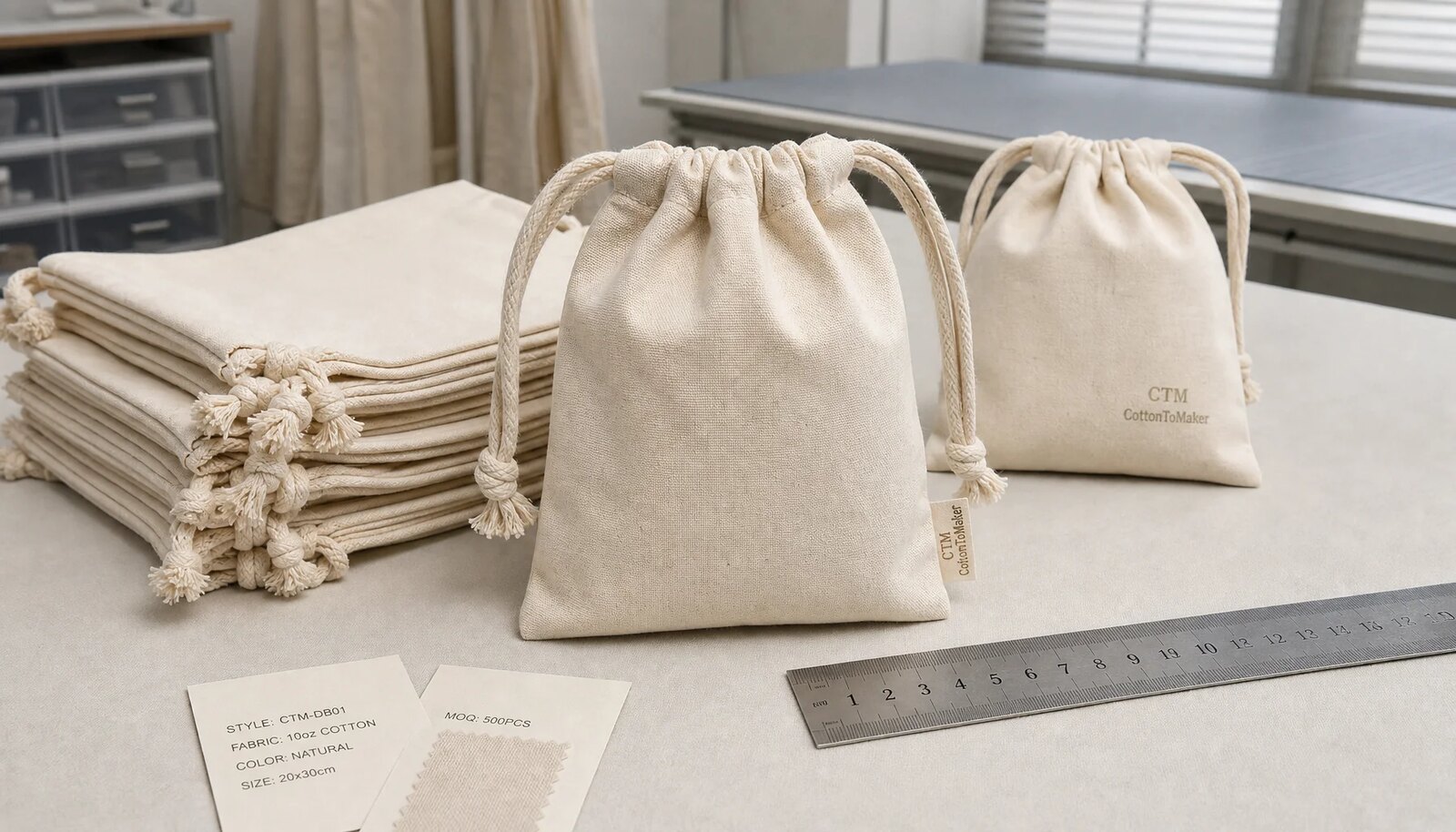
Start With the Buying Problem, Not the MOQ Number
For cotton drawstring pouches, MOQ negotiation usually goes wrong when the buyer starts with a target quantity instead of the real constraint. Factories do not set MOQ only because they want a larger order. They set it because every pouch run carries setup work in fabric sourcing, cutting, sewing, drawcord insertion, print setup, packing, and carton consolidation. If the buyer changes the size, artwork, cord color, and label format all at once, the factory cannot recover that setup cost on a tiny run. The practical move is to decide which spec item is negotiable and which one is fixed for the launch.
If you treat the pouch like a simple giveaway item, you will miss the cost drivers that matter. A natural cotton pouch with a standard size and one-color print is a very different order from a retail-ready pouch with custom dimensions, a branded woven label, and individual polybags. The first can often fit a lower MOQ because the factory can use existing material and repeat cutting patterns. The second needs dedicated materials and more line control. Good negotiation starts with identifying which version of the product you are actually buying.
- Separate the commercial target from the production spec.
- Standardize the size before you push for a lower MOQ.
- Keep one or two variables fixed so the supplier can see a realistic path to pricing.
Choose the Spec That Gives You Negotiation Room
The easiest way to reduce MOQ pressure is to simplify the pouch itself. Cotton fabric around 110 to 140 GSM is common for light promotional use, while 140 to 180 GSM is more suitable for retail, gifting, or heavier inserts. If the pouch needs to hold cosmetics, jewelry, candles, or small accessories, the buyer should specify the loading requirement before settling on GSM. A thinner fabric may quote cheaper, but if the product looks limp or tears at the seam, you lose the negotiation later when returns or repacking start. The same logic applies to the drawcord: a basic cotton cord is easier to source than a dyed or branded cord, and a standard natural color is easier to keep in stock.
Print method also changes the MOQ conversation. Screen print is usually the most predictable for simple logos and one or two colors, but it needs screen setup and is most efficient on larger quantities. Heat transfer or digital print can help when artwork is detailed or the run is small, but you should expect different wear performance and a different unit-cost curve. If the pouch will be packed with a gift set, a small label or woven tag can be cleaner than large-area print. Buyers should decide whether the logo is doing branding work, compliance work, or both, because the answer changes what the factory should quote.
- Use 110-140 GSM for light promotional use and 140-180 GSM when the pouch needs stronger hand feel or retail value.
- Keep artwork simple if the order is small and you want the factory to hold the MOQ down.
- Avoid multiple cord colors or multiple print positions on the first order unless they are commercially necessary.
How Factories Calculate MOQ and Where Flexibility Exists
Most factories do not calculate MOQ from one variable. They look at fabric purchase minimums, cutting efficiency, print setup, sewing line changeover, and packing labor. A factory may accept 500 pieces on paper, but if the fabric mill only sells by roll and the run wastes half a roll in offcuts, the real commercial MOQ is higher than the sales team admits. This is why one supplier may say 300 pieces is possible and another insists on 1,000. They are not necessarily contradicting each other. They are running different material sources, line layouts, and internal overhead assumptions.
The negotiation leverage is usually in standardization. If you accept the supplier's standard cotton color, standard cord type, and one print color, the factory can often reduce setup waste and give you a lower MOQ. If you need custom dyeing, special packaging, or multiple labels, the MOQ should rise. That is normal. The mistake is asking for a lower quantity while also asking the factory to absorb every customization. Buyers get better responses when they trade complexity for flexibility: one standard pouch spec in exchange for a lower order floor, then a second custom version once the first run proves demand.
- Ask what part of the MOQ comes from fabric roll minimums, screen setup, or sewing line changeover.
- Negotiate the volume break against a standard spec, not against a moving spec.
- If the supplier offers a lower MOQ, verify whether the price rises sharply or whether quality is being relaxed.
Compare Sourcing Routes Before You Push Back on Price
The cheapest quote is not always the cheapest route. A direct factory gives the best control over sewing, print, and packing, but it may demand a higher MOQ and slower response time. A trading company can sometimes secure smaller quantities because it aggregates orders, but the buyer must be careful about hidden markups and unclear subcontracting. A domestic decorator can turn small numbers quickly, which is useful for event deadlines, but it usually loses on unit cost and standardization. The right sourcing route depends on whether you are buying a one-time event pouch or trying to build a repeatable supply chain for retail or promotional programs.
For procurement teams, the comparison should focus on what the route protects and what it hides. If the factory controls the full process, your biggest risk is lead time and capacity. If a trading company is involved, the biggest risk is losing visibility on who actually makes the pouch. If a local printer is involved, the risk shifts to material inconsistency and higher landed cost. The table below is useful because it turns the decision into a practical sourcing question instead of a vague preference for 'better pricing'.
- Direct factories are best when the spec is stable and the order can repeat.
- Trading companies are useful when you need one buying point, but they require stronger document control.
- Domestic decorators work for short deadlines, not for building a low-cost repeated supply plan.
Read the Quote Like a Buyer, Not a Gift Shopper
A usable quote for cotton drawstring pouches should break down the variables that actually drive the final number. The buyer needs to see the fabric weight, pouch size, print method, artwork count, packing format, and the quantity break at each tier. If the quote only shows one unit price, it is hard to judge whether the supplier is competitive or simply hiding setup charges elsewhere. A good quote should also state what happens when the order changes by a small amount. If you need 2,800 pieces instead of 3,000, does the factory re-rate the whole order or only the extra 200 pieces? That answer matters more than a broad sales promise.
Ask the supplier to quote the same spec at several quantities, not different specs at each quantity. A buyer cannot compare a 1,000-piece quote on 110 GSM natural cotton with a 5,000-piece quote on 140 GSM dyed cotton and call that a valid price break. The quote should also separate one-time charges from reusable charges. Screens, plates, woven labels, and artwork setups should appear as line items so the team can judge whether the first order is expensive because of tooling or because the production price is truly high.
- Request quantity tiers at the same construction so the pricing curve is real.
- Make sure the quote separates one-time tooling from recurring unit cost.
- Include packing, labels, and carton markings in the same document so the landed cost is visible.
Samples Should Prove Production, Not Just Design
For low-MOQ negotiations, the sample process is where many orders either become safe or become expensive later. A flat artwork proof only tells you whether the logo sits in the right place. It does not tell you whether the pouch will hold its shape, whether the drawcord slides cleanly, or whether the print becomes uneven on the real fabric. A better sample is a sewn pre-production sample made with the same fabric weight, the same cord, and the same closure method planned for bulk. If the factory cannot make that sample, the buyer should understand that the final order may vary in construction.
Sample approval should be treated like a production control step. Measure the finished size, pull the drawcord repeatedly, inspect seam strength, and check the print edge under normal light. If the pouch is for retail, confirm whether the sample carries the same label placement and packing format planned for shipment. For event programs, test whether the pouch opens and closes easily when loaded with the actual giveaway or product insert. The point is not to approve a beautiful sample. The point is to approve the exact risk profile that will matter when 3,000 identical pieces leave the factory.
- Approve a sewn sample with the same fabric, cord, and print method as bulk.
- Measure size, inspect seams, and test drawcord movement under real use.
- If the order is retail-facing, review label placement and carton packing during sample approval.
Packing Details Can Quietly Raise or Lower MOQ
Packing is often treated as an afterthought, but it can change the negotiation outcome. If the buyer wants individual polybags, barcode stickers, insert cards, and retail-ready carton marks, the supplier has to add labor and materials to a line item that was otherwise simple. That may not increase the nominal MOQ, but it will increase the commercial threshold where the supplier is willing to move. For very small runs, bulk packing without individual bags may be the only way to keep the offer realistic. For retail or distribution customers, however, the packing spec is not optional because warehouse intake depends on it.
A practical packing instruction should name the number of pieces per inner bag, the carton quantity, carton dimensions, and any moisture protection required for sea freight. Cotton pouches are not fragile, but they can still pick up dust, moisture, or label damage if packing is loose. If the goods will travel long distance, ask for carton reinforcement and clear master carton marks. It is easier to negotiate a lower MOQ when the packing path is simple, because the factory can move the goods through fewer labor steps and less packaging inventory.
- Bulk packing is usually the easiest way to reduce cost on first orders.
- Retail-ready packing should be specified in writing before the factory prices the job.
- Carton count and carton size matter for freight cost and warehouse receiving.
Lead Time Risk Often Matters More Than the Unit Price
The cheapest quote is not a win if the delivery window is too loose. Cotton drawstring pouch lead time is usually driven by material availability, print queue position, sewing capacity, and packing backlog. A factory that can sew quickly may still be slow if the cotton fabric must be dyed or if the print shop is booked. Buyers should ask for the production clock to start from a specific event, usually sample approval plus deposit, not from the day the quote is issued. That avoids a false sense of speed in the sales conversation.
Lead time becomes a bargaining tool when the buyer can trade flexibility for a lower MOQ. If you can accept a standard fabric color, a simple one-color print, and bulk packing only, the factory may move the order earlier in the queue or accept a smaller order. If the event date is fixed, the buyer should build a buffer for artwork approval, sample revisions, and freight booking. A late color decision can destroy any MOQ gain because the supplier then has to restart the print or cutting schedule. In sourcing terms, time is part of the order quantity.
- Start the lead-time clock from sample approval and deposit, not from the initial quote date.
- Treat artwork revision as a schedule risk, not a minor admin step.
- Use standard materials if you need the factory to commit to a shorter production window.
A Practical Negotiation Sequence That Works
The best negotiation sequence is simple: lock the spec, get tiered quotes, narrow the supply route, and only then push on MOQ. Start by sending one clean RFQ with the finished size, GSM, print method, packing spec, and target delivery date. Ask for three quantity tiers on the same spec and request separate line items for setup fees. Once you receive the quote, identify which variables are driving the MOQ. If the factory says the lower quantity is possible only by using a standard pouch size or one print color, decide whether that trade is acceptable. This is much better than asking for a discount without changing any commercial assumption.
If the supplier still holds a hard floor, use trade-offs instead of pressure. Offer a repeat order forecast, accept bulk packing, reduce the number of artwork colors, or agree to the factory's standard cord and fabric color. If the business really needs a smaller first run, pay for the setup work and negotiate the second order as the reward for performance. That is often the most realistic path because factories care about future throughput, not only today's ticket. Buyers who speak in production terms usually get better MOQ flexibility than buyers who only ask for a lower number.
- Send one RFQ with one spec and three quantity tiers.
- Trade complexity for flexibility instead of asking for a lower number in isolation.
- Use a second-order forecast as leverage if the first order must stay small.
Specification comparison for buyers
| Spec decision | Recommended option | When it fits | Buyer risk to check |
|---|---|---|---|
| Direct factory vs trading company | Direct cut-and-sew factory with in-house printing | Repeat orders, clear artwork, and a stable forecast | Confirm they are not silently subcontracting the sewing or print step |
| Domestic printer vs offshore factory | Domestic printer for urgent launch runs | Tight event deadlines or a small first buy | Unit cost is usually higher and fabric choices are narrower |
| Stock pouch + print vs fully custom | Stock natural cotton pouch with overprint | You need speed and can accept standard sizes | Fabric weight, drawcord quality, and seam finish may be lower than a bespoke run |
| Fully custom sewing vs stock inventory | Custom size, custom label, and custom cord spec | Retail packaging, branded kits, or long-term repeat orders | MOQ rises because cutting, sewing, and finishing each need setup time |
| Recycled or certified cotton route | Specialist supplier with traceable material paperwork | When sustainability claims appear on the pack or product page | Verify whether the claim covers the pouch fabric only or the full finished article |
| Packaging-inclusive supplier | Factory that also handles polybags, barcodes, and carton marks | Retail distribution, DC receiving, or marketplace prep | Packaging errors can delay warehouse intake and increase rework cost |
| Multi-item promotional vendor | Use only when pouches are one line in a larger event kit | Single PO convenience matters more than textile depth | Textile QC is often weaker and margin is hidden inside other line items |
| Sample shop vs production factory | Use a low-MOQ sample shop for prototype approval, then move to the real factory | Artwork testing or a first market test | The sample can look better than mass production if the supply chain changes later |
Buyer checklist before sampling
- Lock the finished size, fabric weight, and cord style before asking for prices.
- Separate print cost from sewing cost so the quote shows where the MOQ pressure comes from.
- Ask for quantity breaks at the same construction, not a different spec that makes the comparison useless.
- Request a sewn pre-production sample, not only a flat print proof.
- Confirm whether the price includes carton packing, inner polybags, and barcode labels.
- State your acceptable size tolerance and print placement tolerance in writing.
- Ask for the actual bulk lead time from sample approval and deposit, not the sales estimate from today.
- Check whether the supplier can hold the same cotton shade and GSM across repeat orders.
- Verify carton count, carton dimensions, and gross weight if the goods will ship by sea.
- Ask who pays for plates, screens, embroidery programming, or label tooling if the artwork changes.
Factory quote questions to send
- What GSM or ounce weight is being quoted for the cotton fabric, and is it pre-shrunk or raw?
- What is the MOQ by size, by print color count, and by artwork location?
- Does the quoted price include sewing, drawcord insertion, packing, and carton marks?
- What are the price breaks at 1,000, 3,000, and 5,000 pieces, and what changes at each tier?
- Which print method is included: screen print, heat transfer, digital print, embroidery, or woven label?
- What are the sample fee, plate fee, screen fee, and whether any of them are refundable on bulk order?
- What bulk lead time do you commit to after sample approval and deposit, and what can extend it?
- What QC documents can you provide with the shipment: measurements, inline inspection, final inspection, and packing photos?
Quality-control points to confirm
- Fabric weight matches the quoted GSM within an agreed tolerance, with no visible weave inconsistency across the lot.
- Finished width and height stay within the buyer's tolerance, usually tighter on retail bags than on giveaway pouches.
- Drawcord pulls smoothly, knots are secure, and the cord length is consistent from pouch to pouch.
- Stitching is even at the side seams and top hem, with no skipped stitches, loose threads, or open corners.
- Print placement stays within the approved artwork position and does not crack, blur, or ghost after handling.
- If natural cotton is used, shade variation remains within an agreed visual standard and does not create obvious carton-to-carton mismatch.
- Packing count is accurate per inner bag and per carton, with correct carton marks and barcode labels.
- No oil marks, odor, moisture, or cutting dust should be present at packing and final inspection.