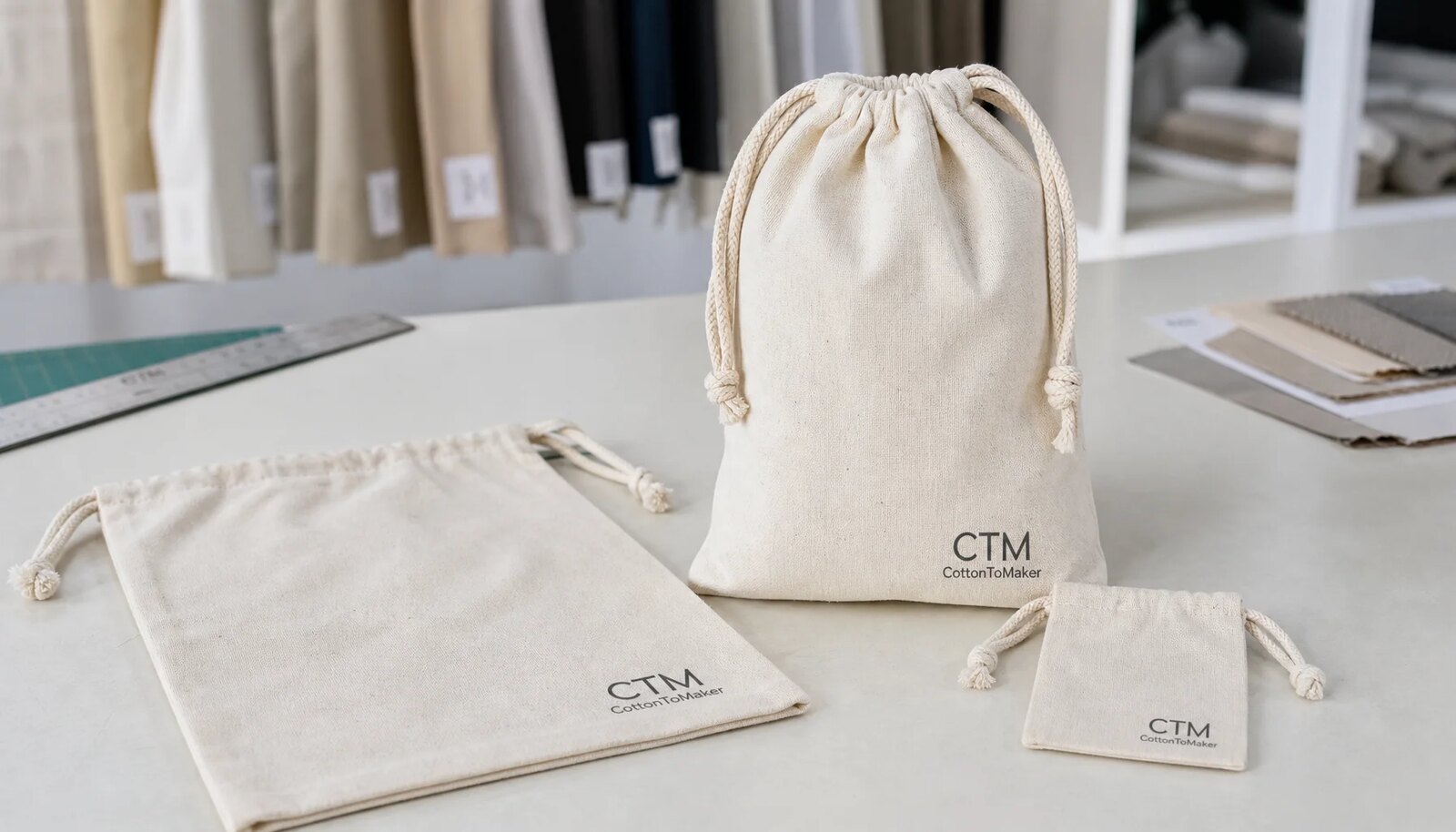
Buying Problem: Logo Placement Changes the Pouch Cost and Reject Rate
For wholesale cotton drawstring pouches for craft fairs, logo placement is not only a design decision. It affects print setup, defect rate, sewing sequence, packing method, and the way the pouch looks when filled on a vendor table. A logo that looks balanced on a flat artwork file can move too high after the drawstring is pulled, or too low after the bottom seam creates thickness under the print screen.
Procurement teams should treat placement as a production specification, not a note in the artwork email. The RFQ should state the finished pouch size, fabric GSM, logo dimensions, distance from seams, print method, and acceptable tolerance. This gives suppliers a measurable target and makes competing quotations easier to compare.
- State placement from the finished top edge, not from the cut panel before sewing.
- Keep logos away from the drawstring channel where fabric gathers during use.
- Use a print-safe rectangle for every pouch size instead of one universal logo position.
- Request a photo of the pouch filled with the buyer’s typical product weight, not only laid flat.
Choose the Pouch Size Before Freezing the Logo Position
Craft fair buyers often order several pouch sizes for different vendors: small jewelry pouches, medium soap pouches, candle dust bags, and larger drawstring gift bags. The same logo artwork cannot be placed at the same absolute distance on every size. A 50 mm wide logo may look clean on a 150 x 200 mm pouch but oversized on a 100 x 140 mm pouch.
A better approach is to define logo size as a percentage of the usable front panel and then set minimum clearances. For small pouches, the logo often works best at 35-45 percent of pouch width. For medium and large pouches, 25-35 percent may look more premium and reduce ink coverage. This also helps avoid a quote gap between suppliers using different print assumptions.
- For jewelry pouches around 80 x 100 mm, avoid tiny text under 2 mm high.
- For soap pouches around 120 x 160 mm, keep the logo below the cord channel but above the product bulge.
- For candle or ceramic pouches, allow more bottom clearance because the filled product stretches the lower panel.
- For mixed craft fair kits, approve each size separately rather than scaling artwork blindly.
Fabric GSM Affects Print Sharpness, Opacity, and Feel
Cotton drawstring pouches are commonly quoted in ounces or GSM. A light 4 oz to 5 oz fabric, roughly 135-170 GSM depending on construction, keeps unit cost lower and suits light packaging. A midweight 6 oz fabric, roughly 200 GSM, gives better opacity and a more stable surface for screen printing. An 8 oz fabric, roughly 270 GSM, feels more reusable but adds material cost, carton weight, and sewing bulk.
The logo placement decision should match the fabric. On thin natural cotton, a large dark logo can show ink strike-through or uneven color where yarn texture varies. On heavier cotton, small details can still print well, but the pouch may not gather as softly at the drawstring. Buyers should not approve artwork on a different GSM than the bulk fabric.
- 4-5 oz cotton: good for low-cost event packaging and lightweight craft goods.
- 6 oz cotton: balanced choice for visible retail presentation and repeat use.
- 8 oz cotton: stronger hand feel for premium sets, heavier contents, or reusable packaging claims.
- Natural cotton: popular for craft fairs but shows seed specks and yarn variation.
- Bleached or dyed cotton: cleaner logo contrast but requires colorfastness and shade control.
Logo Placement Rules That Prevent Common Production Mistakes
The safest front logo area is usually below the drawstring channel and above the bottom seam, with enough side clearance for sewing variation. For many medium cotton pouches, the top of the logo should sit at least 25-35 mm below the finished top edge or 15-25 mm below the drawstring stitch line. The lower edge should normally stay at least 20-30 mm above the bottom seam.
Placement must also consider how the pouch will be presented. If vendors hang pouches from a display hook, the upper panel is more visible. If pouches lie flat on a table, the center-front position is more readable. If the pouch contains a rounded item such as a candle, a low logo may curve around the product and become less legible.
- Avoid printing across side seams, bottom seams, cord holes, or the gathered mouth.
- Use lower-front placement only when the filled product does not distort the logo.
- Use side labels when the front panel needs to remain neutral for multiple craft vendors.
- Require a measured placement diagram with top, side, and bottom distances in millimeters.
- Keep one-color logos simple when printing on textured unbleached cotton.
Print Method Selection: Screen Print, Transfer, Embroidery, or Label
Screen printing is normally the most practical method for wholesale cotton drawstring pouches when the logo uses one to three solid colors. It gives a durable, direct-on-fabric look and scales well when order quantities justify screen setup. It is also easier to inspect because color, position, and edge sharpness can be compared against the approved sample.
Heat transfer is useful for gradients, small multi-color artwork, or artwork that cannot be separated cleanly for screens. The tradeoff is hand feel, edge durability, and heat sensitivity. Embroidery can make a premium pouch, but it adds stitch density, backing, and puckering risk on lighter cotton. Woven side labels are efficient when the same base pouch serves several designs or when buyers want subtle branding.
- Screen print: best for solid logos, repeat orders, and controlled unit cost at volume.
- Heat transfer: useful for complex color but needs wash, rub, and peel testing.
- Embroidery: suitable for small marks on 6 oz or heavier cotton, not large filled logos.
- Woven label: good for clean front panels and multi-brand distributor programs.
- Inside neck label: possible but less visible for craft fair display selling.
MOQ Logic and Cost Drivers Behind the Quote
Many buyers focus on the lowest pouch unit price and miss the cost split behind it. Cotton GSM, pouch size, cord type, logo color count, artwork setup, labor sequence, and packing method all change the quote. A supplier quoting one logo color on 5 oz natural cotton cannot be compared directly with another quoting two-color screen print on 8 oz bleached cotton with individual packing.
MOQ is usually driven by material procurement, dyeing or bleaching, print setup, cutting efficiency, and packing labor. If the program has many small SKUs, the factory may accept the total order quantity but still apply minimums per size, per color, or per logo. Procurement teams should request an MOQ matrix instead of only asking for a general minimum order quantity.
- Lower cost path: one pouch size, natural cotton, one-color screen print, bulk flat packing.
- Higher cost path: multiple sizes, dyed cotton, multi-color logos, individual retail packaging.
- Hidden cost: screen charges repeated for each logo color or placement.
- Hidden cost: extra inspection and sorting when several artwork versions share one shipment.
- Hidden cost: carton volume increases when pouches are packed individually instead of compressed flat.
Sample Approval Should Test the Final Use, Not Only the Logo
A correct sample is more than a pretty print photo. The pre-production sample should use the actual bulk fabric, actual cord, actual print method, final logo size, and intended packing format. If the sample is made from available stock fabric only, the buyer may approve a result that cannot be repeated in bulk.
For craft fair programs, the sample should be tested with the real product or a weight substitute. Put the jewelry box, soap bar, candle jar, small textile item, or stationery set inside the pouch and pull the drawstring closed. The logo may shift visually when the pouch is filled. This is the stage to adjust placement before the factory cuts bulk fabric.
- Measure finished pouch width and height after sewing and pressing.
- Measure logo width, height, and distance from top edge and side seams.
- Rub the printed area with a clean white cloth after curing to check ink transfer.
- Pull the drawstring open and closed at least ten times to check cord movement.
- Pack the sample overnight under light pressure to see whether print marks transfer.
- Photograph the sample flat, filled, closed, and displayed upright.
Quality Control Thresholds for Logo Placement and Sewing
Incoming inspection should separate aesthetic tolerances from functional failures. A logo that is 2 mm off-center on a small cotton pouch may be acceptable if it is still visually balanced. A logo printed into the drawstring channel, across a seam, or with clear ink bleeding should be treated as a major defect because it affects retail presentation.
Sewing and drawstring performance are just as important. Loose threads, broken stitches, uneven cord length, blocked cord channel, fabric stains, and poor closing action will create complaints at craft fairs even if the logo is correct. A basic AQL inspection plan should list major and minor defects in advance so the supplier understands how the shipment will be judged.
- Logo position: set plus or minus 3 mm for small pouches or plus or minus 5 mm for larger pouches when feasible.
- Logo color: compare under consistent lighting against the approved physical sample or Pantone target.
- Print adhesion: no peeling, tackiness, heavy cracking, or ink transfer after curing.
- Fabric surface: no obvious oil stains, dark contamination, holes, or heavy slubs on the front panel.
- Drawstring function: pouch must open and close smoothly without trapped cord or skipped stitches.
- Carton count: verify quantity by SKU and logo version before sealing shipment.
Packing and Carton Planning for Craft Fair Distribution
Packing decisions affect warehouse handling and landed cost. Flat bulk packing is efficient for low-cost craft fair packaging because it reduces carton volume. Inner polybags or paper bands by SKU help receiving teams count and distribute pouches without opening every bundle. Individual packing looks cleaner but increases labor, plastic use, carton volume, and unpacking time.
The packing specification should match the sales channel. A distributor shipping to many craft vendors may need 50 or 100 pouches per inner bundle with clear SKU labels. A retail buyer building gift kits may need smaller bundles by color or logo. Carton marks should include PO number, item code, pouch size, logo version, quantity, gross weight, net weight, and carton number.
- Use flat packing when warehouse efficiency and freight volume matter most.
- Use inner bundles when multiple pouch sizes or logo versions ship together.
- Use individual packing only when the pouch itself is sold as a retail unit or gift component.
- Avoid random mixed cartons unless the receiving warehouse specifically requests them.
- Request carton dimensions and weights before shipment booking to estimate freight accurately.
Lead Time, Schedule Risk, and Reorder Control
A realistic timeline includes artwork review, sample making, sample courier time, sample revision, bulk fabric preparation, cutting, printing, curing, sewing, trimming, QC, packing, and export documentation. The schedule becomes risky when the buyer approves artwork late, changes the logo size after sample approval, adds pouch sizes, or requests dyed cotton without allowing shade approval time.
For reorders, the biggest risk is assuming the previous sample will be matched automatically. Cotton fabric shade, yarn texture, ink batch, cord color, and sewing tolerance can vary between lots. Keep a sealed approved sample and require the factory to compare the new bulk production against it before final packing. Reorder RFQs should include the old PO number, sample reference, artwork file, and any approved deviations.
- Allow separate time for artwork proofing and physical sample approval.
- Freeze logo placement before bulk cutting to avoid material waste and schedule delay.
- Confirm whether the print shop and sewing line are in-house or subcontracted.
- Hold a production slot only after deposit, artwork, and final sample approval are aligned.
- For urgent craft fair deadlines, reduce SKU complexity before trying to compress production.
Specification comparison for buyers
| Spec decision | Recommended option | When it fits | Buyer risk to check |
|---|---|---|---|
| Front-center logo placement | Keep artwork centered 25-35 mm below the drawstring channel and inside a safe print area | Best for craft fair retail pouches where the pouch is displayed upright or hung from a peg | Logo can distort if placed too close to the gathered top or cord opening |
| Lower-front logo placement | Place small logos 20-30 mm above the bottom seam with at least 15 mm side clearance | Works for premium handmade goods, soap, jewelry, candles, and small gift sets | Bottom seam thickness can affect print pressure if the logo is too low |
| Side label branding | Use a woven cotton side label sewn into the side seam or near the drawstring channel | Useful when the front panel must stay clean for product labeling or artisan tags | Label MOQ, label lead time, and sewing position tolerance must be quoted separately |
| Fabric weight | Use 5 oz/170 GSM to 8 oz/270 GSM cotton depending on product weight and opacity needs | 5 oz fits light craft packaging; 8 oz fits reusable retail pouches and heavier items | Thin fabric can show contents and may not hold sharp logo edges after washing |
| Print method | Use screen print for simple solid logos; heat transfer for gradients; embroidery only for small premium marks | Screen print is most efficient for bulk craft fair programs with 1-3 colors | Fine lines, small text, and large ink coverage need sample testing before bulk approval |
| MOQ logic | Consolidate pouch size, fabric, cord, and logo colors to reduce setup cost per unit | Best when distributors serve multiple craft vendors under one pouch program | Many small size/color splits can push the real MOQ higher than the headline MOQ |
| Packing format | Pack flat in export cartons with inner polybags or paper bands by size and logo variant | Fits retail replenishment, craft fair kits, and warehouse picking by SKU | Random mixed packing creates receiving delays and makes logo defects harder to isolate |
| Supplier evidence | Request actual production photos, print test results, tolerance sheet, and carton packing sample | Needed for importers comparing factories rather than trading only on unit price | Low quotes may exclude artwork setup, sample remake cost, carton marks, or inspection support |
Buyer checklist before sampling
- Define pouch use: jewelry, soaps, candles, stationery, small apparel accessories, or mixed craft fair kits.
- List finished size, fabric GSM, cotton color, cord type, seam style, logo size, logo color, and placement in the RFQ.
- Set a print-safe area that avoids the drawstring channel, side seams, bottom seam, and heavy gathered fabric.
- Approve one pre-production sample per size and per print method before releasing bulk fabric cutting.
- Check logo position tolerance in millimeters, not only by visual approval photos.
- Confirm whether the quote includes artwork setup, screens, digital proofing, sample freight, export cartons, and carton marks.
- Require carton packing by SKU, pouch size, logo variant, and purchase order line.
- Keep one approved sealed sample for factory production control and one for incoming inspection at destination.
Factory quote questions to send
- What finished size tolerance do you apply for this pouch size after sewing and pressing?
- What GSM and cotton construction are you quoting, and is it natural, bleached, dyed, or organic cotton?
- What is the maximum printable logo size for the selected pouch without distortion near seams or the drawstring channel?
- Which print method do you recommend for our artwork, and what line thickness or text height is unsafe?
- Are screen charges, artwork handling, sample cost, and sample courier cost included or listed separately?
- What MOQ applies per pouch size, per cotton color, per logo color, and per print placement?
- Can you provide a pre-production sample using the actual bulk fabric, cord, print ink, and packing method?
- What inspection standard do you use for logo position, print color, stains, loose threads, drawstring function, and carton packing?
- How many days are needed for sample making, sample revision, bulk production, packing, and export document preparation?
- What carton dimensions, gross weight, net weight, and units per carton should we use for freight estimation?
Quality-control points to confirm
- Logo center deviation should normally stay within plus or minus 3 mm for small pouches and plus or minus 5 mm for larger pouches, unless a tighter tolerance is agreed.
- Print edges should be clean with no visible ink bleeding, pinholes, ghosting, peeling, or obvious color difference against the approved sample.
- The drawstring should open and close smoothly after printing, pressing, packing, and carton compression.
- Finished size tolerance should be agreed by pouch size; many buyers use plus or minus 5 mm for small bags and plus or minus 10 mm for larger utility pouches.
- Fabric stains, oil marks, dark yarn contamination, needle holes, and broken stitches should be treated as major defects on natural cotton pouches.
- Cord length should be consistent enough for knotting and closure; short cords create poor user experience at craft fairs.
- Cartons should be packed by SKU with clear carton marks, correct quantity, and no moisture damage before shipment.