The Buying Problem: Logo Looks Good on Proof, Poor on Filled Pouch
Wholesale cotton drawstring pouches for tech startups often look simple on a spreadsheet: cotton pouch, one-color logo, drawstring closure, export carton. The problem starts when the approved logo position is based only on a flat digital proof. A soft pouch changes shape after it is filled with a charger, cable, adapter, badge, earbuds, sample hardware, or onboarding card. The lower part bulges, the drawcord channel wrinkles, and the front center line may no longer sit where the buyer expected.
For procurement teams, the practical goal is not just a nice print. The goal is repeatable logo placement across thousands of soft textile items, with acceptable cost, stable packing speed, and low rejection risk. A good RFQ should define pouch size, packed item, fabric weight, print method, logo location, tolerance, packing, and inspection criteria in the same document. If those details are missing, suppliers quote different assumptions and the lowest price may simply be the vaguest quote.
- Treat the packed product as part of the pouch specification, not an afterthought.
- Approve logo placement on a physical sample filled with the real or dummy tech item.
- Avoid placing fine text close to the bottom seam, side seam, or drawcord channel.
- Compare quotes only after each supplier confirms the same print position, fabric GSM, and packing method.
Choose Pouch Size Before Logo Placement
Logo placement cannot be finalized until the pouch size and fill behavior are known. A 10 x 15 cm pouch for a cable behaves differently from a 15 x 20 cm pouch carrying a power adapter and instruction card. Small pouches have limited flat print area, and the drawcord channel takes more visual space than buyers expect. Larger pouches allow a stronger brand mark, but the fabric may sag if the cotton is too light.
Start with the actual item dimensions, then add practical handling allowance. A pouch that only fits on paper may slow down warehouse packing because operators need to push the item through the opening. For startup welcome kits and distributor bundles, a few extra millimeters can reduce packing labor, seam stress, and returns caused by torn channels. When the buyer wants the logo to appear centered after filling, the supplier needs the expected content thickness, not just length and width.
- For cables, badges, or small cards, common sizes include 10 x 15 cm and 12 x 18 cm.
- For adapters, small devices, or mixed accessory kits, 15 x 20 cm or larger may be safer.
- Keep the logo inside the stable flat zone, normally away from the bottom bulge and top channel.
- State whether final size is measured before or after washing, pressing, and packing.
Fabric Weight and GSM Affect Print Sharpness
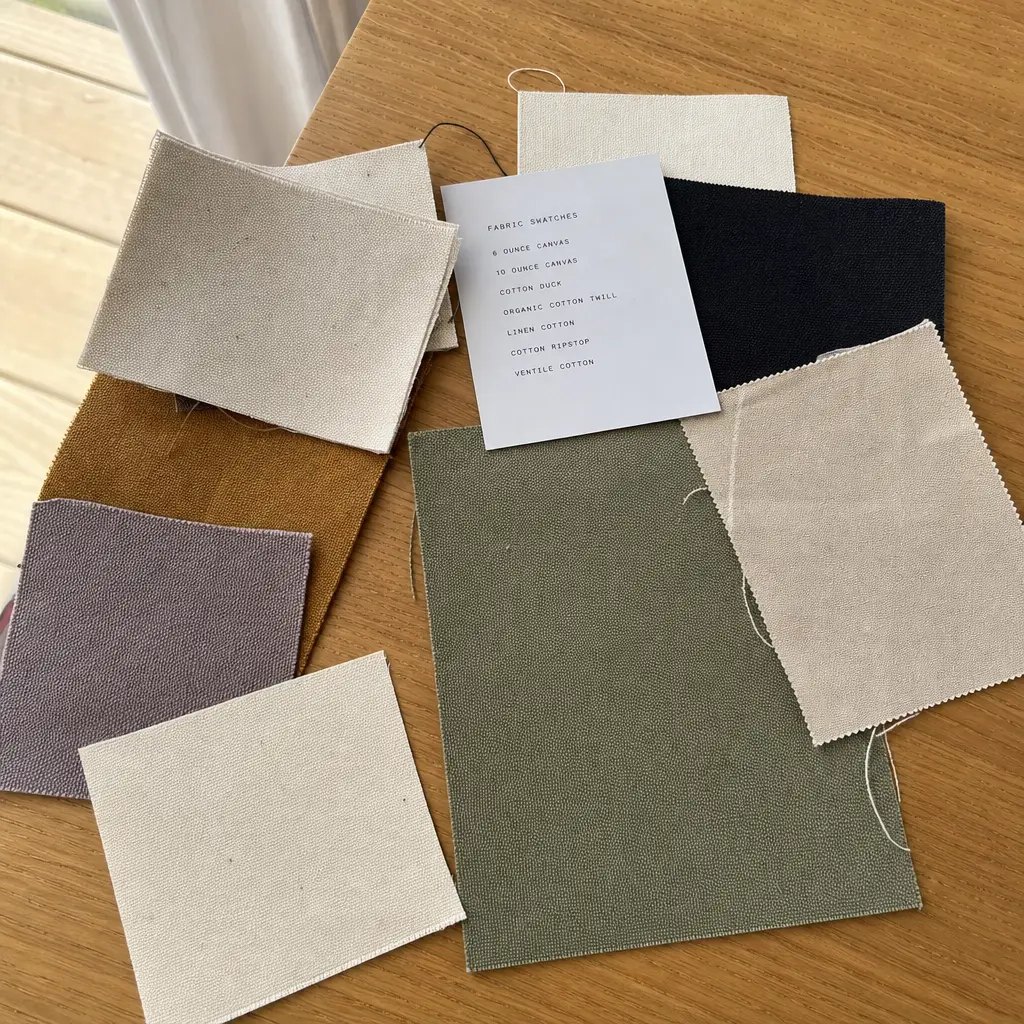
Cotton drawstring pouches are commonly quoted by ounce or GSM. A light 5 oz cotton, around 170 GSM, can work for low-cost event giveaways or light inserts. Around 6 oz to 7 oz, roughly 200-240 GSM, is often a better balance for tech startup kits because the fabric has more opacity and holds a screen print more cleanly. Heavier 8 oz cotton, around 270 GSM, gives a more substantial hand feel but increases material cost, carton weight, and shipping cost.
The print method also reacts differently by fabric weight. Thin cotton can absorb ink unevenly and may show the product inside the pouch, especially in natural or white colors. Very heavy cotton can handle bolder prints or sewn labels, but tight drawcord channels and thick seam allowances need more careful sewing. If the buyer wants a crisp logo, the RFQ should avoid vague wording like “standard cotton” and require a target GSM with acceptable tolerance.
- 5 oz or about 170 GSM: economical, suitable for light promotional use, less structured.
- 6-7 oz or about 200-240 GSM: balanced choice for most branded tech pouches.
- 8 oz or about 270 GSM: stronger look, better opacity, higher freight and sewing cost.
- Natural cotton shade and seed flecks should be approved because they affect logo contrast.
Logo Placement Options That Actually Work
The safest logo position for most cotton drawstring pouches is front center, placed below the drawcord channel and above the lower bulge area. The logo width often works best at 55-65% of pouch width for a clean startup kit appearance. Oversized logos can wrinkle around the pouch edges, while very small logos may disappear when pouches are packed in a box with only part of the front visible.
Side labels and corner prints are useful when the buyer wants a quieter retail look. A woven side label sewn into the seam can feel more premium and survives better than a large print in some reuse situations. However, labels introduce their own MOQ, color approval, and lead time. Bottom-corner logos look neat on thick cotton but are risky on small pouches because the seam curve and filling pressure can distort the mark.
- Front-center print: best brand visibility and easiest inspection.
- Side seam woven label: premium detail, lower print area, separate label MOQ.
- Bottom-corner print: subtle branding, but keep away from seam bulk.
- Inside print or care mark: useful for SKU or compliance notes, not for main branding.
Print Method Selection for Startup Logos
Screen printing is usually the most reliable method for wholesale cotton drawstring pouches with simple startup logos. It is cost-efficient at volume, works well for one or two solid colors, and gives a consistent look on natural cotton when the artwork is prepared correctly. The buyer should provide vector artwork and specify Pantone reference, print size, and print position. Fine lines, small legal text, and low-contrast gray on natural cotton should be tested before bulk production.
Heat transfer can help with gradients, complex colors, or very small runs, but it may feel less natural on cotton and can crack or peel if the transfer quality is poor. Embroidery is rarely the first choice for small drawstring pouches unless the fabric is heavy enough or the design is converted into a patch. Digital print can work for detailed artwork, but cost and hand feel vary. The RFQ should not just say “logo print”; it should name the method or request separate quotations.
- Use screen print for solid one-color or two-color logos with clear edges.
- Use heat transfer when gradient artwork is unavoidable and the buyer accepts a transfer feel.
- Use woven labels for small brand marks where texture matters more than large visibility.
- Avoid embroidery on very light cotton unless the factory confirms backing, puckering control, and minimum detail size.
MOQ Logic and Cost Drivers
MOQ for cotton drawstring pouches is not controlled by only one number. The factory may have one minimum for pouch sewing, another for custom dyed fabric, another for screen print setup, and another for woven labels or special drawcords. A buyer requesting 800 pieces in a custom Pantone fabric color with a woven label may face a higher practical MOQ than a buyer ordering 2,000 pieces in natural cotton with one-color screen print.
Cost drivers are also easy to hide inside a single unit price. Fabric weight, pouch size, drawcord material, print colors, print sides, label type, individual packing, carton quantity, and sample rounds all change the quote. Procurement teams comparing suppliers should request line-item options rather than only the lowest unit price. This makes it easier to decide whether a side label is worth the cost, whether heavier cotton is necessary, or whether bulk packing can reduce both labor and plastic.
- Natural cotton normally has lower MOQ than custom dyed cotton.
- One-color screen print has lower setup complexity than multi-color print or transfer.
- Woven labels can require separate artwork approval and minimum label quantity.
- Individual polybags add material, labor, packing time, and sometimes compliance concerns.
Sample Approval: What to Sign Off Before Bulk
A correct pre-production sample should use the same cotton GSM, drawcord, print ink, label, stitch construction, and packing method planned for bulk production. A lookalike sample made from available fabric is acceptable only for early size testing, not final approval. For logo placement, the buyer should review the pouch flat, filled, closed, and opened. Many placement complaints appear only after the cord is pulled and the pouch top wrinkles.
The sample approval record should include photos with a ruler or measurement notes, not only an email saying “approved.” Mark the logo distance from top edge, side seam, and bottom seam. Record whether the pouch was pressed before measuring. If the product will be shipped in bulk pack, inspect how the logo looks after several pouches are stacked together. If it will be individually bagged, approve the fold position because a fold line across the logo can create a poor first impression.
- Approve flat view, filled view, closed view, and packed view.
- Measure logo placement from fixed sewn edges, not from a soft wrinkle line.
- Keep one signed master sample at the factory and one with the buyer or inspector.
- Do not release bulk production until fabric, drawcord, print, and packing are all approved.
QC Thresholds for Soft Cotton Pouches
Soft cotton pouches cannot be inspected like rigid plastic parts. Fabric stretches, seams shift slightly, and natural cotton may show shade variation. The buyer should define realistic thresholds in the purchase order instead of expecting perfect paper-like alignment. For many small and medium cotton pouches, a size tolerance around ±5 mm is practical, while larger pouches may need a wider tolerance. Logo placement tolerance of ±3 mm to ±5 mm is usually more realistic than demanding zero movement.
Inspection should cover both appearance and function. A beautiful logo is not enough if cords slip, seams open, or ink transfers onto the packed accessory. The inspector should open and close random samples, pull the drawcord with moderate force, check stitch density, examine loose threads, and rub the print after curing. For natural cotton, the buyer must decide in advance whether small seed flecks are acceptable, because rejecting normal fabric characteristics after production creates avoidable disputes.
- Classify wrong logo orientation, heavy ink smudge, and missing print as major defects.
- Classify loose threads, minor shade variation, and small cotton flecks according to approved standard.
- Test drawcord closure repeatedly on samples from different cartons.
- Check print curing before packing to prevent transfer marks inside cartons.
Packing and Export Handling
Packing affects cost, delivery speed, warehouse handling, and the final appearance of the logo. Bulk packing, such as 50 or 100 pieces per inner polybag, is economical and reduces plastic. It works well when the buyer will repack pouches into kits at a local warehouse. However, bulk packed cotton pouches can wrinkle and rub against each other, so carton compression and moisture protection need attention.
Individual polybag packing protects light-colored pouches and keeps each piece clean for retail or event distribution, but it adds labor and material. It also increases packing volume and may conflict with sustainability goals. If the pouch is folded before bagging, the fold line should not cut through the logo. For importers and distributors, carton data should be requested before order confirmation because carton dimensions and gross weight affect freight, storage, and landed-cost comparison.
- Bulk pack is suitable for local kitting operations and lower packaging cost.
- Individual pack is suitable for retail handling, direct event distribution, or white cotton protection.
- Specify inner bag quantity, carton quantity, carton marks, and moisture control.
- Request estimated carton size and gross weight with each quote option.
Lead Time and Schedule Risk
Lead time should be counted from final sample approval, artwork approval, deposit, and material confirmation, not from the first RFQ email. Cotton pouch production includes material preparation, cutting, printing or labeling, sewing, trimming, inspection, packing, and export booking. A simple natural cotton pouch with one-color print is usually faster than a dyed fabric pouch with woven labels and individual packing, but every factory schedule depends on capacity and order season.
The most common schedule risk is late artwork correction. A logo that looks fine on a website may not be suitable for screen printing on cotton. Thin lines, gradients, small text, and unclear color references can trigger several proof rounds. Another risk is changing pouch size after sampling because the actual tech item does not fit. Procurement teams can reduce delay by sending real product dimensions, vector artwork, Pantone references, packing requirements, and target delivery date in the first RFQ.
- Separate sample lead time from bulk production lead time in the purchase plan.
- Reserve extra time for custom dyed fabric, woven labels, and complex print approval.
- Lock artwork before the factory burns screens or orders labels.
- Confirm export carton data early if freight booking or retail DC routing is time-sensitive.
Specification comparison for buyers
| Spec decision | Recommended option | When it fits | Buyer risk to check |
|---|---|---|---|
| Front-center logo on natural cotton | Screen print 1 color, 55-65% of pouch width, placed above lower seam allowance | Best for startup onboarding kits, charger pouches, and simple event giveaways where brand visibility matters | Logo may look too low after filling; approve placement on a stuffed sample, not only a flat artwork proof |
| Small woven side label | Cotton or polyester label sewn into side seam with CTM or brand mark | Useful when the pouch is reused and the buyer wants a retail-style detail instead of a large print | Side label MOQ and label lead time can delay the pouch order if artwork is approved late |
| Bottom-corner logo | Small screen print or heat transfer positioned 20-30 mm above bottom seam | Fits premium accessory bags where the device or cable should look like the main product | Corner prints can distort near seam bulk; keep fine text away from stitched edges |
| Two-side branding | Front logo plus rear usage icon, QR code, or product identification mark | Works for distributors packing multiple tech accessories and needing SKU control | Second print setup increases cost and inspection time; define front/back orientation clearly in the tech pack |
| Pouch size for startup tech kits | Common 10 x 15 cm, 12 x 18 cm, 15 x 20 cm, or custom size with 5-8 mm tolerance | Choose based on cable, adapter, badge, card, sample device, or retail insert dimensions | Too tight pouches slow packing and stress seams; test with the actual packed item before bulk approval |
| Fabric weight | 5 oz/170 GSM to 8 oz/270 GSM cotton depending on opacity and hand feel | 5 oz suits light giveaways; 6-7 oz suits most startup kits; 8 oz gives better structure for retail bundles | Thin cotton can show contents and wrinkle more; heavier cotton raises freight weight and may need stronger drawcords |
| Drawcord style | Self-fabric cotton cord, braided cotton cord, or polyester cord matched to target price | Cotton cord gives natural feel; polyester cord runs smoother for high-volume packing | Cord diameter affects closure; oversized cords can jam in narrow channels |
| Print method | Screen print for solid logos, heat transfer for gradients, embroidery only for thicker cotton or patches | Use screen print for most wholesale startup pouch orders because it is stable and cost-efficient | Fine lines below 0.3 mm, low-contrast ink, or heavy ink coverage can fail after rub testing |
| Packing method | Bulk pack 50-100 pcs per inner polybag or individual polybag only when retail handling requires it | Bulk pack reduces plastic and labor; individual packing protects white or light-color pouches in distribution | Loose bulk packing can wrinkle logos; specify carton size, inner bag count, and moisture protection |
Buyer checklist before sampling
- Define the packed product dimensions before selecting pouch size; add space for easy insertion, not only product fit.
- State cotton fabric weight in GSM or oz, color, shrinkage expectation, and whether natural cotton flecks are acceptable.
- Provide logo artwork in vector format with Pantone or CMYK reference and minimum line thickness.
- Specify exact logo placement from top edge, side seam, and bottom seam, including whether measurements are taken flat or after drawcord channel folding.
- Choose print method based on artwork complexity, fabric color, wash or rub expectation, and target MOQ.
- Approve a physical pre-production sample packed with the actual tech accessory or a same-size dummy.
- Set acceptable size tolerance, print position tolerance, color tolerance, seam strength, drawcord pull strength, and carton marking requirements.
- Confirm whether pouches are packed flat, folded, nested, bulk packed, or individually bagged before comparing freight quotes.
- Require quote data by line item: fabric, printing, label, drawcord, packing, sample fee, tooling, carton quantity, and lead time.
- Lock final artwork and sample approval date before calculating delivery; do not count lead time from first inquiry.
Factory quote questions to send
- What cotton fabric weight do you recommend for this pouch size and packed product weight, and what GSM tolerance do you control in production?
- Can you quote front-center screen print, small side label, and bottom-corner print as separate options so we can compare brand visibility against unit cost?
- What is the MOQ for the pouch fabric color, print setup, woven label, and custom drawcord if each component has a different minimum?
- What print position tolerance can you hold in bulk production, and how do you inspect it on soft cotton pouches?
- Will the drawcord channel width suit the proposed cord diameter after sewing and shrinkage?
- Can you make a pre-production sample using the actual fabric, drawcord, print ink, and packing method rather than a substitute material?
- How many pieces fit per carton under bulk pack and individual polybag pack, and what are the estimated carton dimensions and gross weight?
- What lead time applies after sample approval and deposit, and which steps may extend it: dyed fabric, labels, printing, or packing materials?
- What test results or in-house checks can you provide for print rub resistance, seam strength, colorfastness, and needle detection if required?
- How will defects be classified for print offset, loose thread, fabric stain, size deviation, cord slippage, and wrong logo orientation?
Quality-control points to confirm
- Size tolerance should be agreed before production; common soft pouch tolerance is about ±5 mm for small pouches and ±8 mm for larger pouches unless tighter control is quoted.
- Logo placement tolerance should be practical for cotton fabric movement; ±3 mm to ±5 mm is more realistic than a paper-print standard.
- Print color should be checked on actual cotton, not only against a digital proof, because natural cotton absorbs ink differently from coated paper.
- Print rub resistance should be tested after full curing; wet or rushed ink can transfer onto cords, inserts, or neighboring pouches.
- Drawcord pull strength should be checked by repeated opening and closing, especially for pouches used by event teams packing thousands of kits.
- Seams should be inspected for skipped stitches, loose ends, broken thread, and puckering near the drawcord channel.
- Natural cotton shade variation and seed flecks should be classified as acceptable or unacceptable before the order is placed.
- Carton packing should prevent moisture, odor, crushing, and logo scuffing during export handling.