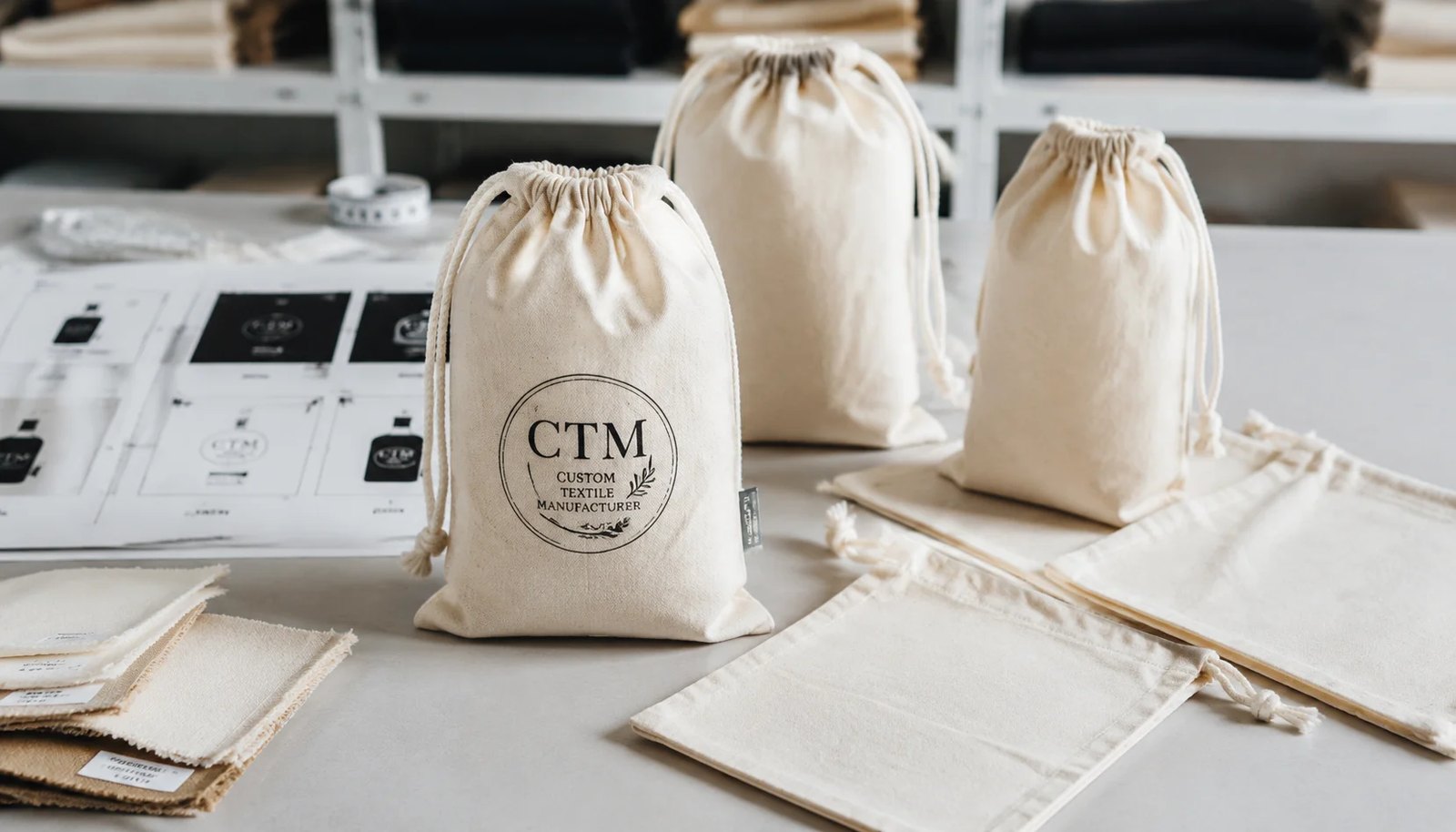
Start With The Retail Use
For liquor retailers, a cotton drawstring pouch is rarely just a fabric bag. It may be a bottle gift sleeve, a tasting kit pouch, a holiday bundle package, a loyalty gift, or a reusable retail add-on. The print proofing checklist should start with that use because the artwork, pouch size, fabric strength, and packing method all change when the pouch must hold a real bottle rather than a small accessory.
The most common production mistake is approving artwork on a flat pouch without testing the packed shape. A 750 ml bottle pushes fabric forward, changes the visible print area, and can make a logo look lower or wider than expected. If the pouch will be displayed upright on a retail shelf, the proof must be judged both flat and filled.
- Single 750 ml bottle pouch: confirm internal height, bottle shoulder fit, and drawcord closure above the cap.
- Mini bottle set pouch: confirm bottom width and fabric strength because small bottles shift during handling.
- Gift card or tasting token pouch: lighter GSM may work, but print alignment becomes more visible on small sizes.
- Retail merchandise pouch: prioritize hand feel, repeat use, and brand presentation over the lowest fabric weight.
- Seasonal liquor promotion: lock artwork approval dates early because printing queues tighten before holiday packing.
Choose Fabric GSM Before Pricing
Cotton drawstring pouches are often quoted too loosely, with suppliers writing only natural cotton or canvas pouch. That is not enough for a procurement comparison. Fabric weight affects unit price, print sharpness, opacity, bottle support, and freight weight. For most liquor retail pouches, 120 to 160 GSM cotton is used for lightweight promotional bags, 180 to 220 GSM gives a better retail hand feel, and 240 GSM or higher moves toward a sturdier canvas-style pouch.
Natural cotton is popular because it looks simple and works with black, dark green, burgundy, or navy print. The tradeoff is that natural cotton has seed flecks and a warm base color, so ink colors will not look like they do on white paper. Bleached white cotton gives cleaner color but shows dirt more easily during sewing, packing, and store handling. Dyed cotton adds another approval step because fabric shade variation can affect the final brand color.
- 120-160 GSM: cost-efficient for light retail giveaways and small accessories, but less structure for glass bottles.
- 180-220 GSM: common balance for liquor gift pouches where print appearance and hand feel matter.
- 240-280 GSM: stronger presentation for premium bottle bags, with higher material cost and freight weight.
- Natural cotton: good for rustic or craft spirits branding, but Pantone color will appear warmer.
- White cotton: better for bright print colors, but requires tighter cleanliness control in production.
Match Print Method To Artwork
The print proofing checklist should name the print method, not just say custom logo. Screen print is usually the most stable option for one-color or two-color liquor retailer logos. It gives solid coverage, practical cost at wholesale quantities, and good durability when ink is properly cured. It also requires screen setup, so the price changes with color count and design revisions.
Heat transfer can handle more detail, small text, or full-color artwork, but the buyer must approve hand feel and edge appearance. On lightweight cotton pouches, a large transfer panel can feel stiff. Digital print can work for complex graphics, but natural cotton may reduce brightness and fine lines can be affected by fabric texture. Embroidery is less common for low-cost pouches but can work for premium small logos if the fabric GSM is high enough and the backing does not distort the pouch.
- Screen print: best for solid logos, store names, bottle icons, and one to three spot colors.
- Heat transfer: useful for gradients, fine detail, or small runs, but test flexibility and wash or rub behavior.
- Digital print: useful for full-color artwork, but request a fabric swatch print before approving bulk.
- Embroidery: premium feel for small marks, but unsuitable for very fine liquor label text on light fabric.
- Woven label: good for repeat retail programs when the pouch should carry a consistent brand tag without large print coverage.
Define The Proofing Standard
A print proof is not only an image approval. For wholesale cotton drawstring pouches, the proof should confirm file accuracy, print size, print position, ink behavior, and how the pouch looks after sewing. A digital mockup is useful for layout discussion, but it does not prove ink absorption, fabric movement, or drawcord interference. A physical sample is the safer approval point for liquor retailers because the packaging is handled by staff and seen by customers up close.
Use measurable acceptance criteria. Instead of writing logo centered, specify the print size in millimeters and the distance from the finished bottom edge or side seam. Instead of writing Pantone match, state whether a reasonable tolerance is acceptable on natural cotton. If the design has small legal text, age restriction wording, or store address lines, print a real sample at final size before approving.
- Artwork file: vector AI, EPS, or PDF for logos and line art; high-resolution raster only when unavoidable.
- Print size: state width and height in millimeters, not a percentage of pouch area.
- Print position: measure from finished pouch edges after sewing, not from cut fabric panel only.
- Color target: provide Pantone references and approve how they appear on actual cotton fabric.
- Small text: set a minimum stroke and text height that remains readable on woven fabric texture.
- Tolerance: agree on acceptable shift, skew, and color variation before bulk production starts.
Control MOQ Logic
MOQ for cotton drawstring pouches is not one number. It can be driven by fabric purchase quantity, dye lot, print setup, cutting efficiency, sewing line changeover, packing method, or carton labeling. A supplier may accept a low MOQ for a stock natural cotton pouch with one-color print but require a higher MOQ for custom dyed fabric, uncommon size, heavy GSM, or multiple store-specific designs.
For liquor retailers, the buying team should separate total order quantity from design quantity. A 10,000-piece order with one artwork is simple. A 10,000-piece order split across 20 store logos is a different production job because each design needs proofing, printing setup, segregation, packing, and carton marking. This is where many quotes look cheap at first and become expensive after artwork is finalized.
- MOQ by fabric: natural stock cotton usually has lower MOQ than dyed or organic fabric.
- MOQ by print design: each logo or colorway may require separate setup and minimum run quantity.
- MOQ by size: custom cutting patterns increase setup time if many pouch sizes are mixed.
- MOQ by packing: store-level assortments or barcode labeling can raise labor cost even when pouch quantity is high.
- MOQ by delivery date: urgent orders may need a higher minimum to justify line scheduling.
Read Quotes Beyond Unit Price
A proper quote for wholesale cotton drawstring pouches should let a buyer compare the same product across suppliers. If one quote includes 180 GSM cotton, screen print, individual polybag, export carton, and FOB terms while another includes 140 GSM cotton, bulk packing, and EXW terms, the cheaper unit price is not a real saving. Procurement teams should require a quote data sheet, not just a price in an email.
Cost drivers are predictable. Fabric GSM and pouch size affect material consumption. Print color count and ink coverage affect setup and production speed. Small batch designs increase handling. Individual packing, barcode labels, hangtags, and store allocation add labor. Freight changes when cartons are oversized or when heavy GSM fabric is selected. A good supplier should be able to show which decisions are changing the cost.
- Unit price basis: state quantity, size, GSM, fabric color, print method, color count, and packing.
- Setup charges: separate screen, artwork, sample, label, and special packing costs.
- Trade term: compare EXW, FOB, CIF, DDP, or delivered warehouse terms carefully.
- Carton data: request carton size, gross weight, net weight, and pieces per carton.
- Lead time basis: clarify whether quoted days start after deposit, artwork approval, or sample approval.
- Validity: cotton fabric, exchange rate, and freight can change, so quote validity should be stated.
Approve Samples In Stages
Sampling should follow the risk of the order. For a repeat natural cotton pouch with one-color logo, a printed pre-production sample may be enough. For a new liquor retailer program with custom size, dyed fabric, multiple artworks, or bottle-specific fit, the buyer should approve fabric swatch, print strike-off, and full pouch sample before bulk production. Skipping these steps saves days at the start but can cost weeks if bulk goods are wrong.
The sample should be checked with the actual contents whenever possible. Put the bottle, gift set, or retail item inside the pouch, close the drawcord, stand it upright, and view the print from customer distance. A pouch that looks correct flat may cover part of the logo when the cord gathers. A design that looks centered on an empty pouch may tilt when wrapped around a bottle shoulder.
- Fabric swatch: approve color, GSM, hand feel, weave texture, and shrinkage concern.
- Print strike-off: approve ink color, sharpness, opacity, curing, and hand feel on actual fabric.
- Fit sample: approve finished size, usable internal space, drawcord closure, and filled appearance.
- Packing sample: approve fold method, label position, barcode readability, and carton arrangement.
- Golden sample: keep one signed sample with the factory and one with the buyer for inspection reference.
Set QC Thresholds
Quality control for printed drawstring pouches should cover both textile defects and print defects. Common textile issues include size variation, loose threads, skipped stitches, dirty marks, uneven hems, weak drawcord channels, and cords that fray or slip out. Common print issues include off-center placement, ink bleeding, pinholes, poor curing, color variation, smudges, ghosting, and skewed artwork.
For retail liquor programs, appearance defects matter because the pouch becomes part of the gift presentation. A small dirty mark on an industrial packing bag may be acceptable, but the same mark on a bottle gift pouch can lead to store rejection. The inspection plan should define major and minor defects in practical terms. Print errors on the front logo area are usually major. Loose thread inside the pouch may be minor if it does not affect use.
- Size tolerance: agree on finished width and height tolerance, commonly tighter for bottle-specific pouches.
- Print position: define acceptable horizontal and vertical movement, such as within a few millimeters for small pouches.
- Ink durability: run dry rub and light scratch checks after curing, especially for dark ink on natural cotton.
- Seam strength: pull test drawcord channel and side seams by hand or with agreed force where needed.
- Cleanliness: reject visible stains, oil marks, heavy lint, and print smears on retail-facing surfaces.
- Quantity accuracy: inspect carton counts by SKU and design because mixed liquor retail programs are prone to packing errors.
Plan Packing And Distribution
Packing is often treated as an afterthought, but it affects store labor and landed cost. Bulk packing is cheaper and uses less material, but store teams may need to count and sort pouches before a promotion. Individual polybags protect white or light cotton from dirt, but they add cost, plastic use, and unpacking time. Paper bands or bundled packing can be a middle option for retailers trying to reduce plastic while keeping quantities controlled.
Carton marks should match the way the goods will be received. If the retailer distributes by store, cartons may need campaign codes, SKU numbers, pouch size, design name, quantity, and destination labels. If the goods go to a distributor warehouse, carton size and weight matter for palletizing and handling. Heavy canvas-style pouches packed too densely can create cartons that are difficult to lift or more likely to split.
- Bulk pack: lowest packing cost, best when warehouse teams can sort and count efficiently.
- Inner bundle: useful for 25, 50, or 100 pieces per bundle to simplify store allocation.
- Individual bag: protects clean white or premium printed pouches, but adds material and labor cost.
- Barcode label: needed when pouches are sold as retail merchandise rather than used as free packaging.
- Carton label: include PO number, SKU, artwork code, quantity, gross weight, carton size, and country of origin where required.
- Pallet plan: request carton dimensions early if the buyer must calculate warehouse space or container loading.
Protect The Schedule
Lead time risk usually sits in approval gaps, not only in sewing capacity. A realistic timeline includes artwork review, digital layout, fabric confirmation, sample production, courier transit, buyer review, revision if needed, bulk material purchase, printing, cutting, sewing, trimming, packing, final inspection, booking, and shipment. When the pouch is tied to a liquor holiday promotion, the approval calendar should be managed as tightly as the production calendar.
The buyer can reduce schedule risk by freezing artwork before sampling and assigning one approval owner. Multiple brand teams reviewing the same proof can create late changes, especially when liquor brand marks, store logos, and compliance text all appear on one pouch. Any artwork change after screen making or sample approval should trigger a written review of cost and lead time impact.
- Artwork proofing: allow time for file cleanup, Pantone clarification, and print position approval.
- Sampling: include factory sample time and courier transit, not just sample production days.
- Revision buffer: reserve time for one correction if the first print proof is not acceptable.
- Bulk production: count from final sample approval and deposit or payment milestone, as agreed.
- Inspection: schedule final inspection before shipment, not after the vessel or courier pickup is booked.
- Transit: add buffer for seasonal freight congestion if pouches must arrive before a retail promotion date.
Specification comparison for buyers
| Spec decision | Recommended option | When it fits | Buyer risk to check |
|---|---|---|---|
| Direct factory sourcing | Use when the pouch size, fabric GSM, drawcord, and print artwork are already defined | Best for repeat liquor retail programs, chain store promotions, and private-label gift sets where the buyer can approve a production sample | Factory quote must include fabric GSM tolerance, print method, packing method, sample fee, and mass production lead time, not only a unit price |
| Trading company or importer-managed sourcing | Use when the buyer needs consolidation with bottles, gift boxes, POS items, or other packaging | Useful for distributors handling mixed seasonal assortments or multiple supplier shipments | Confirm whether print proof approval is handled directly with the pouch factory or filtered through a middle layer that may delay corrections |
| Stock blank pouch with local print | Use natural or white cotton blanks only when speed matters more than exact color, size, or drawcord match | Works for small store groups, urgent tasting events, or short-run promotions below factory MOQ | Blank stock may have uneven shrinkage, unknown GSM, and seam variation that can distort centered liquor brand artwork |
| Custom cut-and-sew pouch | Specify size, GSM, drawcord, seam type, print area, and packing from the start | Best for premium liquor retailers, bottle gift bags, miniature bottle sets, and store-branded packaging | The buyer must approve a pre-production sample because small changes in height, hem depth, or cord position affect bottle fit |
| Screen print approval route | Approve ink color, print size, print position, coverage, and curing quality against a physical sample | Most practical for one-color to three-color liquor store logos, vintage marks, and holiday campaign artwork | Pantone matching on natural cotton is not identical to coated paper; request an acceptable tolerance before bulk printing |
| Heat transfer approval route | Use for fine detail, gradient artwork, or small multicolor labels when hand feel is acceptable | Fits promotional pouches with complex liquor brand graphics or limited runs where screen setup cost is inefficient | Transfers can feel heavier on lightweight cotton and may crack if the wrong film or curing conditions are used |
| Digital print approval route | Use on smoother cotton when variable detail or full-color artwork is needed | Suitable for boutique retail artwork, regional spirits launches, or designs with illustration detail | Color can look muted on natural cotton; request a printed swatch under the same fabric and pretreatment conditions |
| Overseas bulk shipment | Pack by design, color, and carton label with export cartons sized for pouch weight, not just carton volume | Best for full retail chains, distributors, and seasonal programs with enough planning time | Lead time must include artwork proofing, sample revision, fabric purchase, printing queue, sewing, QC, and transit buffer |
Buyer checklist before sampling
- Define the pouch use before quoting: single bottle, mini bottle set, tasting token bag, gift card pouch, or retail merchandise bag.
- State finished size with tolerance, not only approximate size; include usable internal height after drawcord closure.
- Specify cotton fabric weight in GSM and whether natural, bleached white, dyed, or organic cotton is required.
- Confirm whether the quoted GSM is before washing, after finishing, or supplier nominal stock weight.
- Provide artwork as vector file with Pantone references, print dimensions, and print position measured from finished pouch edges.
- Approve a physical printed sample on the actual fabric before bulk production for any retail-facing liquor brand artwork.
- Set acceptance criteria for print registration, ink coverage, color tolerance, skew, smudging, and curing.
- Test bottle fit using the real bottle or a dimensionally accurate dummy, including cap height and shoulder width.
- Check drawcord strength, knot security, cord fraying, and whether the closure still works after the print area is handled.
- Confirm packing by SKU, pouch count per polybag or paper band, master carton quantity, carton marks, and barcode needs.
Factory quote questions to send
- What fabric composition and GSM are included in this quote, and what is the normal GSM tolerance in bulk production?
- Is the fabric greige, finished natural, bleached white, dyed cotton, recycled cotton blend, or organic cotton?
- What finished size tolerance can you hold after cutting, sewing, and ironing?
- Which print method do you recommend for this artwork, and why is it better than screen print, heat transfer, or digital print for this order?
- Can you print a physical proof on the same fabric, same GSM, same ink, and same curing process as bulk production?
- What is the MOQ by size, fabric color, print design, and packing method?
- Are screen charges, artwork setup, sample fees, and courier fees included or separate?
- How many days are needed for artwork proofing, sample making, buyer approval, fabric purchase, printing, sewing, packing, inspection, and shipment?
- What packing method is quoted, and can cartons be labeled by store, SKU, language, barcode, or campaign code?
- What QC standard will be used for print defects, dirty marks, loose threads, broken drawcords, size tolerance, and carton quantity?
Quality-control points to confirm
- Finished pouch size should be measured flat after sewing and pressing, with tolerance agreed before production.
- Usable internal height must allow the intended liquor bottle or gift item to sit below the drawcord channel without forcing the closure.
- Fabric GSM should be verified from bulk fabric, not only from a showroom sample.
- Print position should be measured from the finished bottom edge and side seam because cut panel reference points disappear after sewing.
- Ink color should be compared under consistent light, with allowance for natural cotton base color.
- Print curing should pass rub testing and reasonable handling without tackiness, cracking, or ink transfer.
- Drawcords should pull smoothly without tearing the top channel or loosening the side seam.
- Seams should be free from skipped stitches, open ends, and loose thread nests, especially near the drawcord channel.
- Cartons should match the packing list by design, quantity, color, and SKU so store distribution does not require re-sorting.
- Bulk inspection should include random bottle fit testing when the pouch is made for a specific liquor bottle size.