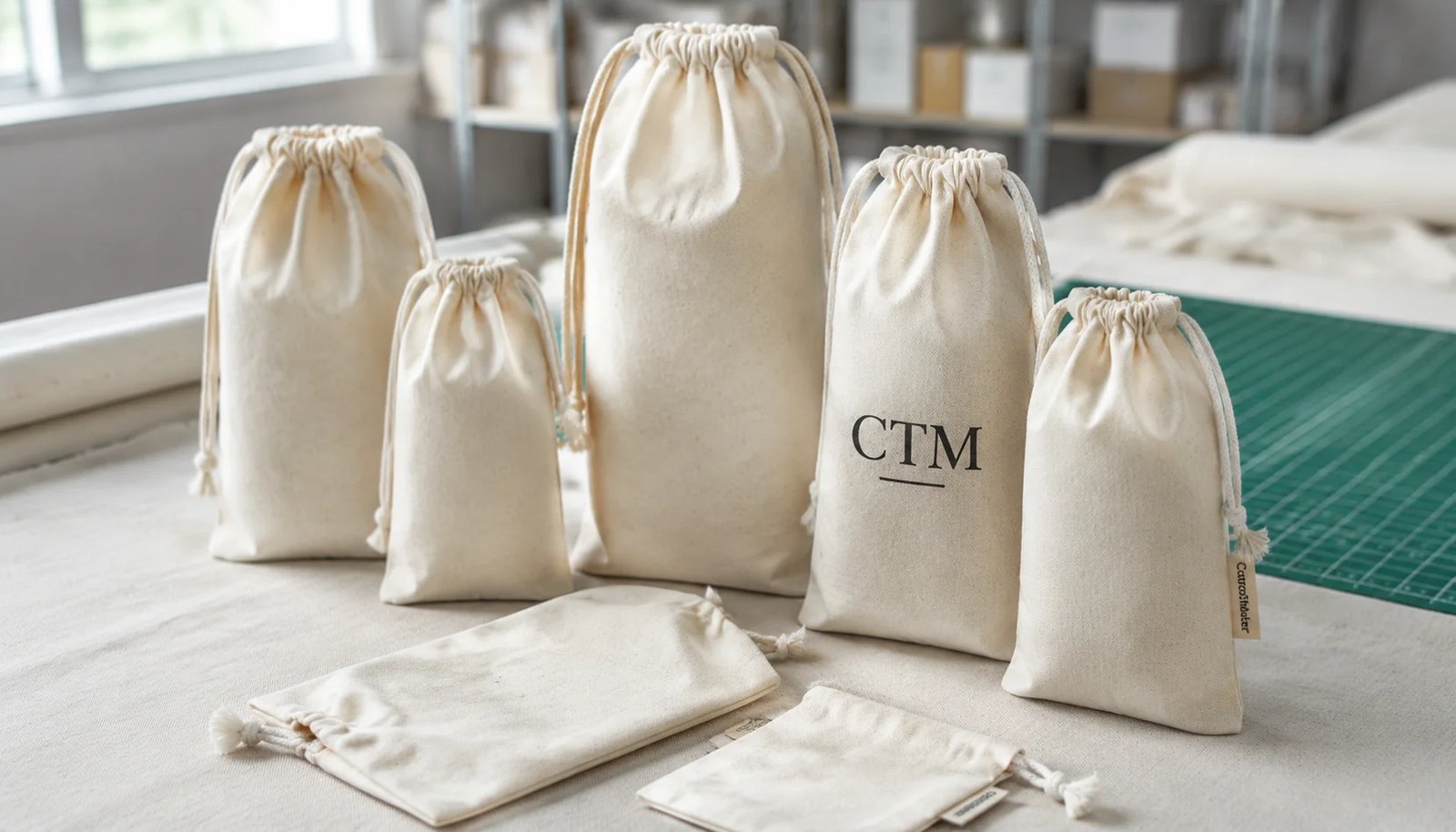
Start With Retail Use
Wholesale cotton drawstring pouches for liquor retailers are not all bought for the same job. A pouch used for a mini bottle gift set has different construction pressure than a pouch used for a corkscrew, tasting glass charm, loyalty card, or premium bottle neck accessory. Before comparing prices, procurement should define the packed item, the selling environment, and how many times the shopper is expected to open and close the pouch.
The fastest way to create bad quotes is to send only a size and a logo. A factory then has to guess the fabric weight, seam allowance, cord type, print method, packing method, and acceptable defect level. Those guesses make quotes look cheaper or more expensive for reasons that are not visible on the spreadsheet. A useful RFQ ties the pouch specification to the liquor retail use case.
- For mini bottles or tasting packs, test usable internal volume, not only flat size.
- For gift-with-purchase programs, prioritize fast packing, clean logo visibility, and low defect rate.
- For premium spirits, heavier cotton and better cord improve hand feel but raise freight weight.
- For distributor branch allocation, packing and carton marks can matter as much as the pouch itself.
Size And Fit
A drawstring pouch loses usable height at the channel area. If the listed size is 100 x 150 mm, the full 150 mm is not available for the product because the drawstring tunnel and top gathering take space. This is a common mistake when a buyer sizes the pouch from the bottle height alone. For liquor retail items, allow enough height above the product so the pouch can close without forcing the cord.
For small pouches, a few millimeters decide whether warehouse staff can pack quickly. A pouch that is technically large enough on paper may still be slow to use if the bottle shoulder, cap, insert card, or protective wrap catches on the side seam. The approval sample should be filled with the real packed item and closed several times, including by someone who was not involved in the specification.
- Use finished size in the RFQ: width x height after sewing and pressing.
- Add 10-20 mm width clearance for small rigid items and more for grouped items.
- Allow 20-35 mm height above the product for clean drawstring closure.
- Set tolerance before production, such as +/-5 mm for small pouches and +/-8 mm for larger sizes.
- If multiple bottle formats share one pouch, test the largest diameter and the tallest closure.
Fabric Weight
Cotton pouch fabric is usually discussed in ounces or GSM. For liquor retail packaging, 5 oz to 6 oz cotton, roughly 170-200 GSM, is often enough for small accessories, mini bottles, tasting kits, and promotional pouches. It keeps the pouch flexible and helps the drawstring close neatly. Below that range, natural cotton can become too transparent, especially when packed with dark glass or printed inserts.
For a stronger gift impression, 7 oz to 8 oz cotton canvas, roughly 240-280 GSM, gives better body and durability. The tradeoff is cost, sewing resistance, heavier carton weight, and a bulkier gathered top. Heavy fabric is not automatically better. If the pouch is small, thick fabric can make the mouth stiff and reduce usable volume.
- Natural cotton may show seed specks; approve whether this is acceptable for the retail brand.
- Bleached cotton gives a cleaner print base but may feel less natural than unbleached cotton.
- Dyed cotton needs colorfastness control, especially if the pouch contacts white labels or paper inserts.
- Pre-shrunk cotton is useful when tight size control or post-processing is required.
- Record GSM tolerance in the purchase order if the pouch must match previous campaigns.
Print Method
Screen printing is usually the most stable choice for wholesale cotton drawstring pouches when the liquor retailer needs a clean logo, store name, campaign mark, or simple seasonal graphic. It works well on natural cotton when the artwork uses solid shapes and limited colors. The buyer should provide vector artwork, Pantone references, print size, and print location from the seam or bottom edge.
Detailed labels, fine legal text, QR codes, and gradients need more caution. Cotton texture can break small lines, and ink spread can close counters in small letters. Heat transfer or digital print may solve color detail, but the hand feel can be less natural and the print edge may be visible. For liquor retail brands, the print should be approved for both appearance and durability after packing friction.
- Minimum readable text height should be tested on actual fabric, not assumed from artwork.
- One-color screen print normally gives the best cost control for bulk promotional pouches.
- Multi-color artwork needs registration tolerance and setup charges listed separately.
- Print should cure fully before packing to prevent ink transfer between stacked pouches.
- Avoid placing critical artwork too close to side seams or the gathered drawstring area.
Construction Details
The drawstring system affects both retail appearance and packing speed. A double drawstring is easier for shoppers to pull closed from both sides and gives a better gift feel. A single drawstring can reduce cost and labor, but it may hang unevenly or feel less finished. Cord type also changes the result: cotton cord matches natural fabric, while polyester cord gives stronger color consistency and abrasion resistance.
Channel width, cord diameter, seam strength, and knotting method should be treated as production specifications, not minor details. If the cord is too thick for the tunnel, staff will struggle to close the pouch. If the cord is too thin, the pouch looks low value beside premium glass packaging. Loose knots can slip into the channel and become a store-level complaint.
- Specify single or double drawstring clearly in the RFQ.
- Record cord material, diameter, color, and knot or tip finish.
- Require smooth cord pull after sewing and after bulk packing compression.
- Use reinforced stitching for heavier contents or reusable retail packaging.
- Avoid metal tips unless the brand accepts extra cost, weight, and safety review.
MOQ Logic
MOQ for cotton drawstring pouches is driven by fabric availability, dyeing, print setup, cutting efficiency, and labor changeover. A supplier may accept a low MOQ for natural cotton in a standard size but require a higher MOQ for dyed fabric, uncommon GSM, custom cord color, or multiple print designs. Comparing MOQ without the linked specification can lead procurement to choose a quote that changes later.
For liquor retailers running regional promotions, the practical question is often not the lowest possible MOQ but the cleanest split between designs, stores, or campaign dates. A 10,000-piece order across five artwork versions is not the same production job as 10,000 pieces of one logo. Each version may need separate screens, setup time, packing separation, and inspection records.
- Separate total order quantity from MOQ per size, per color, and per print design.
- Ask whether price breaks are based on total pieces or identical SKU pieces.
- Confirm whether sample charges and screen charges are refundable or one-time costs.
- For repeat orders, keep fabric, cord, and print standards on file to reduce reapproval work.
- If the order is split by destination, include packing allocation in the quote stage.
Cost Drivers
The lowest unit price often hides missing items. A proper wholesale quote should show fabric weight, pouch size, print method, number of print colors, cord specification, packing method, carton details, sample cost, setup cost, and inland freight terms. Without those fields, procurement cannot tell whether Supplier A is cheaper or simply quoting a lighter pouch with simpler packing.
Cotton pouches are labor-sensitive products. Small changes in size, seam style, label placement, cord threading, and individual packing can change output speed. A sewn side label, barcode sticker, or hangtag may look minor to a buyer, but it adds handling steps. For liquor retail programs with tight launch dates, reducing unnecessary operations can be more valuable than pushing the fabric weight down.
- Fabric: higher GSM and dyed colors raise material cost and sometimes MOQ.
- Printing: each color or position can add setup cost and slower production.
- Labels: woven labels, side tabs, and hangtags add both material and sewing or packing labor.
- Packing: individual polybags improve store handling but add cost and plastic compliance review.
- Freight: heavier cotton increases carton weight and landed cost, especially by air.
Sample Approval
A sample should prove the production method, not only the general shape. For approval, the best sample uses the quoted fabric weight, actual drawstring, correct finished size, and the chosen print process. A substitute sample is useful for early sizing discussion, but it should not be treated as final production approval if fabric, cord, or print method will change.
Sample review should include fit, closure, print, fabric feel, seam quality, and packing behavior. For liquor retail buyers, the sample should be placed next to the bottle or accessory it will support. The brand owner may focus on logo appearance, while warehouse teams care about packing speed and carton sorting. Both views matter before deposit and production start.
- Measure finished size at top, middle, and bottom to detect sewing distortion.
- Insert the real product and close the drawstring at least ten times.
- Rub the print after curing with a dry white cloth to catch obvious ink transfer.
- Check whether the logo remains visible when the pouch is filled and gathered.
- Photograph and sign the approved sample so factory QC has a clear reference.
Packing And Cartons
Packing is where many liquor retail pouch orders become messy. If a distributor needs to ship to several branches, mixed cartons may create receiving errors. If a retailer needs store-ready allocation, cartons should be marked by SKU, purchase order, design, and quantity. If the pouch print is dark or heavy, the factory should avoid packing before ink is cured, because stacked fabric can pick up marks.
Carton compression also matters. Cotton pouches can tolerate folding, but excessive pressure creates creases across the printed area and makes the first retail presentation look poor. For natural cotton, moisture control is important during ocean transit. Inner polybags, carton liners, or desiccants may be appropriate depending on route, season, and destination warehouse conditions.
- Define pieces per bundle and pieces per master carton before production.
- Keep different sizes, colors, and print designs separated unless mixed cartons are specifically required.
- List carton dimensions and gross weight in the quote for freight planning.
- Use carton marks that match the buyer purchase order and warehouse receiving rules.
- Avoid over-compressed cartons for large printed panels or premium gift pouches.
Lead Time Risk
Lead time should be counted from confirmed artwork, approved sample, deposit, and available production materials. An inquiry date is not a production start date. For cotton drawstring pouches, schedule risk usually comes from artwork correction, fabric dyeing, print proofing, and packing allocation. During peak retail seasons, even a simple pouch can be delayed if the buyer waits too long to approve print placement.
Liquor retail promotions often have fixed launch windows, so the schedule should include decision deadlines. If the product must arrive before a holiday, the buyer needs sample approval dates, production completion dates, inspection dates, vessel cutoff dates, and warehouse receiving dates. Air freight can rescue a late pouch order, but it can also destroy the landed-cost advantage of cotton packaging.
- Allow time for artwork cleanup before sample making if files are not vector-ready.
- Add extra days for dyed cotton, custom cord color, or multi-design production.
- Book inspection after packing but before final shipment release.
- For repeat orders, reuse approved specifications to shorten sample discussion.
- Keep a backup plan for partial shipment only if carton allocation can remain clean.
Specification comparison for buyers
| Spec decision | Recommended option | When it fits | Buyer risk to check |
|---|---|---|---|
| Fabric weight for bottle accessory pouch | 5 oz to 6 oz cotton, roughly 170-200 GSM, pre-shrunk if the print is tight to the edge | Mini bottle sets, corkscrews, tasting tokens, gift cards, and lightweight liquor retail accessories | Too light can look transparent under dark bottles or inserts; too heavy may not cinch cleanly at small sizes |
| Fabric weight for premium gift presentation | 7 oz to 8 oz cotton canvas, roughly 240-280 GSM, with reinforced side seams | Holiday packs, premium spirits, loyalty gifts, or refillable retail packaging programs | Higher GSM raises unit cost, shipping weight, and MOQ pressure; sample the drawstring closure with the actual bottle neck |
| Print method for simple brand mark | Screen print with water-based or discharge-style ink where fabric color allows | One to three solid colors, repeat liquor store branding, promotional packs, and distributor campaigns | Small serif text, legal lines, and QR codes can fill in on coarse cotton; approve a strike-off before bulk printing |
| Print method for detailed artwork | Heat transfer or digital print on smoother cotton after wash and rub testing | Seasonal artwork, multi-color gift graphics, photographic labels, or short promotional runs | Transfers may feel plastic on natural cotton and can crack if the pouch is folded sharply in packing |
| Drawstring material | Cotton cord for a natural retail look; polyester cord when color matching and abrasion resistance matter more | Cotton cord suits craft spirits and natural packaging; polyester suits high-volume retail handling | Cord diameter must match channel width; thin cord feels cheap and thick cord can jam at the tunnel seam |
| Closure construction | Double drawstring for retail gift use; single drawstring for low-cost insert pouches | Double drawstring is easier for shoppers to close and reopen; single drawstring reduces labor and material | Uneven cord length, poor knotting, or narrow channel stitching can slow packing and create returns at store level |
| Size allowance | Add functional clearance of 10-20 mm in width and 20-35 mm in height over the packed item | Useful when the pouch must accept multiple mini bottles, wrapped accessories, or irregular gift components | A flat pouch size is not the same as usable internal volume; test with filled retail product, not only a ruler |
| Export packing | Polybag by bundle or master carton with carton marks, moisture control, and count-by-size separation | Works for distributors shipping to multiple retail branches or liquor chains with warehouse receiving rules | Over-compressed cartons crease prints, mixed sizes create receiving errors, and unmarked cartons delay allocation |
Buyer checklist before sampling
- Define the packed item first: bottle size, accessory dimensions, insert thickness, and whether the pouch is for sale, gift-with-purchase, or warehouse kitting.
- State finished pouch size, not only cutting size, and include tolerance such as +/-5 mm for small pouches or +/-8 mm for larger pouches.
- Specify fabric weight in GSM or oz, fabric color, shrinkage expectation, and whether natural cotton specks are acceptable.
- Provide artwork in vector format with Pantone references, print size, print position from seam or bottom edge, and minimum readable text height.
- Choose drawstring type, cord diameter, closure style, knotting method, and whether metal tips, tags, or beads are excluded for retail safety and cost control.
- Request a pre-production sample made in correct fabric, correct size, correct drawstring, and actual print method before approving bulk production.
- Require carton packing details: pieces per inner bundle, pieces per carton, carton dimensions, gross weight, carton marks, and mixed-size rules.
- Ask the supplier to separate mold, screen, sample, labeling, and inland freight costs from the unit price so quotes are comparable.
- Set QC acceptance points for fabric defects, seam strength, print registration, color difference, cord pull strength, and carton count accuracy.
- Confirm lead time from deposit and artwork approval, not from first inquiry, and reserve extra time for sampling and print correction.
Factory quote questions to send
- What cotton fabric weight in GSM and oz are you quoting, and is it greige, bleached, dyed, or pre-shrunk?
- Is the quoted size the finished pouch size after sewing, and what tolerance will your QC team apply?
- Which print method is included in the unit price, and what are the setup charges per color, screen, or artwork position?
- What is your MOQ for this exact fabric weight, pouch size, cord type, and print method, and what price breaks apply at higher quantities?
- Can the sample be made with production fabric and production print, or will it be a substitute material sample?
- How many days are needed for blank sample, printed sample, production, inspection, and export packing after approval?
- What packing method is included, and can cartons be marked by SKU, store allocation, purchase order, or destination warehouse?
- What test or inspection records can you provide for seam strength, print rubbing, color matching, carton count, and needle detection if required?
- Are there extra charges for woven labels, side labels, barcode stickers, hangtags, individual polybags, or FSC-style paper insert cards if requested?
- What quote validity period applies, and which cost items may change with cotton price, exchange rate, or shipping season?
Quality-control points to confirm
- Finished size tolerance should be agreed before production; small liquor accessory pouches usually need tighter control than large gift sacks.
- Fabric GSM should be checked by batch, because a light substitute fabric can reduce cost while making the pouch look weak beside glass bottles.
- Print adhesion should pass dry rub and light scratch testing after the ink is fully cured, not immediately after printing.
- Print position should be measured from fixed edges, usually the bottom seam and side seam, because drawstring channel height can vary.
- Side seams and bottom seams should be free from skipped stitches, open threads, broken needle marks, and puckering visible on the front panel.
- Drawstrings should pull smoothly without tearing the channel seam, and the knot or tip should not slip back through the tunnel.
- Color variation should be controlled separately for fabric, cord, and print; natural cotton shade variation should be approved on a swatch card.
- Carton count accuracy should be checked by SKU, size, print design, and store allocation if the order is split for retail distribution.
- Finished pouches should be packed only after print curing to avoid blocking, ink transfer, odor retention, or pressure marks.
- Moisture control and clean packing are important for natural cotton, especially for long ocean transit or humid destination warehouses.