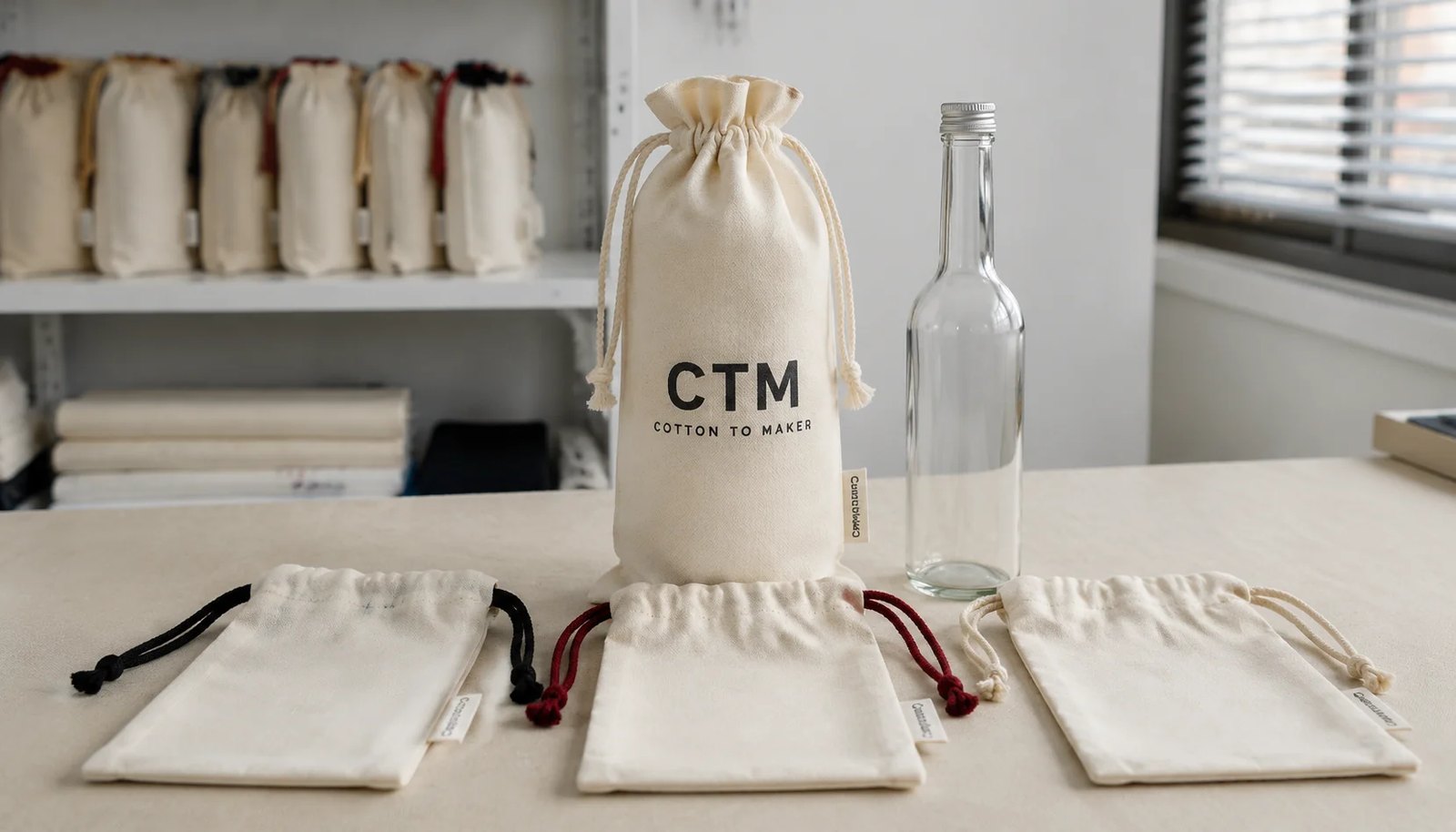
The MOQ Problem Behind Liquor Pouches
Wholesale cotton drawstring pouches for liquor retailers look simple until the buyer tries to reduce MOQ. A pouch may have only two fabric panels, one drawcord channel, and a printed logo, but the production cost is not only sewing time. MOQ is shaped by fabric roll purchasing, cutting efficiency, print setup, cord color, labor scheduling, packing method, and how many versions the buyer wants in one shipment.
For a liquor retailer, the commercial mistake is negotiating only the final quantity. A better negotiation separates the order into the parts that actually create factory cost. If the size is standard, fabric is natural cotton, print is one color, and packing is bulk, a factory can usually be more flexible. If every store region needs a different logo, cord color, and bottle size, the order behaves like multiple small productions even when the total quantity looks large.
- Treat each size, fabric color, and print artwork as a separate MOQ driver.
- Use one body size across several liquor SKUs when possible, then vary the print or label.
- Negotiate around factory setup cost, not around a target number pulled from a buying plan.
- When requesting a lower MOQ, offer simpler packing, stock cotton color, or shared drawcord color as tradeoffs.
Define The Pouch Use Before The Quantity
A cotton drawstring pouch used as a dust sleeve for a bottle does not need the same construction as a retail gift pouch sold or handed over at checkout. Dust sleeves can be lighter and more flexible. Gift pouches need better opacity, smoother sewing, cleaner logo placement, and a drawcord that still looks neat after store handling. If the RFQ does not define the use, suppliers will quote different quality levels and the lowest price may not match the retail expectation.
Liquor packaging also has shape issues that general promo pouches do not. A tall wine bottle, a short spirits bottle, and a boxed mini bottle set all load the pouch differently. The drawstring channel must sit high enough to close above the bottle shoulder or cap. If the pouch is too narrow, the print stretches and the seams work harder. If it is too wide, the filled pouch looks loose on shelf and the logo may rotate away from the front.
- For a single 750 ml bottle, provide bottle height, max diameter, shoulder shape, and cap height.
- For boxed bottles, provide box length, width, height, and corner sharpness.
- For checkout gift packaging, specify whether the pouch must stand, hang, or lie flat in cartons.
- For dust protection only, lighter fabric may be acceptable if opacity is not a brand requirement.
Fabric Weight And Cotton Choices
Fabric weight is one of the cleanest levers in MOQ and cost negotiation. Many buyers write cotton pouch in the RFQ and then compare quotes that are not comparable. A 140 GSM cotton pouch and a 280 GSM cotton canvas pouch are different products. The lighter option can be fine for short-term giveaway packaging, but it may show bottle edges, wrinkle heavily, and feel less premium in hand. The heavier option looks better for spirits or gift packs, but it increases fabric consumption, sewing resistance, carton weight, and sometimes MOQ.
For liquor retail programs, common ranges are 140-170 GSM for light cotton sleeves, 180-220 GSM for standard drawstring pouches, and 260-300 GSM for canvas-like premium pouches. Natural cotton usually gives the most flexible MOQ because the factory can source it more easily and avoid dyeing. Dyed cotton or exact Pantone fabric matching raises risk because minimum dye lots can be much higher than the pouch order itself.
- 140-170 GSM: lower cost, lighter hand feel, best for dust sleeves or simple event giveaways.
- 180-220 GSM: balanced option for most branded liquor retail pouches with screen printing.
- 260-300 GSM: stronger premium feel, better opacity, higher freight weight, and higher sewing stress.
- Natural cotton: more visible cotton seed specks but usually easier MOQ and faster sourcing.
- Dyed cotton: cleaner brand color control but requires dye lot discussion and shade tolerance.
Print Method Affects MOQ More Than Buyers Expect
Logo decoration can make or break the MOQ discussion. One-color screen print on natural cotton is usually the most economical route for stable liquor retail artwork. The screen cost is fixed, but once the setup is done, the unit cost is efficient. This is why factories may accept a lower MOQ for one print design than for several small artwork versions. Each additional color or version adds setup, alignment, drying, and inspection time.
Digital transfer, DTF, and heat transfer can help when the buyer needs small runs or multi-color artwork, but they should not be approved from a photo only. Transfers may sit on the fabric surface, change hand feel, or react differently on rough cotton. Embroidery gives a premium result but can pucker lighter cotton and increases stitch-time cost. Woven labels or side labels can be a smart compromise when one pouch body serves many liquor brands, because the pouch production remains consistent while label versions change.
- Use screen print for one-color or two-color logos in stable bulk programs.
- Use transfer or DTF for small tests, complex graphics, or regional versions.
- Use woven labels when the same pouch body must support several brand identities.
- Use embroidery only after testing puckering, thread coverage, and reverse-side appearance.
- Set logo tolerance in millimeters from center and bottom seam, not only as front centered.
How MOQ Is Built Inside The Factory
A factory MOQ is not one number. It is usually the highest pressure point among fabric sourcing, cutting table efficiency, print setup, sewing line scheduling, and packing labor. If a buyer requests 300 pieces of a custom dyed 280 GSM pouch with two-color print and individual barcode polybags, the factory may reject it because every step is inefficient. If the same buyer accepts natural cotton, one-color screen print, and bulk packing, the factory has more room to discuss a smaller trial quantity.
The best MOQ negotiation gives the supplier a reason to reduce risk. That can be a paid sample, a repeat-order forecast, permission to use available fabric, or agreement to combine production with another compatible order. Avoid pushing for a low MOQ while keeping every custom feature. That usually leads to a quote with hidden shortcuts: thinner fabric, looser inspection, substituted cord, or delayed production priority.
- Fabric MOQ: roll length, color, GSM, and availability decide the starting point.
- Cutting MOQ: small quantities waste table setup time and reduce cutting efficiency.
- Printing MOQ: screens, ink mixing, curing, and cleaning make small runs expensive.
- Sewing MOQ: line operators need setup time for size, seam type, and drawcord channel.
- Packing MOQ: individual bags, labels, and mixed SKU sorting add labor even when sewing is simple.
Negotiation Levers That Do Not Damage Quality
Reducing MOQ safely is about simplifying variables. The strongest lever is size standardization. A liquor retailer may want separate pouches for wine, vodka, whisky, and gift sets, but one carefully sized pouch can often cover several bottle types if the buyer accepts a little extra room. Another lever is fabric color. Natural cotton, black, and common dyed colors are easier than custom shade dyeing. Cord color can also be standardized without hurting the visible brand effect too much.
There are also commercial levers. A buyer can approve a higher unit price for the first small run in exchange for a lower MOQ, then renegotiate after repeat volume is proven. Another option is a tiered quote: 500, 1000, 3000, and 5000 pieces with the same spec. This helps procurement compare the real cost of low quantity instead of forcing the supplier to pretend that a test order has the economics of bulk production.
- Standardize pouch size before negotiating price.
- Keep the same fabric and cord across artwork versions.
- Use one-color print for launch runs, then add complexity after demand is proven.
- Accept bulk inner packing if the pouch is not individually sold.
- Request tiered pricing by quantity and by artwork count, not only one target quantity.
- Offer a repeat forecast only if it is credible; factories discount more confidently when the next order is realistic.
Sample Approval Must Represent Bulk Production
A sample-room pouch can look cleaner than mass production if it is sewn slowly by the best operator using available fabric. For MOQ negotiation, that is dangerous because the buyer may approve a sample that cannot be repeated at the agreed price. The sample should use the intended GSM, the intended drawcord, the actual print method, and the agreed packing direction. If exact bulk fabric is not available before deposit, the supplier should state the difference clearly.
Bottle fit testing is especially important for liquor retailers. Test the pouch empty, filled, closed, and packed in a carton. The logo that looks centered on a flat pouch may sit too low once the bottle is inserted. A narrow pouch can pass measurement but fail in use because store staff struggle to insert bottles quickly. A drawcord that feels fine empty may jam when the pouch is under tension around a bottle shoulder.
- Approve one flat sample and one filled sample photo or video using the actual bottle.
- Measure finished width, height, drawcord channel height, and logo position.
- Rub the print after curing and after the pouch is handled around the bottle.
- Pull the drawcord several times to test channel friction and seam strength.
- Keep a signed or sealed approval sample for comparison during final inspection.
Packing Choices Change Unit Cost And Freight
Packing is often treated as a final detail, but it affects both MOQ and landed cost. Bulk packing in inner polybags or master cartons is the lowest labor route. Individual polybags protect each pouch and support retail distribution, but they add material, packing time, carton volume, and sometimes barcode management. If store staff will remove the pouch from packaging before use, individual polybags may be unnecessary cost.
Liquor retailers should also think about moisture and odor. Cotton can absorb warehouse smells and humidity if cartons are weak or stored badly. For ocean freight, an inner polybag liner or moisture control plan may be more useful than individual bags on every pouch. Carton markings must separate sizes, artwork versions, and store allocations clearly. Mixed designs in one carton without a packing list create receiving errors that cost more than the saved packing labor.
- Bulk pack for backroom use, event distribution, or when stores will handle pouches before gifting.
- Individual polybag for retail sale, premium gift sets, or when barcode scanning is required.
- Use carton labels showing SKU, artwork version, pouch size, color, quantity, gross weight, and carton number.
- Request carton dimensions early so air freight and ocean freight comparisons are based on real volume.
- Avoid over-compressing heavy cotton pouches; deep creasing can affect shelf presentation.
Lead Time Risk Around Retail Promotions
MOQ negotiation and lead time are connected. A low-MOQ order may be accepted by the factory but placed behind larger production unless the schedule is clearly agreed. Liquor retail programs often peak before holidays, tasting events, store openings, and gift seasons. The calendar should include artwork approval, sample making, sample transit, buyer review, deposit, bulk fabric purchase, printing, sewing, packing, inspection, export booking, and transit.
For a straightforward cotton drawstring pouch with available fabric and one-color print, production may be relatively fast after sample approval, but the risky parts are before and after sewing. Artwork revisions, unclear bottle dimensions, late barcode files, and changed packing instructions can consume more time than sewing itself. International freight can also become the schedule bottleneck near peak season. A buyer who wants low MOQ and urgent delivery should simplify the spec first.
- Lock artwork before sample making; late logo changes reset print approval.
- Approve fabric GSM and color before negotiating final production lead time.
- Reserve extra time for dyed fabric, multi-color print, embroidery, or many SKU versions.
- Book inspection before goods are packed into the final export carton when possible.
- For seasonal liquor promotions, work backward from store delivery date, not vessel departure date.
Quote Data Needed For Landed-Cost Comparison
A cheap pouch quote is not useful if it lacks the data needed to calculate landed cost. Procurement teams should require the same quote fields from every supplier: finished size, fabric GSM, fabric composition, print method, number of colors, drawcord material, packing method, pieces per carton, carton dimensions, gross weight, sample charges, setup charges, production lead time, payment terms, and Incoterms. Without these fields, the buyer is comparing incomplete offers.
Landed cost is especially sensitive when the pouch is heavy canvas or individually packed. A 280 GSM pouch may have a better retail feel but can increase shipping weight and carton volume. Individual polybags and retail headers can reduce pieces per carton. If the order ships by air for a promotion, the dimensional weight can matter more than unit price. The right decision is not always the lowest FOB cost; it is the lowest acceptable cost for the required presentation, schedule, and receiving process.
- Request FOB and EXW if comparing factories in different regions; request DDP only when the supplier has proven import capability.
- Compare unit price together with carton CBM, gross weight, and pieces per carton.
- Separate sample charge, screen charge, and bulk unit price in the quote.
- List each artwork version as a line item so setup costs are visible.
- Require validity date for the quote because cotton, labor, and freight costs can move.
Specification comparison for buyers
| Spec decision | Recommended option | When it fits | Buyer risk to check |
|---|---|---|---|
| Factory direct order | Cotton bag manufacturer with cutting, sewing, printing, and packing control | Best for repeat liquor retail programs, branded bottle sleeves, seasonal gift packaging, and orders where color or logo consistency matters | Confirm whether printing is in-house or subcontracted, because subcontracted print can add lead time and weaker accountability during rework |
| Trading company or general gift supplier | Use only when the order combines many unrelated items and the pouch spec is simple | Works for small promotional bundles where the pouch is not a core retail-facing pack | Quote may hide the actual pouch factory, making fabric GSM, shrinkage, and print approval harder to control |
| Stock pouch with logo print | Natural or black cotton pouch in existing size with one-color screen print | Useful for low launch quantities, event packs, and urgent retail tests where exact sizing is flexible | Stock size may not fit tall liquor bottles cleanly; test bottle insertion and drawstring closure before approving |
| Custom cut-and-sew pouch | Size, GSM, drawcord, seam, label, and packing built to RFQ | Best for premium spirits, multi-bottle gift sets, or brand standards that need exact fit and shelf appearance | MOQ is higher because fabric cutting, line setup, and print screens are dedicated to the order |
| Domestic decorator with imported blanks | Buy imported blank pouches, then print locally | Fits very tight launch dates or uncertain artwork that may change close to shipment | Unit cost rises and print position may vary if blanks are not pressed and fixtured consistently |
| Consolidated import through distributor | Distributor manages pouch sourcing, liquor accessories, and carton consolidation | Useful when the buyer lacks import operations or needs mixed SKUs shipped together | Margin is built into the quote; request carton dimensions and pouch origin for landed-cost comparison |
| Low-MOQ digital print route | DTF or digital transfer on cotton pouch for short runs and multi-color artwork | Suitable for test batches, local store versions, or artwork with many colors | Hand feel and wash/rub resistance can be weaker than screen print; approve a physical printed sample |
| Bulk screen print route | Screen print on 6 oz to 10 oz cotton with controlled ink deposit | Best for stable liquor brand logos, high repeat volume, and cleaner unit cost at scale | Color changes and many artwork versions create setup charges; group versions by print color when negotiating |
Buyer checklist before sampling
- Define the bottle size or insert dimensions before discussing MOQ; provide height, diameter, shoulder shape, and whether the pouch must close above the cap.
- State fabric requirement in GSM or ounces, not only as cotton or canvas; common ranges are 140-170 GSM for light retail sleeves, 180-220 GSM for standard promotional pouches, and 260-300 GSM for heavier premium bottle bags.
- Separate MOQ by size, fabric color, print design, and drawcord color so the supplier cannot quote one blended MOQ that later changes during production.
- Decide whether the pouch is a dust bag, a retail gift bag, or a protective bottle sleeve; each use needs a different fabric weight, seam strength, and packing method.
- Request a pre-production sample using bulk fabric, bulk cord, and actual print method before releasing deposit for full production.
- Set print acceptance criteria for logo size, position tolerance, ink color reference, rub resistance, and visible registration on both flat and filled pouch conditions.
- Confirm whether cotton shrinkage, dye lot variation, or off-white natural cotton flecks are acceptable for the brand presentation.
- Specify individual packing only when retail handling requires it; unnecessary polybags can add cost, labor, and carton volume.
- Require carton size, gross weight, net weight, and units per carton in the quotation so freight comparison is possible before supplier selection.
- Build a lead-time buffer for peak gifting seasons, especially before Q4, Lunar New Year, or major alcohol retail promotion windows.
Factory quote questions to send
- What is the MOQ by pouch size, fabric color, print design, and drawcord color, and which part of the MOQ is driven by fabric purchase versus sewing line setup?
- Can you quote 140 GSM, 180 GSM, 220 GSM, and 280 GSM cotton options for the same pouch size so we can compare unit cost and presentation?
- Is the fabric greige, bleached, dyed, or organic cotton, and what tolerance should we expect on GSM, width, and shrinkage?
- Which print method do you recommend for our artwork: screen print, heat transfer, DTF, digital print, embroidery, woven label, or leather patch, and why?
- What are the setup charges for screens, color changes, sample making, and revised samples?
- Will the production sample be made with actual bulk fabric and actual bulk drawcord, or only available sample-room material?
- What is your standard seam allowance, stitch density, and drawcord channel height for bottle pouches?
- How many pieces per carton, what are carton dimensions, and can you quote both bulk packing and individual polybag packing?
- What inspection standard do you use for stains, broken stitches, print offset, size tolerance, and cord function?
- What is the realistic production lead time after sample approval and deposit, excluding international transit?
Quality-control points to confirm
- Finished size tolerance should be agreed before production; for small liquor pouches, plus or minus 5 mm is usually more practical than an undefined tolerance.
- Fabric GSM should be checked from bulk rolls, not only the approved sample; a thin substitute can change drape, opacity, and perceived value.
- Bottle fit must be tested with the real bottle or a dimensionally accurate dummy, including closure above the cap if required.
- Drawcord must pull smoothly without tearing the channel seam, and the cord ends should be knotted, heat sealed, or finished according to the approved sample.
- Logo position should be measured from the bottom seam and center line, not judged only by eye on an empty pouch.
- Print adhesion should be checked by dry rub and light scratch tests after curing, especially for dark ink on natural cotton or transfer print on heavier canvas.
- Stitching should be free from skipped stitches, loose threads, needle holes outside the seam line, and puckering around the drawcord channel.
- Packing inspection should include carton strength, inner polybag count, barcode or SKU labeling, moisture protection, and mixed-design separation.