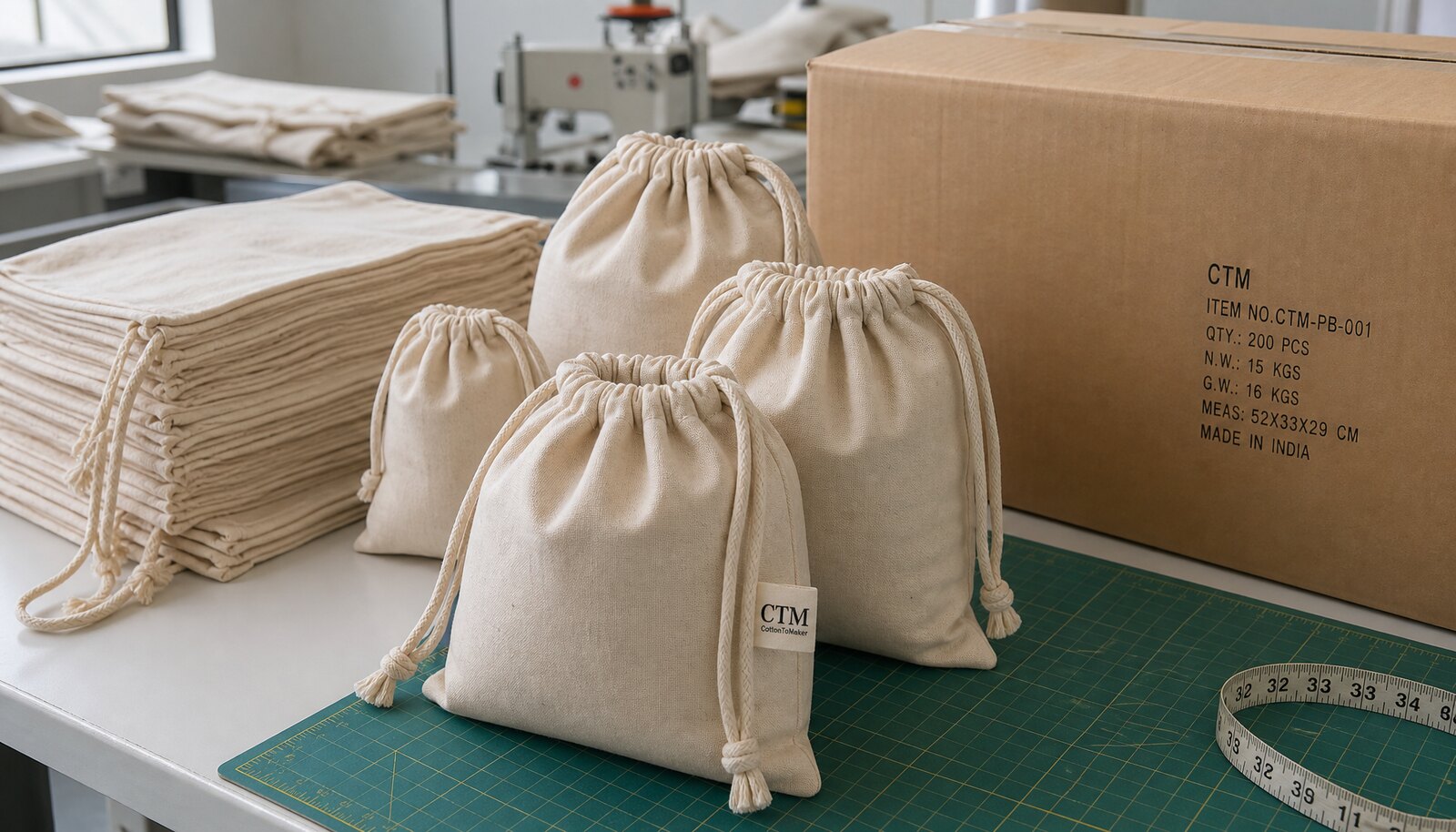
Why carton packing matters in a gift-shop program
For gift-shop buyers, the carton plan is part of the product spec. A cotton drawstring pouch can look good in a sample room and still create problems at receiving if the outer carton is too heavy, the count is awkward to verify, or the print gets creased before the first store opens the box. That is why the pack is not an afterthought. It affects freight, labor, damage risk, and shelf readiness.
The wrong carton plan also hides operational problems. An oversized carton can cost more in freight and still deliver fewer saleable units per cubic meter. A loose pack can tangle cords, crease the pouch face, and make count verification slow. For B2B procurement, the goal is not to maximize the number of pouches in one box. The goal is to keep the shipment readable, protect the retail appearance, and make the receiving team faster.
- Plan for receiving speed, not just export efficiency.
- Keep carton weight manageable for warehouse staff and store teams.
- Use one carton logic for each SKU so counts are easy to audit.
- Ask for packed-carton photos before you release bulk.
Start with pouch size, fill weight, and GSM
Cotton drawstring pouches are easier to buy when the spec starts with the contents, not the fabric alone. A small jewelry pouch or sachet pouch does not need the same body as a pouch for candles, mugs, or small gift sets. As a practical starting point, 100 to 120 GSM works for light-duty pouches in the 8 x 10 cm to 10 x 12 cm range. Buyers usually move up to 120 to 140 GSM for the common 12 x 16 cm to 15 x 20 cm gift-shop size, where the pouch needs more structure and a better shelf look. Once the pouch gets larger, carries heavier contents, or needs to hold a premium shape after packing, 140 to 180 GSM is often the more defensible range.
The fabric weight should always be matched to the real use case. A pouch that holds a lightweight soap bar does not need the same structure as one carrying a ceramic trinket, candle tin, or multiple small items. Natural cotton usually fits a rustic or eco-led gift-shop look, while bleached cotton gives a cleaner background for bright logos and cleaner shelf presentation. The key is not to chase the lowest fabric cost. The key is to select a GSM that survives packing, transport, and repeated handling without collapsing into a soft, misshapen bag.
- 8 x 10 cm to 10 x 12 cm: 100 to 120 GSM is usually enough for light contents.
- 12 x 16 cm to 15 x 20 cm: 120 to 140 GSM is a common buyer-friendly range.
- 20 x 25 cm and up: 140 to 180 GSM is safer for shape retention and heavier fills.
- Use the pouch weight class, not just the flat size, to decide GSM.
- If the pouch must stand on shelf, weight and weave matter more than lowest price.
Choose the decoration method with carton behavior in mind
The decoration method changes both appearance and packing behavior. A one-color screen print is usually the cleanest choice for a simple gift-shop pouch because it sits flat, keeps setup manageable, and tends to repeat consistently across a production run. Heat transfer can work when the artwork has more detail or more colors, but it can introduce a different hand feel and needs tighter packing control so the print surface does not scuff in transit. A woven or sewn label is useful when the brand wants a more durable retail mark without heavy ink coverage on the pouch face.
Print placement matters as much as the print method. A logo too close to the channel or seam can fold awkwardly in the carton and land with a permanent crease. Large solid prints also affect how neatly the pouch stacks, which changes carton yield and can increase carton height. For procurement, the print decision should be made together with the carton plan. If the decoration changes the fold behavior, it changes freight, count accuracy, and receiving speed.
- Use screen print for simple logos and repeatable bulk orders.
- Use heat transfer only when the artwork detail justifies the added handling risk.
- Use woven or sewn labels when the brand wants a premium mark that will not crack.
- Approve print placement against the actual pouch body, not only against flat artwork.
Set MOQ from the actual setup steps
MOQ should reflect the number of setup steps, not just a supplier's headline minimum. One size, one fabric color, one print method, and one carton mark is straightforward. Add a second size, another print color, a retail hang tag, a barcode label, or a store-split carton plan, and the practical MOQ rises because the factory has more cutting, printing, labeling, and packing work to coordinate. That is why two quotes can look similar on the unit price but still be built on very different production assumptions.
For sourcing conversations, a simple 8 x 10 cm to 10 x 12 cm pouch on stock fabric with one-color print often starts around 3,000 pieces. A 12 x 16 cm to 15 x 20 cm pouch with 120 to 140 GSM, retail labels, and a cleaner carton plan often lands closer to 5,000 pieces. If the order includes mixed assortments, printed cartons, or store-split packing, the practical MOQ may move to 8,000 pieces or more across the program. Those are not universal rules. They are useful starting points so the buyer can judge whether the quote matches the complexity of the job.
- Quote by one size, one fabric, one decoration method, and one carton plan.
- Ask the supplier which line item is driving MOQ up: sewing, print setup, labels, or packing.
- Do not compare a loose-bulk quote against a retail-ready quote as if they were the same offer.
- If MOQ rises, ask for the smaller-price delta that would come from simplifying the pack.
Define the carton plan by the receiving team, not by the exporter
Gift-shop buyers usually need one of three carton logics: bulk cartons for fast warehouse handling, store-split cartons for direct allocation, or mixed assortment cartons for curated display sets. Bulk cartons are easiest to produce and audit, but they still need clear labels and a count that the warehouse can verify quickly. Store-split cartons reduce downstream labor when cartons go straight to branches, but they need better labeling and tighter count control. Mixed assortment cartons can work well for gift sets or souvenir programs, but they are the easiest place for picking errors to hide.
A useful carton plan starts with handling limits. If the carton is too heavy, staff will rework it or damage it. If it is too large, freight efficiency drops and the warehouse has to move more air. If the pouches are printed or labeled, overfilling the carton can damage the retail face before the product ever reaches the shelf. The carton should protect the saleable appearance of the pouch, not just survive export.
- Bulk cartons fit warehouse-driven replenishment.
- Store-split cartons fit chain retail allocation.
- Mixed assortments fit curated gift displays but need tighter SKU control.
- Choose a carton weight that staff can handle without repacking or damage.
- Use carton marks that match the PO, SKU, color, and count exactly.
Use a worked packout spec before you ask for freight
A concrete packout spec helps a buyer compare suppliers on something real. For example, a 15 x 20 cm pouch at 120 GSM with one-color screen print can be quoted with a pack like this: 240 pieces per master carton, folded face-to-face in 6 bundles of 40, carton size around 46 x 36 x 30 cm, and gross weight around 6.8 kg. For pallet loading, that could mean 4 cartons per layer, 5 layers per pallet, or 20 cartons total on a 1200 x 1000 mm pallet, with a max pallet height around 1200 mm. That is not a universal standard. It is a procurement example that shows the level of specificity needed to compare quotes properly.
The unit count in the carton is not a fixed rule. A smaller pouch may justify a higher carton count if the gross weight stays manageable and the folds stay clean. A larger or heavier pouch may need a lower count so the carton does not crush the top layer or push the freight cost too high. The useful question is always the same: what carton count gives you a safe gross weight, a clean pack, and a pallet pattern that your warehouse can receive without repacking?
- Example pouch: 15 x 20 cm, 120 GSM, one-color print.
- Example master carton: 46 x 36 x 30 cm.
- Example unit count: 240 pcs per carton in 6 bundles of 40.
- Example gross weight: about 6.8 kg.
- Example pallet pattern: 4 cartons per layer, 5 layers high, 20 cartons per pallet.
Lock QC gates before bulk sewing and packing
Quality control for pouch programs should start before the order moves into bulk. First confirm a blank sample so you can check fabric hand feel, finished size, seam behavior, and drawcord action. Then review a decorated sample, because a logo that looks balanced on artwork can land too high, too low, or too close to the seam once it is stitched on the real pouch. The last step before bulk should be a packed carton sample or packed-carton photo set, so the supplier proves the fold direction, bundle count, carton marks, and loading logic.
The QC standard should be simple enough to audit on the floor. The stitching must be even, the cords must slide smoothly, and the printed area should not crack or rub in a dry test. Carton count must match the PO exactly, and the carton labels should match the color, size, and SKU code. If the buyer asked for a pallet pattern, that pattern should be visible in the packed-carton approval set before anything ships.
- Check blank sample, decorated sample, and packed carton sample in that order.
- Test the pouch with the real fill weight, not just a theoretical dimension.
- Verify that print placement stays away from the channel and seam line.
- Confirm carton marks, counts, and pallet height before release.
- Ask for a pre-shipment carton photo so the warehouse can plan receiving.
Compare quotes on landed cost and supplier control
A low unit price can hide a more expensive landed result if the carton plan is weak. A loose-packed carton may reduce factory labor but cost more in freight because the cartons are larger or less efficient on a pallet. A cheaper quote may also exclude the items your warehouse still needs, such as labels, barcode stickers, inner bundles, or carton marks. Once those costs are added back in, the quote can move above a supplier that priced the complete pack correctly from the start.
The cleanest way to compare suppliers is to put every quote on the same basis: the same pouch size, same GSM, same print method, same carton count, same inner packaging, same destination, and same Incoterm. Then compare not only the unit price but also the packing labor, carton efficiency, and rework risk. Example: if one supplier quotes $0.23 per pouch on 10,000 pieces, adds $200 in packing extras, and lands freight plus destination handling at $900, the total landed cost is $3,400 or $0.34 per piece. If another supplier quotes $0.21 but needs more packing labor and a larger carton that pushes freight higher, the lower headline price may be the more expensive option.
- Compare quotes only after the spec, carton count, and destination are identical.
- Include inner packs, labels, and carton marks in the quote comparison.
- Watch the carton density as well as the unit price.
- Treat rework risk and receiving labor as real procurement costs.
Use one RFQ format so suppliers quote the same thing
A clear RFQ prevents most comparison problems before they start. Tell suppliers the finished pouch size, fabric GSM, color, drawcord style, print method, artwork size, carton count, inner packaging rules, carton label format, destination, and the Incoterm. Add the sample stages you want and the QC checkpoints you expect before shipment. The more exact the packing plan, the less room there is for a supplier to fill in missing assumptions on your behalf.
For a recurring program, the RFQ should become the master spec. That file should control future reorders so the carton count, label format, and sample approval process do not drift over time. If you need a second option, ask the supplier to quote three lanes in the same response: a stock spec, the recommended spec, and a retail-ready pack. That makes the tradeoff between unit price, packing labor, and freight visible without forcing you to re-brief each vendor separately.
- One RFQ should define size, fabric, decoration, and carton logic.
- Ask for three quote lanes when useful: stock, recommended, and retail-ready.
- Include sample approval stages and QC thresholds in the first request.
- Use the same RFQ on every supplier so the quotes remain comparable.
- Treat carton plan changes as spec changes, not minor edits.
Protect reorder quality when the program scales
Most repeat-order problems happen after the first approval. A reorder can drift because the supplier substitutes a slightly different fabric lot, changes the fold direction, packs cartons a little tighter, or updates carton artwork without flagging the change. For a gift-shop program, that drift matters because the pouch is usually part of a retail presentation, not just a disposable shipping item. Buyers should freeze the master sample, the carton spec, and the label file so every reorder follows the same approved standard.
A stable reorder file also helps seasonal planning. If you know the exact carton count, gross weight, and pallet pattern, you can forecast warehouse space and freight more accurately before the next campaign. Keep the packed-carton photo set, the carton mark artwork, the approved sample, and the supplier response on the same record. That gives purchasing, logistics, and receiving one source of truth when the program is repeated.
- Freeze the approved sample so later reorders stay on spec.
- Keep the carton mark artwork and packing list format in the reorder file.
- Record the fabric lot, print version, and label version for traceability.
- Use the same carton count and pallet pattern unless a formal change is approved.
- Ask for pre-shipment photos on every repeat order, not only the first one.
Specification comparison for buyers
| Supplier model | Best fit | What to verify | Quote risk to watch |
|---|---|---|---|
| Stock inventory seller | Fast replenishment, test buys, or seasonal fill-ins | Actual size, fabric weight, print consistency, and carton labels | Mixed lots can hide count drift or shade variation |
| Direct factory, standard spec | Repeat orders with one size, one fabric, one print | Who cuts, sews, prints, and packs; ask for line photos | A low unit price may exclude packing labor or labels |
| Direct factory, custom carton pack | Gift-shop chains and distribution programs that receive by store or by SKU | Carton count, gross weight, carton dimensions, and pallet pattern | Packing changes can raise MOQ or extend lead time |
| Trading company | Mixed sourcing needs or early-stage programs | Which factory actually makes the pouch and who signs off on QC | The quote may hide packing or freight assumptions |
| Regional converter | Short lead times or lower inland freight to your warehouse | Fabric lot consistency, print control, and carton repeatability | Imported fabric or trim can shift color and hand feel |
| Private-label manufacturer | A permanent branded pouch line | Artwork approval steps, label placement, and change fees | More rounds of approvals before bulk starts |
| Assortment packer | Curated gift-shop displays or multi-item sets | How each SKU is separated, counted, and marked in the carton | Receiving errors can stay hidden until store allocation |
| Consolidation service | When pouches ship with other gift items under one inbound plan | Carton marks, packing list detail, and SKU separation | Good freight math but weak receiving clarity if labels are messy |
Buyer checklist before sampling
- Lock finished pouch size by usable fill, not by flat cut size alone.
- Choose fabric GSM and color before asking for pricing.
- State the product weight or contents the pouch must carry.
- Specify one print method, one print position, and the maximum number of print colors.
- Say whether cartons must be packed by SKU, by store, or as a mixed assortment.
- Define target carton count, gross weight ceiling, and whether inner polybags are allowed.
- Ask for carton dimensions and pallet loading estimates in the first quote.
- Request a blank sample, decorated sample, and packed carton photo before bulk approval.
- Set tolerance bands for size, stitching, print placement, and carton count.
- Match every quote to one Incoterm and one destination so freight is comparable.
Factory quote questions to send
- What pouch size and fabric GSM do you recommend for this item weight, and why?
- What is your MOQ by size, color, print method, and carton packing format?
- If I move from 120 GSM to 140 GSM, what changes in price, lead time, and carton count?
- Which print method will you use, and what setup charges apply for screens, plates, or artwork changes?
- Can you quote the pouch with and without inner polybags, barcodes, and retail labels?
- What carton count do you recommend for this size, and what gross weight will each carton reach?
- What are the carton dimensions, CBM, and pallet pattern for your proposed pack?
- Can you give a second quote for a retail-ready pack versus a bulk pack so I can compare labor and freight?
- What sample stages do you provide before bulk: blank sample, decorated sample, and packed carton sample?
- What QC checks do you run before packing and before shipment?
Quality-control points to confirm
- Fabric GSM should match the approved target within the agreed tolerance for the program.
- Finished pouch size should stay within tolerance so the intended gift item still fits cleanly.
- Stitching should be even, with no skipped stitches, seam gaps, or loose threads at stress points.
- Drawcord action should be smooth, with secure stopping and no fraying after repeated opening and closing.
- Print placement should match the approved artwork and stay clear of the drawstring channel, seam line, and fold line.
- Printed areas should not show obvious rubbing, cracking, or transfer in a dry rub check.
- If woven labels are used, the label position and stitching should be consistent across the full order.
- Carton count should be exact by SKU, with carton marks matching the PO, color, size, and quantity.
- Packed carton photos should show the inner arrangement, bundle count, and label placement before shipment.
- Pallet height and carton orientation should match the agreed loading plan so cartons do not crush in transit.