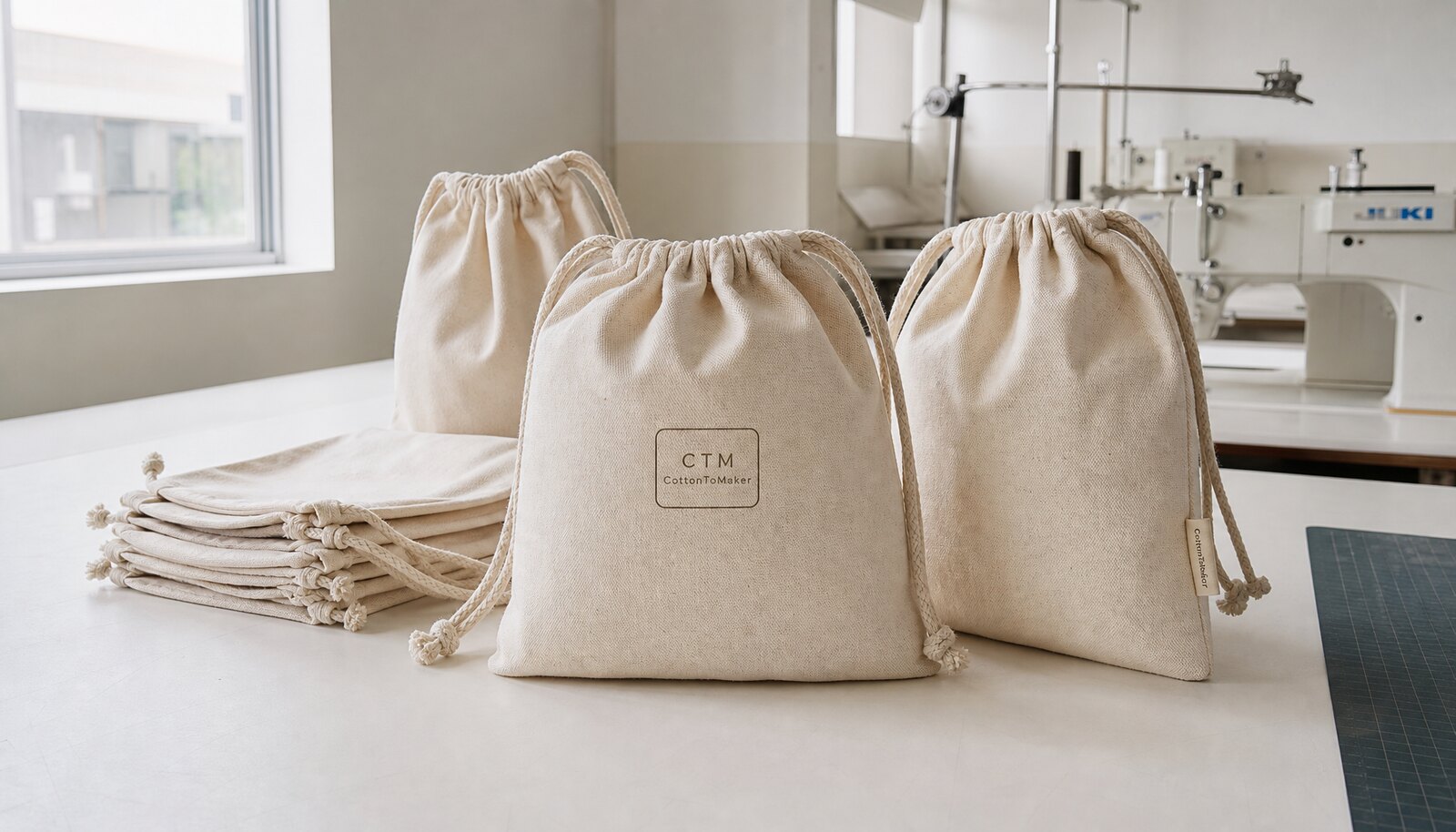
Why logo placement changes the buying decision
For gift shops, a cotton drawstring pouch is not just packaging. It is part of the presentation, part of the resale experience, and often the first branded surface the customer sees after opening a gift set. That means logo placement affects more than aesthetics. It affects shelf clarity, perceived value, warehouse handling, and whether the pouch still looks intentional after it is tied, folded, tagged, and repacked.
Buyers sometimes treat logo position as an artwork question and only later discover that the product itself makes the decision. A mark that looks balanced on a flat art board can disappear once the cord is pulled tight. A design that looks premium in a mockup can land on a seam, fold line, or channel edge and suddenly look cheap. For wholesale cotton drawstring pouches for gift shops, placement is a functional spec, not a cosmetic preference.
- Use placement to support the retail role of the pouch, not just the brand mark.
- Check the logo in the same condition the customer will receive it: filled, cinched, folded, and packed.
- Treat the pouch size, fabric weight, and cord layout as part of the logo decision, because all three change how the artwork reads.
Start with a spec sheet before you discuss artwork
The most efficient buying process starts with a pouch spec, not a logo file. Before you ask a supplier to quote, define size, fabric weight, weave density, cord style, seam construction, and intended use. If the pouch holds jewelry or sachets, a lighter body may be enough. If it holds candles, soaps, or mixed gift items, the pouch needs enough structure to stay upright and show the logo without collapsing. A good spec sheet tells the supplier what the pouch must do in use, not just what it should look like in a photo.
Cotton weight matters, but it is not the only fabric variable. A smoother weave often gives cleaner print edges than a coarse weave at the same GSM. Pre-shrunk or washed fabric may reduce size drift, but it can also change hand feel and cost. If your buyer group wants a softer, more natural look, ask for the actual finish and not just the fiber content. Supplier claims like '100% cotton' are not enough for decision-making unless they also define the weave, finish, and tolerance on the finished pouch.
- Define the intended contents and typical fill weight before approving size.
- Ask for the actual fabric finish, not only the fiber composition.
- Request a measured spec for body width, height, seam allowance, and drawcord channel depth.
Use placement rules that survive production, packing, and display
Center front is the easiest logo position to read from a distance, so it is often the right default when the pouch itself carries the brand. It works best for simple one-color marks, short names, and clean icon-style logos. The downside is that center placement can lose visibility if the pouch is cinched tightly or packed with a heavy insert that pulls the front panel into folds. That is why center placement should be checked on a filled sample, not only on a flat blank pouch.
Lower-front placement is a better answer when the top part of the pouch needs to stay open for a hangtag, a ribbon, or a visible product inside the bag. It also helps if the drawcord channel is visually heavy or if the pouch will be tied in a way that obscures the upper panel. Side placement and side labels create a more restrained retail look, but they make sense only when the buyer values a subtle finish and can accept less logo visibility from the shelf. Back-panel placement is useful when the front needs to stay clear for barcodes, seasonal stickers, or product messaging.
The practical rule is simple: keep the critical part of the logo out of the areas that change shape. Avoid the top channel, side seams, and fold lines. Ask the factory to mark the exact artwork window on a production drawing, not just on a mockup. That drawing should show seam allowance, safe margins, and the usable print area after sewing.
- Center front gives the strongest visibility, but only if the pouch is usually seen open or lightly cinched.
- Lower-front keeps the top field cleaner and can preserve the logo when the bag is tied tightly.
- Side labels work for premium positioning, but they should not interfere with stacking, folding, or display trays.
- Always confirm the artwork window on a dimensioned production drawing.
Choose the decoration method by risk, not by habit
Screen printing is still the most practical choice for many wholesale cotton drawstring pouches because it gives stable repeatability, low decoration cost at volume, and good visual clarity on plain cotton. It is the method to prioritize when the logo is simple, the color count is low, and the order will repeat. For buyers, the key question is not only whether screen print is available, but whether the factory can control registration, ink opacity, and edge sharpness on the actual fabric weight you are buying.
Heat transfer is more flexible for short runs or changing artwork, but it carries durability risk. On a pouch that will be handled, folded, and possibly rubbed against other retail items, a weak transfer can crack, lift, or show edge wear sooner than expected. Woven or sewn labels move the brand into a more tactile, premium lane and can be a good choice if you want a subtle logo with a retail feel. Embroidery can look strong on heavier cotton, but it can also pucker lighter fabric and distort a small pouch panel. Use it only when the body weight and panel size can support the stitch density.
The comparison should include failure modes, not only price. Ask which method has the best resistance to rubbing, folding, moisture, and storage compression. Also ask whether the factory performs a wash or rub test on the actual pouch size before bulk approval. That answer tells you more about process maturity than a vague promise that the print is 'good quality.'
- Screen print is the default for stable, repeatable programs with simple artwork.
- Heat transfer is acceptable for short runs, but ask directly about cracking and rub resistance.
- Woven or sewn labels suit premium retail positioning and subtle branding.
- Embroidery should be limited to heavier pouch bodies that can handle stitch density without puckering.
Compare factories by verification, not by promises
A strong quote is backed by proof. Ask the supplier to identify the actual manufacturing site, the decoration site, and the packing site. If those are not the same place, you need to know which facility is responsible for which defect. A clean price means little if the seller cannot show who owns fabric inspection, print setup, sewing control, and final packing. For procurement buyers, factory verification is not optional because it determines who carries the risk when a pouch fails placement, staining, or count accuracy.
Certification needs similar discipline. If a supplier mentions ISO, BSCI, SEDEX, GOTS, or another program, do not accept the label alone. Ask for the certificate number, scope, validity date, and the legal entity named on the document. Not every cotton pouch order needs a certification requirement, but if your retail customer asks for it, the supplier must be able to show real paperwork. The same logic applies to test reports. A report is useful only if it covers the product type you are buying, comes from a credible lab, and matches the factory and product specification on the purchase order.
You should also ask how the supplier handles nonconforming material. What happens if incoming cotton has oil stains, if the print shifts, or if stitching opens during inspection? A serious factory can describe its rejection, rework, and reinspection process clearly. If the answer is vague, the factory is probably relying on downstream sorting instead of process control.
- Request the actual factory name, not just the selling company name.
- Verify certification scope, issuing body, validity date, and legal entity.
- Ask what happens when incoming fabric, decoration, or packing fails inspection.
- Prefer suppliers that can describe their defect containment process without hesitation.
Write the RFQ so quotes are comparable line by line
A useful RFQ makes suppliers quote the same product on the same basis. Include size, GSM, weave or finish, cord type, logo placement, decoration method, number of colors, acceptable placement tolerance, packing format, and target ship date. If the pouch will be sold in a gift set, include the fill item or its weight range. That context changes how the pouch behaves and how the supplier should recommend placement and construction.
The RFQ should also make the approval path explicit. State which sample is binding, what tolerances are acceptable, and whether the factory may change decoration method if the original choice is unstable at bulk. Good suppliers use that detail to price accurately. Weak suppliers use vague RFQs to hide assumptions, then later charge for every change. The more precise your RFQ is at the start, the less time you spend translating different quote formats into a real comparison.
When comparing bids, separate the pouch body, print or label, packing materials, case marking, and freight. Do not compare a full landed cost from one supplier against a factory gate price from another. That produces false savings. Compare like for like, then decide based on control, quality evidence, and lead-time reliability. The cheapest quote is not useful if it omits a setup cost or assumes a packing format your warehouse cannot receive efficiently.
- Include exact pouch dimensions, GSM target, print area, and finish in the RFQ.
- State the fill item or use case if the pouch will be used inside a gift set.
- Require the supplier to quote body, decoration, packing, and freight separately.
- Name the approval sample and the tolerance rules in the RFQ, not after the order is placed.
Use samples to test the pouch in real use, not just on paper
A flat artwork proof only confirms that the design file exists. It does not prove that the logo will sit correctly on fabric after stitching, folding, filling, and tying. The sample process should include at least one pre-production sample and a bulk-reference sample that both sides sign off. The best test is a filled pouch, cinched the way it will actually be sold, with the intended contents or a realistic weight substitute inside. That is the only way to see whether the logo shifts, hides in a fold, or loses clarity across the fabric grain.
The sample review should be measured, not subjective. Check the logo width, height, and position from the top seam and side seam. Measure the blank margins around the artwork. Compare the sample against the approved drawing and not just against memory. If the pouch is part of a gift assortment, place it beside the other components during sample review. A logo that looks perfect alone can clash with a ribbon, box, tissue, or hangtag once the full set is assembled.
A useful supplier will also show the first article from production before the rest of the order is run. That is the moment to catch a wrong placement, the wrong shade, a channel distortion, or a print that is too light on natural cotton. If the first article is wrong, stop the run. It is cheaper to rework one piece than to sort thousands later.
- Review the pouch filled and cinched, not only flat.
- Measure placement from seams and compare it to the signed-off drawing.
- Use the same lighting and folding method that the finished order will have.
- Require first-article approval before the full run continues.
Set QC standards that the factory can actually inspect
Good quality control for cotton pouches should be specific enough that the factory can inspect it and your inspector can enforce it. AQL is the right starting point for lot acceptance, but the buyer should also define the defects that are critical, major, and minor. For example, a loose thread may be minor, but a seam opening, wrong logo placement, or wrong pouch size is usually a major or critical defect depending on the use. If you do not define the defect class, the factory will classify problems in the most favorable way for shipment.
Set targets for the physical characteristics that matter most. Common buyer requirements include a controlled shrinkage limit after wash or damp-heat testing, a colorfastness target for print or label color, a consistent stitch-per-inch range, and a minimum rub resistance for the decoration. The exact threshold should reflect the end use, but the point is to make the standard measurable. A pouch that looks fine in a photo can still fail if the logo cracks after handling or if the fabric shrinks enough to shift the artwork into a seam.
Failure-mode testing is especially useful because it predicts how the pouch will behave after real handling. Ask for checks that simulate folding, rubbing, light moisture, and repeated cinching. A pouch that opens and closes cleanly after these checks is much safer for retail than one that only passes a visual inspection. If the factory cannot explain how it tests for these failures, it is probably relying on final sorting instead of process control.
- Use AQL, but also define which defects are critical, major, and minor.
- Set measurable limits for shrinkage, stitch density, print rub resistance, and colorfastness.
- Test the pouch for folding, rubbing, moisture exposure, and repeated cinching.
- Reject glossy promises that are not backed by a repeatable inspection method.
Packing, folding, and carton marks can change the retail result
Packing is part of the product, not an afterthought. Decide whether each pouch needs an individual polybag, a size sticker, a barcode, a hangtag, or an insert card. If the pouch will be retailed directly, packing should preserve the shape and keep the logo cleanly visible. If the pouch will be shipped as an internal gift component, the packing can be simpler, but it still needs to protect the fabric from creasing, moisture, and warehouse dirt. The wrong fold can make a well-printed pouch look off-center the moment it is opened.
Carton discipline matters because gift shop buyers often receive mixed colors and sizes in the same inbound program. Ask for clear carton marks, consistent case counts, and a master carton label format that matches your warehouse workflow. If your team scans barcodes at receiving, put the barcode where it can be read without opening the pack. If your team sorts by color, make sure the outer carton marking is obvious. These are small details, but they save time and reduce receiving errors every time the product moves through the supply chain.
Also confirm whether the supplier uses moisture protection, desiccant, or lining for long transit. Cotton can absorb odors and dampness, and a pouch that arrives with a storage smell immediately damages the retail impression. For higher-value gift shop programs, a cleaner pack format is worth more than a marginally lower unit price.
- Approve the fold method because it changes how the logo appears on opening.
- Match carton marks to your receiving and inventory workflow.
- Use moisture protection when transit conditions or storage time make it necessary.
- Keep case counts consistent so replenishment is fast and accurate.
Lead time and landed cost should be reviewed together
The real lead time for wholesale cotton drawstring pouches includes fabric sourcing, potential pre-treatment, decoration setup, sampling, sewing, packing, carton labeling, and export booking. If the supplier gives you only a single lead-time number, ask for the breakdown. The breakdown shows where delays can happen and whether a late artwork change will force a new screen, new label run, or a full resample. That is the kind of schedule risk procurement buyers need to see before they commit to a retail launch date.
Landed cost should be reviewed with the same discipline. Freight, carton cube, packing style, and setup charges can change the real unit cost more than the pouch body price does. A lower FOB quote can be weaker if it comes with oversized cartons, inefficient folding, or a decoration method that needs expensive packing steps. Compare the same spec across suppliers: same GSM, same size, same placement, same decoration method, same pack format, and same shipping basis. If the quotes still differ, choose the supplier with the cleaner process, better sample record, and more transparent defect responsibility.
For reorder planning, ask how pricing changes if you hold the body constant but vary the art placement, cord color, or packing format. That information helps you keep future launches flexible without forcing a full product redesign. It also tells you which variables actually drive cost and which are just procurement noise.
- Break lead time into fabric, setup, sewing, packing, and shipping.
- Compare landed cost on the same spec, not on mixed assumptions.
- Ask which changes trigger a new setup charge or a new sample run.
- Use reorder planning to understand which variables drive the true cost.
Specification comparison for buyers
| Spec decision | Recommended option | When it fits | Buyer risk to check |
|---|---|---|---|
| Sourcing route | Direct factory with in-house sewing and decoration | Best when you need one accountable producer for fabric, stitching, logo application, and packing across repeat orders | Verify that the same site actually handles both sewing and decoration; otherwise the factory may quote as if it controls the whole process when it only coordinates subcontractors |
| Sourcing route | Trading company with named factory disclosure | Useful when you are launching several SKUs at once, need mixed categories, or want one commercial contact for procurement | Ask for the real factory name, decoration site, and inspection responsibility; hidden markups and unclear defect ownership often sit in the middle layer |
| Sourcing route | Stock pouch with local overprint or relabeling | Works for rush programs, seasonal gift sets, or a pilot run before you commit to larger reorder volumes | Check shade consistency, print-area limits, and whether the stock pouch dimensions leave enough flat space for clean placement |
| Logo placement | Center front | Best for gift shop pouches that need immediate shelf recognition and simple brand recall | Confirm the mark still reads clearly after cinching; a centered design can disappear if the pouch is usually tied tightly or stacked in a tray |
| Logo placement | Lower-front or lower-third | Useful when you want the upper field to stay open for fold lines, hangtags, or product visibility | Keep the artwork clear of the drawcord tunnel and leave margin so stitching and side tension do not deform the print |
| Logo placement | Side label or seam label | Good for premium retail presentation where the branding should feel subtle rather than promotional | Check that label stiffness does not affect drape, stacking, or the way the pouch sits in cartons and display trays |
| Decoration method | Single-color screen print on 120 to 160 GSM cotton | A strong default for stable repeat programs with bold marks and moderate artwork complexity | Ask for rub resistance, ink opacity on natural cotton, and whether fine text survives the fabric weave |
| Decoration method | Woven or sewn label | Fits premium lines, subtle branding, and designs where tactile finish matters more than large logo visibility | Verify thread color, label edges, and whether the label changes the pouch silhouette or adds packing friction |
| Packing route | Flat-folded, counted, and carton-marked by size and color | Best for distributors and gift shops that need fast receiving, clean inventory counts, and predictable shelf replenishment | Confirm whether the logo remains visible or creased after folding; the wrong fold can make the pouch look off-center when opened |
Buyer checklist before sampling
- Lock the pouch size, fabric weight, weave density, drawcord style, and intended insert weight before asking for art proofs.
- Approve logo placement on a filled sample, not just on a flat pouch image.
- Ask the supplier to state the usable print area after seam allowance, cord channel, and fold line are removed.
- Require a line-by-line quote that separates pouch body, decoration, packing, carton marks, and inland freight.
- Specify whether the pouch must arrive individually polybagged, folded a certain way, or packed by size and color.
- Request both a pre-production sample and a photo of the first production piece before bulk continues.
- Set carton count, master carton marking, and barcode placement before production starts.
- Keep one golden sample signed by both sides and use it as the final bulk reference.
- Ask for third-party certificates or test reports only if the supplier can identify the issuing lab, product scope, and validity date.
- Define your acceptance plan in advance, including AQL level, shrinkage limit, colorfastness target, and print durability threshold.
Factory quote questions to send
- What exact GSM are you quoting, and what tolerance do you allow on bulk fabric weight?
- Who actually performs the printing or label attachment, and is that work in-house or subcontracted?
- What is the usable print area after seams, top channel, and fold allowance are removed?
- How many colors are included in the quoted decoration price, and how much does a second placement add?
- What is the MOQ by pouch size, color, and artwork position, and can any of those be combined across SKUs?
- What packing format is included: individual polybag, folded bulk pack, insert card, sticker, carton count, and outer carton marks?
- Which sample stage is the final approval reference for bulk inspection?
- What lead time assumptions are built into the quote for fabric sourcing, decoration setup, sewing, packing, and export booking?
- Can you provide the factory name, audit date, and any current social, quality, or environmental certification that applies to this product line?
- What happens if the first production lot fails placement, shrinkage, or print-durability checks; who pays for rework or replacement?
Quality-control points to confirm
- Fabric weight matches the approved GSM target within the agreed tolerance.
- Bulk shrinkage after a controlled wash or damp-heat test stays within the buyer's limit, and the pouch still opens and closes cleanly.
- Pouch dimensions remain within the accepted size range, and both sides look symmetrical when filled.
- Logo placement matches the approved sample and stays clear of seams, the drawcord channel, and fold lines.
- Print edges are sharp, with no smudging, pinholes, ghosting, or cracking after normal handling and rub testing.
- Stitching is even, with no skipped stitches, loose threads, broken topstitching, or popped side seams.
- Stitch density is consistent with the buyer spec, commonly targeting an even seam appearance rather than visible gaps or over-compressed fabric.
- Drawcord slides smoothly and cinches without twisting, snagging, or uneven channel tension.
- Cotton surfaces are clean, dry, and free from oil marks, stray fibers, mildew odor, or storage stains.
- Cartons are packed to the agreed count, labeled correctly, and protected so the pouches do not arrive creased, damp, or compressed beyond recovery.