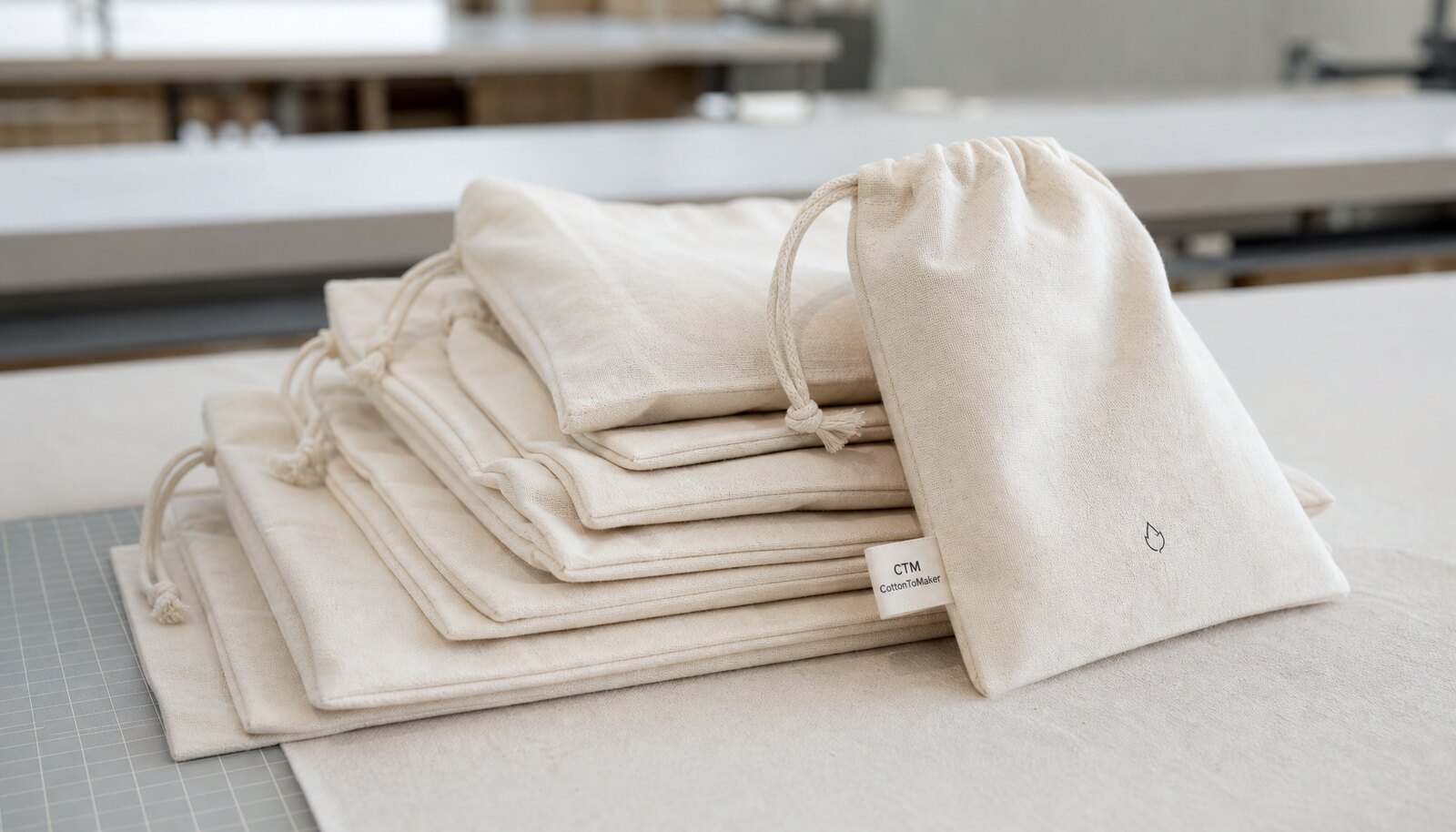
Work Backward From the Gift-Shop Selling Date, Not the Purchase Order Date
For wholesale cotton drawstring pouches for gift shops, the only date that truly matters is the date the product has to be ready for shelf, display, or distribution. Buyers often lose time because they begin counting from PO issue date or artwork approval date and forget that the factory clock includes material booking, sample approval, bulk sewing, decoration, packing, inspection, and freight booking. If the pouches are meant for a holiday aisle, a museum shop, a seasonal promotion, or a chain-store gift set, the schedule should be built backward from the launch window with a buffer for rework and transit delays. That buffer is not waste; it is the difference between a planned launch and a missed season.
A usable planning sheet should separate three blocks: pre-production, bulk production, and post-production logistics. Pre-production includes tech pack review, sample round, and material confirmation. Bulk production includes cutting, sewing, branding, and packing. Logistics includes carton finalization, inspection booking, freight reservation, and customs or delivery coordination if needed. The more custom the pouch, the more time must be placed in the first two blocks. A stock blank with no decoration may move quickly, but a gift-shop order with custom-dyed cotton, retail labels, or mixed SKUs needs a schedule that is more deliberate.
The buyer should also ask one simple question before requesting a quote: what is the latest acceptable delivery date that still leaves enough days for receiving, counting, and shelf setup? That answer tells you whether the order can move by ocean, needs partial air shipment, or should be split into a first shipment and a follow-up replenishment. This matters especially for gift shops because sell-through timing is often tied to tourism peaks, holidays, or event calendars rather than normal replenishment cycles. The best procurement result is not the shortest stated lead time; it is the lead time that aligns with the selling date without relying on last-minute rescue shipping.
- Set the shelf or distribution date first, then count backward for sample approval and freight.
- Treat sample sign-off as a real production gate, not an administrative checkpoint.
- Add extra time if the order includes custom fabric color, retail-ready packing, multiple sizes, or a tight holiday deadline.
- Confirm whether the delivery date includes arrival at destination, not just factory completion.
Choose Cotton Weight Around Shelf Feel, Product Load, and Sewing Speed
Fabric weight affects more than unit cost. It changes how the pouch sits on a display table, how much it protects the product inside, and how quickly the sewing line can complete each unit. A lightweight cotton pouch, often around 100-120 gsm, is usually suitable for jewelry, small cards, sachets, sample kits, or other low-weight contents. It keeps the price competitive and is easier to pack in volume, but it may look too flat or too transparent if the gift shop is aiming for a premium presentation. If the pouch is too light for the product, the opening may also lose shape more quickly after repeated handling by shoppers.
For gift-shop assortments that need a fuller and more durable handfeel, 140-180 gsm is often the safer range. It gives the pouch more structure, reduces show-through, and handles heavier items such as soap bars, small candles, stones, cosmetic kits, or souvenir bundles more comfortably. Heavier cotton can increase sewing time and freight weight, but it also lowers the risk of customer complaints about flimsy construction. That tradeoff is often worth it when the pouch is part of the product experience rather than just outer packaging.
The buyer should not approve gsm in isolation. Ask for the cotton type, finish, shrinkage behavior, and whether the fabric is natural, bleached, or dyed. Natural cotton can be the right choice for a handmade or eco look, but the buyer should check for color consistency and any visible slubs that may be acceptable in one market and rejected in another. If the pouch is meant to be reused, the thread count, seam strength, and cord tension should be considered together with gsm. A lightweight pouch with strong contents and weak seams tends to create more risk than a slightly heavier bag with balanced construction.
- Use 100-120 gsm for light inserts, small souvenirs, and price-sensitive gift-shop programs.
- Use 140-180 gsm when the pouch must feel premium or carry harder, heavier items.
- Match fabric weight to seam strength and cord load instead of choosing gsm only by price.
- Ask for a swatch or fabric photo under the intended print color to confirm opacity and handfeel.
Branding Method Changes the Production Calendar More Than Many Buyers Expect
The decoration method is one of the most important lead-time variables in a pouch order. A simple one-color screen print can be efficient because the setup is straightforward and the line can run in volume once the screen and placement are approved. But even simple print needs a clear schedule for artwork confirmation, screen preparation, drying or curing, and a final visual check. If the logo contains small text, thin lines, or precise positioning, the factory may need an extra sample round or a tighter approval tolerance to avoid blurred edges or misregistration in bulk.
Woven labels, sewn brand tags, and other stitched branding methods solve a different problem. They are useful when the logo area is small, the artwork must remain crisp on textured cotton, or the buyer wants a durable brand mark that does not depend on print density. These methods add stitching labor and trim handling, so they are not always faster than print, but they can reduce the risk of poor logo reproduction. For gift shops, the decision often comes down to shelf appearance: do you need a soft, understated pouch, or a more branded item that reads clearly at a glance?
Multiple print colors or multiple branding locations usually add setup time, and the effect is not linear. The first print is usually the cheapest to set up, while the second location or extra color may create a separate alignment and curing step. Buyers should ask whether the supplier is quoting a standard production line or a one-off sample room approach. A sample-room process may look quick for a few pieces but become inefficient in bulk. The most reliable quote is the one that describes the exact process to be used in mass production, not only the desired decoration result.
- Single-color screen print is usually the simplest route for repeat programs.
- Woven or sewn branding is safer when small logos must remain readable on textured cotton.
- Every added print color, print location, or finishing step adds schedule risk.
- Ask for the actual print size in millimeters so the logo does not shrink during production planning.
Compare Sourcing Routes Before You Compare Unit Price
A good procurement comparison starts by identifying the sourcing route, because route choice changes visibility, control, and lead time. A direct factory quote is usually the best option when the buyer needs control over fabric weight, sewing details, print placement, and packing format. It is easier to compare one factory's production assumptions against another's if both are quoting the same construction and the same delivery basis. But direct factory buying only works well if the factory is transparent about who makes the goods, where the material comes from, and whether the approval sample will come from the same line as bulk production.
A trading company can be useful when the buyer needs broader capacity, lower communication effort, or backup sourcing options across more than one plant. The tradeoff is visibility. The quote may look clean, but the buyer should still ask who is making the product, what line will run the order, and whether the trading company has authority to control sampling and bulk production timing. If the answer is vague, the schedule risk is higher than the unit price suggests. Trading companies are not automatically slower or weaker; the key issue is whether the buyer can trace the real production path well enough to manage it.
Stock blank pouches with local decoration are often the fastest way to get a gift-shop program launched, especially when the order is small or the selling window is short. The risk is that the blank may not match the final brand standard in fabric weight, cord style, stitching, or color tone. That option is best for a test run, a rush replenishment, or a low-volume program where the buyer values availability over exact customization. The wrong mistake is to compare a stock blank quote and a fully custom sewn quote as if they were the same product. They are different supply models, and they should be judged on different terms: speed, consistency, control, and repeatability.
- Ask every supplier to state whether they are the factory, a trading company, or a decorator of imported blanks.
- Do not compare a blank pouch plus decoration against a fully custom-sewn pouch without adjusting for scope.
- Use sourcing route as a lead-time and control decision before treating it as a price decision.
- If the order may repeat, ask whether the supplier can hold the same fabric and trim spec for the next buy.
Build a Quote That Can Be Compared Line by Line
A useful RFQ for wholesale cotton drawstring pouches should let the buyer compare one supplier against another without guessing what has been included or omitted. The quote should identify the exact finished size, fabric gsm, cotton type, closure style, branding method, packing format, and delivery basis. If the supplier only gives one all-in price, it may be impossible to tell whether the lower price is coming from thinner fabric, looser seam allowance, a cheaper cord, or a packing method that does not match the gift-shop channel. Procurement teams need the quote to expose the assumptions, not hide them.
The same logic applies to MOQ. A pouch priced for one size, one color, and one logo version is not automatically comparable with a quote that allows multiple colors or split sizes. If the order includes several gift-shop SKUs, ask the supplier to show the price at base spec, then show how the unit cost changes when you add another color or another artwork version. That gives you a clearer picture of whether the factory is charging a real setup fee or simply using variant complexity to protect capacity. It also helps the buyer decide whether to simplify the first order in order to hit the launch date.
A good quote should also state what is already available and what still needs to be sourced. If the supplier says the lead time is short, ask whether that is because the fabric is in stock, the cord is in stock, or a similar order is already in production. If the answer is unclear, the quoted date is just a guess. A schedule only becomes useful when the supplier can explain the starting point. Buyers should also define the delivery term in the request: ex-works, FOB, or delivered to destination. Otherwise, two quotes that look similar may not be comparable at all.
- Require a cost split for fabric, cutting, sewing, branding, packing, and cartons.
- State the MOQ per size, per color, and per artwork version.
- Ask whether the quote assumes stock materials or fresh procurement.
- Request a delivery basis so landed-cost planning is not distorted by hidden freight assumptions.
Approve Samples as a Production Control Point, Not a Courtesy Step
Sample approval is where many pouch programs either become easy to manage or become expensive to rescue. The first sample should confirm construction logic, logo position, cord behavior, and how the fabric feels in hand. It does not need to be perfect in every tiny detail, but it should be close enough that bulk can be repeated without special treatment from the sample room. If the sample looks good only because someone hand-adjusted it outside the normal process, it is not a reliable approval sample for a wholesale order. For gift-shop buyers, the sample should prove the factory can make the pouch at scale, not just one nice piece.
The cleanest process is to define what the approved sample must prove. That usually includes finished size, seam quality, opening behavior, logo clarity, cord length, and packing presentation. If the order includes multiple sizes or colors, approve the base style first and then confirm variants with clearly labeled references. This avoids the common mistake of treating a single sample as approval for several untested versions. It also reduces the risk that later comments are interpreted as a redesign instead of a correction. The buyer should keep comments specific: if the logo is too low by 8 mm, say that. If the cord is too stiff, say that. Vague feedback creates schedule drift.
A strong sample workflow also includes a response rule. For example, the buyer can specify that one round of minor corrections is acceptable, but any change to fabric weight, closure design, or print method requires a new sample and a revised lead time. That prevents the factory from assuming that every comment is a small adjustment. The most useful sample is the one that removes ambiguity before bulk production begins.
- Use one golden sample as the reference for construction, print, and packing.
- Approve the base style first if the order includes multiple colors or sizes.
- Write down the exact reason for any sample rejection so the factory can correct the right issue.
- If a change affects fabric, cord, or decoration method, treat it as a new production input rather than a cosmetic note.
Lock Packing, Carton Marking, and Receiving Format Early
Packing is one of the easiest parts of the order to leave undecided and one of the easiest ways to miss a ship date. For gift-shop programs, the buyer needs to choose between bulk carton packing, inner packs, or retail-ready individual polybags with barcodes and inserts. Bulk packing is cheaper and faster because it uses less labor, but retail-ready packing can be essential if the pouches will go straight to store shelves. The wrong assumption is to leave packing until after sewing is complete. In real production, packing is part of the schedule, and it can become the bottleneck if the order was approved without a clear pack plan.
Carton planning also matters to the receiving team. Retail buyers and distributors often want clean carton splits by size, color, or SKU. They may also need master carton labels, style codes, country-of-origin marking, and barcode placement aligned to warehouse receiving rules. If the pouches are part of gift bundles or multicolor assortments, the carton split should be written down before production starts so the factory does not have to improvise. A carton plan that looks obvious to the buyer may still be unclear to a packing line that is handling multiple variants on the same day.
The buyer should ask for the packing count per inner pack, master carton count, carton dimensions, and gross weight estimate early in the process. Those numbers matter for warehouse storage, pallet planning, and freight booking. If the program is seasonal, even small changes in carton size can affect the shipping method or pallet efficiency. Packing is not just an administrative detail; it changes cost, speed, and how the goods arrive at the destination.
- Decide on bulk packing or retail-ready packing before bulk sewing starts.
- Define carton splits by color, size, style code, and destination requirement.
- Add barcode, country-of-origin, and master carton mark rules to the PO.
- Ask for carton dimensions and gross weight so freight can be booked realistically.
Use Quality-Control Thresholds That Match Retail Reality
QC for cotton drawstring pouches should focus on the defects a gift-shop buyer or end customer will actually notice. The most common issues are uneven seams, loose cords, print misalignment, stains, shade variation, distorted openings, and poor packing accuracy. It is not enough to say the goods should be "good quality." The factory needs a clear threshold: what is rejectable, what is reworkable, and what is acceptable within tolerance. Buyers often use an AQL framework, but the more important part is the defect definition. A two-line inspection note is rarely enough for a retail-facing textile item.
A practical approach is to write major and minor defects before inspection starts. Major defects can include open seams, wrong size, wrong color, missing cord, unreadable logo, or broken drawstring function. Minor defects can include a loose thread, slight wrinkle, or very small alignment shift that does not affect use or shelf appearance. If the pouch is part of a gift set, the standard should be stricter because a bag defect affects the whole set. The buyer should also confirm that inspection samples are taken from across cartons, not just the top layer, because packing variation can hide issues deeper in the shipment.
For operational control, ask the supplier to keep a photo record of any rejects and the corrective action taken. That helps the buyer distinguish a one-off issue from a lot-level problem. It also gives the factory a clearer reason for rework. If a pouch is destined for a gift shop shelf, inspect not only the pouch itself but also the label, carton mark, and count accuracy. A perfect pouch in the wrong carton still creates a receiving failure. QC is really a release decision, not just a defect count.
- Write defect definitions for seam opening, print blur, stains, cord failure, and wrong pack count.
- Inspect across cartons rather than only on top-layer samples.
- Treat carton label accuracy and packing count as quality issues.
- Use written acceptance thresholds so the inspection result does not become a negotiation.
Plan Backward From Ship Date and Protect Landed Cost
The final schedule should be built backward from the required delivery date and then stress-tested with realistic delays. If the order uses stock fabric and simple branding, the production window may be short. If it requires custom dyeing, multiple sizes, retail labels, or split cartons, the window stretches. Freight choice can also make or break the plan. Ocean freight is usually the best way to keep landed cost controlled, but it needs more calendar time. Air or express freight is a rescue option when the launch is close, but it can erase the price advantage of a cheaper factory quote very quickly.
This is why the buyer should compare ex-factory price, packing cost, freight mode, and delivery timing together. A low unit price that arrives late is not a good retail program. For gift shops, missing a holiday aisle, market event, or tourist season can cost far more than a small increase in unit cost. The real procurement question is not simply who is cheapest; it is who can deliver the agreed spec in time for the selling window with the fewest corrections and the most predictable receiving process. That is especially important when the pouch is part of a seasonal display or tied to a collection launch that cannot move later.
A simple planning rule helps: keep one buffer for production, one buffer for inspection, and one buffer for freight. The buffers do not need to be large every time, but they should exist on paper. If a supplier says the order can be finished very quickly, ask what happens if raw material arrives late or if the sample needs a correction. The most reliable supplier is usually the one that can explain the schedule honestly, not the one that gives the shortest answer.
- Compare ex-factory, FOB, and delivered cost before choosing the supplier.
- Add schedule buffer for artwork changes, material shortages, inspection, and booking delays.
- Choose freight based on the selling window, not only on the freight rate.
- If the launch is seasonal, consider splitting the order into an initial shipment and a replenishment plan.
Specification comparison for buyers
| Decision point | Lower-cost / faster option | Higher-control / more robust option | Price impact | Lead-time impact |
|---|---|---|---|---|
| Sourcing route | Stock blank pouch with local decoration | Direct factory production with fabric, sewing, and branding controlled in one place | Usually lowest initial unit cost, but added local decoration can raise landed cost | Fastest if the blank is already in warehouse |
| Sourcing route | Trading company handling multiple plants | Direct factory with transparent line ownership | Trading company may add margin; direct factory is often cheaper at scale | Can be slower if approval has to pass through an intermediary |
| Fabric weight | 100-120 gsm cotton | 140-180 gsm cotton | Lightweight fabric lowers material cost; heavier fabric increases cost and freight weight | Heavier fabric can add cutting/sewing time and may require more careful packing |
| Branding method | Single-color screen print | Woven label, sewn tag, or multi-step branding | Screen print is usually cheaper per unit; labels add labor and trim cost | More print colors or extra placement adds setup and curing time |
| Packing format | Bulk carton only | Retail-ready individual polybag, barcode, and carton marking plan | Bulk packing reduces labor; retail-ready packing increases unit cost | Packing can become the schedule bottleneck if not defined early |
| Variant strategy | One size, one color, one artwork | Multiple sizes, colors, or logo versions in one order | Base style is cheapest; each extra variant adds material and handling cost | Every added variant can lengthen sourcing, sampling, and carton split planning |
| Inspection model | Basic final check only | AQL-based inspection with written defect thresholds and carton checks | Inspection cost rises slightly; rejection risk becomes clearer | Adds time before shipment, but can prevent costly disputes later |
Buyer checklist before sampling
- Confirm finished pouch dimensions in millimeters and include acceptable seam tolerance in the tech pack; do not rely on nominal size wording.
- Lock cotton type, fabric weight in gsm, and whether the material is natural, bleached, dyed, or pre-shrunk; ask for the fabric spec sheet.
- Specify cord material, cord diameter, cord tip finish, and drawstring channel construction so the factory does not substitute a weaker closure.
- Choose one primary branding method, one logo position, and one color count; define the maximum acceptable print shift and artwork reduction rules.
- State whether the order is bulk packed, inner-packed, or retail-ready, and define barcode, carton mark, and master carton label requirements before sample approval.
- Request a sample that reflects the actual bulk method, not a hand-finished one-off; if possible, ask for a pre-production sample made from the same fabric lot and print process.
- Ask for a lead-time breakdown by phase: material booking, sample approval, bulk sewing, branding, packing, inspection, and freight booking.
- Define defect thresholds for stitching, stains, shade variation, loose cords, print misalignment, and distorted openings before inspection starts.
- Set an overrun or underrun tolerance in writing and confirm how the factory handles split colors, split sizes, and short cartons.
- Require quote terms to match the buying plan: ex-works, FOB, or delivered; include destination city, carton count, and any special packing charge.
Factory quote questions to send
- What is the exact finished size, fabric gsm, cotton type, and construction method used for this pouch quote?
- Is the quoted lead time based on stock fabric, reserved mill stock, or fresh raw-material procurement and dyeing?
- What is the MOQ per size, per color, and per artwork version, and does the MOQ change if packaging is retail-ready?
- Can you break the price into fabric, cutting, sewing, print or label, packing, carton marking, and extra packaging materials?
- Which print or branding method is included, how many colors are priced, and what is the cost and time impact of adding a second print location?
- Will the approved sample match the actual bulk line, fabric lot, cord type, and print screen or label used in production?
- What is your standard packing configuration, and what is the surcharge for individual polybags, barcode stickers, inserts, or hang tags?
- What inspection standard do you use for stitching, seam strength, print clarity, stain control, and cord function?
- What production buffer is built into the schedule for artwork changes, raw-material delays, or rework after sample comments?
- What freight basis is assumed in the quote, and what carton size, gross weight, and packing count should I use for landed-cost planning?
Quality-control points to confirm
- Finished dimensions should be checked on a sample from multiple cartons, not only on the golden sample. A practical tolerance is often within ±5 mm for small pouches and tighter only if the buyer explicitly requires it.
- Top hem, side seams, and bottom seams should be straight, secure, and free from skipped stitches, popped stitches, puckering, or seam gaps. A visible seam opening is a major defect.
- Drawcords should slide smoothly through the channel, close the opening evenly, and not twist, snag, or tear the hem when pulled to normal use tension.
- Cord length should be consistent within the agreed tolerance, often around ±10 mm to ±15 mm depending on pouch size; if the cords are decorative, the ends should still be even.
- Logo placement should stay within the approved position window, with no obvious tilt, blur, or color loss. For small logos, define a maximum shift in millimeters before production starts.
- Fabric should be free from holes, heavy slubs, oil marks, dye streaks, and noticeable shade variation within the same lot. Natural cotton can vary slightly, but the variation should not be obvious in the same carton.
- If labels or side tags are used, they should be stitched flat with no loose threads, crooked placement, or seam distortion. A label that affects capacity or creates a rough edge should be rejected.
- Carton labels should match the packing list, barcode data, style code, size split, and color split. Wrong carton labels are a shipping-quality issue, not just an admin issue.
- Agree on major and minor defects in writing before inspection. Example: open seam, wrong size, wrong color, missing cord, or unreadable logo = major; loose thread or slight wrinkle = minor if within the agreed limit.
- Use a sample size rule such as AQL 2.5 for major defects and 4.0 for minor defects only if the supplier can support it operationally. The defect definitions matter more than the number alone.