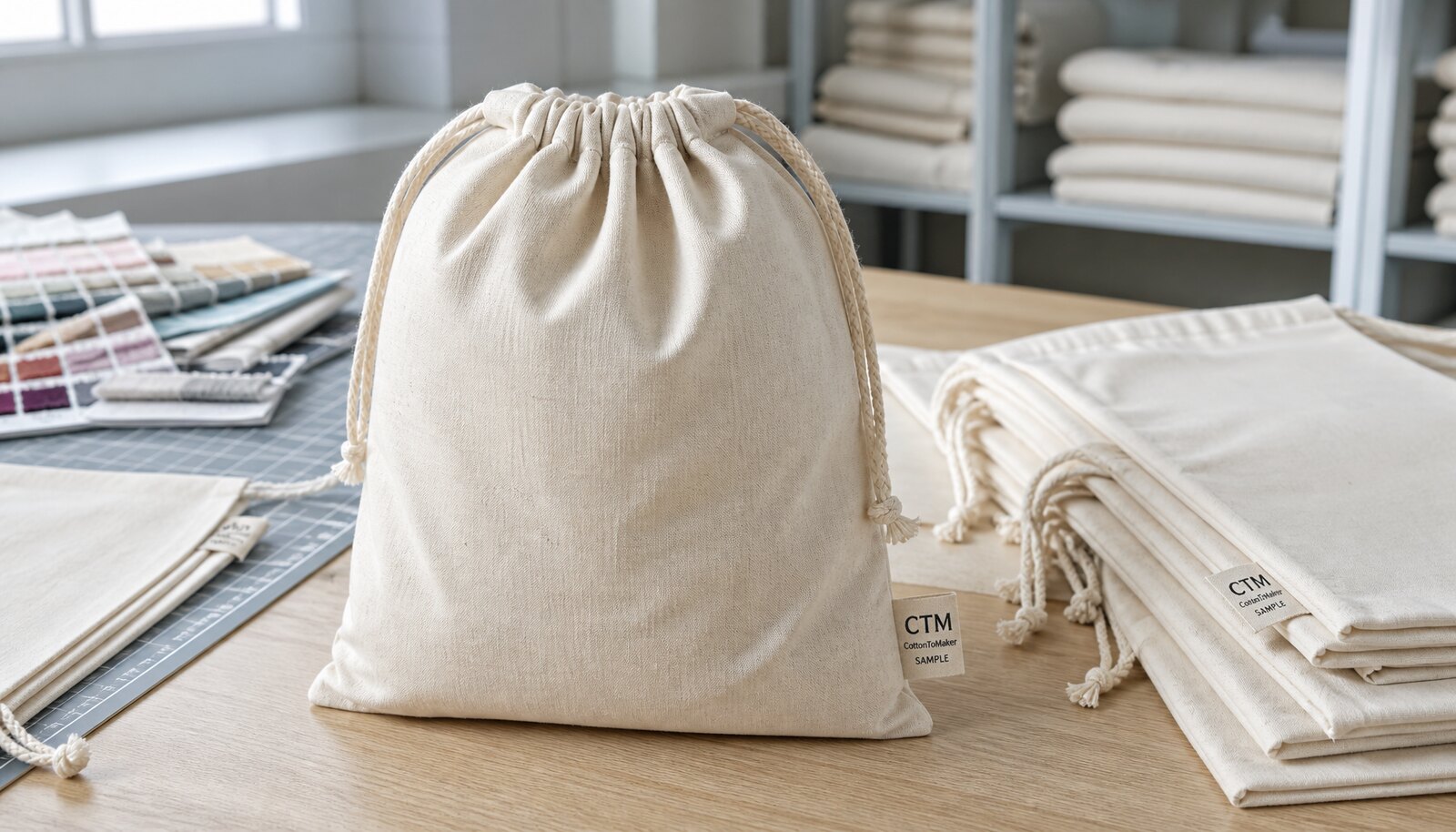
Start With The Retail Job, Not The Pouch
When buyers source wholesale cotton drawstring pouches for gift shops, the first mistake is treating the pouch like a generic commodity. A pouch that will sit on shelf and carry a brand story has different requirements from a pouch that only protects an item in transit. The commercial use case decides the fabric weight, the closure feel, the decoration method, the pack format, and the amount of QC you need to insist on.
A gift shop pouch can be a sellable accessory, a protective sleeve, or a branded add-on bundled with another product. Those are not interchangeable jobs. A jewelry insert may need a softer hand and a smaller format, while a candle or soap set needs more body so the pouch does not collapse in display. If you do not define the role up front, suppliers will quote their default version of the product instead of the version your store actually needs.
- Name the contents the pouch must hold and the maximum bulk or weight.
- Decide whether the pouch is merchandise, packaging, or a reusable insert.
- State how it will be displayed: loose, hung, stacked, boxed, or bundled.
- Call out the retail expectation: premium feel, budget price, or a balance of both.
Specify Fabric, Size, And Cord As One System
For cotton pouches, fabric weight drives almost every other buying decision. A lighter cloth can keep the price down, but it may look thin under store lighting and can wrinkle easily in handling. A mid-weight cotton, commonly in the 140 to 170 GSM range, is usually the safest starting point for gift shops because it gives the pouch enough structure without pushing the cost too high. Heavier cloth can feel more premium, but it also adds freight weight and changes the way the pouch folds and packs.
Size should be defined as a finished dimension, not a vague reference to a supplier template. The wrong size often shows up only after the product is packed with the actual gift item. Ask for the cut size, seam allowance, channel depth, and expected shrinkage so the factory knows exactly what it has to hit. The cord should be specified too. A braided cotton cord around 3 mm is a reasonable default for many retail pouches, but the right choice depends on the weight of the contents and how premium the pouch is meant to feel.
- Use 140 to 170 GSM as a practical default when the pouch is sold at retail.
- Use lower GSM only when the pouch is an insert, promo item, or short-life accessory.
- Use heavier cloth when the product must feel substantial or carry more weight.
- Specify cord diameter, cord color, and whether the cord is cotton or a blended construction.
- Ask whether the fabric is pre-shrunk if the pouch needs to stay dimensionally stable after handling.
Choose Construction And Decoration To Match The Brand Promise
Decoration should match the commercial role of the pouch. Screen printing remains the most practical option for simple logos, short copy, and repeat orders because it keeps unit cost and placement control manageable. If the artwork is detailed or multi-color, digital print can help on shorter runs, but buyers should inspect how the ink sits on the cotton texture and whether the colors still read cleanly at retail distance. Woven labels and sewn patches are useful when the pouch has to look more like a branded product than disposable packaging.
Construction matters just as much. A reinforced top channel helps the drawcord run smoothly and reduces distortion at the opening. Side seams should be straight and secure, and the top hem should not pucker when the cord is pulled. The decoration also needs to stay away from the stress points. If the logo sits too close to the seam or the channel, the pouch may look fine in a photo but fail in use or become awkward to close.
- Use screen print for simple marks and predictable repeat orders.
- Use digital print only when artwork detail justifies the added control risk.
- Use woven labels or sewn patches when the pouch is sold as part of the retail experience.
- Keep decoration clear of the seam line and cord channel.
- Ask for a placement drawing, not just a verbal promise.
Use The Comparison Table To Judge The Buying Variables
The comparison table is meant to help you evaluate the actual purchase variables, not just the supplier type. A cheap pouch that uses underweight fabric, a weak cord, and loose packing can become expensive once it reaches the shelf or warehouse. Likewise, a premium-looking pouch may be priced well if the production is stable, the carton count is clean, and the freight profile is efficient. Compare the same spec across every supplier before you decide that one quote is truly better.
The important point is that every row in the quote should be tied to a measurable choice. If the fabric weight is 160 GSM, the supplier should say so. If the cord is 3 mm braided cotton, that should appear in the spec sheet. If the carton holds 200 units and the destination freight is based on volume weight, that also belongs in the quote. The supplier who cannot describe these details is not yet quoting a real production order.
- Compare fabric weight, cord, seam construction, decoration, size tolerance, packing, and shipment term on the same basis.
- Do not accept a quote that leaves one of those variables unspecified.
- Treat carton dimensions and gross weight as pricing inputs, not afterthoughts.
- Use the same approval sample and the same destination when comparing unit price.
Verify Factories And Traders Differently
A direct cut-and-sew factory gives the buyer the most control over fabric, sewing, printing, and packing, but only if the supplier really owns those steps. A trading company can be helpful when you need mixed SKUs, consolidated paperwork, or one contact point for a broader gift program. The risk is not the label on the business card. The risk is whether the person quoting the job can actually control the production chain and document it when something changes.
If a supplier says they are a trader, ask who owns the actual sewing floor, who prints the artwork, and who signs the final inspection. If they say they are a factory, ask for the physical production address, the person responsible for quality, and proof that the sample came from the same operation that will make bulk. The goal is not to exclude either model. The goal is to know who is accountable when the color changes, the cord shifts, or the packing count drifts.
- Ask who buys the fabric and who owns the print screens or artwork files.
- Ask which steps are done in-house and which are subcontracted.
- Ask for the name of the person who signs off the pre-production sample.
- If the quote comes from a trader, ask for the real factory location and recent production photos.
- If the quote comes from a factory, ask whether the order will stay on that line or be moved.
Model MOQ And Landed Cost Before You Compare Quotes
MOQ is usually a reflection of setup cost, cutting efficiency, and packing labor. A one-color pouch in a standard size can often be produced at a lower minimum than a pouch with multiple colors, a woven label, and retail packing. That is why MOQ should not be treated as a fixed industry number. It changes when the process changes. Buyers get better comparisons when they break the quote into blank pouch cost, decoration setup, packing labor, and one-time sample charges.
Landed cost is the real unit price. The formula is straightforward: ex-works unit price plus sampling amortization plus decoration setup amortization plus freight plus duty or tax plus destination handling plus a small allowance for receiving and rework. Two quotes that look close on paper can diverge sharply once carton dimensions, cargo density, and warehouse receiving costs are included. A pouch that packs efficiently in cartons may outperform a cheaper bag that ships in larger volume or arrives in a retail-unfriendly format.
- Ask for three quantity breaks so you can see where the unit price actually moves.
- Separate one-time setup fees from recurring unit cost.
- Quote the same incoterm and destination for every supplier.
- Use carton size and gross weight to estimate freight before you compare the final landed cost.
- Include duty, inland transport, and receiving labor in the buyer-side model.
Make Sample Approval A Real Gate, Not A Courtesy Step
A sample only helps if you treat it as the production standard. The first sample should prove the fabric feel, the size, the cord movement, the logo placement, and the general finish. If the pouch will be sold as a retail item, the sample should also show the packaging and label treatment, because the shelf presentation is part of the product. A nice photo is not enough when texture, stitch quality, and cord behavior matter. You need a physical sample and a clear approval trail.
Ask the supplier to identify which sample governs production. If the pre-production sample differs from the first hand sample, the final approved sample should be the one attached to the order. If the supplier changes fabric lot, cord construction, decoration method, or packing format after approval, the approval needs to be repeated. That is the simplest way to prevent a small process change from becoming a quality dispute at shipment.
- Keep one approved physical sample or a clearly marked master sample.
- Mark the approved logo size and placement on the sample record.
- Require a fresh sign-off if the supplier changes fabric lot, cord type, or packing format.
- Check the first production pieces against the approved sample before full run release.
- Do not approve a sample if the pouch only looks right but fails the function test.
Set QC Acceptance Criteria You Can Actually Inspect
Quality control should name defect types, not just say to check quality. Finished dimensions should match the approved sample within a defined tolerance, and the tolerance should be tighter on smaller pouches because a small error matters more there. Stitching should be straight and secure, with no open seams, skipped stitches, or loose thread tails beyond the limit you set. The cord must run smoothly through the channel without snagging or twisting the top line. These are visible, inspectable outcomes, not subjective opinions.
Decoration needs its own acceptance rules. The logo should stay within the agreed placement tolerance, and the print should not bleed, crack, or smear during a simple dry-rub check if that test is part of your standard. If the product uses a solid brand color, compare the print and fabric under consistent daylight or an agreed light source. For larger orders, use an inspection plan such as AQL 2.5 for major defects and 4.0 for minor defects if that fits your internal process. At minimum, reject any wrong SKU, open seam, unreadable label, or carton count mismatch.
- Measure finished size against the approved standard before bulk acceptance.
- Reject open seams, skipped stitches, or thread tails that exceed the agreed limit.
- Pull the cord repeatedly to confirm smooth movement and secure knots.
- Check print placement against the approved reference, not against memory.
- Verify carton labels, SKU counts, and packing mix against the purchase order.
- Use a simple dry-rub test if your print system requires it.
Control Packing, Labeling, And Carton Counts
Packing can make or break a pouch program once the goods leave the factory. Bulk packing is cheaper, but it can leave retail stock creased or dusty if the warehouse or store needs a presentation-ready item. Individual polybags protect the pouch and help with shelf appeal, yet they add material and labor cost. The right decision depends on how the product is sold. If it is going straight into gift sets or retail display, packing is part of the SKU, not an afterthought.
Labeling needs the same discipline. If the pouch requires a barcode, item code, country-of-origin label, hangtag, or size sticker, those details should be in the quote and in the approval sample. Carton counts should be consistent so the warehouse can receive and replenish the product without repacking. If mixed sizes or mixed artwork are allowed, they should be controlled at the carton level with a clear packing list. A low factory price is not useful if the receiving team spends an hour fixing the cartons.
- Choose bulk or retail-ready packing before the order is placed.
- Include barcode, hangtag, and country-of-origin needs in the spec sheet.
- Set carton counts to match warehouse handling and store replenishment patterns.
- Keep mixed SKUs separate unless you have a deliberate kitting plan.
- Request carton dimensions and gross weight before booking freight.
Turn The Checklist Into A Decision Filter
The best supplier is usually the one that can restate your spec clearly, prove that the order will be made the way it was quoted, and keep the quality stable on reorder. If the supplier cannot explain the fabric, cord, decoration, packing, and inspection plan in plain terms, the quote is not ready for production. Buyers do not need more optimism. They need fewer assumptions.
Before you release a purchase order, confirm that the supplier has accepted the same finished size, the same GSM, the same cord spec, the same decoration method, the same pack format, and the same shipment term that you used for comparison. If one of those elements is still floating, the quotes are not really comparable. Tighten the spec, request a revised quote, and only then choose the supplier that best fits your retail calendar and margin target.
- Only place the order when the supplier can repeat the spec without correction.
- Only compare quotes after the size, fabric, cord, print, and packing are identical.
- Only approve production after the sample matches the written standard.
- Only accept the landed-cost comparison after freight and destination charges are included.
Specification comparison for buyers
| Purchase variable | Practical default for gift shops | Tradeoff | What to confirm in writing |
|---|---|---|---|
| Fabric weight | 140 to 170 GSM cotton for the best balance of feel, cost, and shelf presence | Lower GSM reduces cost but can feel flimsy; higher GSM increases cost and pack weight | Ask for the exact GSM, whether the cloth is pre-shrunk, and the allowed batch tolerance |
| Cord material and diameter | Braided cotton cord around 3 mm for small and medium pouches | Thinner cord lowers cost but can feel weak; thicker cord looks premium but adds cost and may bulk up the channel | Request a physical cord sample, the diameter, and the cord color reference |
| Seam construction | Double-stitched side seams with a reinforced top channel | Single-stitch construction is cheaper but is more likely to open or pucker under handling | Specify stitch density, thread type, and whether the top channel is separately reinforced |
| Decoration method | Screen print for simple logos; woven label or sewn patch for premium retail positioning | Screen print keeps setup simple; woven labels and patches improve presentation but add labor and lead time | Lock logo size, placement, color method, and artwork file format before sampling |
| Finished size tolerance | About +/- 0.5 cm for small pouches and +/- 1 cm for larger pouches | Tighter tolerance reduces fit risk but can increase rejection and cost | State the finished size, seam allowance, and the exact acceptance band |
| Packing format | Bulk pack for internal inserts; individual polybag or retail-ready pack for shelf sale | Retail packing improves presentation but raises labor and material cost | Confirm inner pack count, barcode placement, and whether each SKU stays separated |
| Documentation level | Pre-production sample, final inspection photos, and carton markings | Better documentation improves reorders and receiving but takes more supplier coordination | Ask for the actual sample approval record, inspection report, and carton label mockup |
| Shipment term | Quote on the same incoterm and destination so the comparison is apples-to-apples | Ex-works can look cheaper but hide freight and destination handling | Require the supplier to quote the same term, destination, carton dimensions, and estimated weight |
Buyer checklist before sampling
- Define the pouch's job first: retail product, packaging insert, or reusable gift bag.
- State the finished size, not just the cut size, and include the tolerance you will accept.
- Choose cotton GSM by use case and avoid mixing a lightweight insert spec with a premium retail spec.
- Specify the cord material, diameter, and color so the closure feels and looks consistent across the run.
- Lock the decoration method, logo size, placement, and artwork format before sampling.
- Confirm whether the pouch should be pre-shrunk or whether a small amount of shrinkage is acceptable.
- Define the packing format: bulk pack, individual polybag, hangtag, barcode, or retail-ready set.
- Ask for quote breaks at several quantities so setup costs and recurring costs are visible.
- Require a pre-production sample and treat it as the approval standard for bulk production.
- State carton count, master carton limits, pallet needs, and any warehouse handling constraints.
Factory quote questions to send
- What is the exact fabric specification, including GSM, weave type, and any pre-shrink treatment?
- Is the quoted price for a blank pouch, a decorated pouch, or a retail-ready packed pouch?
- What setup fees apply for screens, plates, woven labels, embroidered patches, or hangtags?
- What MOQ applies per size, per color, and per print design?
- Can you quote three quantity breaks so I can see where the unit price changes?
- What sample do you provide first, and what becomes the production reference if there is a difference?
- What are the standard size tolerance, print placement tolerance, and seam tolerance?
- How will the goods be packed, and what carton count, carton size, and gross weight should I expect?
- What is the production lead time after sample approval, and what issues could extend it?
- Which steps are done in-house, and which steps are subcontracted or handled by a partner factory?
Quality-control points to confirm
- Finished dimensions match the approved sample within the agreed tolerance band.
- Fabric weight and hand feel are consistent with the ordered GSM and do not feel noticeably lighter in bulk.
- Seams are straight, secure, and free from skipped stitches, open edges, or loose thread tails longer than the agreed limit.
- The drawcord moves smoothly, knots hold under normal use, and the top channel does not twist or collapse.
- Logo placement matches the approved reference and stays clear of the seam and cord channel.
- Print color is consistent across the run, with no obvious smearing, cracking, bleeding, or undercure.
- If rub testing is required, the print does not visibly transfer after the agreed dry-rub check.
- Carton count, SKU mix, and label information match the purchase order exactly.
- Bulk fabric shade, cord shade, and printed finish match the pre-production sample lot as closely as the spec allows.
- Use an inspection plan such as AQL 2.5 for major defects and 4.0 for minor defects if that is your house standard.