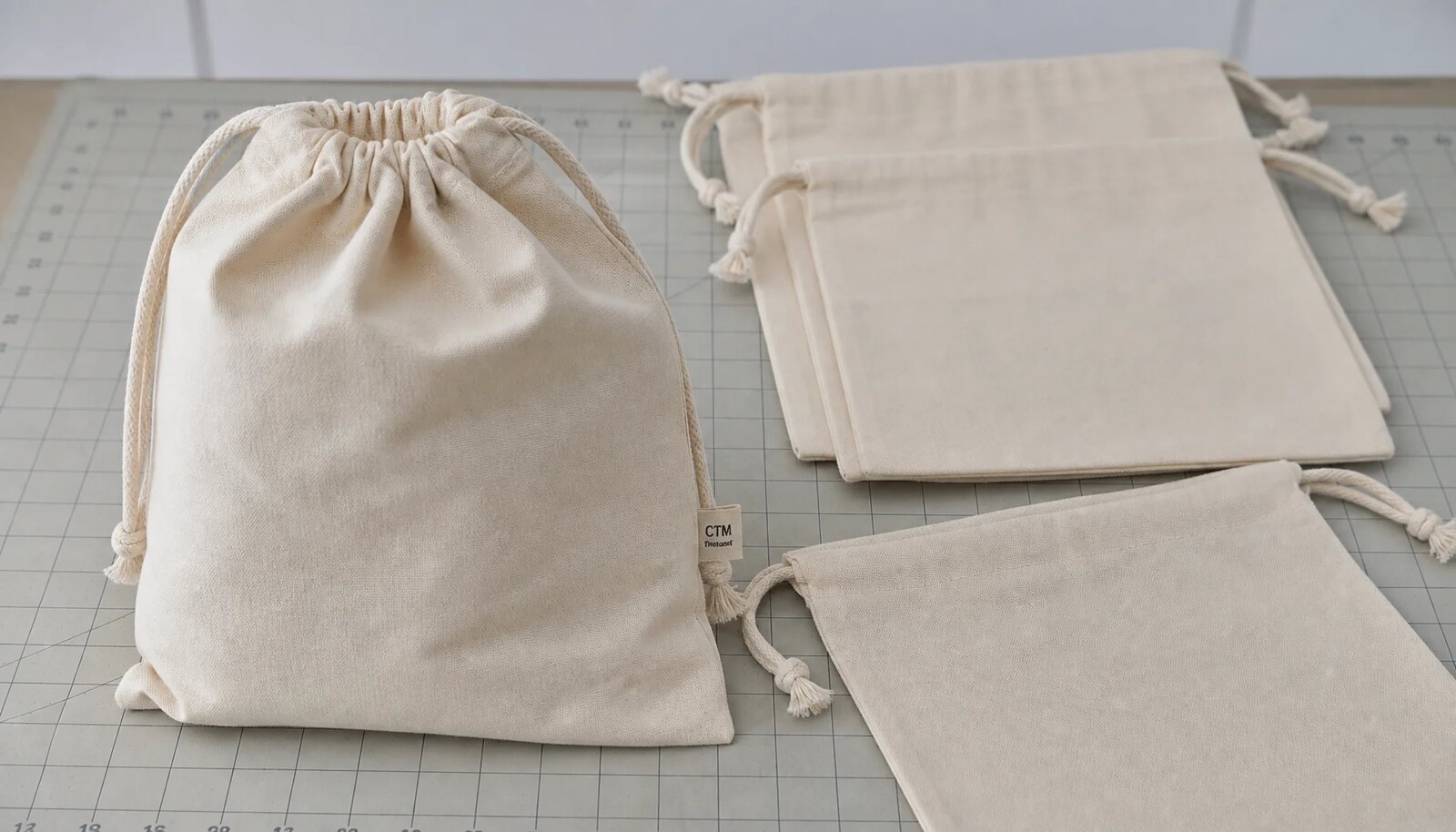
Start With the Vendor Use Case
Wholesale cotton drawstring pouches for farmers market vendors should not be sourced as a generic logo item. The same pouch might be a paid packaging component for handmade soap, a holder for seed packets, a reusable pantry refill bag, a wrap for candles, a jewelry pouch, or a market event giveaway. Each role changes the right fabric weight, closure strength, print placement, packing format, and inspection standard.
Farmers market packaging gets handled repeatedly. Vendors unpack cartons, refill table displays, cinch and uncinch bags, answer customer questions while holding stock, and repack unsold goods after the market. Shoppers also touch the pouch before they buy. A thin fabric, weak cord, crooked logo, or pouch that will not close fully can make a good product look less finished.
The RFQ should describe field use before asking for a unit price. Tell suppliers what goes inside the pouch, the product dimensions, the fill weight, whether the top must close fully, and how the pouch will be displayed. A pouch that sits in a tabletop basket may need different body and print placement than one used in a subscription box or event kit.
- Define the commercial role before requesting price tiers.
- List product type, product dimensions, and estimated fill weight.
- State whether the pouch must close fully, sit flat, hang, or fit into a tray.
- Identify the route: vendor table, retail shelf, distributor warehouse, kit assembly, subscription box, or event handout.
Turn the RFQ Into a Spec
A useful RFQ includes more than quantity, size, and artwork. It should name finished dimensions, fabric GSM, weave, cotton finish, cord material, cord diameter, draw style, print method, artwork size, placement, packing format, carton quantity, inspection requirement, and target ship window. Without those details, each supplier fills the blanks with its own defaults, and the quotes stop being comparable.
Finished size needs a clear basis. Some suppliers quote cut panel size before sewing. Others quote finished flat size after sewing and pressing. Stock blanks may be close to the requested size but not exact. For B2B buying, the cleanest approach is to quote finished flat width and height after sewing and pressing, then set a written tolerance. For many small and medium pouches, +/-5 mm is a practical starting point.
The RFQ should also state what must be included in the price. Ask suppliers to separate screen charges, artwork setup, sample fees, individual bags, hangtags, barcode labels, inner cartons, export cartons, and inspection support. Include incoterm, pickup point or port, quote validity, payment terms, production lead time after sample approval, and supplier assumptions. This turns the pouch from a loose idea into a product specification.
- Use finished flat dimensions after sewing and pressing as the measurement basis.
- Include usable capacity requirements when the pouch must fit a specific product.
- Set tolerance by SKU rather than using one vague quality note for every size.
- Require suppliers to list included and excluded costs in the quotation.
Choose the Right Fabric Range
Fabric weight is one of the clearest quality signals in cotton drawstring pouches. Around 160-180 GSM cotton canvas or twill is a practical middle range for many farmers market vendor programs. It has enough body for repeated handling, gives a cleaner surface for simple printing, and avoids the disposable feel of very light cloth while still cinching easily.
A lighter 120-140 GSM cotton can work for seed packet sets, sample inserts, short-use event pouches, or low-weight promotional packaging. The tradeoff is visible: lighter fabric may be more translucent, wrinkle more readily, and feel less substantial. If the pouch is part of a paid retail presentation, inspect light fabric before approving it for bulk production.
Heavier 200-240 GSM canvas can suit premium pouches, dense gift bundles, and refill programs where reuse is part of the offer. It is not automatically better. Thick fabric adds bulk at side seams and the top channel, increases carton volume, and can make the cord harder to pull. If you select heavy fabric, test the fabric, seam allowance, channel width, and cord together on a filled sample.
Finish matters as much as GSM. Natural cotton may vary in shade, slub, and surface texture. That variation can support a handmade or natural brand position, but it still needs boundaries. Ask whether the fabric is greige, natural, bleached, dyed, washed, pre-shrunk, or untreated before cutting, and keep an approved swatch for production comparison.
- Use 120-140 GSM for light inserts, seed packets, or simple giveaways.
- Use 160-180 GSM for most reusable branded farmers market pouches.
- Use 200-240 GSM only when the heavier hand feel supports the product and closure performance has been tested.
- Confirm finish, shade range, surface texture, and shrinkage expectations before production.
Specify Construction and Closure
Cotton drawstring pouches look simple, but small construction choices affect how reliable they feel. Side seams should be straight and closed. Bottom corners should sit square. The top hem should not twist. The channel must be wide enough for the cord to move smoothly while still keeping the top edge neat when cinched.
Cord selection should match fabric weight and pouch size. Cotton cord usually suits natural packaging, but diameter matters. A cord that is too thin can feel weak and may cut into the fabric under tension. A cord that is too thick can drag, bunch, or make the pouch hard to close. Knotted ends are common and cost-efficient, while wrapped, stitched, metal, or plastic tips may change both cost and appearance.
Ask suppliers how they sew the pouch and how they classify defects. Skipped stitches, open seams, frayed channel openings, seam slippage, loose long threads, missing cords, and weak knots should be defined before inspection. The goal is not to over-engineer a simple item. The goal is to prevent defects that customers will notice immediately.
Use a filled handling test for dense goods. Candles, jars, soap stacks, spice containers, and mixed bundles stress the bottom and side seams in a way an empty flat sample cannot. Fill the pouch with the intended product or an equivalent weight, close it, lift it, open it, and repeat. If the channel puckers heavily or the cord binds, revise the spec before bulk production.
- Define top channel width after selecting cord diameter.
- Classify skipped stitches, open seams, frayed openings, seam slippage, and missing cords as defects.
- Check the pouch flat and filled because distortion may appear only under load.
- Approve cord knots or finished ends that do not unravel during repeated pulls.
Set Print Rules Before Sampling
For simple logos on cotton drawstring pouches, screen printing is often the most practical wholesale decoration method. It is repeatable at bulk quantities, efficient for one-color or two-color artwork, and durable when ink deposit and cure are controlled. Farm names, maker marks, small icons, product labels, and seasonal market artwork usually translate well to screen print on natural cotton.
A digital mockup is not enough for approval. Cotton texture, slub, shade, and fabric weight can change apparent ink opacity and edge sharpness. Request a strike-off or pre-production sample on final fabric whenever possible. If an early sample uses substitute fabric, label it as a prototype and do not treat it as final print approval.
Other decoration methods may fit specific programs. Heat transfer can help with short runs or detailed multi-color artwork, but buyers should check gloss, edge lifting, cracking, hand feel, and compatibility with the natural cotton look. Embroidery can look premium on heavier canvas, yet it may distort lighter cloth. Digital print can support complex artwork, but rub resistance and reorder color consistency should be verified.
Artwork placement needs numbers. State print size, location, orientation, color reference, registration tolerance, and placement tolerance. A 10-15 mm clearance from side seams, bottom edge, and drawcord channel is a useful starting point on many pouch sizes. Very small pouches may need smaller artwork rather than forcing a large logo into a tight space.
- Request a physical print strike-off or pre-production sample on final fabric.
- Define print size, placement, color reference, orientation, and registration tolerance.
- Keep artwork away from seams, corners, and drawcord bunching where possible.
- Include cure, odor, tack, and rub-check expectations in the inspection standard.
Compare Quotes Without Guesswork
A low unit price is useful only when every supplier is quoting the same item. One quote may be based on a 140 GSM stock blank, standard cord, one-color print, and bulk packing. Another may include 180 GSM canvas, custom cord length, tighter carton labeling, barcode application, and pre-shipment inspection support. Both may be described as cotton drawstring pouches, but they are not the same offer.
Ask each supplier to quote the same price tiers, such as 500, 1000, 3000, and 5000 pieces, using one fixed specification. If the program includes several sizes, print versions, or colors, request SKU-level pricing. A total-quantity price can hide MOQ requirements, setup charges, or higher costs for smaller variants.
Freight and receiving labor can change the real landed cost. Cotton pouches are light, but carton volume increases when fabric is heavy, pouches are individually packed, hangtags are applied, or packing is loose. Ask for carton dimensions, pieces per carton, net weight, and gross weight before comparing landed cost. If the goods go to a 3PL, distributor, retailer, or event packer, confirm barcode labels, carton marks, and inner pack quantities before production.
- Compare identical GSM, size, cord, print, packing, and inspection assumptions.
- Request price tiers and SKU-level pricing for every size, color, and print version.
- Ask for carton dimensions, carton count, net weight, and gross weight early enough to estimate freight.
- Separate setup charges, sample fees, screen fees, labels, hangtags, inserts, and inspection costs.
Qualify Supplier Controls
A supplier profile is less useful than evidence that the factory can control this product. Ask where fabric sourcing, cutting, sewing, printing, finishing, packing, and inspection are performed. Subcontracting is not automatically a problem, but the buyer needs to know who owns each step, who approves changes, and who catches defects before goods are packed.
Product-specific evidence is more valuable than styled catalog photos. Request close-up images of seams, channel openings, bottom corners, cord ends, print edges, and packed cartons from similar orders. Ask for fabric and cord swatches before approving a full sample. A capable supplier should be able to discuss shade variation, lint, odor, seam allowance, print cure time, moisture exposure, and mixed-SKU carton control in practical terms.
Use quote questions to test inspection discipline. How are finished sizes measured? How often is sewing checked during production? Who verifies print cure if printing is outsourced? How are print rejects separated from acceptable goods? What happens if the approved fabric lot is unavailable? These answers reveal whether the supplier is quoting a controlled production process or only a price.
Repeat orders need the same protection as first orders. Require notice before changing fabric lot, cord source, sewing line, print supplier, or packing method after approval. Keep a sealed reference sample with the supplier and one with the buyer. That sample becomes the anchor when farmers market vendors reorder for another season.
- Ask who controls each step from fabric sourcing through final packing.
- Request construction photos, not only styled product images.
- Confirm whether the supplier can keep a sealed reference sample for reorders.
- Require written approval before material, process, or production-site changes.
Approve Samples With Discipline
Sample approval is the best time to prevent bulk-order problems. A digital mockup can confirm artwork direction, but it cannot confirm fabric weight, hand feel, cord function, stitching, shrinkage, odor, print opacity, or cure. The most useful pre-production sample uses final fabric, final cord, final print method, final artwork placement, and final packing materials.
Inspect the sample against the written spec. Measure finished flat width and height after sewing and pressing. Check channel width, cord length, seam allowance, stitch appearance, seam security, print size, print position, and print opacity. Fill the pouch with the intended item or a weight and size equivalent, then open and close it several times.
Add quick functional checks before sign-off. Perform a dry rub check on the print using a clean white cloth after the supplier's stated cure time. Smell the pouch after it has been packed for a short period because odor can appear after printing, washing, steaming, or tight packing. Look for tackiness, ink transfer, heavy wrinkles, lint, fraying, and shade drift between pieces.
Document approval in measurable language. Keep a sealed reference sample, a working sample, and a dated spec sheet with revision numbers. The PO, artwork file, packing instruction, and approved sample should all refer to the same version. Avoid notes like good quality or nice print. Write the actual acceptance points: size tolerance, print placement tolerance, GSM, cord type, packing count, and defect definitions.
- Approve final materials and final print together whenever possible.
- Measure size, channel, cord, and print placement against written tolerances.
- Use a fill test, draw test, rub test, odor check, and visual defect check before sign-off.
- Keep a sealed reference sample and revision-controlled spec for future reorders.
Build the Inspection Checklist
A wholesale cotton drawstring pouches for farmers market vendors quality inspection checklist should follow real use, not only appearance on a table. For a small first order, the buyer may inspect a defined random sample internally. For larger or higher-risk orders, supplier final inspection or third-party inspection can use an AQL plan agreed before production. Common consumer-goods references such as AQL 2.5 for major defects and 4.0 for minor defects may be useful, but the exact level should match order value, risk, and customer requirements.
Define defect categories before inspection begins. Major defects should include issues that affect function, saleability, brand presentation, or receiving accuracy: open seams, missing cords, wrong fabric, wrong size beyond tolerance, wrong artwork, severe stains, mildew odor, uncured print, print transfer, incorrect barcode, mixed SKU cartons, or materially wrong counts. Minor defects may include small loose threads, light wrinkles, minor print specks, or slight shade variation within the approved range.
Inspection should include cartons as well as products. Verify carton marks, counts, SKU split, destination labels, barcode placement, and packing dryness. Pull samples from multiple cartons, not only the top of one carton. Measure several pieces per SKU because size drift can occur during cutting, sewing, pressing, or packing. Compare production pieces to the sealed reference sample for fabric hand, shade, cord feel, print density, and construction.
Functional checks should be quick but real. Fill the pouch with the intended product or equivalent, close it, open it, pull the cord, and check the channel after repeated movement. Look at the print after handling. Check that the pouch still lies reasonably flat and that the seams do not twist. For vendor-facing packaging, appearance and function are linked.
- Define critical, major, and minor defects before production starts.
- Measure finished size across multiple cartons and SKUs.
- Check function by filling, closing, opening, and pulling the cord repeatedly.
- Verify carton counts, carton marks, barcodes, destination labels, and mixed-SKU control before shipment.
Control Packing and Reorders
Packing should match the distribution workflow. Bulk packing is usually the lowest-cost format and works well when the buyer, distributor, or vendor will sort pouches before use. Retail, kitting, subscription, or 3PL workflows may require individual bags, hangtags, barcode labels, inner cartons, exact pack counts, or destination splits. These requirements should be quoted before the PO because packing labor and materials can change cost and lead time.
Cotton packaging needs basic moisture control. If pouches are packed too soon after printing, steaming, washing, or humid storage, trapped moisture can create odor, wrinkling, mildew risk, or ink transfer. Ask the supplier how long printed goods rest before packing and how cartons are protected during humid seasons or long transit routes. Desiccants may help in some shipping conditions, but they should be specified intentionally.
Receiving accuracy matters for B2B buyers. A vendor kit program may need one pouch size per carton, while a replenishment order may need inner packs by SKU and barcode. A distributor may require carton labels on specific sides. An event program may need destination splits by market location. Put these requirements in the quote request, PO, and final inspection checklist.
Reorders should not rely on memory. Natural cotton shade, cord feel, fabric weight, print density, and packing presentation can drift when each reorder is approved casually. Use the sealed reference sample, dated spec sheet, artwork revision, and carton instruction for every repeat order. Ask the supplier to disclose fabric-lot changes or process changes before production.
- Choose bulk, inner pack, or individual pack based on receiving and selling workflow.
- Specify carton marks, inner quantities, master quantities, barcode placement, and destination splits.
- Confirm goods are dry and fully cured before tight packing.
- Use the sealed sample and spec sheet to control reorders across seasons.
Specification comparison for buyers
| Sourcing decision | Practical specification | Best fit | QC or cost risk to verify |
|---|---|---|---|
| Stock pouch vs custom pouch | Stock blanks can reduce lead time; custom cutting controls size, fabric, cord, and placement | Small seasonal orders, event kits, and first-time vendor programs may start with stock; repeat retail packaging usually benefits from custom | Stock sizes may be approximate, and print placement may be limited by existing seams, channel width, and fabric inventory |
| 140 GSM vs 180 GSM vs 240 GSM | 140 GSM is light; 180 GSM is a balanced reusable range; 240 GSM is heavy canvas | 140 GSM for seed packets or giveaways, 180 GSM for most branded vendor packaging, 240 GSM for premium or dense contents | Heavier fabric raises material cost, carton volume, and closure resistance; lighter fabric may look translucent or disposable |
| Finished size basis | Quote finished flat width and height after sewing and pressing, with usable capacity checked against the actual product | Soap bars, candle tins, spice jars, seed sets, jewelry cards, and refill bags | Catalog dimensions may mean cut size, approximate size, or finished size; confirm measurement basis before PO |
| Size tolerance | Use +/-5 mm as a practical starting point for many small and medium pouches; adjust only when fit requires it | Products that must close fully, fit inserts, align with labels, or sit neatly in a display | Overly tight tolerances can increase cost; loose tolerances can cause poor fit and uneven presentation |
| Bulk pack vs individual pack | Bulk pack for low waste and lower handling cost; individual pack only when retail, kitting, barcode, or 3PL workflow needs it | Vendor replenishment, distributor cartons, event kits, subscription assembly, and retail backroom intake | Unneeded individual packing adds cost and plastic; weak bulk packing can create wrinkles, moisture, count errors, and mixed SKUs |
| One-color print vs multi-color print | One-color screen print is usually simplest to control; multi-color work needs registration and color tolerance | Farm names, maker marks, simple product category icons, and seasonal logos | Poor registration, low opacity, tack, odor, rub-off, and ink transfer are common risks if print cure is not checked |
| Cotton cord vs synthetic cord | Cotton cord supports a natural look; synthetic cord may slide more easily and resist fray in some uses | Natural cotton packaging, handmade products, pantry refills, and craft brands | Wrong diameter can bind in the channel, feel weak, shed fibers, or prevent full closure |
| Standard carton vs SKU-controlled carton | Standard cartons reduce packing complexity; SKU-controlled inner packs improve receiving accuracy | Multi-size programs, market-location splits, distributor replenishment, and barcode receiving | Mixed SKUs, wrong counts, missing labels, and repacking labor can erase savings from a cheaper quote |
| Sample photo vs physical pre-production sample | Photos can screen suppliers; physical samples confirm fabric, size, cord, print, odor, and packing | Any order where brand presentation, repeat orders, or product fit matters | Digital approval cannot verify hand feel, shrinkage, print cure, closure function, or carton packing condition |
Buyer checklist before sampling
- Define the pouch role: resale packaging, product packaging, vendor kit component, market giveaway, refill bag, or branded accessory.
- List exact contents, product dimensions, fill weight, and whether the pouch must close fully when filled.
- Specify finished flat width and height after sewing and pressing, plus usable internal capacity if fit matters.
- Set SKU-level size tolerance, such as +/-5 mm for many small and medium pouches unless fit testing requires a different control.
- Name fabric GSM, weave, fiber content, color, finish, shrinkage expectation, and acceptable shade variation for natural cotton.
- Confirm whether the fabric is greige, natural, bleached, dyed, washed, pre-shrunk, or untreated before cutting.
- Define seam construction, top channel width, seam allowance expectation, and reinforcement needs for heavier contents.
- Specify cord material, diameter, length, color, draw style, knot type, and end finish.
- Lock artwork size, color reference, print method, placement, seam clearance, and registration or placement tolerance.
- Request a pre-production sample on final fabric with final cord, final print, and final packing materials where possible.
Factory quote questions to send
- What finished flat size are you quoting, and is that measured before or after sewing, pressing, washing, or packing?
- What size tolerance do you normally hold for this pouch size, and can you inspect to +/-5 mm or the tolerance listed on our spec?
- What fabric GSM, weave, fiber content, color, and finish are included in the unit price?
- Is the cotton greige, natural, bleached, dyed, washed, pre-shrunk, or otherwise finished before cutting?
- What shrinkage range do you expect after washing, steaming, or pressing, and has the fabric been tested before production?
- What cord material, diameter, length, color, knot style, and end finish are included?
- What top channel width will you sew, and have you tested the selected cord through that channel on the final fabric weight?
- What seam construction do you use, and how do you classify skipped stitches, open seams, loose threads, and seam slippage?
- Is printing done in-house or by a subcontractor, and who checks registration, cure, opacity, and rub resistance?
- What packing format, carton quantity, inner pack quantity, carton marks, barcode labels, and moisture controls are included in the quote?
Quality-control points to confirm
- Fabric GSM matches the approved specification within the agreed tolerance or supplier-stated control range, and hand feel is consistent across cartons from the same lot.
- Fiber content, weave, surface texture, natural shade, and slub level match the approved swatch without unexpected coating, excessive contamination, or heavy shade drift.
- Finished flat width and height are measured after sewing and pressing and remain within the approved tolerance for each SKU.
- Usable capacity is checked with the intended product or a weight and size equivalent, especially when the pouch must close fully around boxed or dense goods.
- Side seams, bottom seams, top hem, and channel seams show no skipped stitches, broken stitches, open seams, needle holes, seam slippage, or unraveling.
- Stitch lines are reasonably straight, corners are square, seam allowance is sufficient, and the pouch does not twist or skew when laid flat.
- Top channel width is consistent, openings are clean, and the drawcord does not pinch, bind, shred, or pull unevenly during repeated opening and closing.
- Cord diameter, length, color, material, knot style, and end finish match the approved sample, with no fraying, missing cords, weak knots, or sharp tips.
- Print size, position, orientation, registration, color, and opacity match the approved strike-off within the written placement tolerance.
- Printed areas are cured and dry, with no tackiness, odor, cracking, pinholes, ghosting, smudging, bleeding, or ink transfer during a basic dry rub check.