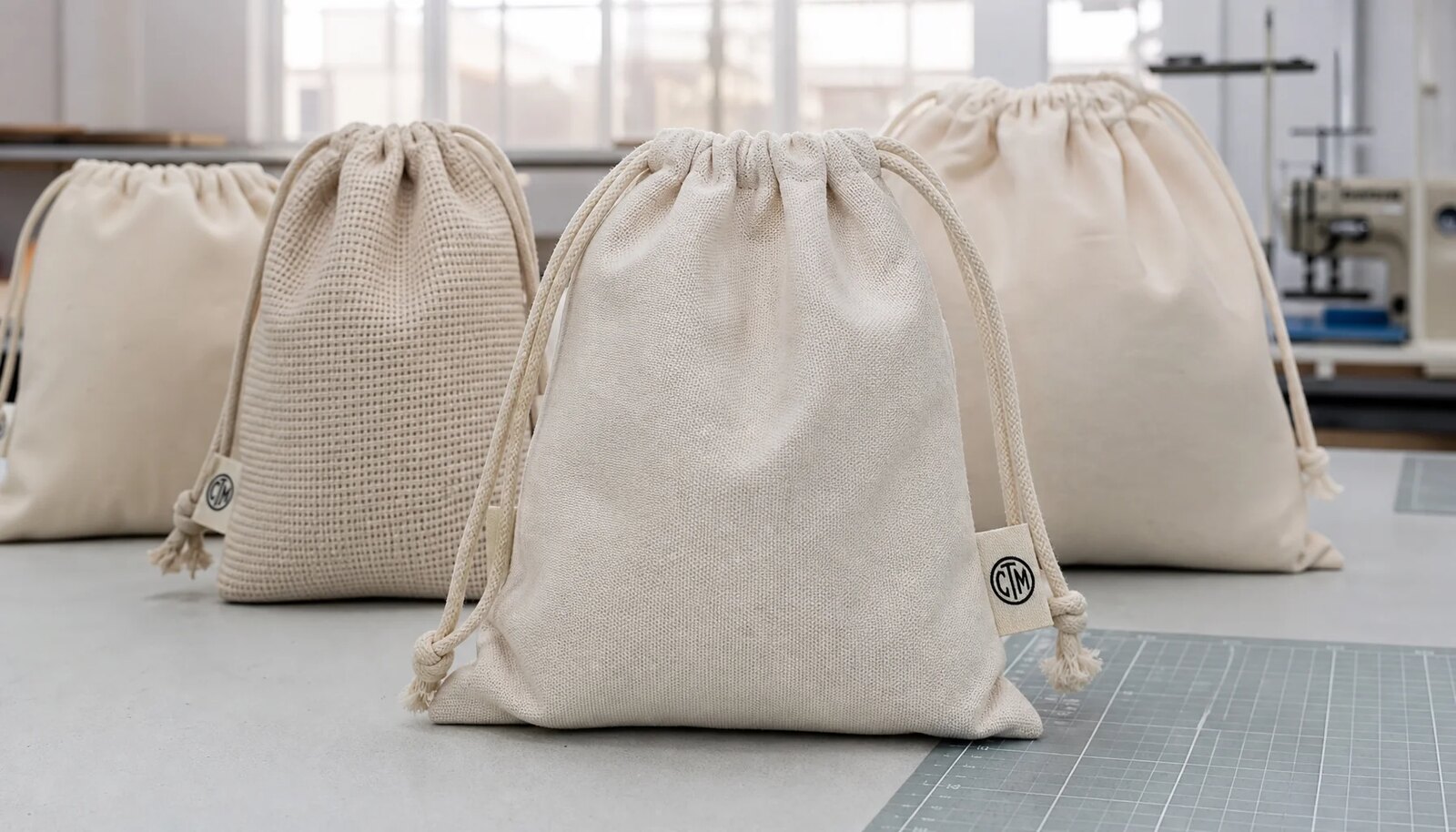
Start With the Filled Product
Farmers market packaging looks simple until the pouch is filled. A bag for seed packets has a very different job from one holding two glass spice jars, a candle tin, or a bundle of soap bars. The procurement spec should begin with the product category, filled weight, product dimensions, and handling pattern rather than with a preferred fabric weight alone.
Market vendors also use pouches in active selling environments. Products are packed before the event, handled on the table, opened by shoppers, retied, and sometimes reused after purchase. A flat sample can look acceptable while the filled pouch twists, strains at the seams, or hides the logo once the drawstring is pulled. Ask product teams or vendor customers for the heaviest realistic fill and the most awkward shape, then sample against that use.
This is the practical starting point for wholesale cotton drawstring pouches for farmers market vendors: define what the pouch must carry, how often it will be handled, and whether it is expected to be decorative, protective, reusable, or simply a clean bundling format.
- Record product type, filled weight, product dimensions, and handling frequency.
- Test the pouch filled, tied, displayed, opened, and retied.
- Decide whether the pouch is retail presentation, reusable packaging, or light bundling.
- Use the heaviest realistic vendor load when approving fabric and stitching.
Use GSM as a Guardrail
GSM, or grams per square meter, gives buyers a shared fabric-weight reference. It is useful for comparing quotes, but it is not a complete performance spec. Two cotton fabrics with the same GSM may feel different because of weave density, yarn, finishing, or shrinkage. Treat GSM as a guardrail, then verify the actual fabric with swatches and filled samples.
For most farmers market vendor pouches, 120-160 GSM is the practical middle range. At 120-140 GSM, cotton usually feels natural and economical for soap, tea, jewelry, seed packets, and small accessories. At 150-160 GSM, the pouch gains body, better print opacity, and a more premium hand for gift items or goods handled often. Below 110 GSM, check transparency and seam stress carefully. Above 180 GSM, check whether the channel still gathers smoothly and whether freight volume is justified.
Do not let suppliers quote vague terms such as light cotton, standard cotton, or thick cotton without a number and tolerance. A clear RFQ should state target GSM, acceptable tolerance, fabric composition, weave, color, and whether substitutions require written approval.
- 90-110 GSM: light sachets, seed packets, samples, and low-load promotional uses.
- 120-140 GSM: common range for soaps, tea, jewelry, accessories, and light gift packaging.
- 150-160 GSM: stronger presentation for premium market goods and repeated handling.
- 160-200 GSM: heavier jars, candle sets, produce bundles, and reusable packaging.
- Require GSM tolerance and approval for any fabric substitution.
Match Weight to Real Market Products
A concise fabric matrix helps buyers avoid overbuilding some SKUs and under-specifying others. Farmers market programs often serve many vendors, so the smartest approach is usually a controlled assortment rather than a unique pouch for every product. Build two or three pouch families around filled weight and product shape.
For a single wrapped soap bar or flat jewelry card, a medium cotton can be enough if the seams are neat and the logo is readable. For spice jars, candle tins, or small ceramics, the fabric must resist corner stress and the channel must close without forcing the buyer to tug hard. Produce bundles are a special case because shape, moisture, and soil can vary; buyers should confirm whether the pouch is decorative takeaway packaging or part of actual produce handling.
The supplier should see product photos or dimensions during sampling. A quote based only on finished pouch size can miss practical issues such as jar shoulders pressing into the print area, soap corners stressing the side seam, or a candle tin making the pouch sit awkwardly on a display table.
- Soap bars: test 120-160 GSM and check corner stress after tying.
- Spice jars: test 140-180 GSM with reinforced seams and stable print placement.
- Candles: check filled shape, bottom seam strength, and whether the pouch stands or slumps.
- Produce bundles: confirm moisture expectations and whether washing or heavier cotton is needed.
- Jewelry and seed packets: prioritize clean stitching, opacity, and low bulk over excessive GSM.
Choose Fabric Finish Deliberately
Plain weave cotton is the default for many wholesale drawstring pouches because it is flexible, printable, and cost-efficient. Cotton canvas gives more structure and durability, but it increases stiffness and carton volume. Muslin-style cotton can support a natural handmade look, but buyers should check weave consistency and print opacity before approving it for branded retail packaging.
Color and finish need the same attention as weight. Natural unbleached cotton may show seeds, specks, and shade variation. Some farmers market brands like that look; others need a cleaner retail presentation. White or dyed cotton can look more polished but may show dirt during packing and requires stronger shade control across lots. If the pouch will be reordered seasonally, ask whether the supplier can hold the same fabric source or whether each reorder needs a new swatch approval.
If washing, pre-shrinking, or special finishing is required, specify it in the RFQ. Otherwise, the factory may quote untreated cotton and the finished size or hand feel may shift after later handling or washing.
- Plain weave cotton is the safest default for flexible, printable pouches.
- Canvas adds structure but can make small pouches harder to close.
- Natural cotton may include specks and shade variation; approve this intentionally.
- Dyed cotton needs shade control and cleanliness checks during packing.
- Ask for fabric source consistency on repeat orders.
Keep Size Assortments Commercial
Size strategy affects MOQ, packing, inventory, and reorder simplicity. Too many sizes split volume and raise setup cost. Too few sizes force vendors into pouches that are too tight to close or too loose to display well. A practical B2B program often starts with small, medium, and large finished sizes tied to product groups.
Always specify finished dimensions, not cut dimensions. Finished width and height are measured after sewing, hemming, and drawstring-channel construction. For small pouches, a half-inch difference can decide whether a soap bar fits or whether the cord can close above a jar lid. Include seam allowance, channel width, and tolerance in the purchase order.
Ask the supplier for filled photos from the front, side, and tied top. This is especially useful when a logo must remain visible after gathering. The best size is not always the tightest fit; vendors need to pack quickly at a stall and customers need to open the pouch without damaging it.
- Limit the program to two or three core sizes when possible.
- Specify finished width by finished height with tolerance.
- Leave enough headroom above the product for a clean closure.
- Confirm whether mixed-size cartons are allowed or prohibited.
- Approve filled sample photos, not only flat sample images.
Specify Cord and Channel Details
The drawcord is a small component with a large effect on customer experience. Cotton cord supports a natural look, braided cord may pull more smoothly, and flat tape can look premium on larger pouches. Low-cost cord can fray, slip, or feel too thin for a reusable farmers market package.
Channel width must match cord diameter and fabric weight. If the channel is too narrow, the pouch binds when customers close it. If the channel stitching is weak, repeated pulling can tear the fabric near the cord exit. Heavier pouches should have stronger top stitching and reinforcement at stress points. Buyers should also define single-draw or double-draw construction, because it changes both function and cost.
Approve cord length on a filled sample. Short cords make the pouch hard to open and tie; overly long tails look messy and can tangle in packing. Include knot style, tip finish, color, and substitution rules in the spec so the production run does not drift from the approved sample.
- Define cord material, diameter or width, length, color, and end finish.
- State single-draw or double-draw construction.
- Check smooth pulling after the pouch is filled and tied several times.
- Require reinforced channel ends for heavier loads or reusable packaging.
- Reject cords that shed, fray, bind, or slip through knots.
Select Branding by Production Risk
Branding on cotton must be chosen for durability and legibility, not decoration alone. Screen printing is usually strong for simple logos, one or two spot colors, and larger wholesale runs. It is less friendly to very small type, fine strokes, tight registration, and gradients on textured cotton. Ask the supplier to flag artwork risks before the strike-off.
Digital print and heat transfer can suit shorter runs or colorful artwork, but both need testing on the actual fabric weight. A transfer can look crisp on a flat sample and then crack where the pouch folds. Embroidery and woven labels can feel premium and reusable, but they add cost and may be too bulky for very small bags. A sewn label is often a steady option when the same branding must work across several pouch colors.
Control placement with measurable details. State print size, print area, distance from top and side seams, ink color reference, and placement tolerance. A digital mockup is not enough for bulk approval; request a production-size strike-off on the approved fabric and keep it with the golden sample.
- Use screen print for simple logos and repeat wholesale programs.
- Use woven labels or embroidery for premium reusable pouches.
- Test digital print and transfers for cracking, adhesion, and rub resistance.
- Set print placement tolerance before production.
- Approve the strike-off on the same GSM and color as the bulk order.
Build Sampling Into the Timeline
A good sample process should confirm fabric, construction, decoration, and packing before bulk production. Start with a swatch or blank pouch in the quoted GSM. Then approve a decorated pre-production sample with correct size, cord, stitching, print, label, and folding method. The final signed golden sample should represent the standard used by production and inspection.
Appearance review is not enough. Fill the sample with the intended product or a realistic substitute, close it, open it, tie it, untie it, and handle it like a market customer would. Measure more than one piece if the factory sends multiples. Look for size drift, uneven gathering, print distortion, weak corners, or cord slippage.
Before deposit or bulk release, align the quote and purchase order with the approved sample. If the sample uses 150 GSM cotton, double-draw cord, and inner packs of 50, those details should appear in writing. Ambiguity at the sample stage becomes a dispute at receiving.
- Approve swatch, blank sample, decorated sample, strike-off, and golden sample as needed.
- Sign and date the golden sample and reference it on the purchase order.
- Test the pouch filled and repeatedly handled.
- Confirm packing format before production is complete.
- Do not approve bulk from a digital mockup alone.
Write QC and Documentation Requirements
Quality control should inspect function, appearance, and packing accuracy. The inspection plan should cover finished size, fabric shade, fabric hand feel, stitching, drawcord function, print placement, ink curing, cleanliness, carton count, and SKU separation. For resale packaging, loose threads, stains, lint, and heavy creases are commercial defects, not minor cosmetic details.
Set tolerances before production begins. State acceptable finished-size variance, print placement tolerance, carton quantity rules, and whether mixed shades are allowed. Ask the supplier which AQL level they use and what inspection sample size applies to the order quantity. For higher-value programs, request inspection photos and a simple report showing measured dimensions, defect categories, and carton checks.
Supplier documentation should be specific. Ask for a fabric test report or incoming inspection record for GSM and composition when material consistency matters. Request packing photos before shipment release, especially for mixed SKUs. If the order is being inspected by a third party, provide the golden sample, strike-off, purchase order, artwork file, and packing instructions so the inspector is checking against the right standard.
- Use AQL and inspection sample size instead of vague final checking language.
- Measure actual finished dimensions and record results by size.
- Check cord movement, seam strength, print rub resistance, and cleanliness.
- Request fabric test reports or incoming fabric inspection records when relevant.
- Require packing photos showing inner packs, carton marks, and SKU separation.
Compare Landed Cost, Not Just Unit Price
A low pouch price can hide missing costs. Compare fabric, cutting, sewing, cord, print setup, run charges, labels, packing labor, inner bags, master cartons, inspection, inland freight, export handling, and expected overrun or underrun. If one quote includes carton packing and another assumes loose bulk goods, they are not equivalent.
Use one spec sheet for all suppliers. It should list finished size, GSM, fabric color, print method, cord construction, reinforcement, quantity by SKU, packing method, carton quantity, carton dimensions, lead time, and documentation requirements. Ask for line-item pricing so upgrades and omissions are visible. This makes it easier to decide whether a higher unit price buys better fabric, cleaner packing, lower inspection risk, or stronger reorder control.
For repeat farmers market programs, reorder consistency matters. Ask whether the supplier can hold the same fabric source, cord supplier, stitch construction, and print ink standard. If they cannot, require fresh swatch and strike-off approval before each reorder. The best commercial quote is the one that matches the use case, passes inspection, arrives countable, and can be repeated without rebuilding the spec from zero.
- Compare ex-factory cost, packing cost, freight impact, inspection cost, and receiving labor.
- Separate required costs from optional upgrades.
- Confirm overrun, underrun, rework, and replacement policies.
- Ask for carton dimensions and gross weight before landed-cost comparison.
- Treat reorder consistency as part of supplier qualification.
Specification comparison for buyers
| Product use case | Typical filled weight | Practical fabric range | Spec notes for buyers |
|---|---|---|---|
| Seed packets, tea samples, sachets, jewelry cards | Under 150 g | 90-120 GSM cotton | Works for light goods where low bulk matters. Check opacity if printing a logo and avoid sharp product corners that can show through thin fabric. |
| Single soap bar, lip balm set, spice pouch, small accessories | 150-350 g | 120-140 GSM cotton | Good everyday range for farmers market packaging. Confirm finished size, seam strength, and whether the print remains readable after the pouch is tied. |
| Two soap bars, spice jars, small candle tins, premium gift items | 350-700 g | 140-160 GSM cotton | Better body and print presence without becoming too stiff. Request a filled sample and check cord movement after repeated opening and closing. |
| Glass jars, candle sets, small ceramics, produce bundles | 700 g-1.5 kg | 160-200 GSM cotton or light canvas | Use reinforced seams and channel ends. Confirm the heavier fabric still gathers cleanly and that carton volume does not erase unit-price savings. |
| Reusable branded merchandise pouch | Varies by product | 150-200 GSM cotton, canvas, or labeled construction | Prioritize durability, consistent shade, neat stitching, and branding method. Ask whether fabric source and cord spec can be held for reorders. |
| High-volume mixed vendor program | Multiple product types | Two or three GSM/size combinations | Do not over-customize every vendor category. Build a controlled assortment and document load targets for each SKU. |
Buyer checklist before sampling
- Define the exact use case: soap, candle, spice jar, tea, jewelry, seed packet, produce bundle, sample kit, or gift set.
- List the expected filled weight, product dimensions, product shape, and whether the pouch is sold empty or filled.
- Specify finished width and height after sewing, not cut-panel dimensions, with acceptable tolerance by size.
- State fabric composition, weave, target GSM, GSM tolerance, color, finish, and whether natural specks or shade variation are acceptable.
- Request a fabric swatch or blank sample in the quoted GSM before approving printed artwork.
- Define drawcord material, color, diameter or width, length, channel width, knot or tip finish, and single- or double-draw construction.
- Specify seam allowance, stitch type, stitches per inch if required, top hem construction, channel reinforcement, and loose-thread trimming standard.
- Provide vector artwork and state print method, ink color reference, print area, placement tolerance, and rub or wash expectation.
- Require a production-size strike-off on the approved fabric before bulk printing.
- Approve one signed golden sample that includes fabric, size, cord, decoration, stitching, fold, and packing format.
Factory quote questions to send
- What GSM and weave do you recommend for this filled weight and product shape, and what GSM tolerance will you hold?
- Is this quote for direct factory production, or are fabric sourcing, printing, embroidery, labeling, or packing subcontracted?
- What is included in the unit price: fabric, cutting, sewing, drawcord, print, label, folding, inner pack, master carton, and carton marks?
- What MOQ applies by size, fabric color, GSM, artwork, and print method, and what price breaks apply at higher quantities?
- Can you confirm finished pouch dimensions, seam allowance, channel width, cord length, and finished-size tolerance in writing?
- Which print method will you use, what artwork file format do you require, and what limits apply to fine text, line weight, and color matching?
- Can you provide a production-size strike-off on the same fabric weight before bulk approval?
- Can you provide a recent fabric test report or incoming fabric inspection record for GSM, composition, and color/shade control?
- What AQL level and inspection sample size do you use for size, stitching, cord function, print, cleanliness, carton count, and packing accuracy?
- How many days are needed for fabric purchase, sample making, strike-off revision, bulk cutting, printing, sewing, packing, and final inspection after deposit?
Quality-control points to confirm
- Measure finished width and height on at least 10 units per size per inspected lot, or follow the agreed AQL sample size if stricter.
- Compare fabric hand feel, opacity, weave density, shade, and GSM against the approved swatch or signed golden sample.
- Fill sample units with the intended product weight or a realistic substitute, then open, close, tie, untie, and handle repeatedly.
- Inspect drawcord movement, cord length, knot security, channel width, and channel stitching for binding, slipping, or uneven gathering.
- Check seam strength by pulling side seams, bottom corners, and drawcord entry points with moderate force.
- Reject units with skipped stitches, broken thread, weak backstitching, needle damage, or untrimmed thread tails that affect resale appearance.
- Verify print placement, color density, registration, ink coverage, edge sharpness, and curing against the approved strike-off.
- Rub the printed area with a clean cloth and check for visible ink transfer, cracking, flaking, or surface tackiness.
- Inspect cleanliness: no oil marks, fabric dust, lint, dirt, shade mixing, heavy creases, or moisture inside inner packs.
- Open random cartons to confirm unit count, size separation, fold method, inner pack quantity, carton markings, PO reference, and SKU label readability.