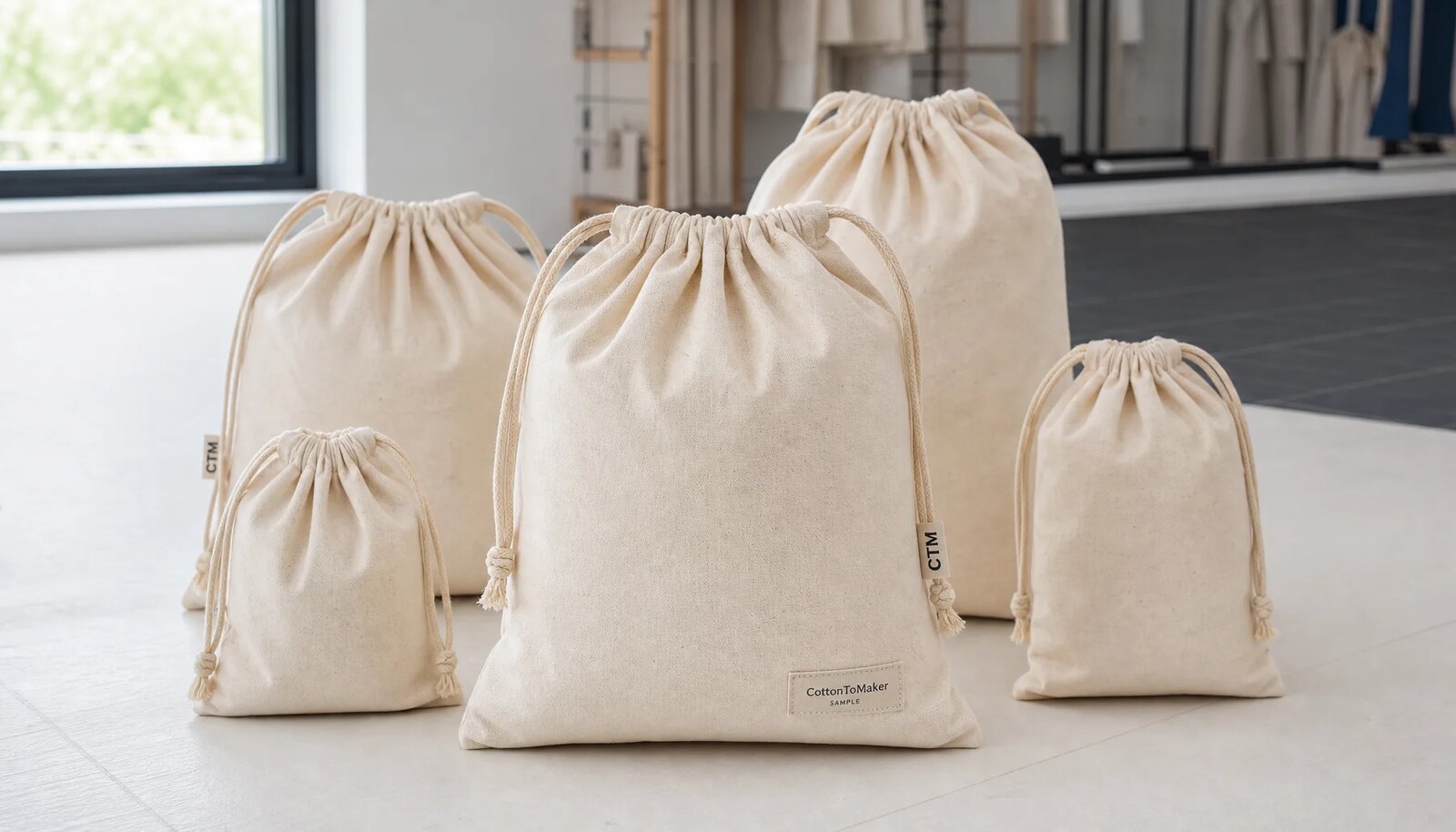
Define the Event Job Before the Spec
A cotton pouch for a registration desk is not the same purchase as a pouch placed in a hotel room, packed inside a retail box, or handed to VIP guests at a sponsor dinner. The shape may look identical in a catalog, but the correct material changes once the pouch has a real job. Event planners should start by naming the role: light carrier, welcome-kit organizer, amenity pouch, sponsor sample bag, retail insert, premium presentation piece, or keepsake.
Map the pouch through the event flow. A bag filled once with cards and a badge can be lighter than one opened and closed repeatedly by a fulfillment team. A pouch displayed on a bed tray or gift table needs cleaner finishing and more consistent decoration than a pouch used only as inner packaging. A sponsor item photographed by attendees may justify better opacity, tighter logo placement, and more controlled color.
Contents belong in the RFQ. Include dimensions, approximate weight, hard corners, liquids, glass, electronics, cosmetics, dust-sensitive surfaces, and whether the pouch must close fully after filling. A rigid box often needs more allowance than its measurements suggest. A thin natural cotton pouch may work for paper inserts but show too much outline for hotel amenities. Once the use case is visible, suppliers can quote the same product instead of guessing.
- Write one sentence describing the pouch role and event distribution method.
- List contents by size, weight, edge condition, fragility, and desired presentation level.
- State whether the pouch is packaging, brand surface, keepsake, or all three.
- Clarify who fills the pouch: factory, fulfillment center, hotel staff, venue team, or event staff.
- Choose the top priority before pricing: cost, speed, print clarity, premium feel, packing control, or repeat consistency.
Select GSM by Contents and Presentation
GSM, or grams per square meter, is useful but often overtreated as a quality grade. It affects opacity, hand feel, sewing behavior, folded bulk, carton volume, and cost. It does not automatically tell you whether the pouch will print well or survive the event flow. A smooth 140 GSM plain weave can carry a cleaner logo than a rougher heavier cotton, while a 180 GSM pouch can feel better but create more carton volume than the event needs.
For low-weight handouts, 120-140 GSM is often practical. It can suit pins, cards, jewelry, stationery, light cosmetics, and small sponsor samples where the pouch mainly organizes items. For welcome kits, amenities, retail inserts, reusable pouches, and sponsor gifts, 140-180 GSM is usually a safer working range because it improves opacity and hand feel without becoming too bulky. Above 180 GSM can make sense for premium presentation or heavier contents, but buyers should expect higher material use, bigger cartons, and possible longer sewing or sourcing time.
Ask how the supplier controls fabric weight. Mills usually manage GSM by fabric lot, not by weighing every pouch. A quote should identify a GSM range or tolerance and be tied to a physical swatch or pre-production sample. This matters for repeat programs because two cottons with the same nominal GSM can differ in tightness, softness, shade, shrinkage, and logo performance.
- Use 120-140 GSM for light, low-bulk handouts with modest contents.
- Use 140-180 GSM for welcome kits, amenities, reusable gifts, and retail-style inserts.
- Use 180-220 GSM when structure or premium hand feel justifies higher cost and carton cube.
- Request a fabric-lot tolerance or approved swatch instead of accepting only a GSM number.
- Test opacity with actual contents under event-like lighting.
- Compare GSM together with weave and finish, not as a standalone decision.
Match Cotton Surface, Color, and Artwork
Fabric surface decides how polished the pouch looks and how predictable the decoration will be. Plain weave cotton is the usual workhorse for event pouches because it sews consistently and gives a familiar natural texture. A smoother surface supports cleaner screen printing, sharper logo edges, and more readable small type. A lightly brushed finish can feel softer but may collect lint or blur fine artwork. Slub or open-weave cotton can look more organic, but irregular yarns may break thin lines, QR codes, and sponsor names.
Color needs physical approval. Natural unbleached cotton is popular for simple event packaging, but it is not white. It may include flecks, seed specks, and mild shade variation. Those traits should be accepted against a sample, not debated after production. Bleached white cotton improves contrast for bright artwork but shows dirt, creases, and handling marks more easily. Dyed cotton supports brand programs, yet it can affect MOQ, shade tolerance, material lead time, and colorfastness expectations.
Artwork should be simplified for the fabric. Dense sponsor grids, small reversed type, thin outlines, and QR codes are risky on textured cotton unless a production sample proves readability. A one-color logo often performs better than a crowded design. When fine detail matters, consider a woven label, side tag, patch, or approved transfer rather than forcing direct print onto an uneven surface.
- Request swatches for natural, bleached, and dyed cotton when color matters.
- Define acceptable flecks, slubs, seed specks, and shade variation.
- Use smoother plain weave for small text and sharper printed edges.
- Avoid QR codes or dense sponsor grids unless tested on the actual cotton.
- Ask whether dyed fabric changes MOQ, lead time, shade tolerance, and approval steps.
- Approve color and decoration from physical samples under consistent light.
Specify Finished Size, Not Catalog Size
Size is one of the easiest ways for quotes to become incomparable. One supplier may quote cut panel size; another may quote finished sewn size. After side seams, bottom seams, and the drawstring channel are added, the usable space is smaller than the fabric panel. For event pouches holding fixed items, that difference can decide whether the pouch closes neatly or looks strained.
The RFQ should state finished flat width and finished flat height after sewing. It should also define the measurement method: flat, empty, drawcord open, measured from outer seam to outer seam and from the top edge or usable opening as specified. Very small pouches need tighter control because a few millimeters can affect jewelry boxes, lip balms, sample tubes, cards, or electronics. For many small and mid-size pouches, tolerances such as +/-3 mm or +/-5 mm are common discussion points when the construction allows them.
Usable space also depends on closure. The channel uses vertical height, and the pouch needs room above the contents to cinch closed. Rigid items need more allowance than soft items. Heavy or sharp-cornered products can stress bottom seams and corners. Approve the sample with an actual fill test, because a pouch can measure correctly and still perform poorly when loaded.
- Specify finished flat size after sewing, not cut size.
- State measurement method and tolerance in the RFQ and purchase order.
- Provide dimensions and approximate weight of all contents.
- Leave enough height above contents for the pouch to cinch without distorting the logo.
- Test rigid, sharp, glass, or heavy items in the pre-production sample.
- Define when a size issue is a major defect before production starts.
Control Construction and Closure Details
Cotton drawstring pouches look simple, so construction details are easy to skip. The top channel must be wide enough for the cord to slide without catching or wearing through the fabric. Side channel openings should be clean because they take repeated pulling force. Side and bottom seams need even stitching, trimmed thread, and corners that do not leave openings where small contents can escape.
Construction matters most during fast packing. Fulfillment teams may open, load, close, stack, count, and carton thousands of pouches in a short window. A sample that passes a quick visual check can fail when handled at speed. Ask the supplier to state top channel height, seam allowance, stitch type, approximate stitch density, and raw-edge treatment. Premium finishing is not required for every order, but the finishing must match the event workload.
Cord choice affects both function and perceived value. Cotton cord gives a cohesive natural look. Polyester cord may slide more easily and hold color more consistently. Thicker cord can feel better but needs a larger channel and may increase cost. Single drawcord closure is efficient for standard programs. Double drawcord closure can feel more balanced and polished for welcome kits, amenities, and VIP gifts.
- Define single or double drawcord, cord material, diameter, color, knot style, and end treatment.
- Specify channel height and confirm smooth cord movement after repeated pulls.
- Ask how raw edges are treated at seams and channel openings.
- Set expectations for stitch density, seam allowance, thread color, trimming, and corner strength.
- Use a cord pull test during sample review.
- For heavier kits, test filled pouches by lifting, cinching, stacking, and reopening.
Choose the Logo Method for Repeatability
Decoration should be selected for repeat production, not just a good-looking mockup. For many wholesale cotton drawstring pouches for event planners, one-color or two-color screen printing is the practical option. It works for simple logos, event names, sponsor marks, and bulk orders where cost control matters. The buyer still needs to define ink color, artwork size, print position, placement tolerance, print side, and whether printing happens before or after sewing.
Artwork must suit a flexible textile surface. Fine lines can fill in, small type can lose edge clarity, and light ink may not cover strongly on natural or dyed cotton. Multi-color designs add registration risk. On a small pouch, a centered logo can look wrong when placement shifts only a few millimeters. Placement tolerance should be part of the written approval, not a subjective review after the goods arrive.
Woven labels, side tags, and patches are useful when direct print is not the right fit. They can carry finer detail and create a more retail-ready finish. Specify label size, fold style, stitch color, orientation, and distance from the seam or top edge. Heat transfer and digital printing can work for multi-color artwork, but the sample must prove hand feel, edge durability, cracking risk, and rub behavior on the actual cotton.
- Use screen print for simple 1-2 color marks and cost-controlled bulk orders.
- Use woven labels, side tags, or patches for fine detail or a more premium finish.
- Use heat transfer or digital printing only after approving hand feel and rub resistance.
- Specify artwork size, print side, distance from edges, centered position, and placement tolerance.
- Ask whether screen charges apply per color, size, artwork, or print position.
- Treat digital mockups as layout tools; approve production from a physical sample.
Compare MOQ, Supplier Route, and Price Basis
MOQ changes with pouch size, GSM, fabric color, decoration method, labels, packing format, and whether the supplier is making custom pouches or decorating stock blanks. A low MOQ may help a private event or pilot order, but unit price can rise because setup and sampling costs are spread across fewer pieces. A higher MOQ may reduce unit cost for repeat events, but only if the buyer can use or store the extra quantity without waste.
Supplier route affects control. A direct factory is useful when the buyer needs custom sizing, repeat fabric, controlled construction, and detailed carton packing. A trading company may help when the event includes several product categories and consolidated sourcing is more important than direct production control. A local decorator can support rush orders or smaller domestic runs, but may rely on imported blank pouches with limited control over fabric, seams, and shade.
Compare quotes only after assumptions match. Use the same GSM range, finished size, cord, logo method, packing count, carton label, delivery term, inspection requirement, and overrun or underrun policy. A low price may reflect thinner fabric, stock sizing, loose tolerances, omitted sampling, no carton labeling, or bulk packing when individual packing was expected.
- Ask for MOQ by pouch size, GSM, fabric color, decoration method, and packing format.
- Clarify whether the supplier makes custom pouches, decorates stock blanks, or subcontracts steps.
- Separate setup charges, screens, labels, sample fees, packing charges, and inspection costs.
- Compare using the same delivery term, carton assumptions, and lead-time basis.
- Ask whether overruns or underruns are allowed and how final quantity is invoiced.
- For repeat events, confirm whether fabric, cord, screens, and approved samples can be matched later.
Use Sampling and QC Before Bulk Release
Sampling turns the written specification into a production standard. A proper pre-production sample should use the actual cotton, GSM range, cord, construction, decoration, and packing method intended for the order. A stock sample can be useful for a first review, but it should be marked reference only when fabric, size, cord, or print method differs. Bulk approval should not rest on a digital proof alone.
Review the sample the way the event team will use it. Measure finished width and height by the agreed method. Pull the cord repeatedly and watch for channel distortion, catching, fraying, or exposed raw edges. Place actual contents inside to test fit, opacity, seam stress, and closure. Look at the print under daylight and indoor lighting. Rub the printed area with a clean cloth to check obvious transfer. If a fulfillment center will fill the pouches, time how easily the sample opens and closes.
Define defects before production. Major defects may include wrong fabric, wrong logo, missing cord, broken seam, unreadable print, wrong size beyond tolerance, severe staining, strong odor, wrong packing count, or mixed cartons that disrupt receiving. Minor defects may include small loose threads or natural cotton variation within the approved sample standard. If AQL inspection is used, agree on inspection level, acceptable quality limits, and defect classification before packing.
- Approve a physical pre-production sample using production materials and construction.
- Record finished size, cord length, logo position, label position, and tolerances in writing.
- Test the pouch with actual contents before bulk approval.
- Define major defects, minor defects, and zero-tolerance issues before production starts.
- Include cord pull, seam inspection, print rub, shade check, odor check, and carton-count verification in QC.
- Keep one approved sample with the buyer and one with the supplier for comparison.
Plan Packing and Lead Time Around the Event Date
Packing affects landed cost, receiving labor, cleanliness, and event readiness. Flat bulk packing is usually best when pouches will be filled later because it reduces carton volume and makes counting easier when inner pack quantities are defined. Inner bags can keep pouches clean and separated. Individual packing should be used when it solves a presentation, barcode, dust-protection, or handout-control need.
If individual packing is required, specify bag material, label or barcode, folded or flat orientation, drawcord position, and any required warning text. These details affect labor, carton cube, inspection, and schedule. Carton labels should include PO number, item name, size, color, quantity, carton number, and destination when relevant. Mixed-size or mixed-color cartons should be avoided unless receiving staff specifically request them.
Lead time should be managed as a chain: artwork review, sample making, sample shipping, approval, fabric purchase, cutting, printing, sewing, trimming, inspection, packing, carton labeling, and freight booking. Dyed fabric, woven labels, custom cords, individual packing, revised samples, holidays, and peak production periods can add time. For fixed event dates, keep the specification simple when speed matters. A lower ex-factory price is not a better buy if it creates emergency freight, manual recounting, or rework before the event.
- Use flat bulk packing when pouches will be filled later and individual presentation is not required.
- Set inner pack quantity, export carton quantity, maximum carton weight, and carton label format.
- Use individual packing only for presentation, cleanliness, barcode control, retail handling, or a fixed handout sequence.
- Request estimated carton dimensions and gross weight before freight planning.
- Ask for lead time by step: artwork, sampling, material purchase, production, inspection, packing, and freight-ready date.
- Freeze artwork, size, GSM, cord, color, and packing before production scheduling starts.
- Keep event date, delivery location, and receiving requirements visible in supplier communication.
Specification comparison for buyers
| Option | Best event use | Specification notes | Buyer risk to check |
|---|---|---|---|
| 120-140 GSM plain cotton | Low-weight handouts, pins, cards, small samples, light sponsor inserts | Specify as a range with fabric-lot tolerance and test opacity with real contents. | Can feel thin, show contents, or distort at seams if used for heavier kits. |
| 140-180 GSM plain cotton | Welcome kits, amenity pouches, retail inserts, reusable attendee gifts | Good balance of hand feel, printability, opacity, and freight efficiency for many events. | Still varies by weave and finish; do not compare by GSM alone. |
| 180-220 GSM cotton | VIP presentation, heavier contents, more structured brand packaging | Use when premium feel matters more than carton cube and unit cost. | Higher folded bulk, possible sewing difficulty, larger cartons, and longer material lead time. |
| Natural unbleached cotton | Organic-looking events, simple inserts, lower-contrast branding | Approve flecks, seed specks, shade range, and logo contrast from a physical sample. | May be mistaken for dirty fabric if appearance limits are not agreed. |
| Bleached white cotton | Clean brand programs, brighter print contrast, cosmetics or wellness kits | Define cleanliness expectations, handling marks, and shade standard. | Shows dirt, lint, creases, and packing marks more easily. |
| Dyed cotton | Brand-color campaigns, sponsor programs, retail-style event packaging | Confirm dye lot, shade tolerance, MOQ, colorfastness expectations, and lead time. | Higher MOQ, shade drift, and re-sampling risk if approval is rushed. |
| Smooth plain weave | Small logos, sponsor names, simple QR or fine-line artwork after testing | Ask for actual fabric swatch and print proof, not only a digital mockup. | Open or slub texture can break small type and reduce print sharpness. |
| Screen print | 1-2 color logos, event names, cost-controlled bulk programs | Define ink color, print size, location, placement tolerance, and print side. | Ink spread, rub transfer, registration drift, and weak coverage on darker fabric. |
| Woven label or patch | Fine detail, premium finish, repeat events, small pouches where printing is crowded | Specify label size, fold style, stitch color, orientation, and placement. | Adds component lead time and may require separate approval. |
Buyer checklist before sampling
- Define the pouch role: giveaway carrier, attendee welcome-kit pouch, hotel amenity bag, cosmetic sample pouch, sponsor gift bag, retail insert, VIP presentation pouch, or post-event keepsake.
- List every item going inside with approximate width, height, depth, weight, sharp edges, fragile surfaces, and whether it is packed by the factory, fulfillment center, venue, hotel staff, or event team.
- Specify finished flat width and height after sewing, not cut size, and state measurement method with an agreed tolerance such as +/-3 mm for very small pouches or +/-5 mm for many mid-size pouches when suitable.
- Choose a cotton GSM range and state the buying priority: lowest landed cost, opacity, smoother print surface, reusable feel, lower carton volume, or premium presentation.
- Confirm weave, surface finish, and color standard, including whether natural flecks, slubs, seed specks, shade variation, or small yarn irregularities are acceptable within the approved sample.
- Define closure details: single or double drawcord, cord material, approximate diameter, cord color, knot style, end treatment, channel height, and reinforcement expectations at side openings.
- State decoration method, artwork size, print location, number of colors, Pantone or brand color target, placement tolerance, one-side or two-side branding, and minimum readable size for sponsor marks.
- Request a pre-production sample using the actual fabric, cord, construction, decoration, and packing method intended for production; label stock samples as reference only.
- Ask suppliers to separate blank pouch cost, decoration cost, setup or screen charges, sample fee, label cost, special packing, inspection or documentation cost, carton dimensions, and freight-ready lead time.
- Specify flat bulk packing or individual packing, inner pack count, export carton quantity, carton markings, maximum carton weight, destination labels, barcode requirements, and whether mixed cartons are allowed.
Factory quote questions to send
- What exact cotton GSM range, weave, surface finish, and color standard are included in the quoted price?
- Is the quote based on finished sewn pouches, decorated pouches, blank stock pouches, packed units, or another assumption?
- Is the stated size the finished flat size after sewing, and what width, height, seam, cord length, and print-placement tolerances will you hold?
- What cord material, approximate diameter, color, knot style, channel construction, and cord-end finish are included?
- What stitch type, approximate stitch density, seam allowance, top channel height, and raw-edge treatment are included in the quoted construction?
- How many artwork colors, print positions, screens, setup charges, label charges, and artwork revisions are included?
- Can you provide a pre-production sample made with the same fabric, cord, decoration method, construction, and packing format as mass production?
- If the first sample is made from stock fabric or stock blank pouches, which parts are only for reference and which parts represent final production?
- What changes after sample approval require a new sample, price revision, or lead-time revision?
- What is the MOQ by pouch size, fabric color, GSM range, decoration method, and packing format?
Quality-control points to confirm
- Measure finished flat width and height after sewing against the approved sample and written specification, using the agreed tolerance for the pouch size and construction.
- Check that suppliers are measuring the same way as the buyer: pouch flat, empty, drawcord open, from outer seam to outer seam, and from the top edge or usable opening as specified.
- Verify cord length, cord diameter, cord color, knot security, draw action, and side-channel openings across randomly selected cartons, not only top-of-carton pieces.
- Pull the cord repeatedly on sampled pieces to confirm it slides without tearing the top channel, exposing raw edges, or pulling free from weak knots.
- Inspect top hems for even folding, secure stitching, clean channel openings, no frayed raw-edge exposure, and no cord abrasion after repeated pulls.
- Inspect side and bottom seams for skipped stitches, loose thread ends, seam puckering, broken or inconsistent stitches, needle damage, uneven seam allowance, and weak corners where contents could escape.
- Confirm fabric GSM, weave appearance, hand feel, opacity, shade, odor, lint, and visible contamination against the approved pre-production sample and swatch record.
- Check natural cotton flecks, slubs, seed specks, or minor shade variation against the agreed appearance standard so normal cotton character is not confused with dirt or staining.
- Verify print size, print position, print density, edge sharpness, ink coverage, color consistency, registration between colors, and orientation under daylight and indoor lighting.
- Perform a dry rub test on printed areas and, when relevant, a light wet rub or humidity exposure check to confirm the decoration does not smear, lift, crack, or transfer easily under normal event handling.