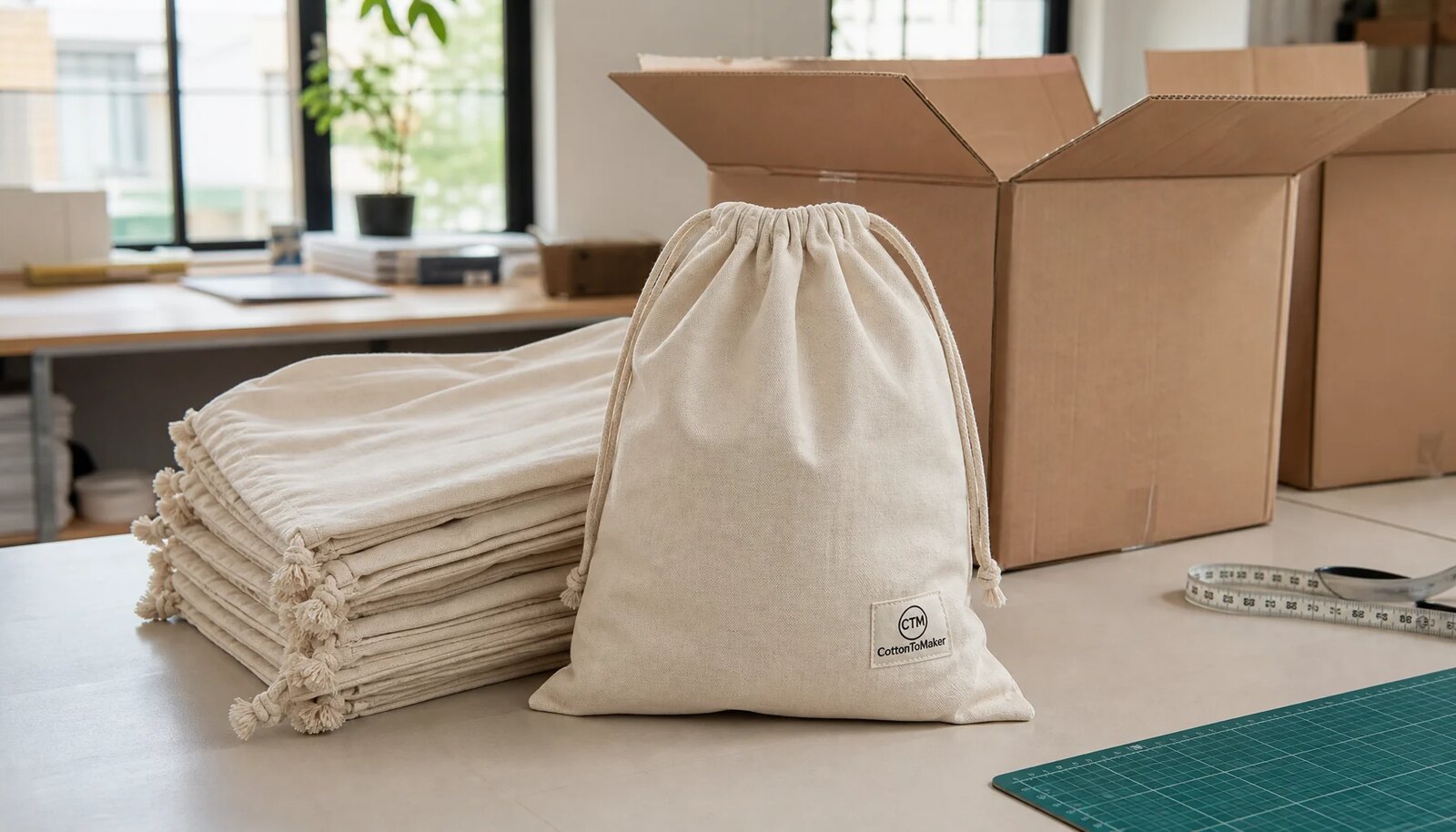
Start With Receiving, Not the Pouch Price
For wholesale cotton drawstring pouches for event planners, shipping carton planning should begin before the supplier quote is accepted. These pouches may pass through a factory, forwarder, importer, distributor warehouse, kitting house, sponsor fulfillment team, venue dock, and temporary event crew before attendees ever touch them. A low pouch unit price loses its shine quickly if cartons arrive too heavy, loosely counted, weak, mislabeled, or mixed by SKU.
The first procurement question is simple: who opens the cartons, and how do they need to count? A warehouse may want palletized cartons with scan-ready labels and fixed quantities. A kitting house may prefer bundles of 25, 50, or 100 so staff can pull pouches without counting every piece. A venue team may need lighter cartons because boxes are being hand-carried through service corridors or service elevators. A distributor may require labels on two adjacent sides so cartons can be identified while stacked.
A useful RFQ defines receiving location, handling method, count logic, label fields, and carton limits before asking for a final price. Suppliers should quote after they know the net pieces per carton, target gross weight, carton dimensions, carton label content, inner pack method, and pallet requirement. Without those details, one quote may look cheaper only because it transfers labor, counting risk, or repacking work to the buyer.
- Identify the final receiving point: venue, warehouse, fulfillment center, distributor dock, sponsor office, or kitting house.
- Set the receiving count method before the PO: full-carton count, bundle count, scan count, or piece count.
- Ask the receiving team for maximum carton weight, preferred carton size, pallet rules, label fields, and appointment requirements.
- Require each quote to show carton dimensions, gross weight, net pieces per carton, total carton count, and estimated total CBM.
- Avoid mixed cartons for direct-to-venue delivery unless the event team has a written sorting plan and enough labor to execute it.
Translate Event Use Into Technical Specs
A cotton drawstring pouch looks like a simple item, but the spec changes with the job it has to do. A pouch holding a badge lanyard, pin, and welcome card can be lighter than one holding glassware, cosmetics, tech accessories, headphones, or a premium sponsor gift. Procurement should ask what goes inside, whether the item has sharp corners, how long it will stay packed, whether attendees are expected to reuse the pouch, and whether the pouch will appear in sponsor photos or VIP kits.
For many branded event programs, 110-140 gsm cotton is a practical middle range. It usually gives enough body for clean screen printing, acceptable opacity for natural or dyed cotton, and reasonable seam stability for light to moderate contents. A lighter 90-100 gsm pouch can work for price-sensitive giveaways, but the contents may show through and the hand feel can be thin. Heavier 150-180 gsm cotton suits premium kits and heavier inserts, but it raises unit weight, lowers carton density, and can change freight cost.
Finished size should be based on the real insert, not on a logo area alone. Ask the supplier to test the approved contents in the proposed pouch and confirm the closing behavior. The item should slide in without forcing seams, and the top should cinch without warping the print. A tight pouch slows kitting and looks strained. An oversized pouch weakens presentation and fills cartons with extra fabric and air.
- Use 90-100 gsm only for light, price-sensitive giveaways with simple contents and modest presentation expectations.
- Use 110-140 gsm for most branded event pouches that need reliable print quality, acceptable opacity, and efficient carton loading.
- Use 150-180 gsm when the pouch carries heavier items, premium gifts, or merchandise expected to be reused after the event.
- Confirm insert fit before approving bulk size; a flat size chart does not prove that the pouch closes properly when filled.
- Specify cord material, cord color, cord length, knot style, channel height, and whether the closure is single-draw or double-draw.
Set Tolerances Buyers Can Enforce
B2B pouch orders need written tolerances because cotton is flexible and production lots are not identical. Without tolerances, a supplier may treat small differences in size, GSM, cord length, or print position as normal, while the buyer sees them as defects. The aim is not unrealistic precision. The aim is a shared pass-fail standard that protects insert fit, brand presentation, and carton planning.
For soft cotton pouches, buyers often allow practical finished-size tolerances such as plus or minus 5 mm on smaller pouches and plus or minus 10 mm on larger pouches, provided the approved insert still fits and the closure works smoothly. GSM should be stated as a finished fabric target with an agreed range because dyeing, washing, finishing, and lot variation can affect the final fabric. Print placement should be measured from fixed pouch edges or seams, not judged only by eye.
Tolerances also affect cartons. If the pouch is larger, heavier, or packed with a thicker cord than quoted, carton count and gross weight can change. A wide print area may stiffen the pouch stack. A switch from flat cotton tape to round cord may reduce compression. Ask the supplier to connect the pouch spec, unit weight, inner packing, and carton count in the quote so changes are visible before purchase approval.
- Write finished pouch width, height, channel height, cord length, and opening tolerance into the spec sheet.
- State GSM as a finished fabric target with an agreed acceptable range after dyeing, finishing, or washing.
- Measure print placement from pouch edges or seam references, and define acceptable shift in millimeters.
- Confirm that tolerance approval does not override insert-fit approval; the pouch must still hold the intended item.
- Require written approval before changing fabric lot, cord type, decoration method, carton count, or inner packing format.
Build the Carton Count Model
Carton planning works best when buyers calculate from finished unit weight instead of guessing a round number. Ask the supplier for the finished pouch weight by size, including fabric, cord, label, decoration, and any inner packing. Multiply that weight by the proposed pieces per carton, then add carton and packing material weight. That gives an estimated gross carton weight before production starts. If the supplier cannot provide unit weight, request a weighed sample batch or first-article carton before approving bulk packing.
For manual event workflows, many receiving teams prefer cartons around 12-15 kg gross weight. Some warehouses can process heavier cartons, but 18-20 kg boxes may slow unloading, raise drop risk, or create handling complaints at venues. Very light cartons can be inefficient too, especially when they waste cube or multiply receiving touches. The best carton plan balances handling comfort, freight efficiency, carton strength, and count clarity.
Carton dimensions should be tested with the actual packing method. Cotton pouches compressed too tightly can arrive heavily creased, marked by print offset, or difficult to air out. Underfilled cartons can collapse when stacked. Overfilled cartons bulge, split at corners, and lose stacking strength. Ask the factory to pack a trial carton, weigh it, photograph the top, side, label, and closure, then confirm whether the carton remains square after sealing.
- Request finished pouch unit weight for every size, GSM, cord style, and artwork version.
- Target a carton gross weight that the receiving team can lift, move, and audit without repacking.
- Ask for outer carton dimensions, net pieces per carton, gross weight, total carton count, and total estimated CBM.
- Leave packing headroom for fabric variation, cord thickness, print thickness, inner bags, and carton tolerance.
- Approve a packed-carton photo before shipment, especially for first-time specs, large orders, or strict venue deliveries.
Choose Packing Around the Workflow
Packing format should follow the event workflow, not factory habit. Loose bulk packing is usually the lowest-cost method and can work when cartons are received as full units and moved directly to storage. It is weaker when staff need exact sub-counts for sponsor kits, room drops, VIP sets, registration desks, or timed assembly lines.
Counted bundles of 25, 50, or 100 make receiving and kitting faster because staff can verify quantities without touching every pouch. Bundles may be held with paper bands, cotton ties, or inner bags depending on cleanliness, presentation, and sustainability requirements. For large kitting projects, the bundle count should match the workcell. If teams build kits in batches of 50, a 50-piece bundle saves motion. If table leads receive 25 pouches each, a 25-piece bundle may be better even if it creates more bands.
Individual polybags deserve a specific reason. They protect each pouch and create a cleaner retail-style handoff, but they add material cost, labor, volume, and waste. They also change carton count because individually bagged pouches do not compress like loose pouches. For many event planners, individual packing is unnecessary unless the pouch will be handled as a finished gift item, stored near items that could soil it, or distributed directly without further kitting.
- Use loose bulk packing when the receiving team counts by full carton and does not need fast sub-picking.
- Use counted bundles for kitting houses, distributor warehouses, and events that split inventory by room, sponsor, session, or attendee tier.
- Use individual polybags only when presentation, cleanliness, retail handling, or component protection justifies added cost and volume.
- Match bundle quantity to the way staff will assemble kits, not simply to the supplier's preferred packing habit.
- Ask for a final packing list that matches physical labels and carton contents carton by carton.
Make Carton Labels Audit-Friendly
A carton label is the receiving team's first control point. At minimum, labels should show buyer name, PO number, SKU, pouch size, fabric color, artwork version, pieces per carton, carton number, total cartons, gross weight, and destination if cartons are routed to more than one site. Labels on two adjacent sides help staff identify cartons on pallets without opening or rotating every box.
For direct-to-venue shipments, plain-language destination notes can be useful: registration desk, sponsor lounge, VIP room, ballroom storage, or warehouse hold. These notes should support SKU and count data, not replace it. Event teams often include temporary staff, so the label must be understandable without relying on supplier shorthand or internal factory codes.
Carton sequence should match the packing list exactly. If the packing list says carton 1 of 80 contains SKU A and carton 2 of 80 contains SKU B, the physical cartons need the same numbering. If the supplier changes carton count after packing, the packing list and labels must be revised before dispatch. Mismatched paperwork can delay receiving, create false shortage claims, and make freight claims harder if cartons are missing or damaged.
- Include buyer name, PO number, SKU, size, color, artwork version, pieces per carton, gross weight, carton sequence, and destination.
- Use two adjacent carton labels for palletized, cross-docked, or venue-received shipments.
- Keep SKU data and plain-language event destination notes on the same label when possible.
- Require the final packing list to match carton labels, carton sequence, SKU separation, and total carton count.
- Do not approve handwritten relabeling for large orders unless the buyer has reviewed photos and accepted the correction.
Match Decoration to Cotton and Cartons
Decoration affects appearance, production timing, and carton density. Screen printing is often the practical choice for cotton drawstring pouches because it handles simple logos cleanly, works well on woven cotton, and adds little bulk. It is especially efficient for one-color or simple two-color event artwork. The main controls are ink coverage, edge clarity, registration, curing, and placement on the finished pouch.
Heat transfer can reproduce more detail, gradients, or small text, but it may feel stiffer on cotton and can change how pouches stack. Large transfer areas can resist folding and create a thicker pile inside cartons. Embroidery gives a premium texture, but it adds bulk, increases cost, and can distort smaller pouches if the stitch count is dense. Woven labels, side tabs, and sewn patches can be useful when buyers want brand presence without a large print area, but they require placement checks and extra sewing control.
Approval should not happen only on a digital proof. The buyer should approve a pre-production sample made from final fabric, final color, final cord, and final decoration method. Review the logo after folding, rubbing, and placing the pouch inside a sample carton. A logo that looks sharp on a flat table can crack at a fold, drift near a seam, or offset onto another pouch if it is packed before full cure.
- Use screen print for simple logos, stable unit cost, short pile height, and predictable carton loading.
- Use heat transfer for detailed artwork only after checking stiffness, adhesion, edge lift, fold behavior, and hand feel on cotton.
- Use embroidery for premium programs where added thickness, stitch cost, and lower carton density are acceptable.
- Approve decoration on the actual finished pouch fabric, not only on a paper proof or generic cotton swatch.
- Require curing time, rub checks, fold checks, and offset checks before pouches are stacked and sealed in cartons.
Write an RFQ That Blocks Assumptions
A strong RFQ makes suppliers quote the same product and the same logistics plan. It should include pouch dimensions, finished GSM, fabric color, cord type, construction details, decoration method, artwork colors, print position, order quantity, delivery location, freight term, sample requirement, carton target, inner packing format, carton label format, and inspection expectations. When these fields are missing, suppliers fill the gaps differently and the buyer ends up comparing unlike quotes.
For B2B procurement, the quote should separate commercial elements clearly. Ask for pouch unit price, decoration setup charges, sample charges, inner packing cost, carton or pallet charges, inspection support, freight estimate, and payment terms. If the supplier gives one blended number, it becomes harder to understand what changed when artwork, carton count, packing method, or freight term changes.
The RFQ should also ask suppliers to list exceptions. A supplier may not be able to meet the target GSM, carton dimensions, MOQ, or lead time exactly. That can be manageable when disclosed early. The real risk is silent substitution: different cotton, different cord, different carton size, different bundle count, or a different print process after the PO is issued. Require assumptions and deviations in writing so the quote becomes a controllable specification, not just a price.
- Include one complete spec sheet with pouch size, GSM, cotton color, cord, decoration, packing, carton, label, and freight requirements.
- Ask suppliers to quote the same Incoterm and destination so landed cost comparisons are meaningful.
- Require line-item pricing for pouch, decoration, setup, sampling, packing, cartons, pallets, freight, and optional services.
- Ask suppliers to state assumptions, exclusions, proposed substitutions, and capacity constraints in the quote.
- Treat quotes that omit carton count, carton dimensions, gross weight, MOQ rules, or overrun tolerance as incomplete.
Inspect the Defects That Matter
Quality control should focus on defects that affect use, appearance, count accuracy, and receiving speed. Start with measurement. The pouch width, height, opening, drawstring channel, and cord length must stay within written tolerance so the approved insert fits without stressing seams. If the pouch is designed for a specific item, the supplier should test that item during sample approval and, when practical, during pre-shipment inspection.
Construction checks should cover side seams, bottom seams, channel stitching, backstitching, drawstring smoothness, knot security, loose threads, needle holes, and fabric defects. A pouch that fails at the channel or bottom seam creates immediate event problems because it is handled during kitting, transport, and attendee pickup. For natural cotton pouches, also check cotton seed flecks if appearance matters, shade consistency, odor, stains, mildew smell, and oil marks from sewing or packing equipment.
Carton QC is just as important as pouch QC. Inspectors should count pieces in selected cartons, confirm inner bundle counts, verify carton labels, record gross weights, and photograph packed cartons before dispatch. If cartons are crushed, overfilled, damp, or mislabeled, the shipment may contain acceptable pouches and still arrive as an operational problem. For larger orders, use a defined sampling plan such as an agreed AQL level or a buyer-specific inspection rule with written pass-fail criteria.
- Check dimensions against approved sample and written tolerance, not supplier memory or a loose visual standard.
- Test drawstring function on both sides and confirm knots, cord length, cord color, and closure smoothness.
- Inspect print or embroidery for placement, color, adhesion, rub resistance, loose threads, registration, and fold behavior.
- Reject stains, odor, mildew marks, broken cords, skipped stitches, holes, sharp debris, and heavy print offset.
- Audit carton labels, carton counts, inner bundle counts, gross weights, SKU separation, and visible carton damage before shipment.
Control Moisture, Odor, and Storage Risk
Cotton is absorbent, so moisture control deserves more attention than many pouch buyers give it. A carton that sits in a humid warehouse, container, or loading area can transfer odor to cotton pouches even when the bags are structurally sound. Natural cotton can also show water marks, mildew smell, or carton staining if packaging is weak. Event planners often open cartons shortly before distribution, leaving little time for airing, sorting, or replacement.
The right protection depends on the route. For local or short-haul delivery, a clean carton and dry storage may be enough. For ocean freight, long warehouse storage, rainy-season loading, or humid destinations, consider carton liners, desiccants, pallet wrap, and clear storage instructions. Desiccants should be used thoughtfully: too little will not help, and loose packets should not fall into product bundles where event staff may mistake them for kit components.
Odor control also connects to decoration. Ink, transfer adhesive, embroidery backing, or finishing chemicals need adequate curing and airing before packing. If pouches are sealed immediately after decoration, they can arrive with strong odor or blocked surfaces. The PO should require that prints are dry and fully cured before folding and that cartons are stored in a clean, dry area before loading.
- Ask whether cotton will be packed only after it is dry, cured, aired, and free from strong finishing or ink odor.
- Use carton liners, desiccants, pallet wrap, or moisture-barrier planning for humid routes, ocean freight, or long storage periods.
- Keep cartons off wet floors and require clean, dry storage before loading.
- Check for mildew smell, water marks, carton staining, print blocking, and odor concentration during final inspection.
- Request photos of pallet wrap, carton condition, loading area, and sealed cartons when moisture risk is high.
Specification comparison for buyers
| Sourcing or packing choice | Best-fit use case | Specs to lock before PO | Buyer risk to control |
|---|---|---|---|
| Direct factory with fixed carton plan | Repeat event programs, distributor replenishment, annual conferences, and buyers who want one accountable source for fabric, sewing, decoration, packing, and export cartons | Finished size tolerance, GSM range, cord type, print method, inner pack count, pieces per carton, carton dimensions, gross weight, carton label format | If carton count and packing method are not written into the quote and PO, the factory may choose a convenient pack-out that slows receiving or changes freight density |
| Direct factory with buyer-supplied warehouse rules | Large programs requiring barcode labels, SKU-separated cartons, pallet patterns, fixed bundle counts, carton orientation rules, or venue-specific receiving instructions | Label artwork, barcode data, carton sequence, pallet height, carton orientation, inner bundle quantity, destination code, photo approval process | Confirm the factory can follow the exact carton map and will not substitute carton dimensions, bundle counts, or label placement without written approval |
| Trading company or sourcing agent | Multi-SKU campaigns with several pouch sizes, cotton colors, drawcord options, or decoration methods across more than one workshop | Supplier identity, final packing responsibility, QC location, carton consolidation method, inspection authority, exception approval process | Hidden subcontracting can slow decisions on defects, rework, and carton corrections; require one party to sign off final packing accuracy |
| Stock holder or distributor | Urgent event orders, smaller quantities, simple artwork, and top-up quantities where existing pouch specs are acceptable | Actual stock size, GSM, color lot, cord type, decoration method, available carton count, dispatch timing, carton dimensions | Stock carton dimensions and pack counts may be fixed, so freight density, brand consistency, and carton label control can be weaker than made-to-order production |
| Blank pouch factory plus local decorator | Regional roadshows, late sponsor approvals, multilingual artwork, or buyers who want blanks produced before final logos are approved | Blank pouch fabric spec, print test fabric, decoration tolerance, blank carton count, printer receiving condition, re-cartoning responsibility | Print durability and placement can vary unless the local decorator tests on the exact finished cotton pouch, not a generic swatch |
| Full-service kitting or pack-out vendor | Attendee kits, VIP gift sets, sponsor boxes, retail-style packs, and direct-to-venue cartons with multiple components | Bill of materials, pouch source, insertion rules, final carton count, component traceability, exception handling, final count checks | Unit cost is higher and component visibility can be lower; require SKU-level packing lists and documented count checks |
| Sea-freight bulk order | High-volume event calendars, seasonal distributor buys, and repeat programs where freight cost matters and timing allows ocean transit | Carton strength, moisture protection, pallet rules, inspection timing, gross weight, cubic volume, carton liner requirements | Humidity, carton crush, storage odor, and delayed receiving become material risks if cartons are weak, overfilled, unlined, or poorly palletized |
| Air-courier pilot or approval order | First-article approval, sponsor sample sets, pre-production verification, or urgent limited replenishment | Sample size, finished GSM, artwork method, packed-carton test, unit weight, measured dimensions, declared shipment weight | Freight can exceed product savings; use air mainly to validate pouch spec, print, fold behavior, carton density, and receiving workflow |
| Mixed-size consolidated cartons | Low-volume SKU families going to one controlled kitting house with time and systems to sort immediately | Carton map, inner labels, exact SKU counts, color coding, receiving instructions, claim procedure | Mixed cartons increase counting errors, picking mistakes, and claims difficulty; avoid them for direct-to-venue shipments |
Buyer checklist before sampling
- Define the event use, insert item, target attendee count, contingency quantity, final receiving point, and who will physically open the cartons.
- Lock finished pouch size, GSM range, cotton color, cord type, drawstring style, seam construction, decoration method, print placement, and packing format before comparing supplier pricing.
- Ask for finished pouch unit weight by size and artwork version, including cord, label, print, and inner packing, then use it to estimate gross carton weight and shipment cube.
- Set a target carton gross weight, maximum carton dimensions, and carton strength requirement; many manual event workflows prefer roughly 12-15 kg per carton unless the receiving team approves otherwise.
- Specify whether pouches should be packed loose, in counted paper bands, in inner polybags, in master bundles, or as retail-ready individual units.
- Require every quote to show net pieces per carton, carton dimensions, carton gross weight, carton grade if available, total carton count, and total estimated CBM.
- Confirm MOQ by pouch size, fabric color, cord color, print method, artwork layout, and packing format, not only the supplier's headline order quantity.
- Ask for production lead time counted from the last dependency: approved pre-production sample, deposit, artwork lock, fabric availability, and confirmed carton plan.
- State whether the quote should be EXW, FOB, CIF, DAP, or DDP so product cost, freight, customs, and destination charges can be compared consistently.
- Write overrun and underrun tolerance into the PO, including how extra pieces will be billed, labeled, packed, and reported before shipment.
Factory quote questions to send
- What is the finished GSM of the cotton after dyeing, washing, finishing, shrinkage allowance, or calendering, and what tolerance do you control in bulk?
- What is the finished pouch unit weight for each size and artwork version, including cord, print, label, and any inner packing?
- What finished size tolerance do you offer for width, height, bottom seam, drawstring channel height, cord length, and opening width?
- What carton dimensions, net pieces per carton, gross weight per carton, total carton count, and total CBM are included in this quote?
- Will the pouches be packed loose, in counted bundles, in inner polybags, with paper bands, or in retail-ready packaging?
- What outer carton grade, wall type, or burst strength will be used, and can you provide a photo of the packed carton before bulk shipment?
- Which decoration method are you pricing, and how many colors, screens, transfers, embroidery stitches, labels, or setup charges are included?
- Can you print or embroider on the final pouch fabric and provide rub, fold, color, registration, and placement approval samples before production?
- What is your MOQ by pouch size, fabric color, cord color, print layout, decoration method, and packing format?
- What overrun or underrun percentage do you allow, and how will excess or short pieces be reported before shipment?
Quality-control points to confirm
- Measure pouch width, height, opening, bottom seam, drawstring channel, and cord length on random pieces against the approved sample and written tolerance.
- Confirm finished GSM, fabric hand feel, color, shrinkage behavior, opacity, and cotton surface match the approved bulk fabric, not only the mill's stated specification.
- Inspect side seams, bottom seams, channel stitching, backstitching, stress points, skipped stitches, loose threads, open seams, needle holes, and uneven sewing.
- Check drawstring pull, knot security, cord length consistency, cord color, frayed ends, and smooth closure on both sides of the pouch.
- Verify print placement, logo size, color tone, edge sharpness, ink coverage, registration, rub resistance, fold behavior, cure level, and transfer adhesion on the actual finished pouch.
- Reject pouches with stains, oil marks, dye spots, holes, strong odor, mildew smell, broken cords, adhesive marks, scorch marks, heavy creasing, or visible print offset.
- Check whether the approved insert item fits easily without forcing seams, distorting the print, blocking closure, or making the pouch look overfilled.
- Count pieces inside inner bundles and cartons against the approved packing method, PO quantity, and final packing list before outer cartons are sealed.
- Record carton label accuracy, carton dimensions, gross weight, net count, carton number sequence, SKU separation, and destination code before dispatch.
- Inspect export cartons for crushed corners, weak tape, overfilling, moisture marks, insufficient liner protection, poor pallet wrap, and unstable stacking.