1. Define the Coffee Use Case Before Asking for Price
Cotton drawstring pouches look simple, but quotes become unreliable when the buyer starts with only a size and logo. A pouch for back-of-house sample distribution can prioritize low cost, fast replenishment, and loose packing. A pouch in a retail gift set needs better opacity, cleaner sewing, controlled branding, and packing that preserves presentation. A subscription insert may sit between those two requirements.
For coffee roasters, the first specification question is whether the pouch is secondary packaging or product-contact packaging. Most cotton pouches for roasters hold a sealed coffee sample bag, tasting card, brew accessory, coupon, or gift component. If the pouch could touch beans, grounds, or unpacked food directly, do not treat it as a standard accessory purchase. Ask for suitable material review and compliance documentation for the destination market.
Coffee also raises odor and storage concerns. Cotton stored in damp cartons or near strong chemicals can arrive with musty, oily, or chemical smells that conflict with coffee branding even when the pouch never touches the product. Natural unbleached cotton also varies in shade. That can look attractive in a craft coffee display, but only if the buyer approves a shade band instead of expecting identical pure-white pieces.
- Classify the program: sample kit, subscription insert, gift set, retail bundle, event giveaway, distributor pack, or internal use.
- Confirm whether the pouch touches only sealed primary coffee packaging or could touch product directly.
- List real contents and approximate load weight before selecting GSM, seams, and cord.
- State whether the pouch is customer-facing, retail-facing, or internal-only.
- Add odor, humidity exposure, shade variation, and contamination limits to the RFQ from the start.
2. Set Finished Size, Capacity, and Tolerances
Many disputes start because one side quotes cut-panel size while the other expects finished size. Specify finished pouch width and height after sewing, pressing if used, and drawcord insertion. State whether the height includes the top channel. If the pouch must fit a mailer, tray, gift box, or retail display, test both the flat dimensions and the filled dimensions.
A useful drawing should show body width, body height, channel height, opening width, cord exit position, gusset or boxed bottom if used, and logo placement. For many small and medium cotton pouches, plus or minus 5 mm on body dimensions is a workable starting point. Print or label placement should have its own tolerance, often plus or minus 3-5 mm depending on artwork and pouch size.
Do not approve a flat sample only. Fill the pouch with the sealed coffee sample, retail bag, spoon, card, or accessory that will actually be packed. Pull the cord closed. Check whether the logo folds into the channel, whether the opening is too tight, whether the corners distort, and whether the cord closes evenly without straining the fabric.
- Quote by finished size in millimeters, not cut fabric size.
- Separate tolerances for body dimensions, channel height, and logo placement.
- Test the largest intended contents, not only the easiest item.
- Keep artwork below the drawcord channel and away from side seams.
- If one pouch must serve multiple SKUs, approve it against the bulkiest SKU.
3. Choose Cotton GSM, Finish, and Shade Standard
GSM is one of the largest cost drivers. A 100-120 GSM pouch can work for light sealed sample bags, event inserts, and low-cost promotional use. It reduces material cost and freight weight but may feel limp or show contents through the fabric. A 140-160 GSM pouch is often the better balance for customer-facing coffee programs because it offers more opacity and hand feel without moving into heavy merchandise-bag territory.
Heavier fabric, such as 180 GSM and above, can be appropriate for premium gift sets, accessories, or reusable merchandise. It also increases unit cost, carton volume, and freight impact. Procurement should therefore compare total landed cost, not only the factory unit price. A thicker pouch that packs fewer pieces per carton may be less efficient for replenishment even if it looks better on a sample table.
Fabric finish matters as much as weight. Natural unbleached cotton commonly shows flecks, slubs, and warm shade variation. Approve a physical shade band and define unacceptable stains or foreign fibers. Bleached cotton gives a cleaner print base. Dyed or custom-dyed fabric supports brand color, but it can introduce lab dips, dye-lot MOQ, colorfastness checks, and extra lead time.
- 100-120 GSM: light inserts, events, back-of-house samples, low-cost campaigns.
- 140-160 GSM: gift, subscription, retail, and most customer-facing coffee pouch programs.
- 180 GSM and above: premium reusable packaging or heavier contents where freight impact is acceptable.
- Approve natural cotton shade variation with a shade band, not a vague description.
- Reject musty odor, damp-storage smell, oil marks, mold signs, and excessive foreign fibers.
4. Specify Construction: Seams, Channel, Cord, and Closure
A low quote often hides in construction details. Ask for seam type, stitch density range, seam allowance, thread color, and trimming standard. For a giveaway pouch, basic construction may be enough. For a reusable retail pouch, crooked seams, open seam ends, loose threads, and uneven corners damage the brand impression.
The drawcord channel should be specified with the cord. A channel that is too narrow makes closure difficult; one that is too wide can look bulky on a small pouch. Many small cotton pouches use cords in the 3-5 mm range, but the correct diameter depends on fabric weight, pouch size, and desired hand feel. Cord exits should be clean, reinforced if required, and resistant to fraying under normal use.
Single drawcords reduce cost and suit simple utility pouches. Double drawcords usually close more evenly and feel more customer-friendly, but they add labor and material. Cotton cord supports a natural look; polyester can slide smoothly but may not match every brand position. State cord material, color, diameter, number of cords, end finish, and whether metal or plastic tips are prohibited.
- Include seam type, stitch density, thread color, and loose-thread trimming in the RFQ.
- Specify channel width and cord diameter together.
- Choose single or double drawcord deliberately; do not compare them as equal quotes.
- Require a fill-close-open test using real coffee program contents.
- Inspect cord exits for fraying, tearing, and uneven closure.
5. Match Logo Method to Artwork and Reorder Plan
One-color screen print is usually the most practical option for coffee roaster logos, origin marks, and simple subscription graphics. It keeps unit cost controlled once the order quantity absorbs the screen fee. The RFQ should show whether setup is included, whether repeat orders pay a new fee, and whether each artwork version creates another charge.
Cotton texture affects print clarity. Fine lines, small text, QR codes, and tight two-color registration are harder on natural fabric than on smooth paper or plastic film. Define artwork size, print area, placement distance from the channel and seams, color target, and tolerance. A digital mockup is useful for layout but should not be the production standard. Use a print strike-off on the same cotton for important color or detail.
Woven labels and sewn patches create a more premium reusable presentation and avoid some surface-ink wear. They also add label MOQ, sewing labor, placement tolerance, and bulk in packing. Heat transfer or digital print may help multi-color artwork, but buyers should test edge feel, flexibility, rub resistance, and how the method looks on the selected cotton.
- Use screen print for simple one-color or two-color artwork at volume.
- Request strike-offs for Pantone targets, fine text, QR codes, or detailed origin graphics.
- Keep artwork away from seams, folds, and the drawcord channel.
- Compare setup fees separately from unit price.
- For woven labels, confirm label MOQ, fold style, placement tolerance, and sewing quality.
6. Build a Bulk Pricing Plan With Real Breakpoints
A useful bulk pricing plan separates unit cost, setup charges, packing charges, and landed cost. Ask all suppliers to quote the same spec at 500, 1,000, 3,000, and 5,000 pieces. Keep finished size, GSM, fabric finish, cord, logo method, packing, inspection requirement, and Incoterm identical. Otherwise, the lowest number may simply be a thinner fabric, stock blank, looser packing, or missing setup fee.
Use tier logic rather than expecting universal prices. For example, if a screen fee is $80 and the first pre-production sample is $50, that fixed cost adds $0.26 per pouch at 500 pcs but only $0.026 at 5,000 pcs. A custom label with a separate MOQ may create a different breakpoint. A dyed fabric may make 500 pcs uneconomic while natural stock cotton is workable.
Illustrative tier analysis can look like this: factory unit price $0.88 at 500 pcs, $0.72 at 1,000 pcs, $0.58 at 3,000 pcs, and $0.52 at 5,000 pcs for the same natural 150 GSM pouch with one-color print and bulk packing. Add setup and sample allocation, then add freight, duty, inspection, and receiving costs. Replace these numbers with supplier quotes; the value is the method, not the example price.
- At each tier, calculate: unit price + allocated setup + packing extras + freight + duty/tax + inspection + receiving/rework allowance.
- Ask why the price drops: fabric yield, setup allocation, print efficiency, labor line efficiency, or carton utilization.
- Compare first-order cost separately from repeat-order cost when setup may not repeat.
- If multiple artwork versions are needed, price each version and its setup cost separately.
- Use landed cost per accepted pouch, not factory unit price, for purchasing decisions.
7. Use a Simple Landed-Cost and Carton Worksheet
Landed cost is where procurement plans become operational. A pouch that looks cheaper at EXW can lose the advantage after inland pickup, export handling, ocean or air freight, duty, customs brokerage, inspection, relabeling, or warehouse receiving. Ask for carton data at quotation stage, not only after production: pieces per carton, carton dimensions, gross weight, net weight, carton count, and total CBM.
Example worksheet for planning only: 3,000 pouches at $0.58 factory price equals $1,740. Add $80 screen fee and $50 sample allocation, bringing product-related cost to $1,870. If estimated freight and origin/destination charges are $420, duty and brokerage are $160, and receiving/inspection allowance is $90, total landed cost becomes $2,540. Divided by 3,000 pcs, the landed cost is about $0.85 per pouch. If 2% fail inspection or are damaged, accepted-piece cost rises slightly because fewer usable pouches absorb the same total cost.
Carton volume also affects replenishment. Suppose a factory estimates 500 pieces per carton, carton size 50 x 40 x 35 cm, gross weight 14 kg. One carton is 0.07 CBM. A 3,000-piece order would be six cartons, about 0.42 CBM and 84 kg gross. If thicker fabric or individual polybags reduce the count to 300 pieces per carton, the same order becomes ten cartons and about 0.70 CBM if carton size stays similar. That change can affect freight class, storage, and 3PL receiving.
- Request estimated carton data before issuing the PO and confirm final carton data before shipment.
- Calculate landed cost by accepted piece, not ordered piece, when defect risk or transit damage is material.
- Model ocean, air, courier, or domestic truck costs according to replenishment urgency.
- Include 3PL labels, carton marks, repacking, and receiving labor if they are part of the workflow.
- Do not approve premium GSM without checking carton count, CBM, and gross weight impact.
8. Plan Sampling and Lead Time Without Guesswork
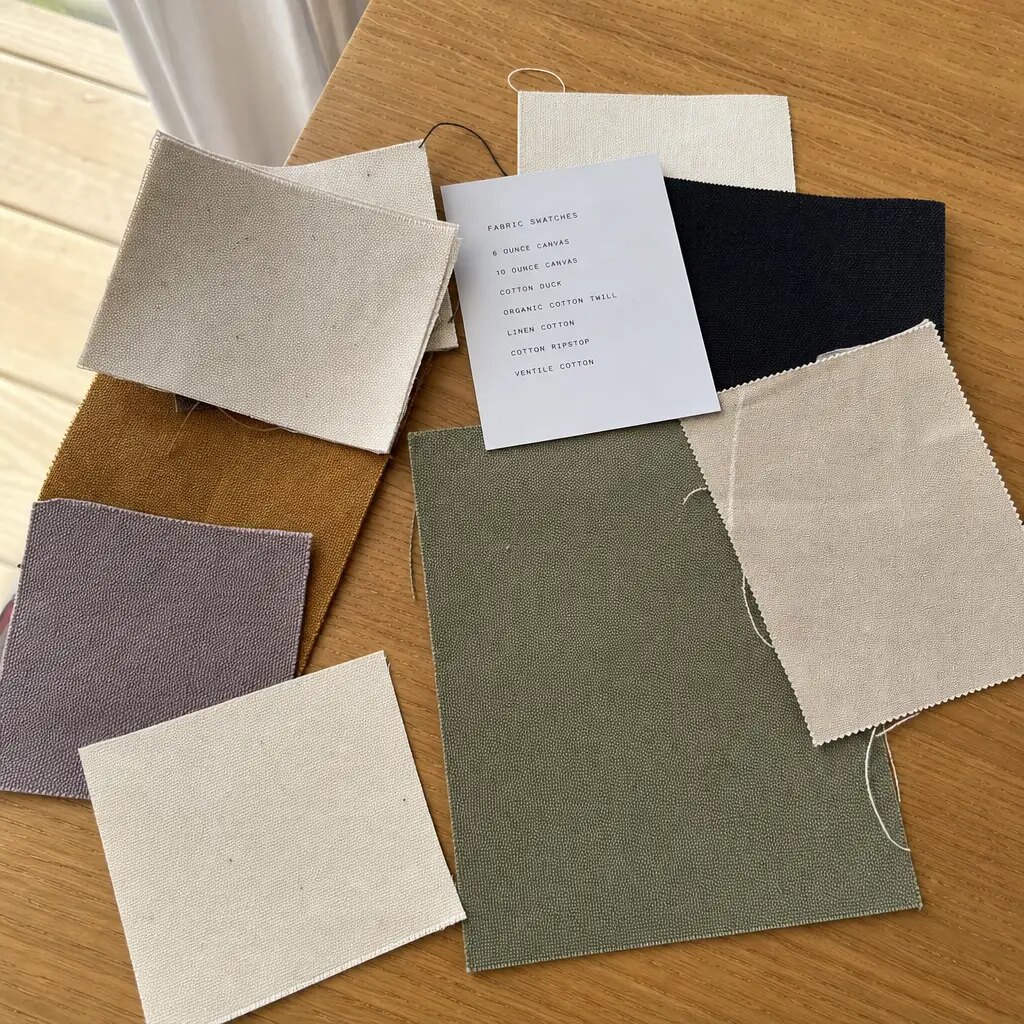
Sampling should move in controlled stages. A swatch confirms GSM, shade, hand feel, and natural fleck level. A prototype confirms finished size, capacity, seam construction, and closure. A print strike-off confirms artwork on the actual cotton. A pre-production sample combines final fabric, cord, construction, logo, and packing method before bulk release.
Typical timing for a simple natural cotton pouch might be 3-7 days for swatches if material is available, 5-10 days for a prototype, 5-10 days for a print strike-off after artwork approval, and 7-14 days for a full pre-production sample depending on complexity. Bulk production after approval may take about 3-6 weeks for straightforward custom sewing and printing. Custom dyeing, woven labels, multiple artwork versions, individual packing, or holiday capacity can add time.
Build the timeline backward from the in-hands date. Include sample transit, buyer review, revision time, deposit/payment release, production, inspection, packing, shipment handover, freight, customs, and receiving. If the pouch is needed for a launch or subscription drop, leave time for receiving inspection before kitting starts. Approving production from photos alone may save days but increases risk for hand feel, odor, closure function, and print texture.
- Approve swatch, prototype, strike-off, and pre-production sample only when each step is needed; skip stages only when risk is low.
- Label the golden sample with date, size, GSM, fabric finish, cord, logo method, artwork version, and packing format.
- Close all sample comments before mass production release.
- Ask for realistic lead times by process, not one vague delivery date.
- Reserve receiving-inspection time before retail, subscription, or gift-set assembly.
9. Set QC Criteria for Coffee-Adjacent Packaging
Quality control should be specific enough for both factory inspection and buyer receiving. Measure finished dimensions from pieces taken across several cartons, not one top stack. Record width, height, opening width, channel height, and gusset or bottom fold if used. If the pouch must fit a coffee bag, insert, tray, or mailer, include a functional capacity test in inspection.
Sewing QC should separate functional defects from cosmetic defects. Open seams, torn cord exits, broken stitches, and closure failure are functional defects. Loose threads, mildly uneven corners, and slight shade variation may be cosmetic depending on the sales channel. Retail gift sets require a stricter visual standard than internal sample distribution.
Coffee roasters should add odor, moisture, and contamination checks. Cotton pouches should not arrive with musty odor, damp-storage smell, chemical odor, oil marks, mold signs, insects, or foreign fibers. If cartons are stored in humid conditions, the risk increases. For ocean shipments, consider inner moisture protection where appropriate, but balance that against sustainability goals and unpacking labor.
- Measure dimensions and print placement against the golden sample and written tolerances.
- Check stitch security, seam gaps, skipped stitches, loose threads, puckering, and cord-exit strength.
- Fill, close, open, and handle random pieces with actual contents.
- Inspect print coverage, color, curing, rub resistance, and legibility on textured cotton.
- Reject unacceptable odor, dampness, stains, mold evidence, oil marks, and foreign contamination.
10. Align Packing With Roastery, Retail, and 3PL Workflows
Packing affects cost, receiving speed, and product appearance. Loose bulk packing is the lowest-cost option when the roastery will count and kit pouches internally. It can create wrinkles and slower receiving counts. Inner packs of 25, 50, or 100 pieces give better warehouse control without the cost of individual packaging. Individual polybags protect from dust and moisture but add material, labor, and sustainability concerns.
Decide whether pouches should arrive flat, folded, bundled, nested, or sorted by artwork version. A fixed fold can speed kitting but may crease the logo. Thicker cotton, double cords, and sewn labels reduce packing density. If pouches go to a retailer, marketplace warehouse, subscription partner, or 3PL, specify barcode labels, SKU separation, carton marks, carton numbers, gross weight limits, and any receiver routing instructions in the RFQ.
Packing must be inspected like the product. Wrong inner quantities, mixed artwork, missing carton labels, or unscannable barcodes can create extra labor and missed launch dates. Ask for packing photos before shipment and compare final carton data to the quote. If carton count or CBM changes materially, update freight and landed-cost calculations before approving dispatch.
- Use loose bulk packing for internal use and lowest cost.
- Use inner packs when count control matters; use individual packs only when protection or receiver rules justify the added cost.
- Avoid folds through the printed logo or sewn label where possible.
- Include barcode, SKU, carton mark, and receiver instructions in the purchase order.
- Verify final carton count, dimensions, gross weight, and total CBM before shipment.
Specification comparison for buyers
| Procurement choice | Best use | Cost and MOQ effect | Lead-time and QC tradeoff |
|---|---|---|---|
| Stock blank plus decoration | Pilots, events, small seasonal runs, urgent café campaigns | Lower setup for small orders; limited size/GSM/color choices; repeat shade may vary | Fastest route if blanks are available, often 1-3 weeks after artwork approval; inspect blank quality before printing |
| Fully custom sewn pouch | Repeat coffee programs, gift sets, subscription kits, retail bundles | Higher MOQ but better control over finished size, GSM, cord, seams, packing, and repeat spec | Commonly 3-6 weeks after sample approval for simple natural cotton; longer for dyeing, labels, or complex packing |
| Direct factory | Buyers needing controlled specifications and repeat orders | Usually sharper unit cost at volume; buyer must manage spec, approvals, inspection, and logistics | Clearer production accountability if sewing and decoration are controlled; confirm which processes are subcontracted |
| Trader or sourcing agent | Mixed orders such as pouches, totes, aprons, dust bags, and merchandise packaging | May add margin but can consolidate suppliers, QC coordination, and shipping | Useful for multi-item programs; ask for factory traceability, carton data, and inspection access |
| One-color screen print | Simple roaster logos, origin marks, batch graphics, subscription inserts | Strong cost-to-brand ratio; screen fee is spread across quantity | Good for repeat orders; approve strike-off for fine text, Pantone targets, or textured cotton coverage |
| Woven label or sewn patch | Premium reusable pouches, merchandise, retail gift kits | Adds label MOQ and sewing labor; may cost more than print at low quantity | More durable presentation but adds placement and sewing QC points |
| Loose bulk master carton | Internal use, roastery kitting, back-of-house sample programs | Lowest packing cost; higher counting and wrinkle risk | Fastest packing; specify inner counts if warehouse accuracy matters |
| Inner packs or individual packs | 3PL, retailer, subscription warehouse, marketplace receiving | Adds labor, bags, labels, and carton complexity | Improves count control and dust protection; verify folds do not crease logos |
| Natural unbleached cotton | Craft coffee look, understated retail display, sustainability-positioned programs | Often practical for standard production; shade band must be accepted | Visible flecks and shade variation are normal; inspect odor, humidity exposure, stains, and foreign fibers |
Buyer checklist before sampling
- Finished pouch width and height in millimeters after sewing and cord insertion; state whether height includes the drawcord channel.
- Actual contents and load weight: sealed coffee sample bag, retail bag inside, tasting card, cupping spoon, brew accessory, gift card, or boxed insert.
- Whether the pouch touches only primary coffee packaging or could touch product directly; if direct contact is intended, request appropriate material and compliance review instead of assuming standard textile suitability.
- Cotton GSM target and acceptable tolerance, such as 140-160 GSM for many customer-facing programs rather than an undefined medium weight.
- Fabric finish: natural unbleached, bleached, dyed, custom dyed, washed, or unwashed, with approved shade band and limits for slubs, flecks, stains, and foreign fibers.
- Drawcord material, diameter, color, number of cords, cord length if important, knot/end finish, and whether metal or plastic tips are prohibited.
- Top channel width, cord-exit finish, seam type, stitch density range, thread color, loose-thread trimming standard, and reinforcement expectations.
- Logo method, artwork file type, print area in millimeters, color count, Pantone or approved color target, and placement tolerance.
- Packing format: loose bulk, inner packs of 25/50/100, individual bags, barcode labels, SKU separation, carton marks, carton weight limit, and receiver requirements.
- Commercial terms: sample fee, setup fees, unit price tiers, Incoterm, destination, payment terms, estimated carton data, freight method, inspection responsibility, and target ship date.
Factory quote questions to send
- Are you quoting a stock blank with decoration or a fully custom sewn pouch? If stock, how do you control repeat availability, cotton shade, and finished-size consistency?
- What is your tier price at 500, 1,000, 3,000, and 5,000 pcs for the same finished size, GSM, cord, logo method, packing format, inspection requirement, and Incoterm?
- Which price components are separate: sampling, screen fee, label setup, artwork version, inner packing, individual polybag, barcode label, carton label, inspection, or local delivery to port?
- What drives MOQ: finished size, fabric roll MOQ, GSM, natural or dyed fabric, cord color, label MOQ, print setup, artwork version, or packing style?
- What finished-size tolerance and print or label placement tolerance are included, and how many pieces will be measured during final inspection?
- What cotton fabric construction, GSM tolerance, shade tolerance, and odor/cleanliness standard are included in the quote?
- What drawcord material, diameter, color, number of cords, channel width, cord-exit finish, and end treatment are included?
- Which logo method are you quoting, what is the maximum print area in millimeters, and can you provide a strike-off on the same cotton before production?
- What are the realistic lead times for swatch, prototype, strike-off, pre-production sample, bulk production, packing, and shipment handover?
- What are the estimated pieces per carton, carton dimensions, gross weight, net weight, total cartons, and total CBM at each quoted quantity?
Quality-control points to confirm
- Finished dimensions must stay within the agreed tolerance for width, height, opening width, channel height, and gusset or bottom fold if used; measure pieces from multiple cartons.
- Fabric GSM must match the approved range, and bulk fabric must match the approved shade band, hand feel, visible slub/fleck limit, and opacity expectation.
- Pouches must be clean and free from stains, oil marks, mold, damp-storage odor, chemical odor, musty odor, excessive loose fibers, foreign fibers, insects, or contamination unsuitable near coffee packaging.
- Stitching must be straight, secure, and free of skipped stitches, broken threads, open seams, seam gaps, puckering, distorted corners, and messy trimming.
- Side seams, bottom seams, top hems, and cord exits must withstand the declared contents during a fill-close-open handling check.
- Drawcord must slide smoothly, close evenly, and not twist the pouch body, tear the channel, or fray excessively at the exits.
- Print must align with the approved placement, match the approved color target within the agreed visual standard, and show acceptable coverage on textured cotton.
- Small text, fine lines, QR codes if used, and logo details must remain legible and must not fill in, crack, bleed, smear, or sit too close to seams or the channel.
- Print curing should pass the agreed rub check or supplier QC method; obvious ink transfer during normal dry handling should fail inspection.
- Packing must match approved inner counts, fold method, SKU separation, carton labels, carton dimensions, gross weight limits, and moisture-protection expectations.