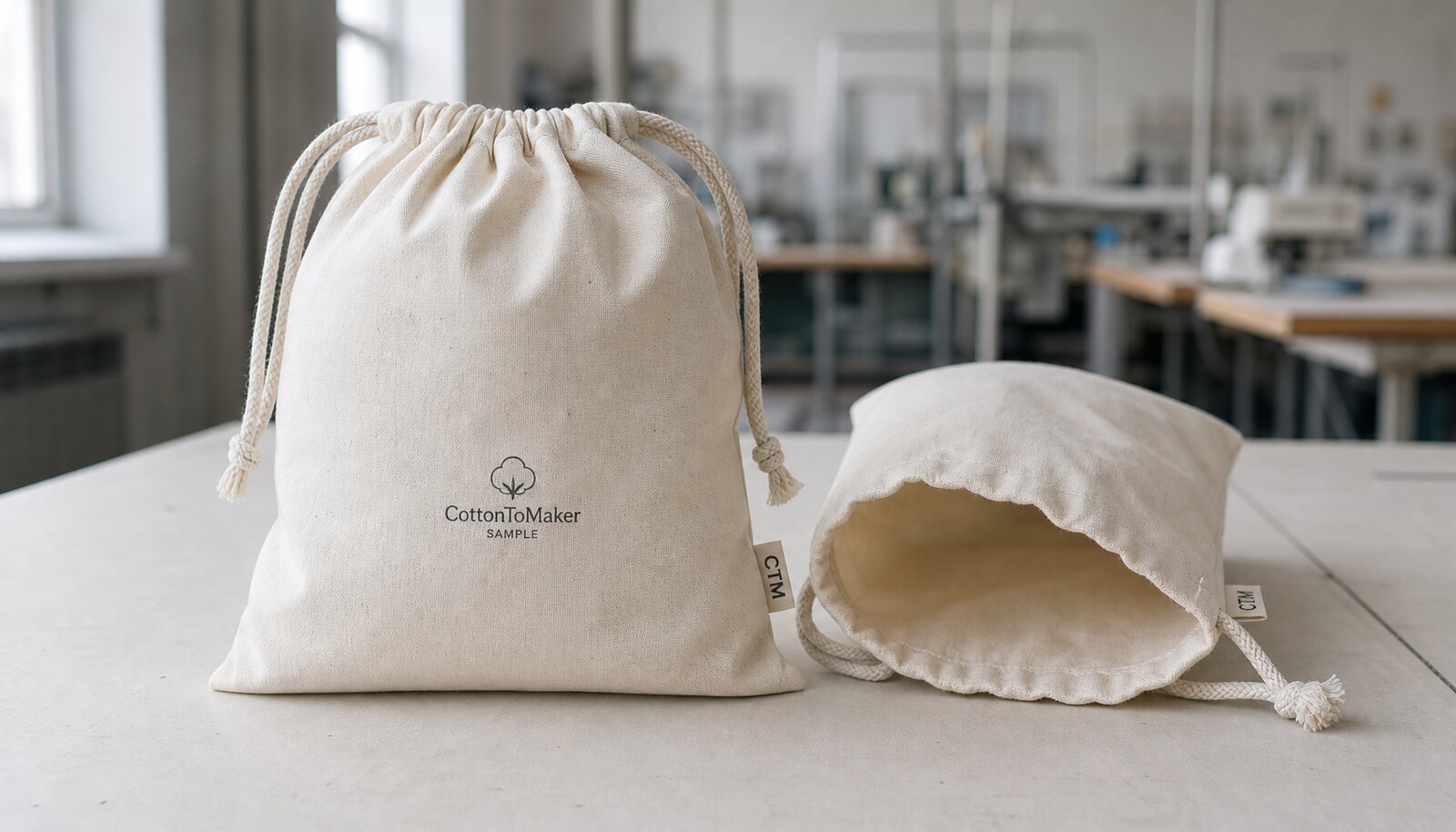
Start With The Bottle, Not The Logo
For boutique wineries, a cotton drawstring pouch is usually a presentation and handling tool, not just packaging. It may carry a bottle for a tasting room sale, protect a club gift during transit, hold a small merch set, or serve as a retail add-on that sits on a shelf and needs to look neat from first glance. The first sourcing question is therefore not which logo to print, but what the pouch must do in use.
That use case changes the spec. A pouch for a 750 ml bottle needs enough opening width to avoid stress at the channel, enough body width to keep the silhouette clean, and enough structure to prevent the contents from printing through the fabric. A pouch for a small tasting kit may need less strength but tighter presentation because the items inside are lighter and easier to shift. The right quote starts from the job, not the artwork.
Buyers often begin with a rough size and a brand mockup, then discover the pouch is too short for the bottle neck, too translucent on the shelf, or too loose to feel premium. That failure is avoidable if the RFQ uses winery-specific language: bottle presentation, club shipment insert, tasting-room gift, seasonal promotion, or retail resale. Once the use is fixed, the supplier can recommend the correct cloth weight, seam allowance, and pack format instead of guessing from an image.
A useful internal brief should also note how customers will handle the pouch. Will it be reused? Will it sit open in a gift basket? Will it be packed with a glass bottle or an item with hard edges? Those details affect drawcord tension, seam reinforcement, and how the opening should close. For wholesale cotton drawstring pouches for boutique wineries, the best spec is the one that reflects actual handling, not a generic pouch description.
- State the primary use: bottle, tasting set, club gift, event giveaway, or retail insert.
- List the real insert dimensions or bottle size the pouch must fit.
- Define whether the pouch must hide contents fully or only present them neatly.
- Note whether the item will be reused by customers or only used once.
- Call out any sharp edges, glass corners, or heavy inserts that could stress the seams.
Choose Cotton Weight, Size, And Shrink Control With Numbers
Fabric weight is one of the most important controls because it affects feel, opacity, print quality, and cost at the same time. A practical buying range is often 140 to 220 GSM. Lighter cloth around 140 to 160 GSM can work for inserts, lower-cost promotions, and soft presentation pieces. Heavier cloth around 180 to 220 GSM usually feels more substantial, hides contents better, and holds shape more cleanly for bottle packaging or retail resale.
GSM alone is not enough. Ask how the cloth is finished before cutting. Is it pre-shrunk, washed, or cut from untreated fabric that may move after printing or after exposure to moisture? If the supplier cannot answer clearly, the pouch may pass a photo review and still drift out of size after curing, folding, or normal use. For winery programs that need repeatability across orders, shrink control matters as much as the nominal weight.
Finished size tolerance should be written into the quote. Buyers need measured width and height limits, not just a pattern size. A common starting point is a +/- 5 mm tolerance for standard pouch dimensions, but the actual limit should match the product size and the buyer's risk tolerance. For bottle-use pouches, the opening width and usable internal depth matter just as much as the outside dimensions because the pouch has to close neatly around the contents.
Construction details should be explicit as well. Ask for seam allowance, channel width, and cord exit placement so the pouch can be inspected against a drawing rather than a vague sample description. A narrow channel can look neat but may bind the cord. A loose channel can look sloppy and make the top edge collapse. A well-specified construction avoids guesswork and makes the final inspection checklist easier to apply.
- Use GSM as a starting point, then lock the acceptable tolerance in writing.
- Ask whether the fabric is pre-shrunk, washed, or untreated.
- Specify finished size tolerance on width, height, and opening width.
- Confirm seam allowance and drawcord channel width before approving bulk.
- Test the pouch with the real bottle or a true-size dummy, not only with a flat drawing.
Match Decoration To Winery Brand Positioning And Inspection Risk
Decoration choice should follow the winery's customer experience, not just the mockup. Screen printing is usually the most stable option for cotton drawstring pouches because it is repeatable, easy to inspect, and cost-efficient for simple logos. A one-color or two-color print usually gives the cleanest procurement path when the brand wants a straightforward premium look without introducing unnecessary defect risk.
Woven labels and sewn patches work well when the winery wants a softer, more tactile presentation or plans to reuse the pouch as a retail item. Embroidery can also look premium, but it changes the surface structure of the fabric and can distort lighter cloth if stitch density is too high. If the logo contains fine lines, small type, or narrow spacing, the buyer should treat decoration as a production risk, not a design flourish.
Print placement matters. A logo too close to a seam can distort when the pouch is filled or closed. A label too near the opening can interfere with the drawcord and create a rough user experience. Ask the supplier to show the artwork position on a dimensioned sample, not only in a flat file. If both sides are branded, say whether the back must match the front or can stay blank to reduce cost and complexity.
If color accuracy matters, request a decorated physical sample or strike-off, not just a PDF proof. Cotton absorbs ink differently from one lot to another, so a digital proof cannot show registration drift, ink spread, or texture effects. The safest sequence is simple: choose the lowest-risk decoration that still fits the brand, review the physical sample, then freeze the method before mass production.
- Use screen print for low color counts and repeatability.
- Use woven labels or sewn patches when the brand wants a tactile premium finish.
- Reserve embroidery for fabrics and logo sizes that can support stitch density without distortion.
- Request a strike-off or physical decorated sample if color accuracy is critical.
- Define print or label position relative to the seam and opening.
Write The RFQ So Suppliers Quote The Same Product
A good RFQ should force apples-to-apples quotes. If the supplier only returns one unit price, the comparison can be misleading because the cheap quote may exclude decoration, folding, packaging, or setup. Procurement needs a breakdown that shows what is driving the cost so that a later change does not turn into a surprise invoice or a delayed release.
The most useful quote structure separates blank pouch cost, decoration cost, packing cost, and sample or setup charges. If the winery wants multiple pouch sizes, ask for each size to be priced separately. If the artwork may change from one season to the next, ask for separate pricing on each print color count and on alternate decoration methods such as woven labels or patches. This makes future reorders easier to budget and reduces back-and-forth during the next campaign.
MOQ should also be read by component, not as a single headline number. A factory may be willing to sew a low minimum on blank pouches but require a much higher order for printed goods because of screen setup or decoration labor. Seasonal winery programs often live or die on that distinction. A quote that says the factory can do the job is less useful than one that says exactly how the MOQ changes by size, print count, and pack-out method.
Compare landed cost, not just ex-works price. A pouch with a slightly higher factory cost can still be the better business decision if it arrives in better cartons, with fewer defects, less rework, and cleaner receiving. The right comparison includes sample charges, freight footprint, carton configuration, and the probability that the supplier will need a second pass before release.
- Request separate pricing for blank, printed, labeled, and retail-packed versions.
- Ask for quantity tiers that match your actual forecasted volumes.
- Make sample fees visible and clarify whether they are refundable against bulk.
- Compare landed cost, not just factory price.
- Ask how MOQ changes when print colors, labels, or packing methods change.
Use A Quality Inspection Checklist With Real Acceptance Thresholds
This is where many sourcing guides stay vague. Procurement teams need thresholds, not general statements about good workmanship. A useful inspection plan should define what is checked, how many pieces are sampled, what counts as a major or minor defect, and what action happens if the lot misses the standard. For wholesale cotton drawstring pouches for boutique wineries, the checklist should cover appearance, size, GSM, stitching, cord function, decoration, carton accuracy, and load performance.
A practical starting point is an agreed AQL framework written into the PO or quality agreement before production starts. The exact AQL level can vary by program, but the bigger issue is that both sides must use the same defect definitions. Major defects should include wrong size beyond tolerance, seam opening, holes, stains, missing print, obvious color mismatch, missing label, or a pouch that cannot close properly. Minor defects may include short loose thread tails or slight fold variation, but they still need an agreed limit.
Stitch quality should be measured instead of described loosely. Buyers can require no skipped stitches, no broken seam lines, and no loose thread tails longer than the agreed limit. If the pouch is for a bottle or a heavier gift item, add a load test that reflects the actual use. A simple static test is often enough: for example, a filled pouch should hold a 5 kg load for 60 seconds without seam opening, cord pull-through, or functional distortion. That threshold can be adjusted to the real product weight, but it must be written down.
Print inspection should be equally concrete. For a simple logo, set an allowable registration limit, such as no more than 1.5 mm of misalignment if the artwork requires tight registration. Also define what happens if the ink is too light, too heavy, blurry, or inconsistent from one carton to the next. The inspector should not have to guess whether a color shift is acceptable. A written threshold keeps the result objective and easier to defend if the lot is disputed.
- Write the AQL level into the PO or quality agreement before bulk starts.
- Define major, minor, and critical defects using plain language and photos if possible.
- Require stitch and seam criteria, not just a generic workmanship note.
- Add a load test for bottle-use or heavy gift-use pouches.
- Set a print misregistration limit, especially for logos with fine lines or multiple colors.
- Keep one sealed golden sample and one factory reference sample for lot verification.
Approve The Sample Like A Production Buyer
The preproduction sample is the reference point for the whole order, so it should be reviewed like a controlled procurement artifact, not a design draft. Measure it with the real bottle or insert when possible. Check the width, height, opening, cord tension, and closing behavior when the pouch is filled. A pouch can look elegant when flat and still fail in use because the opening twists, the seams pull, or the drawcord binds after packing.
A disciplined sample review has three parts. First, visual review: print placement, label position, seam neatness, and color under neutral light. Second, dimensional review: compare the sample against the approved drawing and note any deviation outside the agreed tolerance. Third, functional review: insert the bottle or gift item, close the pouch, shake it lightly, and verify that the load stays secure and the presentation still looks premium.
Keep both a sealed golden sample and a working reference sample. The sealed sample should stay with the buyer or QA team and never be used for handling checks. The working sample can be used for fit checks, photography, and internal comparison. When the bulk shipment arrives, the inspection team should compare cartons to the same reference, not to memory or a screenshot. That simple control prevents many post-shipment disputes.
If the supplier offers a very fast sample, make sure it is actually representative. Ask whether the sample uses the same cotton lot, print method, label stock, and cord style as bulk. If not, request a corrected sample or a written list of differences. The goal is not to slow the order for no reason. It is to ensure the approved sample is meaningful when the first bulk cartons are opened.
- Measure and test the sample with the real bottle or gift item when possible.
- Review it visually, dimensionally, and functionally.
- Keep a sealed golden sample and a working reference sample.
- Confirm whether the sample uses the same cotton lot, print process, and cord style as bulk.
- Freeze artwork version and packing details before mass production.
Treat Packing And Cartons As Part Of Product Quality
Packing is not an afterthought for winery supply. A pouch that is technically correct but badly packed can still disappoint the buyer and the end customer. If the product is headed for a tasting room, gift basket, or retail shelf, the fold, facing direction, dust level, and carton consistency all matter. A premium pouch should arrive looking deliberate, not dumped into a box.
Bulk packing is the cheapest option, but it can increase dust, crush marks, and inconsistency in presentation. Individual polybags improve cleanliness and shape retention but add material, labor, and waste. Some wineries prefer reduced plastic packing for sustainability reasons, but that should be reflected in the spec so the factory knows how to protect the product without weakening carton control. The right answer is usually the simplest pack-out that still protects presentation and count accuracy.
Carton control should be written with measurable data. Ask for inner pack count, carton dimensions, gross weight, and master carton marks by size, color, or artwork version. If multiple versions are produced, they should be segregated clearly enough that a warehouse can receive them without opening every box. If the pouch is part of a set, define whether the factory assembles the set or ships loose components. Each option has different error points and should be priced separately.
Retail readiness also includes labels and compliance text. Even a simple pouch may need a barcode, care label, or origin label if the winery or retailer has a shelf standard. Ask for a packing sketch before production so the label position is not left to interpretation. That reduces misplacement, keeps the pack-out consistent, and makes final inspection faster.
- Define bulk pack, individual bagging, or retail-ready packing before production.
- Confirm inner pack count, carton dimensions, and gross weight.
- Require clear carton marks by size, color, and artwork version.
- Review label placement and orientation in a packing sketch.
- Ask how finished goods are protected from dust, moisture, and crush marks.
Compare Suppliers By Control, Not By Sticker Price Alone
When comparing suppliers, the right question is not who is cheapest but who can deliver the most consistent pouch at the lowest total risk. A low quote can hide weak process control, outsourced decoration, poor sample discipline, or no clear owner for rework. Those problems usually show up later as crooked print, mixed carton counts, slow replacement, or disputes over what was approved.
The comparison should weigh pricing structure, QC control, lead-time reliability, and communication clarity. A direct factory may offer the best control if it can show real records for sample approval, in-process checks, and final inspection. A trading company may charge more, but if it manages documentation well and coordinates a complicated multi-SKU order cleanly, the total program cost can still be lower. The buyer should score the supplier on how it manages variation, not only on how it quotes a piece price.
For boutique winery programs, repeatability often matters more than first-order savings. Customers handle these pouches closely, so the same seam, same print opacity, same fold, and same carton presentation need to repeat across seasons. If a supplier cannot hold that consistency on reorder, the buyer spends time managing exceptions instead of shipping product. A slightly higher price can be the better commercial choice if it buys clean reorders and fewer disputes.
Ask each finalist to explain how they would handle three common problems: an artwork revision after sample approval, a print color mismatch, and a carton count discrepancy. Good suppliers describe who checks the issue, what gets quarantined, when they rework, and how they document the fix. Weak suppliers answer with vague reassurance. That difference is often more useful than a brochure or a polished sales deck.
- Compare pricing structure, QC control, lead-time reliability, and communication clarity.
- Ask finalists how they handle artwork changes, print mismatches, and carton count problems.
- Prefer the supplier that can prove process control with documents and photos.
- Score reorder stability and defect ownership as heavily as first-order price.
Use A Stage-Based Inspection Workflow
A quality inspection checklist works best when it is tied to the production timeline. Do not wait until the shipment is already on the dock to discover a defect pattern. Use stage-based sign-off: sample approval, in-process check, pre-shipment inspection, and shipment release. Each stage should have a named owner and a short, specific list of checks.
At sample approval, the buyer or QA lead confirms dimensions, material, decoration, and pack format. At in-process inspection, the factory QA or line supervisor checks stitching, artwork position, and carton preparation on a controlled sample from production. At pre-shipment inspection, the buyer, a third-party inspector, or the supplier's quality team verifies the finished lot against the agreed AQL and the retained reference sample. Final release should happen only after the report is reviewed.
Sample retention is inexpensive and useful. Keep one sealed golden sample with the buyer, one reference sample at the factory, and one label or pack-out reference if the carton design is complex. Mark each sample with the lot number, date, and approval name. If a claim comes later, both sides can compare the same reference instead of arguing from memory.
The final release decision should be based on the written thresholds. If the lot misses the agreed size, print, seam, or load standard, quarantine it and decide whether the issue can be reworked or whether the lot must be rejected. That decision should be driven by the spec, not by pressure to ship. A checklist only works when it is enforced consistently.
- Use stage-based sign-off: sample approval, in-process check, pre-shipment inspection, final release.
- Assign a named signer at each stage and keep the name on the record.
- Retain a sealed golden sample, a factory reference sample, and a pack-out reference if needed.
- Record lot number, date, and approval name on retained samples.
- Quarantine and document any lot that misses the written thresholds.
Specification comparison for buyers
| Spec decision | Recommended option | When it fits | Buyer risk to check | Pricing / QC / lead-time tradeoff |
|---|---|---|---|---|
| Direct factory with in-house sewing and printing | One factory controls cutting, sewing, decoration, and packing | Best for repeat winery programs, stable artwork, and medium-to-higher volume | Verify the sample is built on the same line as bulk and ask for in-house process photos, batch records, and final inspection reports | Usually the best unit price and the clearest defect ownership; lead time is steadier, but rush orders and special pack-outs can still push cost up |
| Factory sewing plus subcontracted decoration | Bag maker outsources printing or labels to another workshop | Useful when the base pouch spec is simple and the brand needs a local print capability | Ask who owns print registration, rework, and replacement if the decorator misses spec | Often looks inexpensive on sewing alone, but handoffs add risk, extra review time, and slower root-cause resolution |
| Trading company or sourcing office | A middle layer coordinates multiple factories, artwork, and consolidation | Fits buyers managing multiple pouch sizes, mixed gift sets, or changing pack formats | Check whether the quoted factory can be named and whether traceability documents come from the true source | Service fees can be higher, but documentation, change control, and rework coordination may be better for complex programs |
| Stock blank pouch with local decoration | Buy blank cotton pouches and print, label, or pack near the destination market | Good for low MOQ launches, seasonal winery events, or urgent promotions | Confirm blank lot shade, GSM consistency, and whether local finishing can keep print placement and fold quality stable | Fastest path to market, but local finishing adds cost and can weaken control over final color, packing, and defect traceability |
| Domestic converter with imported fabric | Local converter sews from imported cloth or cut panels | Works when communication speed, samples, or domestic compliance matter more than the lowest landed price | Ask for fabric origin records, cutting control, and seam tolerance specs | Usually higher landed cost, but easier to sample, inspect, and reorder on short notice |
| Woven label or sewn patch branding | Use a stitched label instead of heavy full-area ink coverage | Fits premium wine club kits and reusable retail presentations | Check edge fray, attachment strength, and whether the label interferes with the drawcord channel | Slightly higher piece cost than simple screen print, but better perceived value and lower risk of print cracking |
| Sustainable claim route | Use cotton with traceability records and careful labeling language | Needed when the winery or retailer makes environmental claims | Do not rely on verbal claims; request invoices, origin statements, or other available documentation | Documentation can extend sampling and approval time, but it lowers compliance risk and supports cleaner retail messaging |
| Mixed sourcing route | One supplier for pouches, another for cartons, inserts, or kitting | Works for gift programs with complex retail presentation or multi-item bundles | More handoffs mean more count errors if carton control is weak | Can reduce single-supplier dependency, but adds coordination burden and increases the need for a written final pack-out checklist |
Buyer checklist before sampling
- Define the pouch use case first: 750 ml bottle, tasting kit, club gift, retail insert, or event giveaway.
- Lock finished width, height, opening width, and usable internal depth, not only the sewing pattern size.
- State cotton GSM and the acceptable production tolerance in writing.
- Confirm whether the cloth is pre-shrunk, washed, or cut from untreated fabric that may move after decoration.
- Choose the decoration method before quoting and freeze the artwork file or Pantone reference.
- Set the print position, label position, and allowable misregistration limit.
- Confirm cord type, knot style, stopper requirement, and whether the cord ends are heat-sealed, knotted, or wrapped.
- Request a preproduction sample built from the intended bulk materials before approval.
- Specify carton count, inner pack, carton marks, and retail label placement.
- Write the inspection method, AQL level, defect definitions, load test, and replacement terms into the PO or quality agreement.
Factory quote questions to send
- What GSM cotton do you recommend for this pouch size, and what tolerance do you hold on finished fabric weight?
- Is sewing, printing, labeling, and packing done in-house or split across subcontractors?
- What is the MOQ by pouch size, print color count, and packaging style?
- What are the sample charges, sample lead time, and whether sample fees are refundable against bulk?
- What finished size tolerance, seam standard, and print registration limit do you use for bulk inspection?
- Can you quote separately for blank pouch, one-color print, two-color print, woven label, and retail packing?
- What carton count, carton size, and gross weight will you use for export packing?
- What traceability documents can you provide with the shipment, such as fabric origin or batch records if requested?
- Which bulk lead time applies after PP sample approval, and what factors usually extend it?
- If the order needs origin or sustainability documents, what records can you provide with the shipment?
Quality-control points to confirm
- Finished width and height match the approved sample within the agreed tolerance, typically within +/- 5 mm for standard pouch programs unless the buyer specifies tighter limits.
- Measured GSM is within the agreed tolerance band, typically +/- 5 percent of the approved fabric spec for each production lot.
- Stitch lines are straight, secure, and free from skipped stitches, broken seam lines, or loose thread tails longer than the agreed limit.
- Stitch slippage does not exceed the agreed threshold after load testing, and no seam opening is visible after the test.
- Print is aligned within the agreed registration limit, typically no more than 1.5 mm for simple one-color logos unless the artwork allows more variation.
- No visible stains, holes, oil marks, needle damage, or excessive lint clumps appear on outer surfaces or inside seams.
- The drawcord moves smoothly through the channel without snagging, twisting, or pulling out under normal handling.
- For bottle-use or heavy gift-use pouches, the bag passes the agreed static load test, for example 5 kg for 60 seconds without seam failure, cord pull-through, or functional distortion.
- Carton counts are exact, carton marks match the PO, and mixed SKUs or mixed artwork versions are not allowed unless explicitly approved.
- The retained golden sample, the approved production sample, and the bulk lot all match on material, decoration, and pack-out details.