Start With The Selling Channel, Not The Catalog Image
Wholesale cotton drawstring pouches for farmers market vendors look simple until you define where they will actually be used. A pouch for herbs, tea, seeds, soap, candles, or small gift sets does not need the same build as a pouch that sits on a display table, moves through a distributor, or leaves with a premium bundle. The right spec changes with fill weight, reuse frequency, shelf presentation, and whether the contents shed dust, moisture, oil, or scent.
Before you ask for pricing, state the real role of the pouch. Is it primary packaging, a gift bag, a product insert, or a resale item on its own? If that is vague, suppliers tend to quote to the cheapest assumption they can defend, and the sample may not represent the way the pouch will perform in a stall, a warehouse, or a retail receiving lane.
The fastest way to cut noise is to describe the handling path. Say how the pouch is filled, how often it is opened, whether it needs to stand up visually on a table, and whether it must survive repeated cinching. That turns a generic cotton bag into a measurable sourcing item.
- Define the contents by weight and shape, not only by width and height.
- Note whether the pouch is for one-time use, display use, or repeat customer reuse.
- Call out any odor, dust, moisture, or oil transfer risk from the contents.
- Identify the sales channel early if labeling or carton rules may change by route.
Translate The Product Into A Finish-Ready Spec
Cotton pouch sourcing starts with the fabric, but the fabric alone does not buy a consistent result. A quote only becomes comparable when the supplier knows the finished size, target cloth weight, expected hand feel, and the way the pouch will be packed. For light inserts, a thinner fabric can work. For premium presentation or repeated reuse, buyers usually need a denser cloth that holds shape better and resists abrasion at the drawcord channel and bottom seam.
A practical sourcing range for many cotton pouch programs is 100 to 120 GSM for light retail inserts, 140 to 180 GSM for reusable presentation pouches, and 180 to 220 GSM for a more substantial hand. Treat those as starting points, not rules. The key is to have the supplier state the weave, finish state, and expected dimensional behavior before bulk begins. A pouch can look correct when cut and still finish out of spec after sewing, pressing, and packing.
Ask for finished-size tolerance, not cut size only. Sewing allowance, pressing method, and fabric behavior all affect the final result. If the buyer needs the pouch to fit inside a carton, a tray, or a retail sleeve, the supplier should quote to the finished dimension and confirm the measurement method they will use.
- Request fabric GSM, weave type, and finish state in the first quote.
- Confirm whether the supplier is quoting cut size or finished size.
- Ask for shrinkage or dimensional behavior if the fabric is prewashed or dyed.
- Require the supplier to state the acceptable tolerance in writing.
Choose Cotton Weight And Construction By Use, Not By Habit
The build details matter as much as the base cloth. The drawcord is not an accessory; it is the main functional part of the pouch. Round cotton cord is common for small bags, while flat tape or a wider cord can be easier to grip when customers will reopen the pouch often. The channel needs enough depth for the cord to move freely without tearing the opening or twisting inside the seam.
Construction problems often start where the sample looks clean and the production line takes shortcuts. Check the hem finish, side seams, base reinforcement, and cord exit points. Once the pouch is cinched and loaded, seam allowance, bar-tacks, and stress points decide whether the bag holds shape or distorts. For simple sewn pouches, consistency matters more than chasing a single nominal measurement.
Ask for close-up construction photos, not just front-facing catalog shots. You want to see seam direction, reinforcement placement, and how the cord is anchored. If the pouch is for repeat customer use, hand feel after multiple pulls matters. That becomes especially important when the bag is part of a farmers market presentation and not just a disposable insert.
- Confirm cord material, diameter, and knot or stop method.
- Set channel depth and seam allowance before approving the sample.
- Ask where reinforcement is added at the cord exit and lower corners.
- If reuse matters, test the cord feel after repeated pulls.
Match Decoration To Artwork Complexity And Handling
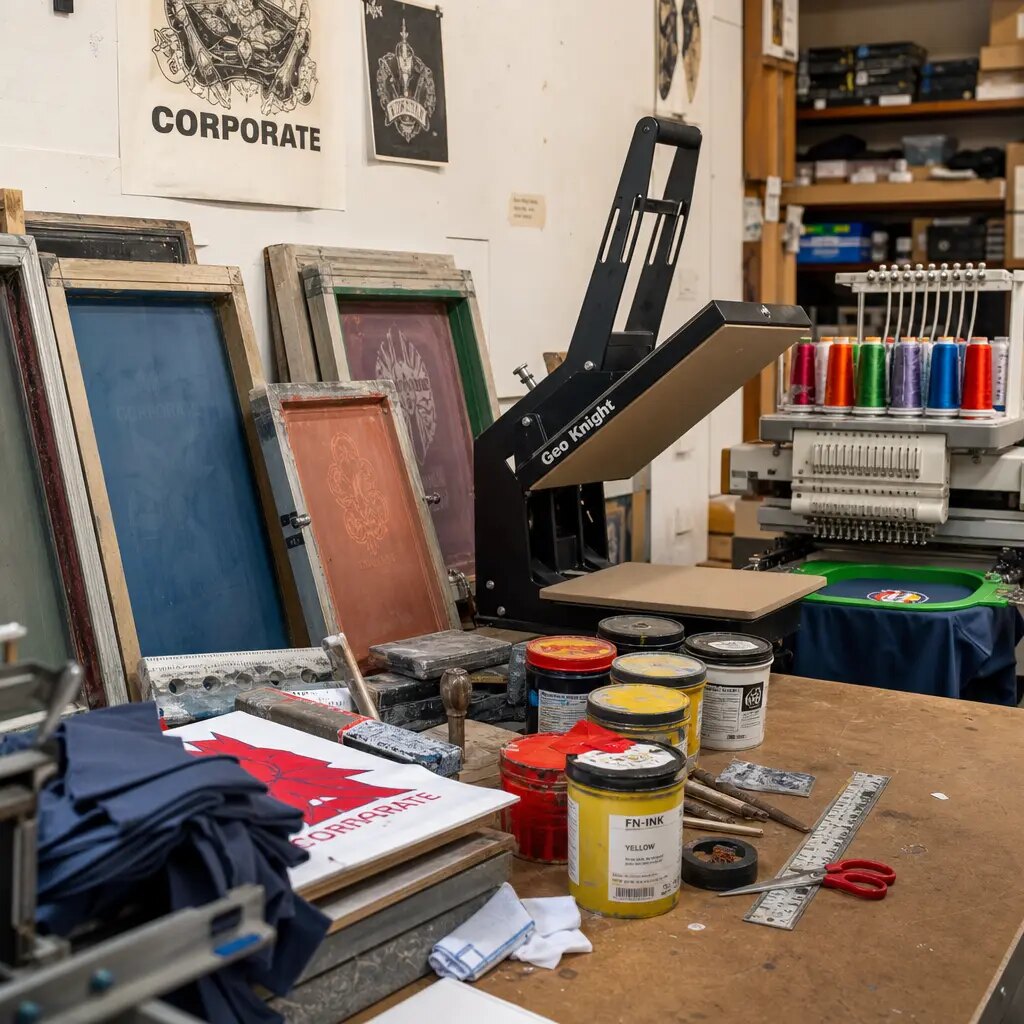
Decoration should follow the artwork, not habit. For simple one-color branding on natural cotton, screen printing is often the most practical choice because setup is manageable and the artwork reads cleanly on textured fabric. If the design has fine type, multiple colors, or needs a more premium identity, a woven label or sewn patch can outperform a large print that loses sharpness once the pouch is cinched or packed.
Placement needs to be treated as a production spec. A logo too close to a seam can warp after sewing, and a flat proof will not show how the art shifts on the finished pouch. Ask the supplier to confirm the print area, the exact distance from the top edge and side seam, and the color reference used for approval. For simple art, a placement tolerance around 3 mm is a practical control point; for premium work, request a preproduction strikeoff or decorated sample.
The print method also affects durability. If the pouch will be handled often, ask about print adhesion, rub resistance, and how the decoration behaves on cotton texture. That is more useful than a generic statement that the print is durable. When a buyer is sourcing wholesale cotton drawstring pouches for farmers market vendors, the decoration must survive handling, folding, and repeated opening rather than only looking good in a product photo.
- Use screen print for simple artwork and repeat orders with stable volume.
- Use woven labels or sewn patches when the pouch needs a cleaner premium identity.
- Use heat transfer only after confirming durability on cotton and expected handling.
- Approve placement from the seam line and centerline, not only from the artwork file.
Compare Supplier Routes And Who Controls The Record
The cheapest quote is not always the best source. A stock wholesaler can move quickly, but the pouch may not match your exact size, GSM, or label requirement. A direct sewing factory gives better construction control and easier repeatability, but it usually expects a tighter spec and a cleaner approval path. A domestic decorator on imported blanks can be efficient for small launches, as long as you know the blank can be reordered unchanged.
Trading companies and overseas factories can both work, but they require different controls. A trading company may help consolidate mixed goods or coordinate communication across several vendors, which is useful when the buyer wants one shipment and one contact. The downside is that markup and decision rights can get blurry unless the factory name, the QC owner, and the lot trace are clear in writing. Direct factory sourcing tends to win when repeat orders and construction fidelity matter more than convenience.
Use the comparison table to judge the source on more than price. A buyer should know who owns the sample, who owns the bulk record, who releases the documents, and who pays if the finished pouch misses the approved target. That is the practical difference between a sourcing contact and a controllable supply chain.
- Use stock wholesalers for speed when exact customization is limited.
- Use direct factories for repeatability and construction control.
- Use trading companies when mixed orders or coordination matter more than lowest cost.
- Use domestic decoration when the blank pouch is already approved and only branding changes.
Read The Commercial Quote Line By Line
A usable quote should separate the bag body, sewing, print setup, labels, inner packs, cartons, and export handling. If all of that is collapsed into one number, it becomes impossible to compare one supplier with another or to see where the real price driver sits. The quote should also show which details are fixed and which are variable, because a second print color, a woven label, or a different carton format can change the economics quickly.
The common cost drivers are fabric GSM, pouch size, decoration method, cord type, and packing count. Custom labels and retail-ready packaging can raise the landed cost even when the bag body itself is simple. Ask for several volume tiers so you can see whether the supplier is quoting an actual production curve or just a flat guess. A quote that does not show setup charges and exclusions is not buyer-ready.
Commercial terms deserve the same scrutiny as the unit price. Confirm deposit timing, balance timing, how long the quote stays valid, and whether payment terms change after the first order. If the supplier says the lead time is short, ask whether that lead time assumes stock fabric, in-line printing, or no packaging changes. That is the difference between a real schedule and a sales estimate.
- Request separate pricing for sewing, printing, labels, and packaging.
- Ask for price breaks at 1k, 3k, 5k, and 10k pieces if the program may scale.
- Confirm whether carton marks, barcode stickers, and inner pack changes are included.
- Identify the freight term clearly if shipping is included.
- Ask how long the quote remains valid and what can trigger a repricing.
Treat MOQ, Sampling, And Reorders As Separate Decisions
MOQ is usually driven by fabric availability, print setup, and sewing line efficiency. A simple natural pouch with one print color can support a lower MOQ than a dyed bag with custom labels and retail packing. If a supplier offers a very low MOQ, verify whether they are using a stock blank or presenting a sample run as production. Low MOQ only helps if the bulk order can be repeated without spec drift.
Sampling should mirror the real order, not just the appearance. A sample made from a different fabric lot, a different print process, or a different pack format can hide the problems that show up in volume. The better practice is to approve a sample that reflects the same GSM, same closure, same label, and same carton logic as the real order. If the supplier says the sample is free, still define what happens if the bulk run diverges from that sample.
Ask whether sample charges are credited against the order and whether artwork revisions trigger a new fee. Those are small commercial points, but they often reveal whether the supplier is set up for controlled development or just wants to push a fast quote. For reorder business, also confirm whether the approved sample, artwork files, and carton master will be stored and reused without fresh setup costs.
- Approve one sample for appearance and one for packing if the channel is strict.
- Treat a loose visual sample as a reference, not a production guarantee.
- Expect higher unit price when MOQ is below the supplier's normal run size.
- Ask which post-approval changes require re-quotation or re-sampling.
Put Compliance Evidence Behind The Claim, Not Beside It
Compliance should follow the way the pouch will be sold. If the pouch touches unpackaged food, ask whether the fabric, print, and finishing are acceptable for that market and use case. If the program is going into retail or distributor channels, fiber content, country of origin, invoice wording, and carton marks may matter as much as the product itself. If the buyer sells in a regulated retail environment, ask whether any claim review is needed for dyes, inks, or finishing agents.
Do not collect random certificates. Request evidence tied to the exact SKU or material lot. If the supplier offers a certification, ask for the certificate number, scope, and validity rather than a generic logo on a sales sheet. If the buyer plans to use organic, recycled, or other certified claims, the certification path needs to be documented before sampling, not after the PO is issued.
For most procurement teams, the cleanest approach is a one-page document that ties the SKU description to fiber content, country of origin, carton marks, label placement, and any required test report. That keeps the warehouse and receiving team from having to interpret a sales quote as compliance documentation. It also makes supplier comparison easier because every bidder is responding to the same evidence set.
- Ask for documents tied to the exact SKU or material lot, not a similar item.
- Request fiber, origin, and claim evidence only when the channel requires it.
- If using organic or certified claims, ask for the certificate number and scope before sampling.
- Confirm that invoice wording and carton labels match the destination channel.
Build QC Around Measurable Checkpoints
Quality control only works if it measures something. For cotton drawstring pouches, define finished size, fabric weight, stitch quality, drawcord function, print position, and pack count before the first production lot starts. Vague language like good quality does not help when a carton arrives with uneven seams or a logo that shifted after pressing. The buyer needs the pass-fail line in writing before the factory starts sewing.
Evidence matters as much as the physical sample. Ask for first-piece photos, in-line inspection notes, and carton images from the actual production lot. If your channel uses AQL or another inspection plan, align the supplier's inspection report with that method. If the buyer needs durability proof, ask for a pull test at the seam, a rub test for print, or a wash test if the bag is meant to be reused and cleaned.
The goal is not to overcomplicate a simple pouch order. The goal is to prevent avoidable rework. A basic cotton pouch can still fail if the cord snags, the seam pops, the print smears, or the carton count is wrong. Those are all cheap to define and expensive to discover after shipping.
- Measure finished size on multiple pieces, not a single approved sample.
- Verify GSM or fabric declaration against the approved spec.
- Check stitching for skipped stitches, broken seams, or loose thread tails.
- If the pouch is printed, check placement and rub resistance before release.
- Keep a signed golden sample and require first-piece approval before bulk run authorization.
Control Packing, Transit, And Reorder Continuity
Packing is not an afterthought. Cotton pouches can be bulk-packed, individually polybagged, or packed with insert cards depending on the channel. For farmers market vendors and simple retail programs, flat presentation and carton efficiency often matter more than elaborate retail packaging. If the product is going into a distributor or retail network, label accuracy and carton consistency become more important than saving a small amount on the pouch itself.
Natural cotton can pick up moisture and odor if the packing method is too loose. In humid lanes, an inner bag or clean liner can be worth the added cost. Ask for pieces per inner pack, inner packs per master carton, and the gross carton weight. If your warehouse team prefers lighter cases, set a carton weight target in advance rather than letting the factory choose the cheapest fill pattern.
Barcode and SKU placement should fit the receiving process. If the warehouse scans at the master carton, do not bury the key code on the pouch only. If the pouch itself must carry the barcode, confirm the label size, location, and print contrast before production starts. Lead time should include sample time, production time, inspection time, and transit time, especially for seasonal launches or reorders that must arrive before market events.
- Specify pieces per inner pack and inners per carton.
- Align barcode and SKU placement with the way your warehouse receives goods.
- Use moisture-aware packing if the route is long or the destination climate is humid.
- Define carton weight and pallet rule before the shipment is packed.
- Keep the approved packing format on file for reorder continuity.
Specification comparison for buyers
| Supplier option | What to verify | Commercial advantage | Buyer risk to control |
|---|---|---|---|
| Direct sewing factory | cord material proof, reinforcement close-ups, load-test photos, approved sample tag, and bulk-line first-piece record | Better sample-to-bulk control and faster production feedback | May be weaker on export paperwork or branded packing unless checked early |
| Trading company | Factory name, production photos, trim-source proof, and who owns QC decisions | Can coordinate small mixed orders and extra services | Markup can hide real factory capability and slow defect decisions |
| Specialized bag workshop | cord diameter, eyelet or reinforced channel, bottom corner reinforcement, seam allowance, bar-tack position, and load target | More practical for detailed construction, trims, and repeat programs | Capacity may be limited during peak seasons |
| Low-price general supplier | 6-10 oz cotton canvas, 210D polyester, rPET, or blended cotton with shrinkage and colorfastness expectations set before sampling | Useful for simple promotional runs with loose specs | Material downgrades, weak packing, and vague inspection scope can erase savings |
| Retail-ready supplier | fold direction, cord protection, bundle count, carton compression, moisture bag, and retail label position | Can handle labels, SKU separation, carton marks, and receiving rules | Higher unit cost must be compared against reduced warehouse work |
| Compliance-focused supplier | Fabric records, labeling review, test plan, and production traceability | Safer for retail programs and repeat brand orders | Documentation claims need evidence, not only sales language |
| Local sample room plus bulk factory | Signed sample, bulk factory handoff, first-piece photos, and deviation owner | Good for complex branding before large production | Sample room quality may not match bulk line unless handoff is controlled |
Buyer checklist before sampling
- Finished width, height, and any gusset depth after sewing, with the exact measuring points and tolerance written down.
- Fabric fiber content, weave type, GSM, finish state, and whether the cloth is natural, bleached, dyed, prewashed, or post-dyed.
- Intended contents by weight and type, including whether the pouch will hold food, soap, herbs, seeds, candles, or other items that may shed dust, oil, or odor.
- Cord material, cord diameter, channel depth, seam allowance, and whether the closure is round cord, flat tape, cotton braid, or a blended cord.
- Decoration method, artwork file format, number of print colors, label type, and placement distance from the top edge and side seams.
- Approved color reference, if the art or fabric is dyed or printed, plus the tolerance for shade variation across the lot.
- Sample fee, sample lead time, and whether the sample charge is credited to the bulk order or charged separately.
- MOQ by color, size, and decoration method, plus whether the supplier can hold the same trim and fabric in a reorder.
- Packing rule: pieces per inner pack, inner pack material, master carton count, carton dimensions, gross weight target, and whether cartons will be palletized.
- Label requirements: fiber content, country of origin, barcode, SKU, carton marks, retailer routing labels, and any claim wording that must appear or be avoided.
Factory quote questions to send
- What exact fabric GSM, weave, and finish are included in the quote, and what shrinkage or dimensional change should I expect after sewing and packing?
- Is the quoted price based on cut size or finished size after sewing and pressing?
- What finished-size tolerance can you hold for this SKU, and how is that tolerance measured on the production line?
- What cord material, cord diameter, channel depth, seam allowance, and closure method are included in the quoted construction?
- What reinforcement is used at the cord exit and lower corners, and is that reinforcement included in the quoted price?
- What unit price applies at 1k, 3k, 5k, and 10k pieces, and what changes at each tier?
- Which one-time charges apply for screens, plates, woven labels, hangtags, sample development, artwork revision, or color matching?
- What print method are you quoting, and what wear, rub, or handling limit should I expect on cotton after normal use?
- What is your actual monthly capacity for this construction, and what lead time variance should I plan for in peak season?
- What is the earliest ex-factory date you can commit to, and what parts of the schedule are sample, production, inspection, and packing?
Quality-control points to confirm
- Measure finished size on multiple samples from different cartons, not just one approved piece.
- Verify fabric GSM or supplier declaration against the approved spec, and flag any variance that changes hand feel, opacity, or drape.
- Check stitching for skipped stitches, broken seams, loose thread tails, uneven stitch density, or seam puckering at stress points.
- Confirm that the cord runs smoothly through the channel, closes fully, and does not snag, twist, or pull unevenly.
- Inspect the seam allowance and channel depth against the approved sample so the cord does not bind after loading.
- Check print placement from the seam line and centerline, not only from the flat artwork proof.
- If the pouch is dyed or printed, confirm color against the approved reference and check for rub-off at the channel and seams.
- Look for reinforcement at the cord exit, side seams, and lower corners if the pouch will be reused or lightly loaded.
- Reject visible contamination such as dust, oil marks, loose fibers, odor, or metal debris before packing.
- Confirm carton count, inner pack count, barcode, SKU, and carton marks against the packing list before freight release.